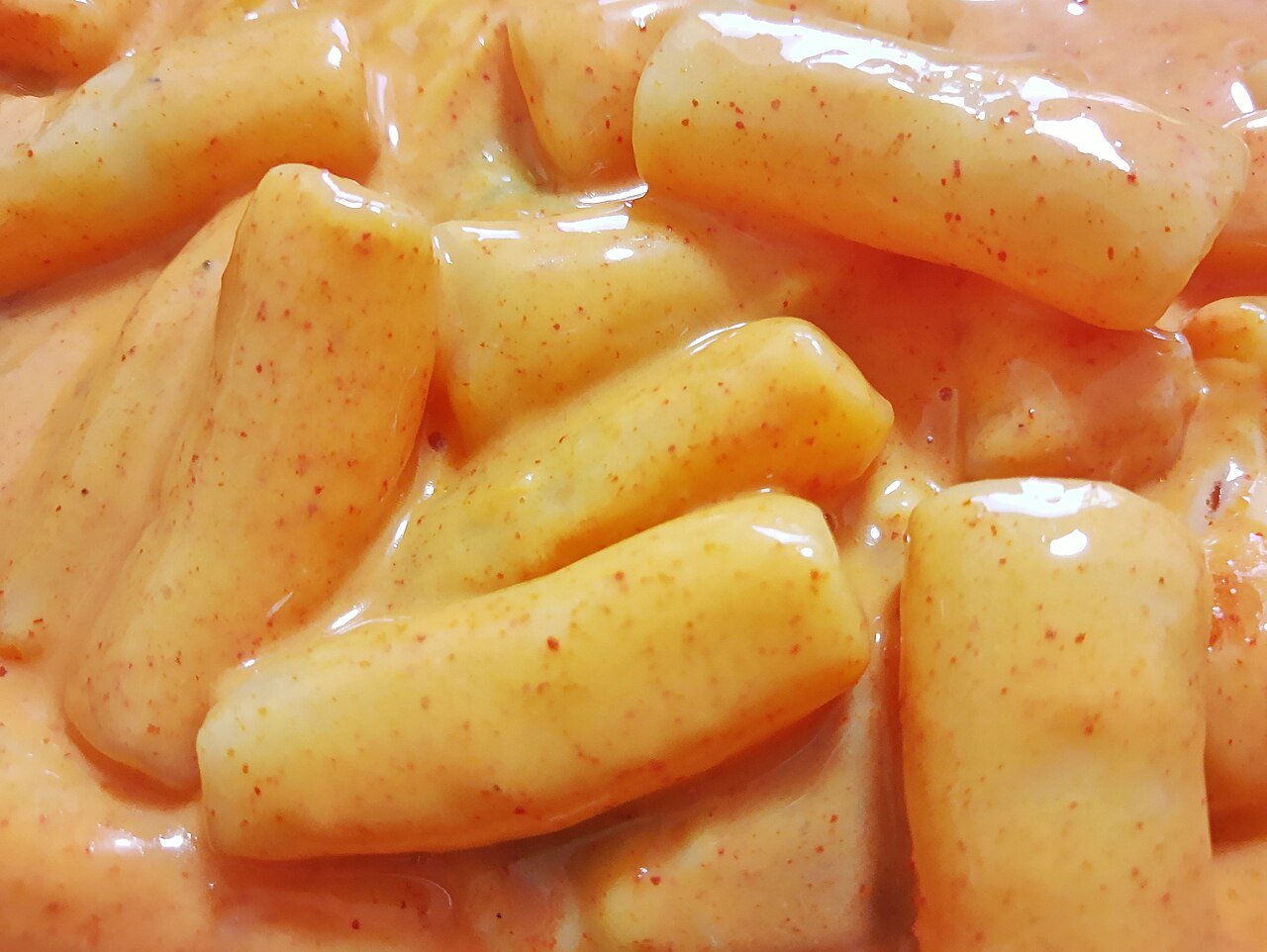
Rose tteokbokki is what happens when a decades-old Korean street snack collides with an Italian pink sauce, and the mashup won. Within a few years it went from a novelty on a handful of restaurant menus to a standard variation you can order almost anywhere tteokbokki is sold, alongside the plain red version and the black-bean jjajang version. Cream in a gochujang pot isn’t a subtle idea, but it turns out to be a very good one.
The part nobody explains well is how much cream is actually the right amount. Go too far and you’ve made an orange alfredo that happens to have rice cakes in it, and the entire identity of the dish — chewy tteok, real chili heat underneath the richness — disappears. This version keeps the balance closer to the tteokbokki side of the equation than the sauce side.
| Time | 25 minutes |
| Serves | 2 as a meal |
| Difficulty | Easy |
| Heat | 2 out of 5 — noticeably milder than plain tteokbokki |
| Vegan? | Not as written; oat milk and vegan butter get you close |
Where the trend came from
The core idea — finishing a spicy Korean sauce with cream — isn’t unique to tteokbokki. Rose-sauce versions of Korean fried chicken and even budae-jjigae showed up around the same stretch of years, all riding the same basic discovery that dairy fat mellows gochujang’s heat without erasing its flavor the way plain sugar does. Tteokbokki just turned out to be the version that stuck hardest, probably because the chewy rice cake soaks up a cream sauce even better than it soaks up the plain one. It’s now common enough in Korea that “rose” has become its own flavor category on menus, sitting next to the original red and the black-bean jjajang version as a third standard option.
Ingredients, and what to use instead
| Ingredient | Where to get it, or what to use instead |
|---|---|
| Garae-tteok, 500 g / 1 lb | Refrigerated or frozen at any Korean grocer. Tteokguk slices work; cut the simmer time roughly in half. |
| Gochujang, 2 tbsp | Standard tub, sold almost everywhere now. Used at half the quantity of a plain tteokbokki recipe on purpose — the cream needs less chili paste to balance against. |
| Heavy cream, 120 ml / 1/2 cup | Whole milk plus a tablespoon of butter is lighter but separates more easily if the pot gets too hot. Coconut cream makes it dairy-free but adds a faint sweetness that isn’t traditional. |
| Eomuk, bacon, or sausage | Any one of the three works as the savory add-in; bacon is the most common restaurant choice because the rendered fat adds another layer to the sauce. |
| Mozzarella, optional | Any melting cheese works; this is an add-on, not core to the dish. |
Rose Tteokbokki
Ingredients
Method
- If using bacon or sausage, cook it first in the pot until it renders some fat and browns slightly, then set aside, leaving the fat behind.
- Add the broth, gochujang, gochugaru, soy sauce, sugar and garlic to the pot. Whisk until smooth.
- Add the rice cakes. Simmer over medium heat 6 to 8 minutes, stirring occasionally, until they’ve softened and the sauce has reduced slightly.
- Add the fish cake (or return the cooked bacon/sausage to the pot). Simmer 3 more minutes.
- Lower the heat before adding the cream — this matters more than it sounds like it should.
- Stir in the cream and let it warm through for 1 to 2 minutes without letting it come to a hard boil. It should turn from red to a rounded pink-orange, not separate or look grainy.
- Scatter the mozzarella on top if using and let it melt in the residual heat, off the burner. Top with scallion and serve.
How to make it
- Brown your protein first, if using bacon or sausage. Leave the rendered fat in the pot — it becomes part of the sauce.
- Build the base sauce, whisking the broth, gochujang, gochugaru, soy sauce, sugar and garlic together until smooth.
- Cook the rice cakes in the base sauce for 6 to 8 minutes, the same as you would for plain tteokbokki, before any cream goes in.
- Add the fish cake or cooked meat. Three more minutes.
- Turn the heat down before adding cream. This is the step that decides whether the sauce looks glossy or looks broken.
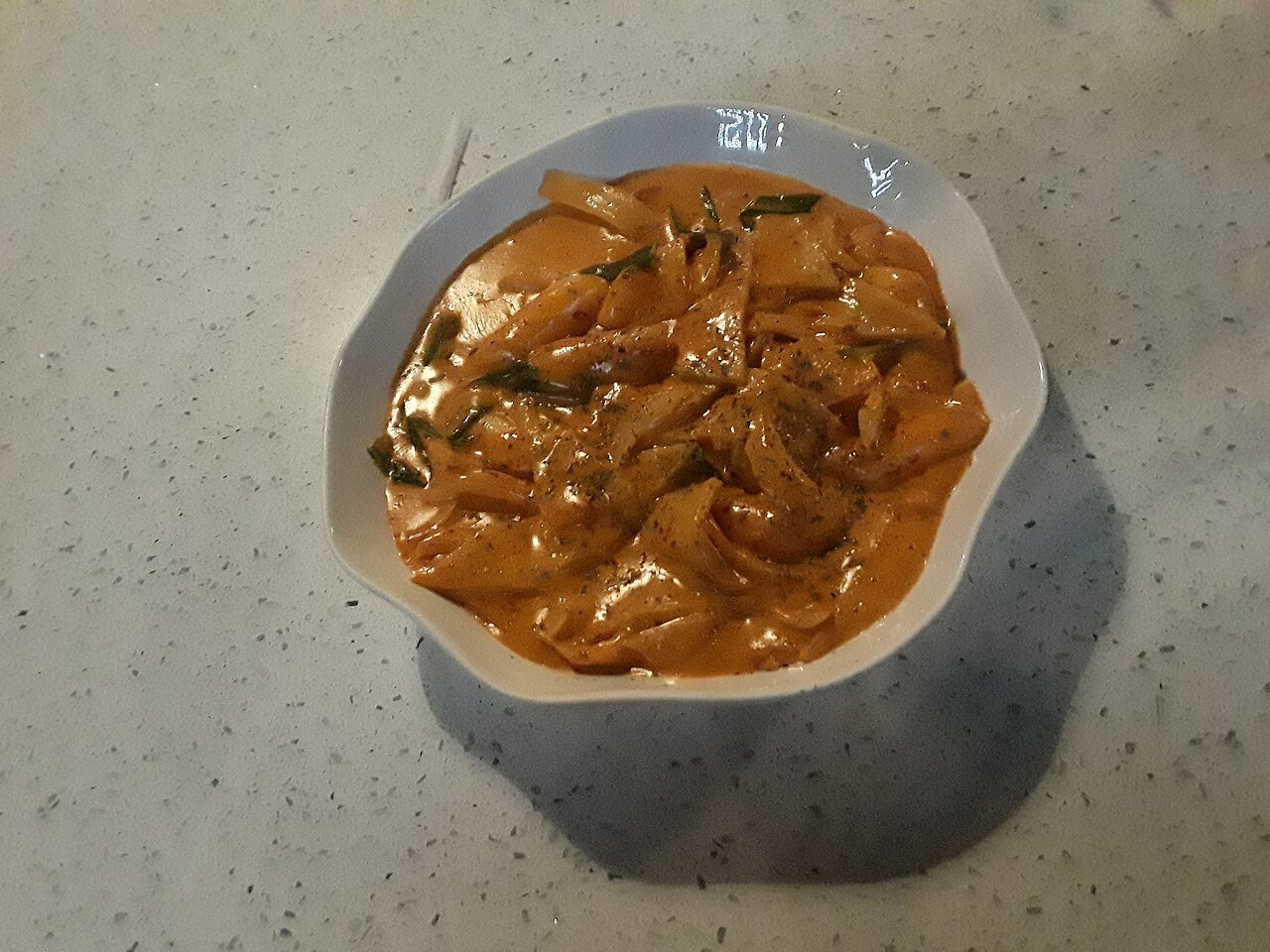
- Stir in the cream, warm gently, don’t boil hard. You’re looking for an even pink-orange color, not a hard simmer with cream floating separately on top.
- Melt cheese on top off the heat if using, then serve.
Why the cream sometimes breaks
Cream sauces split for a simple reason: they get too hot for too long. Once cream is stirred into an already-reducing chili sauce, a hard boil pushes the fat and liquid apart and you end up with an oily sheen instead of a smooth coating. Keep the heat at a low simmer once the cream is in, stir it through, and treat it more like finishing a pan sauce than continuing to cook a soup. If it does start to look grainy, take the pot off the heat entirely and stir — it usually pulls back together once it’s away from direct heat.
Tips and storage
Leftovers keep two days in the fridge, but the sauce firms up considerably once cold, since both the rice cake starch and the dairy set as they cool. Reheat gently in a pan with a splash of milk or broth stirred in to loosen it back up — a microwave tends to overheat one spot and split the sauce again. Don’t freeze it; both the rice cakes and the cream sauce lose their texture.
Common questions
Is rose tteokbokki very spicy?
Less than the standard version, by design. This recipe uses roughly half the gochujang of a plain tteokbokki recipe, and the cream further mutes what heat is there. If you want more kick, add extra gochugaru rather than more gochujang, since gochugaru adds heat without adding more paste to dilute with cream.
Can I make rose tteokbokki without cream?
At that point it’s just tteokbokki — the cream is the entire distinguishing feature of “rose.” If you want the flavor direction without dairy, oat milk or a light coconut cream gets closer than skipping it outright, though both shift the taste slightly.
What’s the actual difference between rose and regular tteokbokki?
Less gochujang, added dairy, and usually a protein like bacon or sausage that a plain pot doesn’t traditionally include. The rice cakes, the cooking method and the base seasoning are otherwise the same dish — see our regular tteokbokki recipe for the original version this one is built on.
Can I add pasta instead of rice cakes?
Some restaurant versions do exactly that, or serve both in the same bowl. Cooked penne or rigatoni holds the cream sauce a little better than rice cakes do, since the ridges and hollow shapes catch sauce the way smooth tteok can’t. If you want to try it, cook the pasta separately and stir it in during the last minute, after the cream has already been added — it doesn’t need to simmer in the sauce the way rice cakes do.
A note on how much cream is “enough”
If you’re cooking this for the first time, resist the instinct to keep adding cream until the color looks fully pale pink. A rose sauce that’s gone too far tastes like a mild cheese sauce with chili powder in it, and you lose the fermented depth gochujang is supposed to bring. The target color is closer to a deep salmon-orange than a pale pink — if it looks like strawberry milk, you’ve added too much.
What to make alongside it
If you want to build this into more of a full meal, stir in a handful of cooked ramyeon noodles once the sauce is done — the noodles carry the cream sauce even better than the rice cakes do. And if fish cake is your protein of choice here, it’s worth knowing it on its own too: a pot of eomuk tang is the same base flavors without the cream, for the nights you want it lighter.