You’re standing in front of a convenience-store cooler at eleven at night, and there’s a whole shelf of triangle-shaped things wrapped tight in plastic, each one printed with tiny numbered arrows you don’t understand yet. That’s samgak kimbap, and the numbers on the wrapper aren’t decoration — they’re instructions, and getting them wrong is the single most common way a first-timer ends up holding a handful of loose rice and a separate sheet of seaweed. This one’s short: what the dish actually is, why the wrapper is engineered the way it is, and how to make your own version at home without any of that plastic.
Quick Facts
| Time | 20 min, no cooking beyond the rice |
| Makes | 4 rice balls |
| Difficulty | Easy |
| Spice level | 1 / 5, mild as written |
| Vegan? | Yes, with a plant-based filling swap |
A Single-Bite Rice Ball, Not a Sliced Roll
Samgak kimbap (삼각김밥, literally “triangle seaweed-rice”) is a triangular block of seasoned rice with one filling pocketed in the center, wrapped in a sheet of seaweed, sized to eat in a few bites straight from the hand. That puts it in a different category from its relatives. Regular kimbap is a long roll sliced into rounds, built around a full cross-section of fillings. Chungmu gimbap is a bare rice roll eaten alongside a separate dish of spicy squid. Samgak kimbap has exactly one filling, entirely enclosed, and it’s designed to be sold individually and eaten on the move — the convenience-store equivalent of a sandwich, not a party platter.
It looks a lot like Japanese onigiri, and the resemblance is real; both are a commercial adaptation of the same basic idea, seasoned rice wrapped around a filling. What’s Korean about samgak kimbap is mostly the fillings — spicy stir-fried kimchi, gochujang-tuna, bulgogi, spicy chicken — and the fact that it’s sold specifically as convenience-store food here, stocked by the dozen next to the instant noodle aisle and the hot water dispenser.
The Wrapper Is Doing Something Clever
Here’s the part that’s actually interesting about the store-bought version. Seaweed goes soft and chewy almost immediately once it touches warm rice, so a triangle wrapped and shelved hours in advance would arrive at your hands soggy if the seaweed and rice sat in direct contact the whole time. The fix is a second layer of plastic film sandwiched between the rice and the seaweed, keeping them physically apart until the moment you open it.
That’s what the numbered tabs are for. Pull tab 1, and a strip of plastic tears away from the middle, breaking the seal without letting the whole thing fall apart in your hands. Pull tab 2, and a second strip comes free from the other side. What’s left is the rice now sitting directly against a still-crisp sheet of seaweed, sealed together in the seconds before you eat it rather than however many hours it sat on a shelf. It’s genuinely well-engineered packaging, built around a real food-science problem — and it’s also exactly why the homemade version below skips the plastic layer entirely: you’re wrapping it to eat within the hour, not shelving it for a day, so the seaweed going a little soft isn’t the same problem it is for a store selling thousands of these a week.

Ingredients, and What to Use Instead
For 4 rice balls.
| Ingredient | Where to get it, or what to use instead |
|---|---|
| 400 g / 2 cups cooked short-grain rice | Calrose or sushi rice. Long-grain rice won’t compress into a triangle that holds its shape. |
| 1 can (150 g / 5 oz) tuna, drained | The classic filling. Shredded rotisserie chicken tossed in the same sauce, or finely chopped leftover bulgogi, both work as a direct swap. |
| 2 tbsp mayonnaise | Standard. This is what makes the filling scoopable rather than dry. |
| 1 tsp gochujang | Half a teaspoon of sriracha is a workable stand-in — thinner, sharper, and missing gochujang’s sweetness, but close enough here since the quantity is small. |
| 2 sheets gim (seaweed) | Sushi nori is identical. Cut into a rectangle roughly the size of one triangle face. |
| Sesame oil, salt, sugar, scallion, sesame seeds | All standard. |
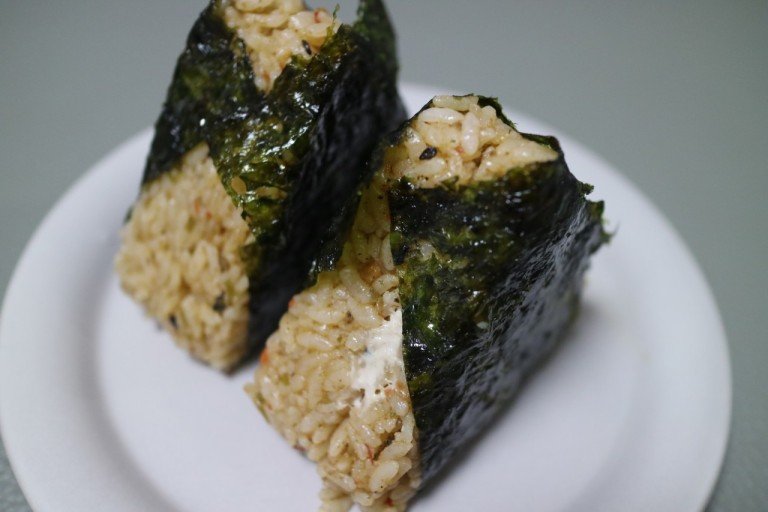
Samgak Kimbap
Ingredients
Method
- Season the warm rice with the sesame oil and salt, folding it through gently, and let it cool until just warm rather than hot.
- Mix the drained tuna with mayonnaise, gochujang, sugar and the chopped scallion until evenly combined.
- Lay a large sheet of plastic wrap over your palm and press a thin layer of rice, about 40 g, into a rough circle.
- Spoon a scant tablespoon of the tuna mixture into the center.
- Add another 40 g of rice on top, fully enclosing the filling.
- Gather the plastic wrap around the rice and shape it into a triangle by pressing three flat sides with your fingers and the heel of your hand, rotating as you go.
- Unwrap and press a rectangle of seaweed onto one face of the triangle, or wrap it fully around like a belt if you’re eating it right away.
- Scatter sesame seeds over any bare rice surface and repeat with the remaining rice and filling.
Shaping the Triangle
This is the only real technique in the recipe, and it’s easier with a sheet of plastic wrap doing the work than with bare hands. Press a thin layer of rice into your palm through the wrap, add the filling in the center, cover with more rice, and then gather the wrap up around it and press three flat sides into shape — like folding a taco into a triangle rather than sculpting it from nothing. Rotate a quarter turn between each press so all three sides come out roughly even.
Don’t over-pack the rice. A dense, hard-pressed triangle is exactly what you’re trying to avoid — the store versions are compressed by machine into something firmer than you’d want to eat, and a home version pressed gently by hand, holding its shape but still soft when you bite into it, is genuinely nicer.
Filling Variations Worth Trying
Tuna mayo with a touch of gochujang is the default and the easiest one to get right on a first attempt. Beyond that, finely chopped kimchi stir-fried with a little sugar and sesame oil until most of the liquid cooks off makes a filling with real punch, and it’s fully vegan if your kimchi is fish-sauce-free. Leftover bulgogi, chopped small enough to sit inside a rice ball without tearing it apart when you bite in, is the other common one, and it’s the best use for bulgogi you only have a small amount of left over.
Storage
Eat these the same day you make them — they’re built for immediate eating, not for keeping. Cooked rice that’s gone into the fridge turns hard and chalky by the next day, the same problem that affects any kimbap, and a triangle rice ball has no filling volume to disguise that texture the way a full roll can. If you’re making a batch ahead, keep the rice and filling separate and assemble just before eating rather than pre-shaping a dozen triangles for later.
Common Questions
What’s the difference between samgak kimbap and regular kimbap?
Regular kimbap is a long roll built around several fillings and sliced into rounds — a full meal in one roll. Samgak kimbap is a single-filling triangle sized for one hand and a few bites, sold individually rather than sliced from something larger. They share the same core ingredients but they’re built, and eaten, completely differently.
Can I make samgak kimbap vegan?
Yes. Stir-fried kimchi (check the label for fish sauce, or make your own without it) makes a filling with plenty of flavor on its own. Seasoned, crumbled firm tofu with a little gochujang and sesame oil is another workable option — softer than tuna, but it holds together fine once the rice is packed around it.
Why did my rice ball fall apart when I bit into it?
Usually one of two things. The rice was packed too loosely to hold the shape without the plastic wrap doing the compression for you, or it had already gone cold and lost its stickiness before you shaped it. Work while the rice is still warm, and press with real, even pressure through the wrap rather than shaping it loosely by hand.
Related
For the roll version with a full cross-section of fillings, regular kimbap is the place to look, and chungmu gimbap covers the bare-roll-plus-side-dish version from the opposite end of the spectrum. If you’re assembling a full convenience-store-style meal at home, the ways Koreans upgrade instant ramyeon is the other half of that combination — rice ball in one hand, hot noodles in the other, which is close to the standard order at the counter by the window.