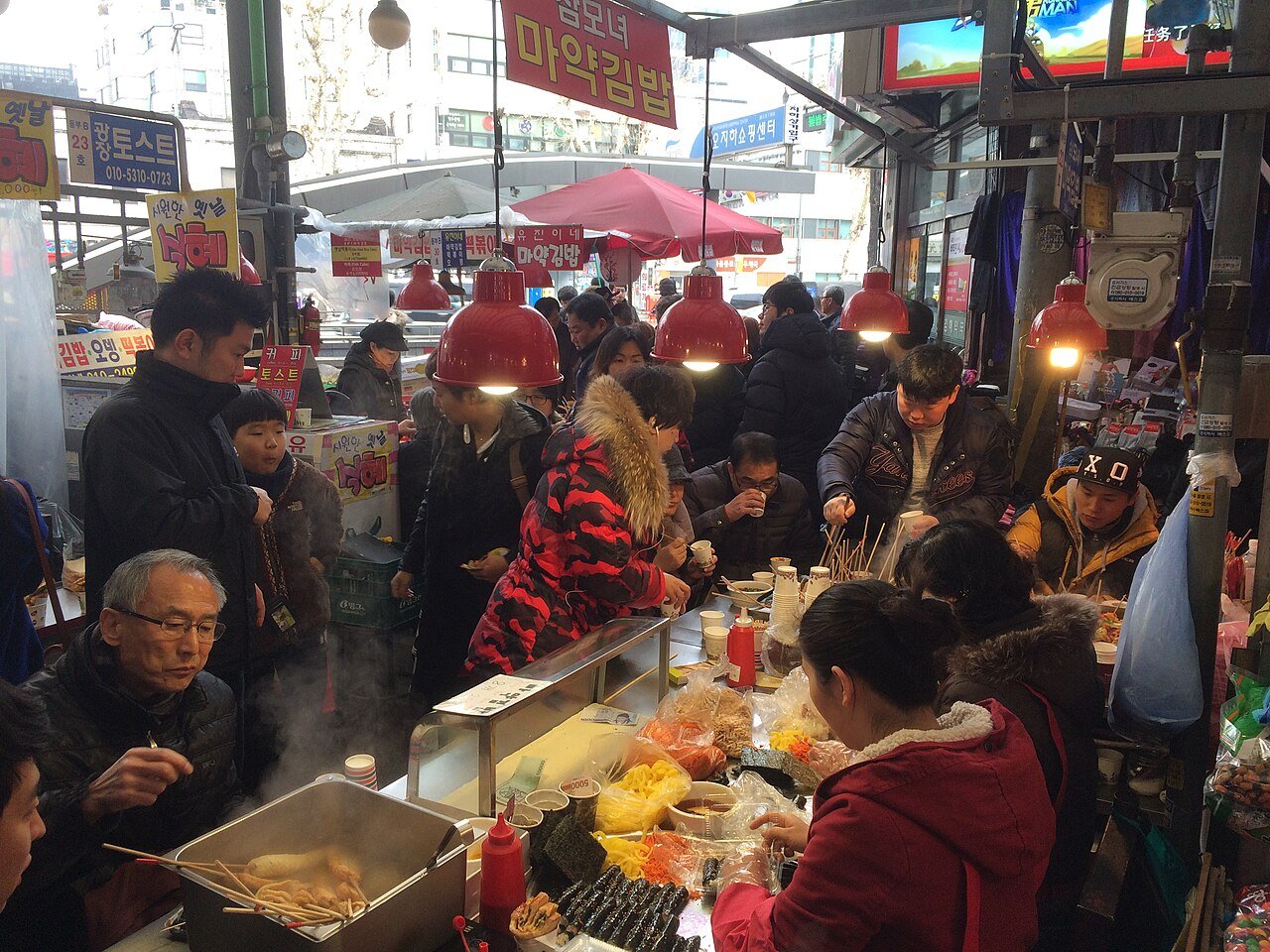
You’re on a plastic stool at a counter barely deep enough for a plate, and the woman working the griddle has already pushed a saucer of mustard-soy toward your elbow without looking up. A ladle of pale batter hits the oil behind her and the whole row gets loud. The man on your left is a stranger, he’s two-thirds through a bowl of noodles, and neither of you is going to acknowledge the other. That’s not rudeness, it’s just how the place runs.
Gwangjang is Seoul’s oldest permanently covered market, and the food aisles cut straight through the middle of it. What trips up first-timers is that it isn’t one food court. It’s four or five distinct zones, and if you wander in without knowing which is which, you’ll eat whatever’s nearest the gate. Here’s the map I’d give a friend.
Quick info
- Neighborhood: Jongno-gu, central Seoul, just west of Dongdaemun
- Nearest station: Jongno 5-ga, Line 1 — Exit 8 puts you at the north gate
- Hours: food alleys roughly 9am to 11pm daily; individual stalls vary
- Closed: the fabric and dry-goods sections mostly shut on Sundays, the food aisles generally don’t
- Budget: ₩15,000–25,000 ($11–19) per person for a full round with drinks
- All details as of 2026 — stalls here change hands, so treat hours as approximate
The mayak gimbap alley
Start here because it’s cheap and it wakes your mouth up. Mayak gimbap are seaweed rice rolls about the width of your thumb, and mayak means narcotic, which is the joke. There’s almost nothing in them: seasoned rice, a matchstick of carrot, a strip of yellow pickled radish. No egg, no meat, no fish cake.
The point isn’t the roll, it’s the dip. A saucer of soy sauce cut with mustard, sesame and a little sugar sits in front of you, and you’re meant to drown each piece before it goes in your mouth. Ten pieces run about ₩4,000–5,000 ($3–4), usually still warm from being rolled a minute earlier.
The version most people know abroad is the packed lunchbox kind. We cover that one in our gimbap recipe — same technique, four more fillings, no mustard.
The bindaetteok row
The mung bean pancakes are the loudest, greasiest, most photographed part of the market, and they earn it. Look for the stone mills turning at the front of these stalls: soaked beans go in whole, thick pale batter comes out, and it’s ladled straight onto a flat pan holding a centimeter of oil. It fries hard on both sides. Edges lacy and brittle, middle still soft.
One pancake is roughly ₩5,000–6,000 ($4–5) and is genuinely big enough for two people. It arrives with raw onion slices and a soy-vinegar dip. Eat it fast — cold bindaetteok is a completely different and much worse food.
This row is also where the makgeolli flows — a kettle of unfiltered rice wine for about ₩4,000 ($3). The pairing isn’t a marketing invention; it’s what the ajummas drink on a slow afternoon.
The yukhoe end
At the eastern edge, past the cooked-food aisles, is a cluster of small restaurants doing one thing: yukhoe. Raw beef in matchstick strips, dressed with sesame oil, soy, garlic and sugar, piled over shredded Korean pear with a raw egg yolk balanced on top. Break the yolk, mix it all with chopsticks, eat.
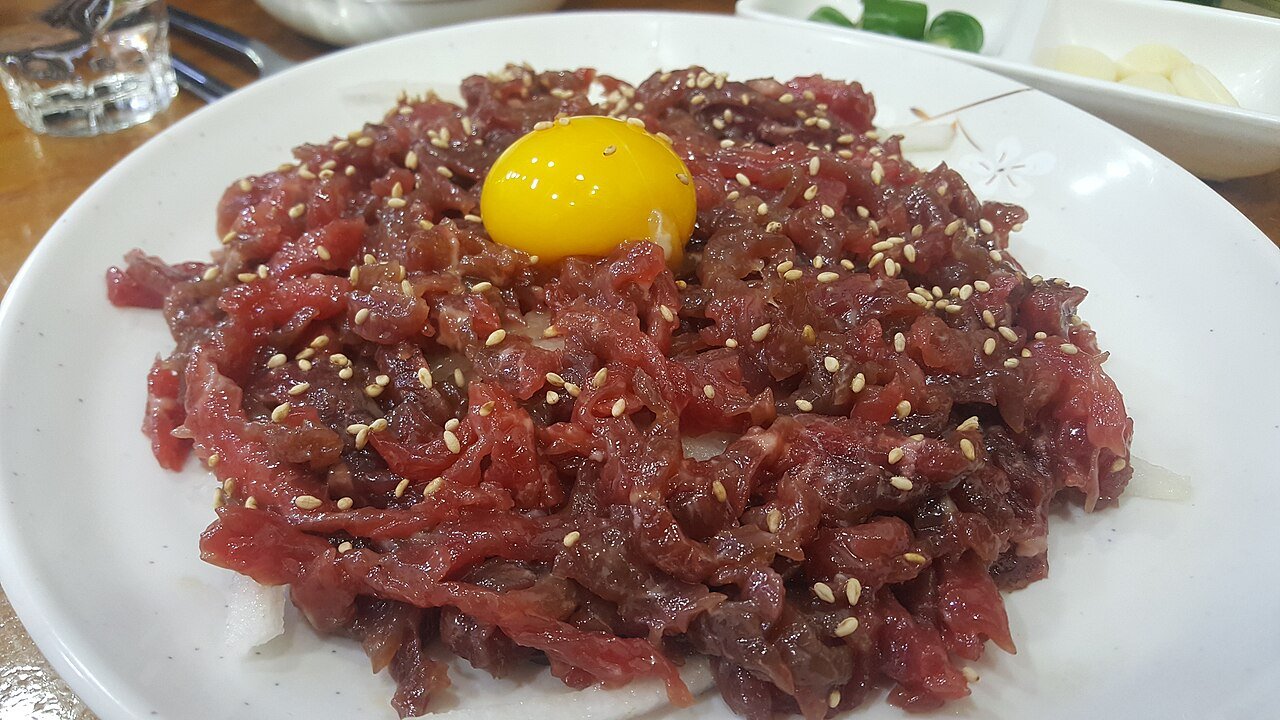
This is the priciest stop — figure ₩20,000–28,000 ($15–21) for a plate, usually shared. These places have proper tables and take cards, so it’s a sensible place to end up after a while on stools.
Jeon, noodles, and everything else
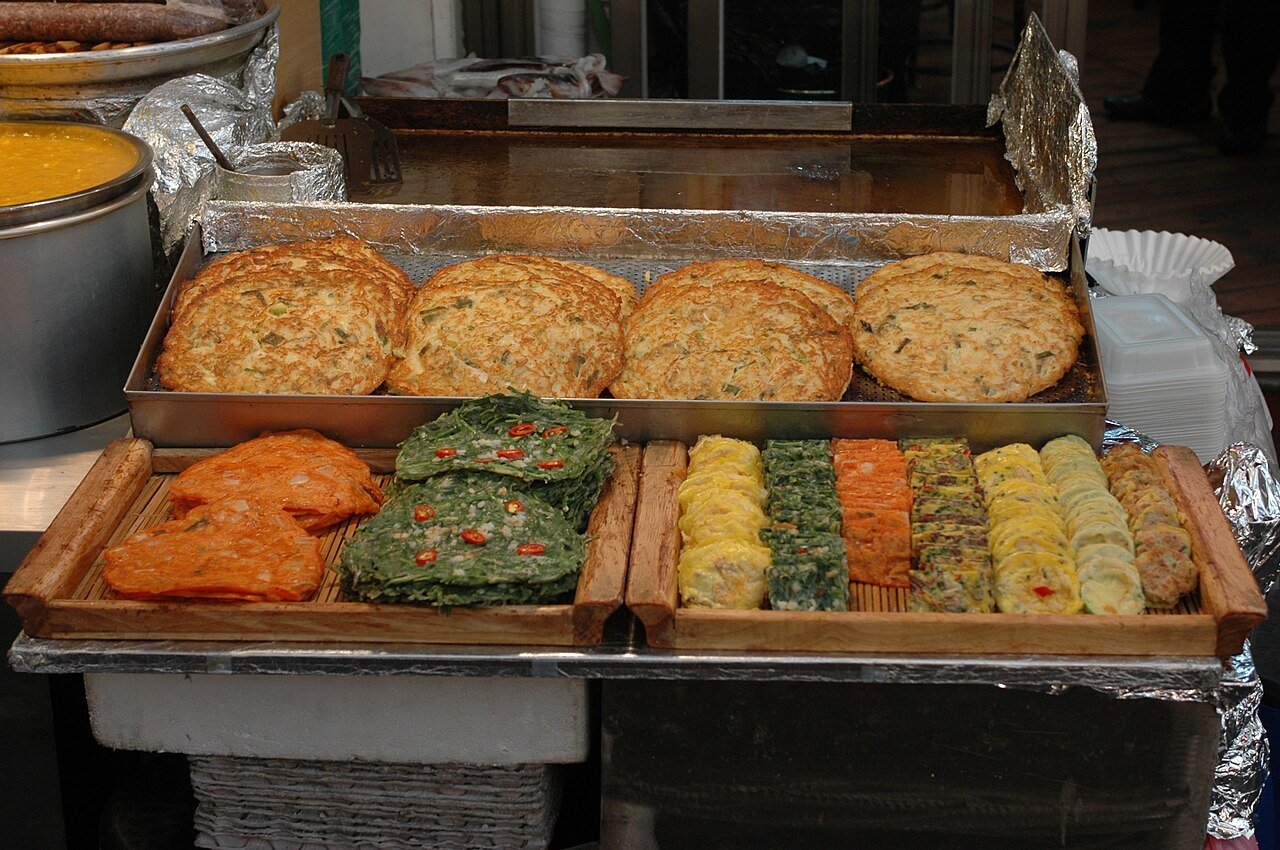
The remaining aisles are a mix, and they’re where I actually eat most often. Tables of jeon — pan-fried zucchini, stuffed pepper, sliced fish, chive-and-seafood — sit out on trays and go back on the griddle when you point. Ask for a mixed plate (modeum jeon), five or six kinds for ₩12,000–15,000 ($9–11).
There’s also a knife-cut noodle section — kalguksu, thick wheat noodles in anchovy broth, ₩6,000–8,000 ($5–6), often with free noodle refills. Plus blood sausage, braised pig trotter, and rice cakes in red sauce. The seafood pancakes here are closer to our haemul pajeon recipe than to anything on the mung bean row.
A realistic first round
Do it in this order and you won’t overfill on the first thing you see: mayak gimbap standing up, then find a counter seat for bindaetteok and split it, then a mixed jeon plate, then decide if you still have room for yukhoe. That’s about ₩18,000 ($14) a head if two of you share everything, and it’s plenty of food.
How the counters actually work
You sit where there’s space. That usually means squeezing onto a bench beside strangers, bag on your lap because there’s nowhere else for it. Nobody minds. Nobody talks to you either.
Order by pointing; holding up two fingers covers quantity. You pay at the end, at the stall where you ate, not up front. Don’t hold a seat while your friend queues elsewhere, and don’t linger over an empty plate during the rush.
On money: bring cash. Roughly ₩50,000 in small bills covers two people. Card readers have spread a lot, and the sit-down yukhoe places take them fine, but plenty of small griddle stalls still prefer cash and a few take nothing else. Don’t discover that after you’ve eaten.
Getting there and when to go
Jongno 5-ga Station, Line 1. Exit 8 comes up almost at the north gate; Exit 7 drops you a minute further along. Euljiro 4-ga on Lines 2 and 5 is a ten-minute walk from the other side.
The timing matters more than anything else on this page: go before 6pm on a weekday. After that the aisles compress into a slow shuffle and you’ll spend the visit queuing behind someone’s tripod. Come between 11am and 3pm and there’s room to stand, room to sit, and vendors with time to tell you what’s in the bowl.
Make it at home
The one dish here that really translates to a home kitchen is gimbap — same rolling motion whether it’s the tiny mustard-dipped kind or the fat lunchbox kind, and no equipment beyond a bamboo mat. Our gimbap recipe covers the rice seasoning, which is the part people get wrong. If the red-sauce stalls are what stuck with you, that story continues in our guide to Sindang-dong Tteokbokki Town.
Questions people actually ask
Is Gwangjang Market cash only?
Not entirely, but plan as if it is. The sit-down restaurants and larger stalls take cards; a fair number of the small food counters prefer cash and some accept nothing else. Carry ₩50,000 in bills and you’ll never have to ask.
Is Gwangjang Market worth visiting for one meal?
Yes, if you go outside peak hours and treat it as a grazing route rather than a single sit-down meal. Two people sharing four dishes across three stalls get a much better afternoon than one person committing to one plate.
What’s the most famous dish at Gwangjang Market?
Bindaetteok, the fried mung bean pancake, is what the market is best known for domestically. Mayak gimbap is what most overseas visitors come looking for. Both are worth it, and they’re a five-minute walk apart.
Related on k-trips.blog
Our sister travel site runs the aisle-by-aisle companion to this piece — which entrance to use and how to navigate Gwangjang, which matters more here than at most Seoul markets. And if pointing at food makes you nervous, their primer on ordering food in Korea has the phrases that do the heavy lifting.
Official market hours are worth double-checking on Visit Seoul or the Korea Tourism Organization before you set out.