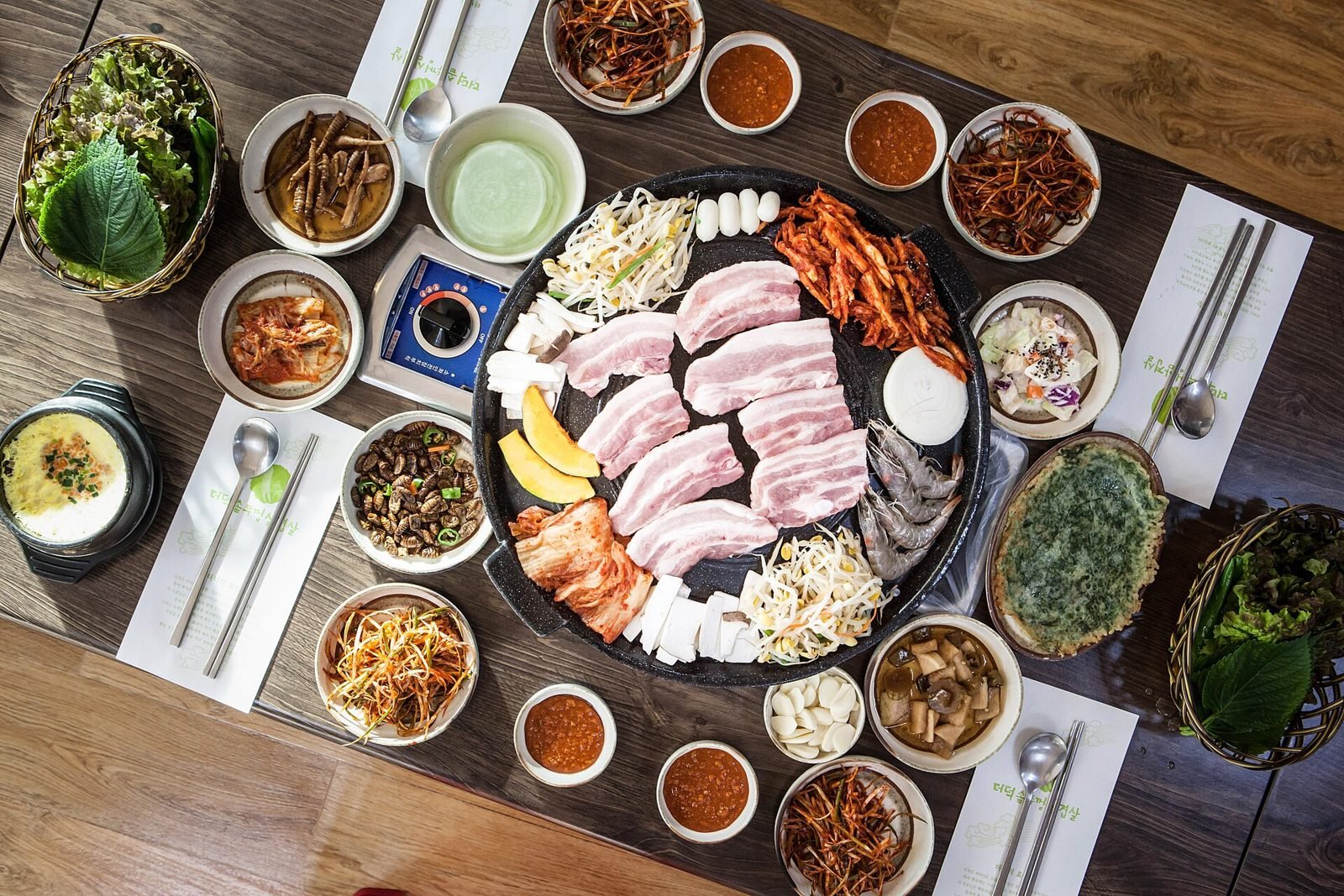
A 200-gram serving of pork belly at a Seoul restaurant averaged 21,321 won in June 2026, according to the Korea Consumer Agency’s Chamga-gyeok price portal as reported by The Asia Business Daily. A restaurant table comes with a grill hot enough to sear and, usually, an extraction system overhead. A home table has neither, so the evening depends on the smoke path, the grill surface and the order of cooking far more than on any marinade.

What the restaurant has and your kitchen does not
Korean barbecue, gogigui, is the practice of grilling meat at the table. The Encyclopedia of Korean Culture defines samgyeopsal (삼겹살구이) as the cut from the abdomen, between where the ribs are removed and the hind leg, grilled. It notes that the cut used to be called segyeopsal and was mostly steamed, boiled or braised; nobody knows exactly when grilling it began, but specialist shops appear to date from the late 1970s, and a 1983 newspaper report mentions a pork belly alley in Seoul’s Samgak-dong. It became widely popular during the 1997 financial crisis, when “IMF samgyeopsal” turned up as a new term.
A restaurant solves three problems by design: a surface hot enough to sear instead of steam, a hood that clears fat vapor, and a kitchen that sends the meat out in a sensible order. At home you replace each one, with a surface that takes direct high heat, a way to move smoke out of the room, and a plan for the order things go on.
Buying the meat is the one decision you make before any of this. The card asks for thick-cut pork belly sliced about 1 cm (0.4 in) thick, enough to render and brown without drying, and for bulgogi-cut beef, thin ribeye or sirloin. Ask the butcher for those two cuts by name and you have the table’s core. Everything else is lettuce, mushrooms and the pantry.
Moving the smoke out
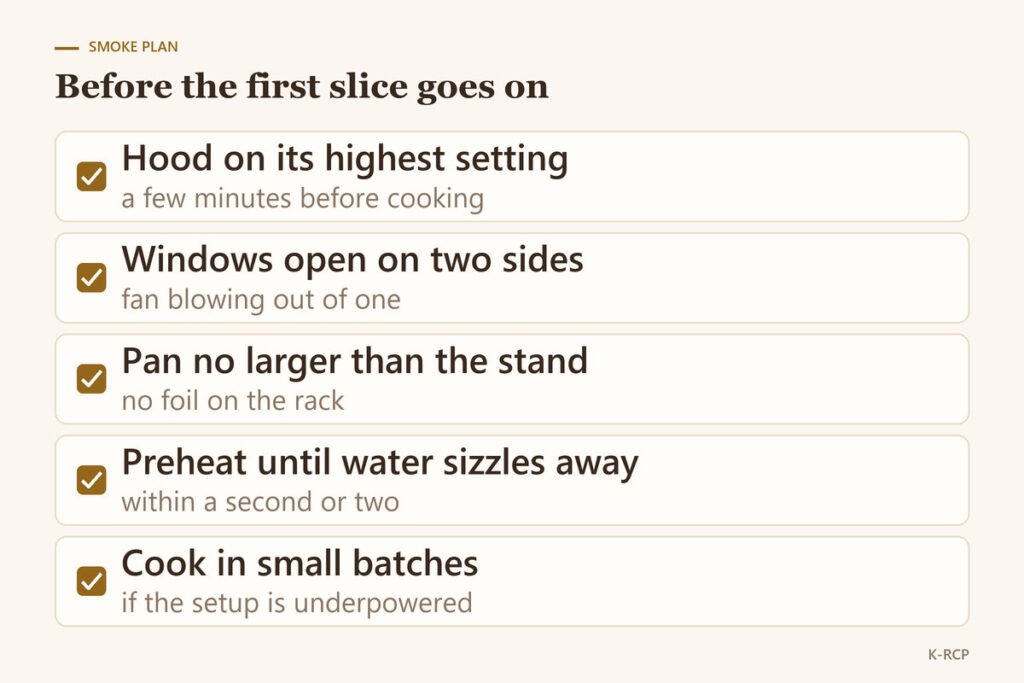
This is the part people skip on the way to the recipe, and it decides the evening. The options run roughly from most to least effective. An outdoor balcony or courtyard, where you are allowed to cook, beats every indoor setup. Next is a portable burner placed directly under your kitchen hood, with the hood on its highest setting a few minutes before the first slice goes down, so air is already moving when the first fat hits the pan. Failing that, open windows on two sides of the room with a fan blowing out of one of them; a single cracked window does little against still air.
The card’s first step says the same thing in one line: set up the grill and get ventilation running before you cook anything, not after the smoke starts. Treat that as the rule for the whole evening. Opening the windows, setting the fan and testing the burner costs little, and it is what separates a smoky apartment from a table people want to linger at. Do it while the rice cooks.
If none of that is possible, a countertop electric grill with a water tray under the surface is usually a quieter choice, because the drippings fall away from the heat instead of burning. It gives less char than an open flame. A cast-iron skillet or griddle on the regular stove works for small portions and needs no special equipment, but with nothing managing the fat it usually makes the most smoke of the indoor options.
A safety note on butane burners
Portable butane stoves are common at Korean tables, and Korean safety agencies have been explicit about their limits. In 2017 the Ministry of Public Safety and Security reported 100 portable butane accidents between 2012 and 2016, with 8 deaths and 133 injuries; restaurants were the most common setting at 35 cases, ahead of homes at 27. The leading causes were cans stored near heat sources (24 cases), oversized grill pans or foil-wrapped racks (11) and improper installation (10). Seoul Shinmun carried the warning: do not use a pan larger than the burner’s stand, do not wrap the rack in foil, do not put cans near other heat, and never heat a can to squeeze out the last gas.
Any flame indoors also needs fresh air, so keep a window open while it burns and never leave it unattended. Do not cover or disable a smoke detector to get around the smoke; solve the smoke instead.
Pork first, beef last: the order on the grill
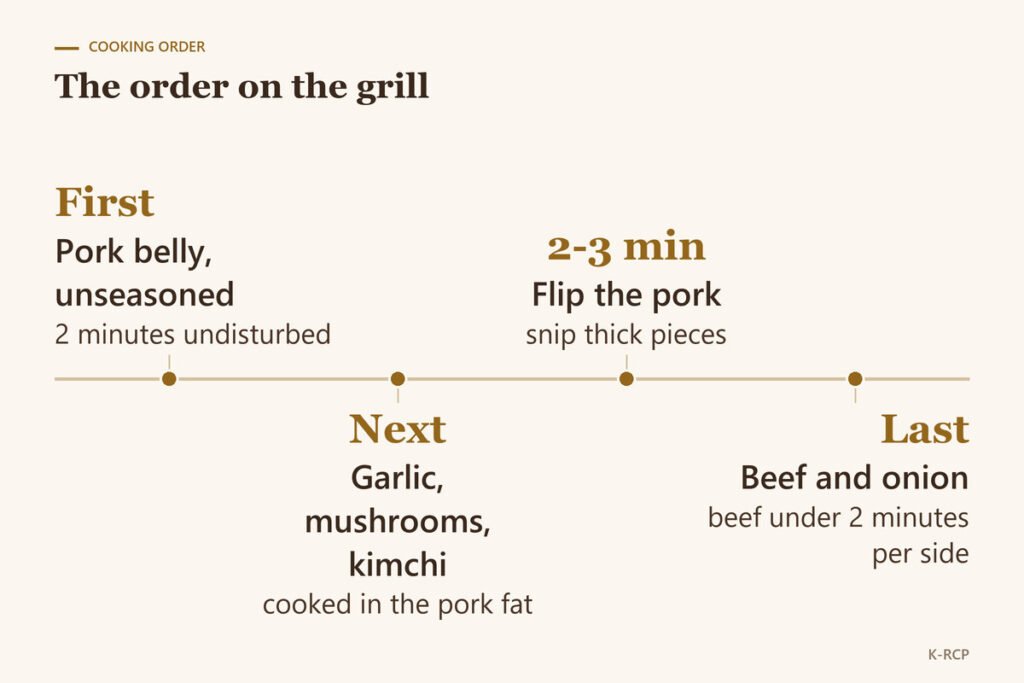
The order is built on one idea: fatty meat renders cooking fat, and that fat is free flavor for everything that follows. Samgyeopsal goes first and unseasoned, spaced so pieces do not touch, and gets 2 undisturbed minutes before the first flip. Salt draws out moisture and slows browning. The Korea Food Promotion Institute’s standard samgyeopsal recipe cuts the belly into pieces about 4 cm wide, grills it on a hot pan until both sides are cooked, and serves it with a simple oil dip of sesame oil, salt and pepper.
Korean BBQ at Home
Ingredients
Method
- Set up your grill (see equipment options below) and get ventilation running before you cook anything, not after the smoke starts.
- Preheat the grill or pan until a drop of water sizzles and evaporates within a second or two.
- Lay the pork belly down first, unseasoned, spaced so pieces aren’t touching. Let it render undisturbed for 2 minutes before flipping.
- Once a pool of rendered fat has collected, push the pork to one side and add the garlic cloves, mushrooms and kimchi directly into that fat. Let them cook in it rather than on a dry section of the grill.
- Flip the pork every 2 to 3 minutes, using scissors to snip thick pieces in half once they’re mostly cooked, so more surface area gets direct contact with the heat.
- Add the marinated beef last. Bulgogi-cut beef is thin and cooks in under 2 minutes per side — don’t put it on until the pork is nearly done, or it will overcook waiting.
- Add the onion wedges alongside the beef; they only need a couple of minutes to soften and pick up char at the edges.
- Serve everything straight off the grill with lettuce and perilla leaves, ssamjang, the sesame oil dip, and rice, so people build their own wraps as they go.
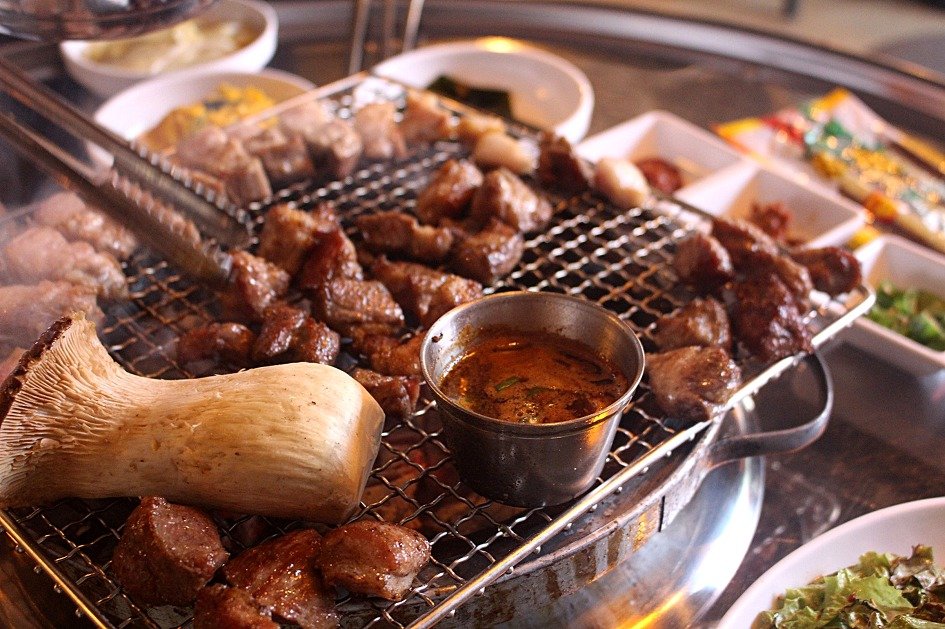
Recipe card photo: Korean barbecue – moksal, samgyeopsal, beoseot, and meljeot on a gridiron by 대경라이프, CC BY-SA 4.0, via Wikimedia Commons.

The same institute recipe grills mushrooms, onion and kimchi together with the meat. The card does it in the pork fat: once a pool has collected, push the pork aside and cook the garlic cloves, mushrooms and kimchi directly in it, not on a dry section of the grill. Flip the pork every 2 to 3 minutes. Kitchen scissors do the work of the restaurant tongs: snip thick pieces in half once they are mostly cooked so more surface touches the heat, then cut the finished meat into bites.
The marinated beef, bulgogi-cut, goes on last, because thin slices cook in under 2 minutes per side and will be gray and overdone if they wait for the pork. Onion wedges join the beef for a couple of minutes to soften and pick up char at the edges. The bulgogi marinade from scratch is on its own page if you would rather not buy the beef pre-marinated.
Heat matters as much as order. Preheat the grill or pan until a drop of water sizzles and evaporates within a second or two; a grill that is not hot enough steams the meat. On an underpowered setup, cook in smaller batches so the surface temperature does not fall.
Setting the table so everyone builds their own
Korean barbecue is a table of small parts. The Institute’s recipe advises serving the meat with plenty of vegetables, wrapped in leaves with ssamjang. That wrapping is ssam, a habit the Encyclopedia of Korean Culture traces back centuries, with lettuce as the classic wrapper. The entry describes wrapping rice and a sauce in leaves as an old Korean eating habit, so the rice belongs on the table from the first piece of meat, not after the last. Put out red leaf or butter lettuce and perilla leaves, ssamjang, the sesame oil dip, grilled garlic and kimchi, and steamed rice. Each person puts a piece of meat on a leaf with a dab of ssamjang and a slice of garlic, folds it and eats it in one bite.
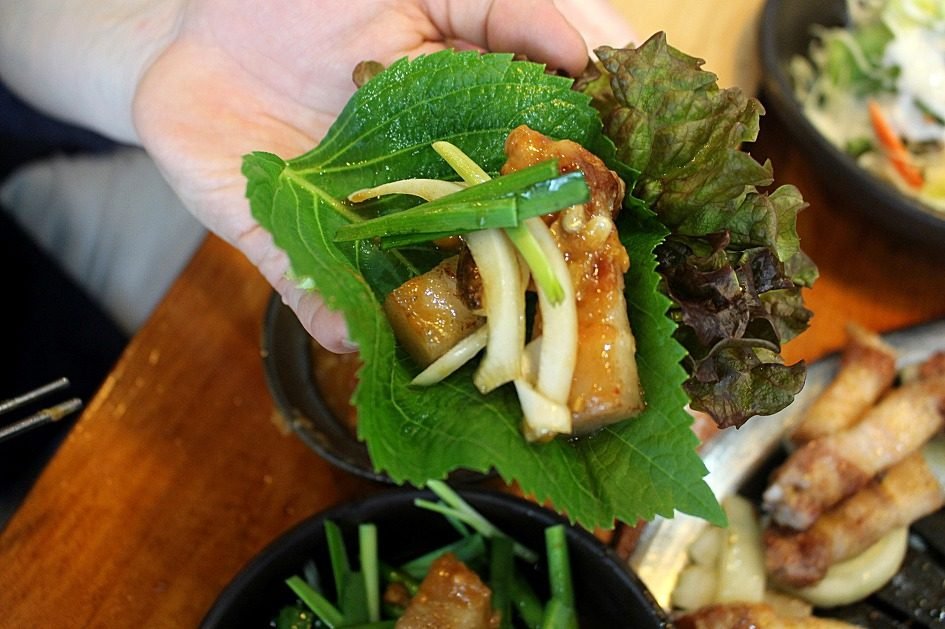

Two dips cover most of the meat. The sesame oil, salt and pepper mix is for plain pork, where it seasons and adds richness in one dunk. Ssamjang belongs inside the wrap. The card’s quick version is 2 tablespoons of gochujang, 1 tablespoon of doenjang, 1 teaspoon of sesame oil, 1 minced garlic clove and 1/2 teaspoon of sugar. Marinated beef usually needs neither dip. For a cold, sharp counterweight to the fat, add a cubed radish kimchi, or a spinach side such as a plate of seasoned sigeumchi namul.
Plan on the generous side of casual. For four people the card suggests 500 g of samgyeopsal, 400 g of bulgogi-cut ribeye or sirloin, 1 thick-sliced onion, 200 g of king oyster or shiitake mushrooms, 2 cups of kimchi and 8 to 10 garlic cloves, alongside rice. If you want to see how a restaurant paces the same meal, the walkthrough of a Korean barbecue restaurant visit goes through it course by course.
Swaps that keep the wrap and the dip working
Few cooks have every item at the moment they want it. These swaps keep the wrap-and-dip mechanic intact, and the table says what each one changes.
| If you lack | Use instead | What changes |
|---|---|---|
| A tabletop grill or Korean barbecue pan | Electric grill with a water tray | Usually less smoke, less char than open flame |
| A ventilated space for a butane burner | Cast-iron skillet or griddle on the stove, hood on high | Works for small portions; the smokiest indoor option |
| Perilla leaves | An extra layer of lettuce, or fresh basil in a pinch | Perilla’s flavor is gone; the wrap still works |
| Doenjang for the ssamjang | Extra gochujang plus a pinch of white miso | Less funk, still savory |
| King oyster mushrooms | Halved shiitake | Softer and earthier instead of firm and meaty |