The story goes that it started with one cart.
Sometime in the decades after the war, a vendor working a corner in Jung-gu began selling rice cakes in a thick gochujang sauce rather than the soy-and-sugar version people knew. It caught on. Neighboring stalls copied it, some became shops with doors and tables, and the shops never left. I won’t give you exact dates or a founder’s name — the version you hear depends on which shop is telling it. But every place on this street traces its style back to that lineage, and the block is still red-signed end to end.
What matters more, if you’re standing there hungry: this is not a place where someone hands you a paper cup of rice cakes. You sit down. They bring you raw ingredients and fire.
Quick info
- Neighborhood: Sindang-dong, Jung-gu, central Seoul
- Subway: Sindang Station, Lines 2 and 6 — Exit 8 (Exit 7 also works), about a 4-minute walk
- Hours: most shops run from around 11am until late evening, several past midnight
- Closed days: the street never fully closes, but individual shops take one weekday off on rotation
- Budget: roughly ₩10,000–16,000 ($7–12) per person, including the add-ins
- All details as of 2026. Small shops change hours without warning, so check on the day.
What actually arrives at your table
Order jeukseok tteokbokki (즉석떡볶이) — “on-the-spot” tteokbokki. A wide, shallow steel pan lands on a portable gas burner set into your table, and everything in it is raw or cold. Cylinders of rice cake. Flat sheets of fish cake, folded rather than sliced. A pile of cabbage. Scallion, sometimes onion, sometimes a boiled egg. A ladle of red sauce sitting on top of maybe two centimeters of water, not yet stirred in.
Then they turn on the burner and walk away.
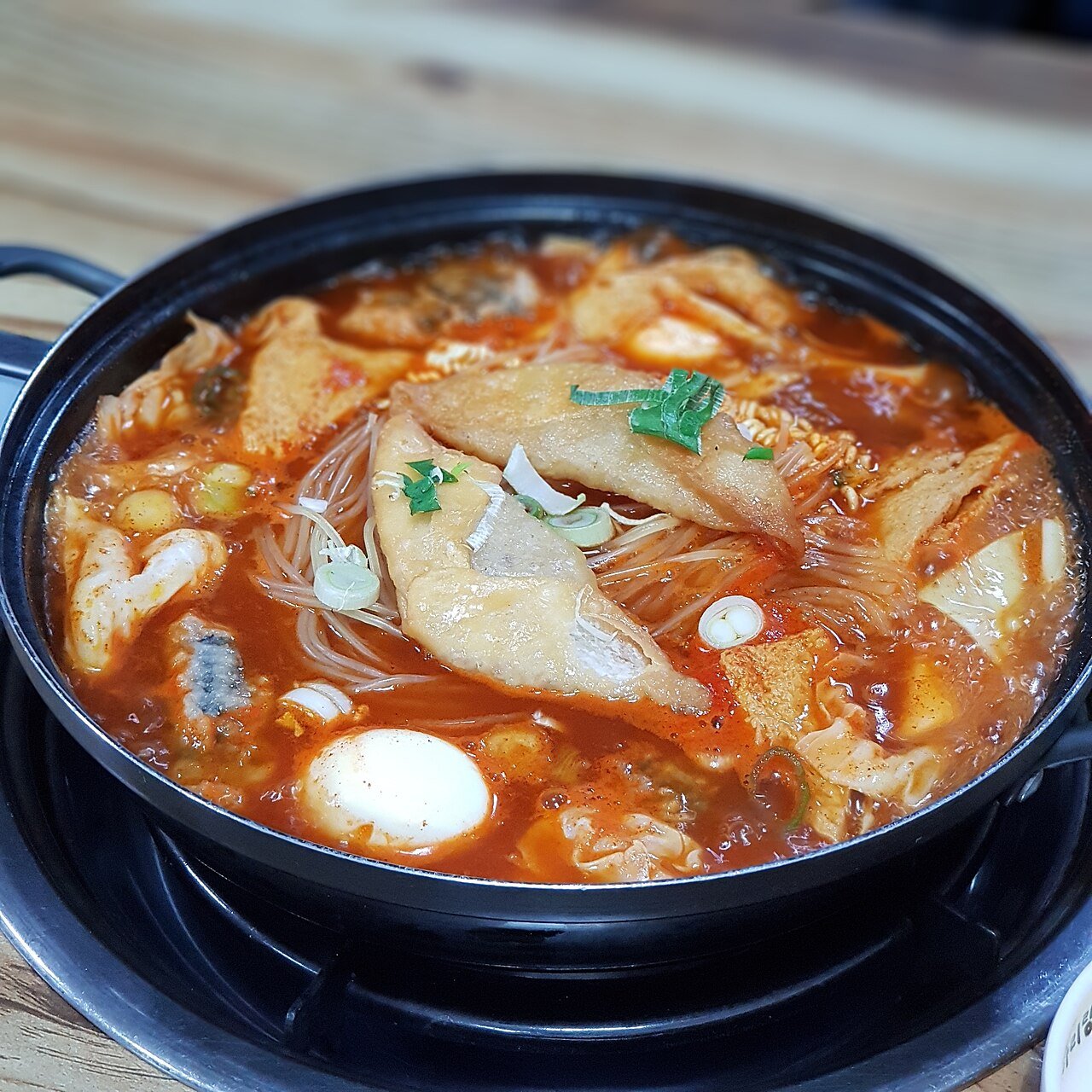
Pans are almost always priced per person with a two-person minimum, and the base pan is only the starting point. The add-ins are where the ordering happens. Ramyeon noodles (sari) are close to mandatory and cost almost nothing. Dumplings, either boiled in the sauce or fried separately. Fried seaweed rolls. And cheese, which arrives as a fistful of shredded mozzarella dumped over the top in the last few minutes.
How to work the pan
Nobody is coming back to cook it for you. That’s the deal, and it takes about ninety seconds to get used to.
Stir. Keep stirring, gently, from the bottom up, because rice cakes will glue themselves to hot steel the moment you stop paying attention. Over eight or ten minutes the water reduces, the sauce goes from watery orange to glossy dark red, and the rice cakes go from stiff to bouncy. When the sauce coats a rice cake and doesn’t slide straight off, it’s done. Turn the heat down — don’t turn it off, since the pan cooling and re-thickening is part of how it eats — and start.
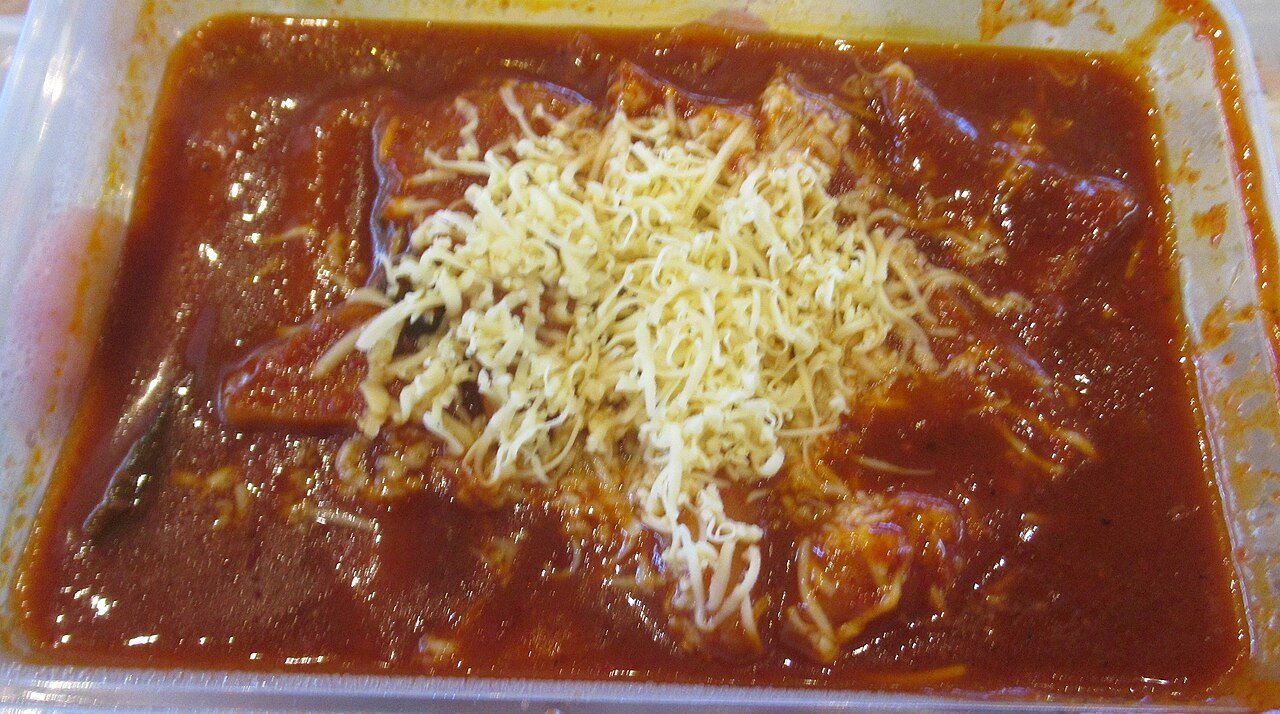
Drop the ramyeon in partway through, not at the start. It’ll go to mush otherwise. The cheese goes on at the very end, over one section rather than the whole surface, so you can have bites with and without.
Don’t leave without the bokkeumbap
When the pan is nearly empty, leave the sauce. Say bokkeumbap juseyo (볶음밥 주세요) and someone will come over with a bowl of rice, dried seaweed flakes, sesame oil and often a sheet of chopped kimchi, tip the whole lot into your leftover sauce, and press it flat across the pan with a spatula until the bottom crisps.
It costs a couple of thousand won. It is, genuinely, the reason a lot of people come. Order it before you finish everything else — you need that sauce.
Seating, payment, and how long you can sit
Tables are small and turnover is real. Weekends, expect to wait outside; there’s often a paper list by the door where you write your party size. Most shops take cards now, but keep ₩20,000 in cash for the ones that still don’t.
You pay at the counter on your way out, not at the table. Water and side dishes are self-serve from a fridge near the wall — standing up to get your own is normal, not rude.
How spicy it really is
Honest answer: medium. Korean shops on this street call it mild, which is not the same thing.
The heat is broad and slow rather than sharp. It builds over ten minutes and sits there. Most first-time visitors land around a 3 out of 5, and the cheese knocks it down noticeably, which is half of why people order it. Many shops will adjust the sauce if you ask when ordering — deol maepge haejuseyo (덜 맵게 해주세요) means “less spicy, please.” Ask before the burner is lit, not after.
Why it doesn’t taste like home tteokbokki
Home tteokbokki is a sauce you build in a saucepan and pour over rice cakes. Street style is closer to a shallow hot pot: everything cooks in one liquid that reduces down onto the ingredients, so the cabbage sweetens into the sauce, the fish cake gives up its salt, and the rice cake starch thickens the whole thing instead of cornstarch doing it.
The sauce also leans further toward chili flake (gochugaru) than most home versions, which run sweeter and rely more on gochujang paste. And the fish cake is a sheet, not a stick — more surface, more sauce clinging to it.
Make it at home
You can get most of this on a normal stove. Our tteokbokki recipe uses a version of the same sauce ratio these shops work from, scaled down for a home pan, with substitutions listed for rice cakes and fish cake if your grocery store is limited. Cook it in a wide skillet rather than a deep pot and you’ll get closer to the Sindang texture.
Add the instant noodles the same way they do here — late, and with a little extra sauce to carry them. If ramyeon is your entry point into Korean cooking generally, our ramyeon upgrade guide covers the same trick in a few other directions.
Questions people actually ask
How spicy is Sindang-dong tteokbokki?
Medium by international standards, mild by Korean ones. It’s a slow-building chili heat rather than a sharp one. Order the cheese, ask for deol maepge (less spicy) when you order, and keep a milk-based drink on the table — every shop sells one for exactly this reason.
Is Sindang-dong Tteokbokki Town one restaurant or many?
Many. It’s a short street of independent shops, most family-run, several with decades of history and their own regulars. The differences between them are real but subtle — sauce sweetness, how much curry powder is in the mix, whether the fish cake is thick or thin. Pick whichever has a line and no menu translation.
Can I make this style of tteokbokki without a portable burner?
Yes. The burner exists so the pan can sit on your table, not because the recipe needs it. A wide skillet on your stovetop does the same job — simmer everything together in shallow water, stir as it reduces, and carry it to the table when the sauce has thickened.
Planning around it
Sindang sits one stop from Dongdaemun and a short ride from Jongno, so it pairs easily with a market afternoon — our Gwangjang Market guide covers the obvious other half of that day. The street also shows up as one stop in our wider K-drama food locations round-up if you’re building a route rather than a single meal.
For the non-food side of the same neighborhoods, our sister site’s guide to K-drama filming locations around Seoul covers walking routes and what’s still standing.
Official district information and current opening details are worth a check on Visit Seoul or the Korea Tourism Organization before you go.