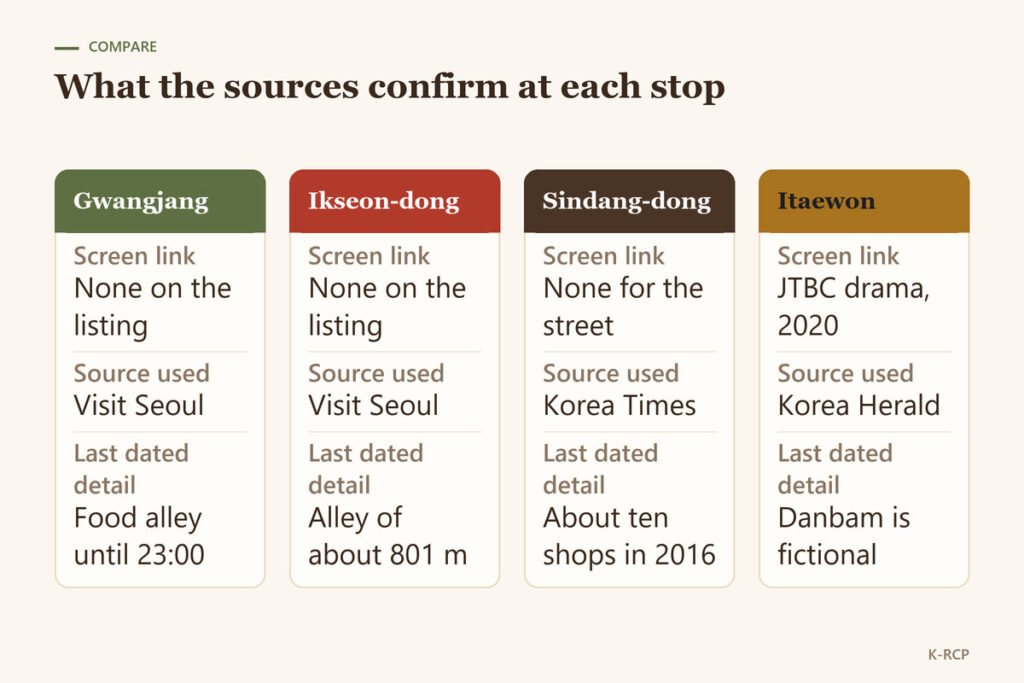
Save every filming credit on your map as a lead, not as a reservation. A location on a fan list is easy to mistake for a restaurant address, when the restaurant in the story may be fictional, the street may only have looked like the one on screen, and the shop may be a different business by the time you arrive. Four Seoul food stops follow, and the sources confirm a screen link for exactly one district, a restaurant that exists only in the script.

A credit is not a kitchen
Productions choose locations for how a place looks, not for what the kitchen serves, so the useful question about any stop is not “was it filmed here?” but “is there still good food here, and is it the same business?” That changes how you build a list. Start from places that are real working food districts, then treat any screen link as a bonus you have verified, not a promise.
Street, set or story?
Sort every stop into one of three bins before you travel. A street is a real place with real shops, such as a market or a food alley. A set was built for filming and may be gone. A story is a business that exists only in the plot. The Korean drama Itaewon Class is the clearest case in this guide: its hero opens a restaurant called Danbam, and the restaurant is part of the script.
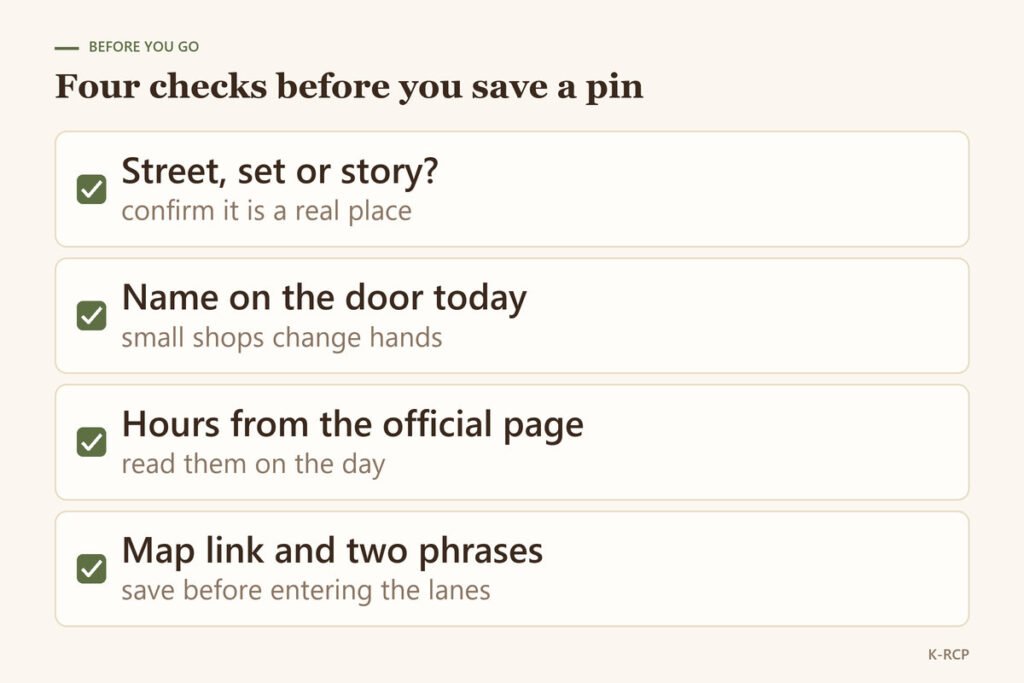
Four checks before you save a pin
- Confirm the place is a real street or market, not a set or a story business.
- Look for the name on the door today, because small Seoul businesses change hands.
- Read the opening hours from the official page on the day you go; Visit Seoul and the Korea Tourism Organization list them.
- Save a map link before entering a maze of lanes, and learn two ordering phrases (given at the first stop).
The third check matters more than it looks. Gwangjang’s own Visit Seoul page lists three different sets of hours for one market, and Ikseon-dong is an alley of separate shops, so there is no single set of hours to quote for it at all. A fan list that gives one opening time for a whole place is a sign that nobody has checked it.
Geography helps. On Line 1, Jongno 3-ga and Jongno 5-ga are neighboring stations, so Ikseon-dong and Gwangjang Market fit into one half-day on foot or by a single stop. Sindang-dong sits on Lines 2 and 6 at Sindang Station and is better paired with a second day around Dongdaemun. Itaewon is its own outing.
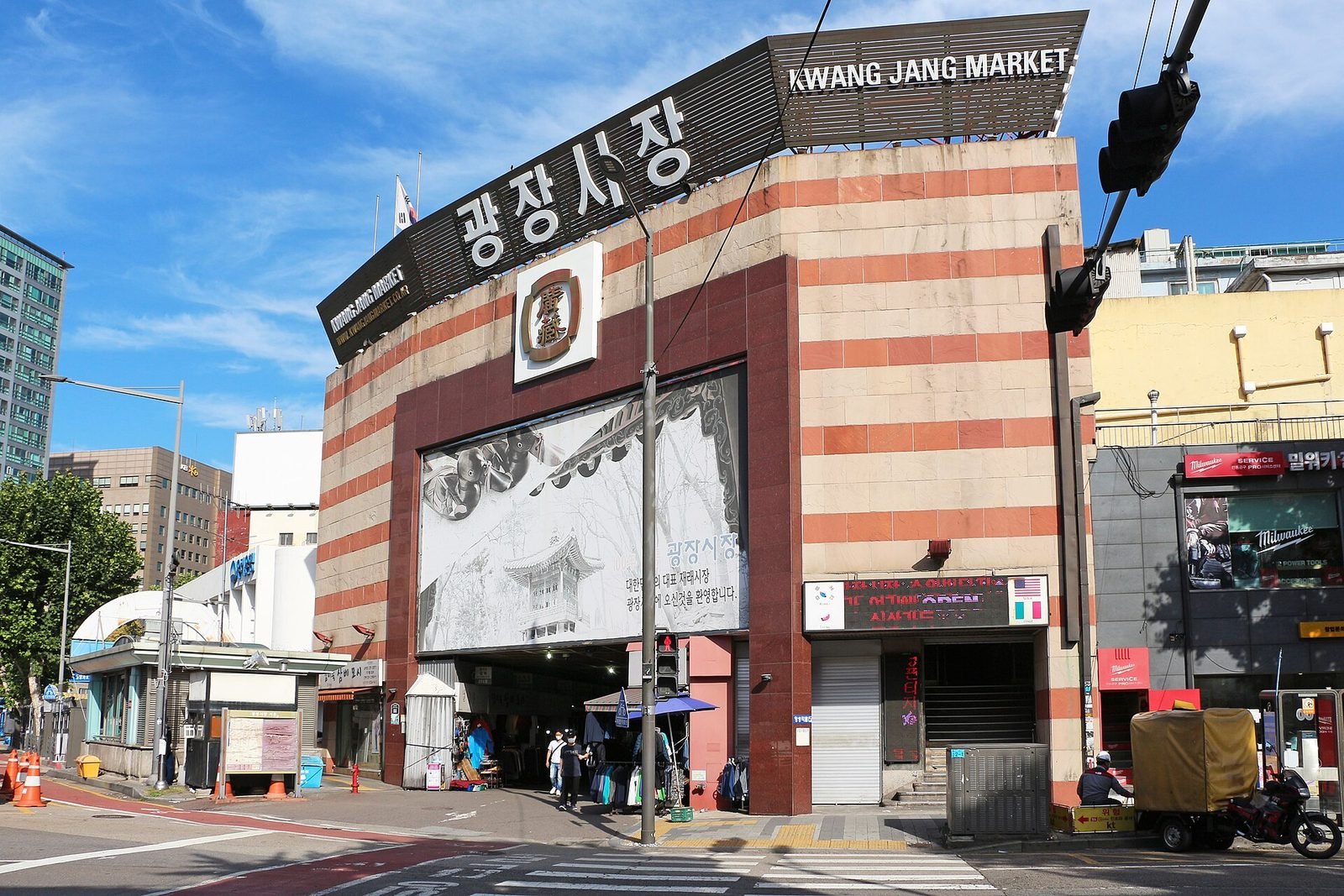
Gwangjang Market, Jongno
If you only have time for one food stop, this is the one. Visit Seoul’s listing says the market opened in the early 20th century and gives no exact founding year. It names “addictive” gimbap and nokdujeon (mung bean pancake) as the places to start, with tteokbokki and fish cake alongside.
The Standard Korean Language Dictionary defines bindae-tteok as a pancake of mung beans that are soaked, peeled and ground on a millstone, mixed with greens and beef or pork, and pan-fried. Visit Seoul’s FAQ lists it first among the market’s favorites, followed by modum-jeon (assorted savory pancakes), mayak gimbap, sundae with head meat, yukhoe (beef tartare) and Korean-style meatballs. Mayak means “addictive,” and the rolls are a relative of the full-size roll covered in the kimbap rolling steps. Raw beef is best bought from a stall with steady turnover.
Visit Seoul adds that most dishes at the stalls are reasonably priced, which makes the food alley a low-risk place to try several things. Two phrases cover most ordering: Igeo juseyo (이거 주세요) means “this one, please,” and you can point; Gyesan haejuseyo (계산해 주세요) means “the bill, please.” At a shared counter, take only the seats your group needs. The nearest exit is Exit 8 of Jongno 5-ga Station on Line 1, about 62 meters away.
The listing also explains the two sets of hours. The general market runs 09:00 to 18:00 and closes on Sundays, the Guie shopping street runs 10:00 to 19:00 and also closes on Sundays, and the food alley stays open 09:00 to 23:00 daily. If your visit falls on a Sunday, or you want a late dinner, the food alley is the part to aim for.
As for screens, the listing mentions no TV or film credit. Travel sites mention a Netflix street-food series that visited the market, but no official page or news report found for this guide confirms the episode, so Gwangjang appears here as a food market first and a location second.
Ikseon-dong, where the alley is the draw
Visit Seoul describes Ikseon-dong Hanok Village as an alley of about 801 meters that links Insadong with the Nakwon Music Market area, lined with fusion-concept cafes, restaurants and shops that contrast with the more traditional Insadong. The closest station is Jongno 3-ga, Exit 4, about 123 meters away on Lines 1, 3 and 5.
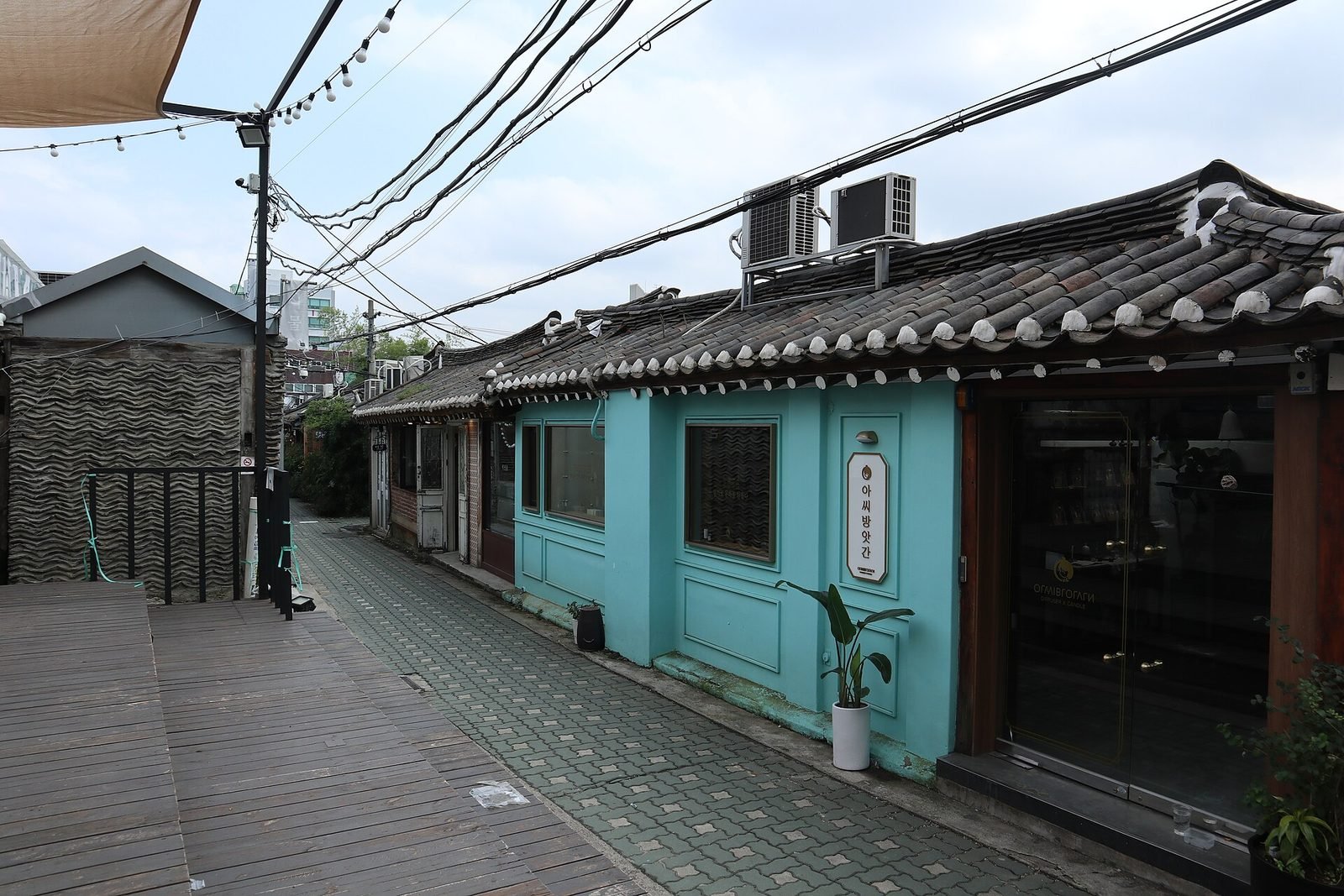

The page calls it one of the city’s popular dating spots and says the narrow alleyways look most striking in winter or after dark. That tells you how to use it: treat Ikseon-dong as one stop in an afternoon of walking, with a cafe or a meal as the pause, instead of the single destination of a day.
Food here is a sit-down meal in a cafe or small restaurant rather than street food. The lanes are narrow and dim after dark, which is the reason to save your destination to a map before stepping in.
The official page lists no film or drama credit for the district. Travel guides name several productions, but none of those lists could be matched to an official or news source, so none is repeated here. If a screen link matters to your trip, check the title and the scene on the broadcaster’s own page before you go.
Sindang-dong Tteokbokki Town
The story of this street is better documented than most, though the sources differ on one detail. The Korea Times reported in 2016 that the Sindang-dong style is attributed to Ma Bok-rim, who mixed black bean sauce with red chili paste, and that her restaurant, opened in 1953, still stood at the entrance of the street. The National Folk Museum’s tteokbokki entry says she began selling tteokbokki from a stall in 1953, soon after the Korean War, and that the idea of adding gochujang is said to have come from a rice cake dropped into a bowl of jjajangmyeon at a Chinese restaurant. Both give 1953, and this guide follows that year. Similar restaurants opened in earnest in the 1980s, and ten such stores survived when Seoul City designated the street a Future Heritage site.
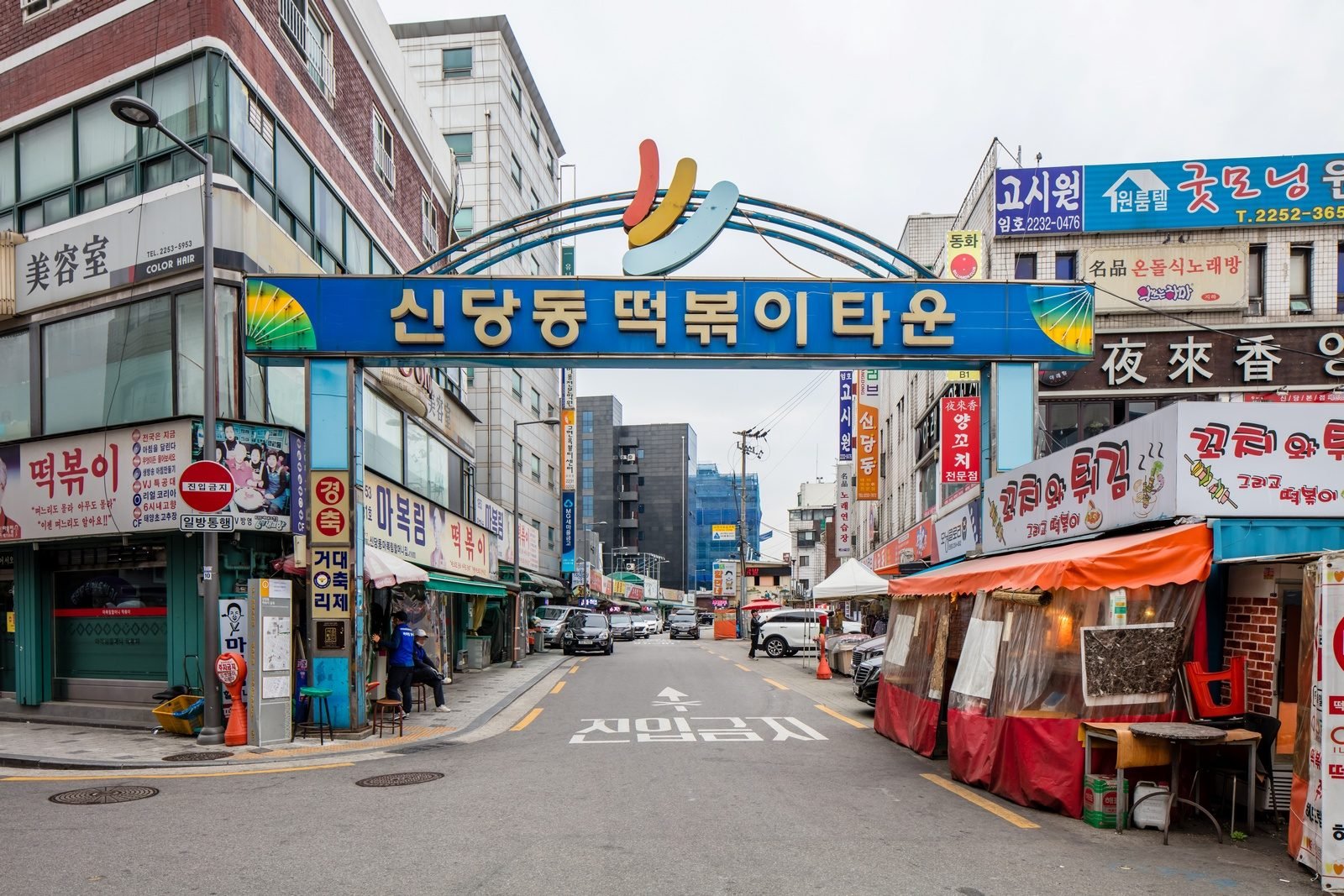

The format is the point. Rice cakes, noodles, fish cakes and vegetables arrive raw in a wide pan on a burner at your table, and you cook and stir them as the sauce thickens. The black bean base is the same fermented chunjang that anchors the black bean sauce behind jjajangmyeon. The 2016 report put the price at 6,000 won for one person, rising to 24,000 won for five, and said the stores were mostly open around the clock, taking turns each month to close at night; treat both as dated reference points, not a menu.
The same report describes how the street evolved. The owner of one store, I Love Sindangdong, said he added a DJ and live music about 16 years earlier to draw younger customers, and his seven shareholders had merged their smaller stores in 2005 to survive. Some shops serve other menus as well, such as pig’s feet or rice, and the sauce comes in variations from a soy and beef “royal court” style to one made with carbonara sauce. The folk encyclopedia dates the alley itself to the 1970s and says the DJ booths turned the shops into a student hangout.
The same entry explains why Sindang-dong tastes different from the older dish. Early tteokbokki was a soy-seasoned stir-fry of rice cake with beef and vegetables; from the 1950s it shifted toward flour rice cakes and fish cakes in a gochujang sauce, and it became the “national snack” from the 1970s onward. It also records the one screen link for the dish that a Korean-language source confirms: the soy-seasoned “royal court” version became better known as “Daejanggeum tteokbokki” after it appeared in the 2003 MBC drama Dae Jang Geum. That link is to the older royal-court dish, not to the Sindang-dong street.
The street has been changing for years. The 2016 report found that business had slowed since 2010 and that owners worried about redevelopment. The folk encyclopedia adds that the gochujang behind the modern dish first appears in print in the 1766 farming and household manual Jeungbo Sallim Gyeongje, but that the gochujang tteokbokki itself came much later, from Ma Bok-rim’s shop in Sindang-dong. No source checked here ties the street to a particular drama, so it earns its place for the food alone.
Where the screen food is a story, not a street
The best-known screen link in this guide points to a place you cannot simply visit. The Korea Herald reported in January 2020 that JTBC’s Itaewon Class would air its first episode on Friday, 31 January, adapted from a webcomic whose artist Cho Kwang-jin also wrote the script. The hero, Park Sae-ro-yi, is fascinated by Itaewon’s energy and opens a restaurant there called Danbam. The restaurant, in other words, is the plot. Itaewon is a real district worth a walk and a meal, but none of the sources checked here names a real restaurant tied to the show, so Danbam stays a story.
The plot explains why the credit does not translate into a table. The Herald summary has Park Sae-ro-yi losing his father in a tragic accident and setting out for revenge on the Jang Ga Group, a restaurant franchise giant, by building his own restaurant. A business that exists to carry a revenge story does not need a real address.
Screen food travels furthest when it is a snack, not an address. The candy challenge in Netflix’s Squid Game has its own page in the honeycomb candy from the Squid Game scene, and it is a better lesson in screen food than any map pin: you can make it anywhere.
Choosing a stop by meal and by timing
Use the table to choose by the kind of meal and the time you have, not by the credit. Hours and prices come from the sources above and can change, so confirm them on the day.
| Stop | What you eat | How you order | Timing |
|---|---|---|---|
| Gwangjang Market | Bindae-tteok, mayak gimbap, yukhoe at stalls | Point and say igeo juseyo | Food alley daily 09:00 to 23:00; market 09:00 to 18:00, closed Sundays |
| Ikseon-dong | Cafe or restaurant meal in a converted hanok | Sit-down, shop by shop | An alley of about 801 meters; hours are set by each shop |
| Sindang-dong Tteokbokki Town | Tteokbokki cooked at the table, then fried rice | One shared pan for the table | Mostly open around the clock in 2016, shops closing in turns at night |
| Itaewon | Restaurants and bars across a busy district | Venue by venue | No fixed stop; the story’s Danbam is fictional |
For a first meal in Seoul, Gwangjang gives the widest choice in the shortest walk. For one dish with a documented origin and a table you cook at, Sindang-dong is the stronger story. Ikseon-dong suits a slower, pricier sit-down, and Itaewon is best taken as a neighborhood, not a set.