The whisk hits the bowl for the fortieth time and nothing has changed. Same thin, dark, watery liquid it was two minutes ago. Then, somewhere around minute four, it turns. The color lightens from black to caramel to pale tan, the texture goes from liquid to mousse, and the whisk starts leaving trails that hold their shape instead of disappearing. That transformation, and the mild forearm ache that comes with it, is dalgona coffee.
This isn’t the honeycomb candy from Squid Game — different drink, different decade, same name by pure coincidence of color. More on that below, because it trips people up constantly.
Quick facts
Makes 1 drink. About 8 minutes of whisking, no cooking. Difficulty: easy, but it’s genuinely a workout if you’re doing it by hand. Caffeinated as written; use decaf instant coffee for a caffeine-free version, same method. Vegetarian, and vegan with a plant-based milk.
What dalgona coffee actually is
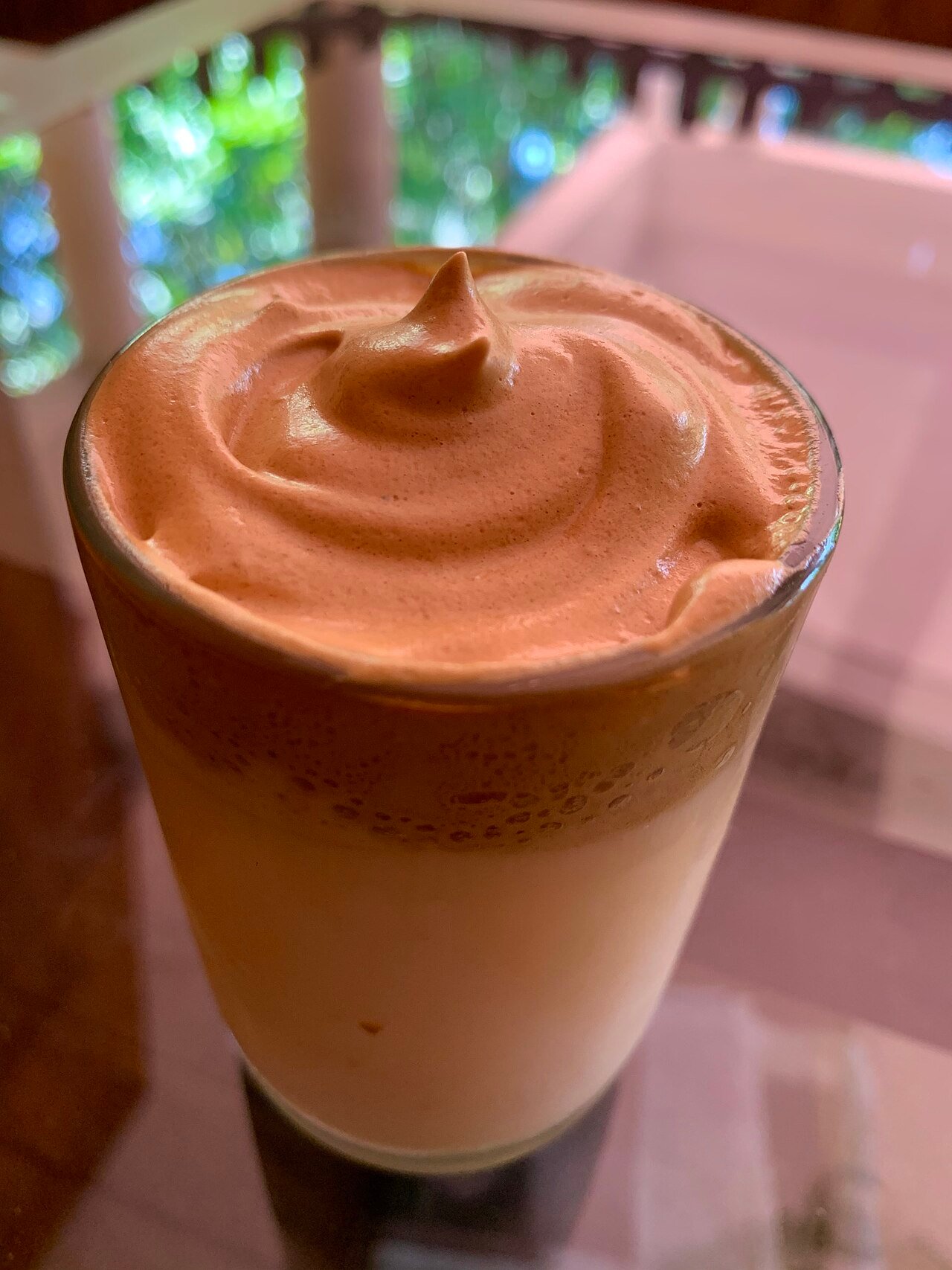
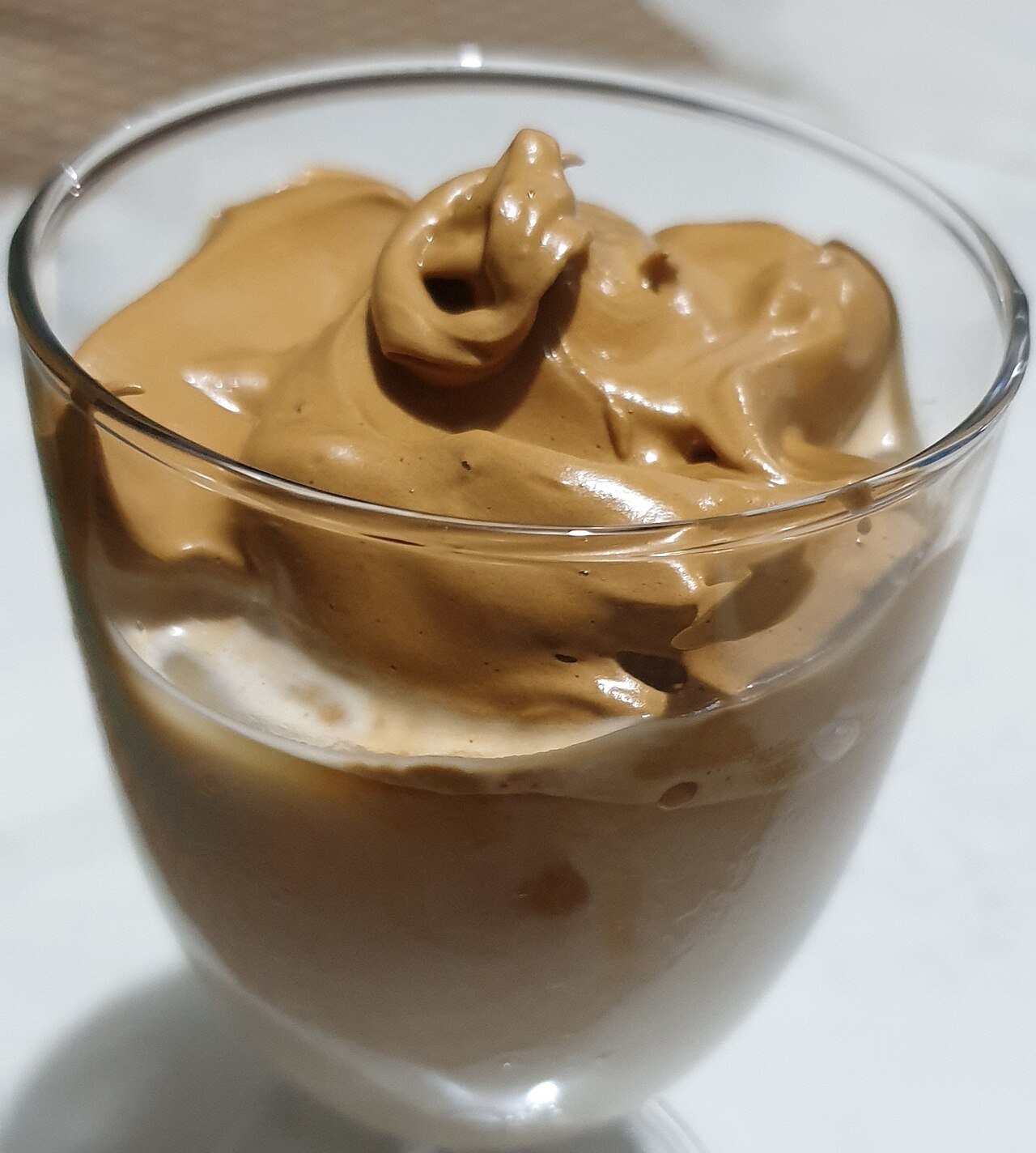
Dalgona coffee is equal parts instant coffee, sugar, and hot water, whipped together until it turns into a thick, pale, mousse-like foam, then spooned over cold milk. It isn’t brewed coffee with foam on top — the foam is the coffee, made stiff enough to hold its shape on a spoon, the same way whipped cream holds a peak.
The name comes from a 2020 Korean television appearance. Actor Jung Il-woo, describing the drink on a travel show, said the foam looked like dalgona, the honeycomb sugar candy sold at Korean school gates for decades — hence the name. The drink itself is older and came from further away: food historians trace it to a version served in Macau, created around 1997 by a former shipwright named Leong Kam Hon. It existed quietly in Asian cafes for over twenty years before that one television segment set off a global trend during COVID-19 lockdowns, when people stuck at home with nothing but instant coffee and free time turned whisking into a competitive sport on TikTok.
Why brewed coffee won’t do this
This is the part that trips people up the most. Brewed coffee, drip coffee, and espresso all lack something instant coffee has: freeze-dried or spray-dried solids that dissolve and re-form structure when you introduce air into them by whisking. It’s structurally closer to whipping egg whites than to frothing milk — you’re trapping air inside a network of dissolved solids, and instant coffee happens to have the right kind of solids for that network to hold. Brewed coffee just doesn’t have enough dissolved solid material in it, so no matter how long you whisk it, it stays a thin liquid.
If a recipe promises this works with your favorite pour-over blend, it doesn’t. Buy a small jar of instant coffee — even a cheap one — just for this.
Ingredients, and what to use instead
| Ingredient (for 1 drink) | Where to get it, or what to use instead |
|---|---|
| Instant coffee, 2 tbsp | Any supermarket, any brand. Instant espresso powder works too and gives a slightly deeper flavor |
| Granulated white sugar, 2 tbsp | Standard. See the FAQ below before swapping this for honey or syrup — it changes the chemistry, not just the taste |
| Hot water, 2 tbsp | Just off the boil. Lukewarm water takes much longer to whip and sometimes never fully stiffens |
| Milk, 1 to 1.5 cups | Any kind. Oat, soy, and almond milk all hold up the foam layer just as well as dairy |
| Ice | Standard |
Three ingredients, all pantry staples, and the ratio is always 1:1:1 by volume — that part never changes no matter how much or little you’re making.
Dalgona Coffee Recipe
Ingredients
Method
- Add the instant coffee, sugar, and hot water to a bowl in equal parts.
- Whisk hard, by hand or with an electric mixer, until the mixture turns pale tan and holds soft peaks — about 2 minutes with a mixer, 8 to 10 minutes by hand.
- Fill a glass with ice, then pour in the milk, leaving room at the top.
- Spoon the whipped coffee on top so it sits as a distinct layer rather than sinking in.
- Stir together right before drinking. It separates fast, so serve it as soon as it’s made.
How to make it
- Measure the instant coffee, sugar, and hot water into a bowl in equal parts — 2 tablespoons of each makes one drink.
- Whisk hard. An electric hand mixer gets you there in about 2 minutes; a manual whisk or even a fork takes 8 to 10 minutes of steady effort. Either way works — the electric version is just far less tiring.
- Watch the color and texture, not the clock. The mixture goes from dark and watery to lighter tan, then thick and glossy, and finally to a stiff foam that holds a peak when you lift the whisk out. That’s when it’s done.
- Fill a glass with ice and pour in the milk, leaving room at the top for the foam.
- Spoon the whipped coffee over the milk so it sits as its own layer rather than dissolving straight in.
- Stir just before drinking, and drink it soon after making it — the foam is stable for maybe 20 minutes before it starts to weep and separate.
Where it goes wrong
Under-whisking is the most common failure. If you stop at the “thick and glossy” stage instead of pushing to full stiff peaks, the foam sinks into the milk instead of floating, and you end up with a slightly frothy iced coffee rather than the two-layer drink people expect.
The second failure is patience, or the lack of it. By hand, this genuinely takes the better part of ten minutes of continuous whisking. People give up around minute three, decide it isn’t working, and either add more water (which makes it worse) or declare the recipe broken. It isn’t — it just needs more arm.
Store leftover whipped coffee, if you somehow have any, in the fridge in a sealed container for up to a day. It’ll lose some volume but re-whisks reasonably well.
Frequently asked questions
Can I use decaf coffee?
Yes. Decaf instant coffee has the same dissolved solids that make the whipping work, so the method and texture are identical — you just lose the caffeine.
Can I reduce the sugar?
Not by much. The sugar isn’t only there for sweetness; it’s part of what stabilizes the foam structure as you whip in air. Cut it by more than a quarter and the foam often won’t hold stiff peaks at all, no matter how long you whisk. If you want it less sweet, add less of the finished foam to your milk rather than reducing sugar in the base.
Is dalgona coffee the same thing as dalgona, the Squid Game candy?
No, and this is the single most common confusion around this recipe. Dalgona from Squid Game is a hard, brittle sugar-and-baking-soda candy pressed with a stamped shape, sold at Korean street stalls for decades. Dalgona coffee is a whipped instant-coffee drink that only got its name because the foam happens to be the same honeycomb color as the candy. Different ingredients, different technique, different era — they just share a name and a color.
What to make next
If the name mix-up brought you here from the candy side, our Squid Game dalgona recipe is the one with the needle game, not the coffee. For another Korean sweet that’s just as quick to make at home, hotteok, the syrup-filled street pancake, is a good next stop. And if you’re just getting into Korean pantry staples beyond instant coffee, our Korean pantry starter kit covers what’s worth buying first.