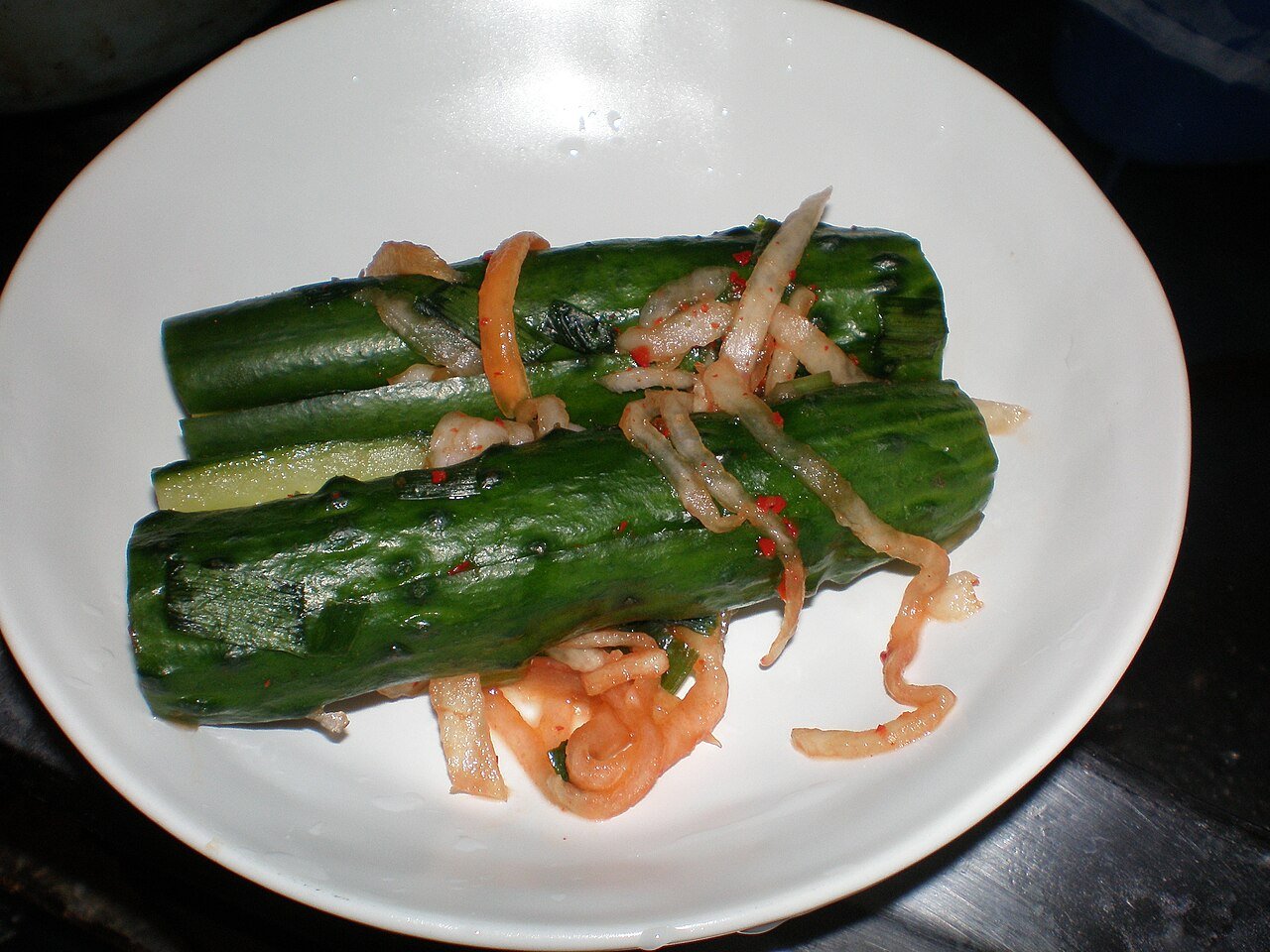
By late June, the cucumber tables at Korean markets change character. The knobby, thin-skinned kind — shorter than an English cucumber, with a faint ridged texture — stack up in crates that turn over fast, and the vendors know exactly why people are buying them. Nobody’s making napa cabbage kimchi in this heat. Cabbage wilts, ferments too fast, and turns sour and unpleasant within days when the temperature won’t drop below 28°C overnight. Cucumbers, on the other hand, are basically made for the season — and stuffed with the same chili paste that seasons every other kimchi on the table, they become oi sobagi.
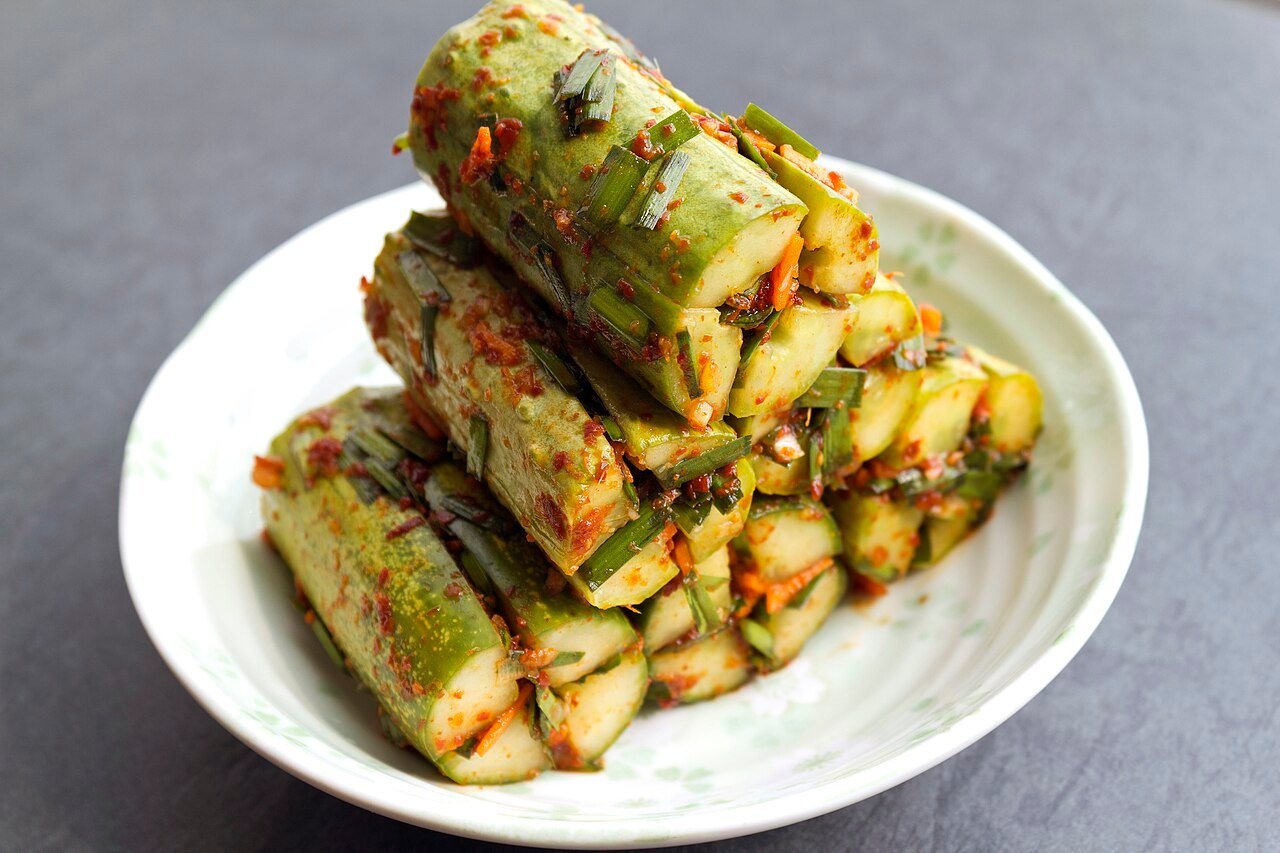
Oi sobagi (오이소박이) means, roughly, “cucumber with something tucked inside,” and that’s the entire method: cucumbers slit into quarters that stay joined at the base, packed with a quick chili-and-vegetable filling, and left to sour for a matter of hours rather than weeks. It disappears from Korean tables the moment the weather turns, and shows back up reliably every spring. This isn’t a kimchi you keep in rotation year-round; it’s a kimchi with a season.
Quick facts
- Total time: about 45 minutes active and waiting, ready to eat the same day
- Makes: 6 stuffed cucumbers, serving 4 as a side
- Difficulty: easy
- Spice level: 2 out of 5
- Vegan-friendly: yes, with the fish sauce swapped, noted below
Why this one doesn’t keep like other kimchi
Napa cabbage and radish both hold their structure through weeks of fermentation because they’re dense, low-water vegetables to begin with. Cucumber is mostly water, and once it starts fermenting, that water works against it — the flesh softens fast, and what was crisp on day two turns limp and a little slimy by day ten. Korean households treat oi sobagi as a short-run dish by design: made in small batches, meant to be finished within a week, never packed away for the long ferment that baechu kimchi or kkakdugi get.
That’s also why the salting step here is shorter and gentler than in most kimchi. Twenty minutes is enough to soften the cucumber and pull out some water without collapsing it completely — oi sobagi is meant to still have bite.
Ingredients, and what to use instead
| Ingredient (for 6 cucumbers) | Where to get it, or what to use instead |
|---|---|
| Kirby or Persian cucumbers, 6 | Korean grocers, farmers markets, or a well-stocked supermarket in summer. English cucumber works if quartered lengthwise with the seeds scraped out first — it holds much more water, so drain it well and press before stuffing |
| Gochugaru, 3 tbsp | Sold online everywhere. Substitute: 2 tbsp sweet paprika plus 1/2 tsp cayenne, close on heat and color but flatter on flavor |
| Fish sauce, 2 tbsp | Any Thai or Vietnamese brand. Vegan swap: 4 tsp soy sauce plus 1/2 tsp sugar |
| Garlic chives (buchu), 1/2 cup | Korean or Chinese grocer. Regular chives or scallion tops work, just milder |
| Carrot, garlic, ginger, scallions, sugar | Any supermarket |
Oi Sobagi Recipe
Ingredients
Method
- Trim the ends off each cucumber. Standing each one on end, cut two deep slits in a cross pattern from one end, stopping about 2 cm / 3/4 in before the bottom so the four quarters stay attached.
- Rub 3 tbsp salt over and into the cut cucumbers. Let them sit 20 to 25 minutes, turning once, until they’ve softened slightly and released visible liquid.
- Rinse the cucumbers briefly under cold water and stand them upright in a colander to drain for 10 minutes.
- Stir together the gochugaru, fish sauce, sugar, garlic, and ginger in a bowl to make a thick paste.
- Fold in the scallions, garlic chives, and carrot.
- Holding each cucumber over the bowl of filling, gently pack the paste into all four slits until it’s visibly stuffed inside, not just smeared on the surface.
- Arrange the stuffed cucumbers snugly in a container, any leftover filling spooned over the top.
- Leave at room temperature for 3 to 6 hours, then refrigerate. It’s ready to eat the same day and best within the first week.
How to make it
- Trim the cucumber ends. Cut two deep slits in a cross pattern from one end of each cucumber, stopping short of the bottom so it holds together in four connected quarters.
- Rub salt over and inside the cuts. Let the cucumbers sit 20 to 25 minutes, turning once, until they’ve softened slightly and released liquid.
- Rinse briefly and stand upright in a colander to drain for 10 minutes.
- Mix the gochugaru, fish sauce, sugar, garlic, and ginger into a paste, then fold in the scallions, garlic chives, and carrot.
- Pack the filling into all four slits of each cucumber, working it in rather than just smearing the surface.
- Arrange the stuffed cucumbers snugly in a container and spoon any extra filling over the top.
- Leave at room temperature 3 to 6 hours, then refrigerate.
Where this goes wrong
Under-salting is the most common failure, and it comes from treating oi sobagi like a delicate dish that needs a gentle touch. Skip the salting step or cut it too short, and the cucumber stays too firm to hold the filling well, releasing water into the paste later instead of before — the finished dish turns watery within a day or two.
Over-stuffing without pressing filling into the cuts is the other one. If the paste just sits on the outside instead of being worked into the slits, it slides off in the container and you end up with bare cucumber and a puddle of red paste at the bottom, rather than kimchi that’s seasoned all the way through.
Storage
This is the one kimchi on this site meant to be eaten quickly rather than aged. It’s good from the first afternoon and stays genuinely crisp for about 3 to 4 days in the fridge. By day five or six it starts to soften noticeably, and by day ten the texture has usually gone past what most people enjoy. Make a smaller batch more often, rather than a big one you’re hoping will last.
What to serve it with
Oi sobagi is a side dish in the truest sense — it isn’t built to be a meal’s centerpiece, and it works best paired with something that benefits from a cold, crunchy, faintly acidic contrast. Grilled meat straight off a hot pan is the classic pairing, since the cucumber cuts through fat in the same way pickles do at a barbecue anywhere else in the world. It’s also good next to plain white rice and almost nothing else, which is how a lot of Korean households actually eat it on a hot evening when cooking anything more involved feels like too much. Because it’s ready the same day, it works as a same-afternoon addition to a summer meal in a way that most other kimchi, needing days or weeks, simply can’t.
Frequently asked questions
Can I make oi sobagi with regular English cucumbers?
Yes, though the texture is a little different. Quarter the cucumber lengthwise and scrape out the watery seed core with a spoon before salting, since English cucumbers hold far more water than the smaller Korean varieties.
Why did my oi sobagi turn watery so fast?
Under-salting is the usual cause. If the cucumbers didn’t release visible liquid during the salting step, they weren’t ready to be stuffed, and they’ll keep releasing that water into the filling in the fridge instead.
How long does oi sobagi actually last?
About a week at most, and it’s best in the first four days. Unlike napa or radish kimchi, this isn’t a dish that improves with age — the cucumber’s texture only goes one direction.
The rest of the kimchi shelf
Oi sobagi is a summer specialty within a much bigger family. For the everyday, year-round kimchi this whole category is built around, baechu kimchi covers the full traditional method, and easy mak kimchi is the fast version for a weeknight. When the weather turns cold and cucumbers stop being the obvious choice, kkakdugi, cubed radish kimchi, takes over as the crunchy side dish of choice, especially next to soup.