Say kimchi and most people picture napa cabbage in a red paste. In a Seoul seolleongtang house, though, the cold, red, squared-off kimchi on the table is kkakdugi (깍두기, roughly kkak-doo-gi), and it is made from radish. So why does a bowl of cloudy beef-bone soup arrive with cubes instead of leaves?
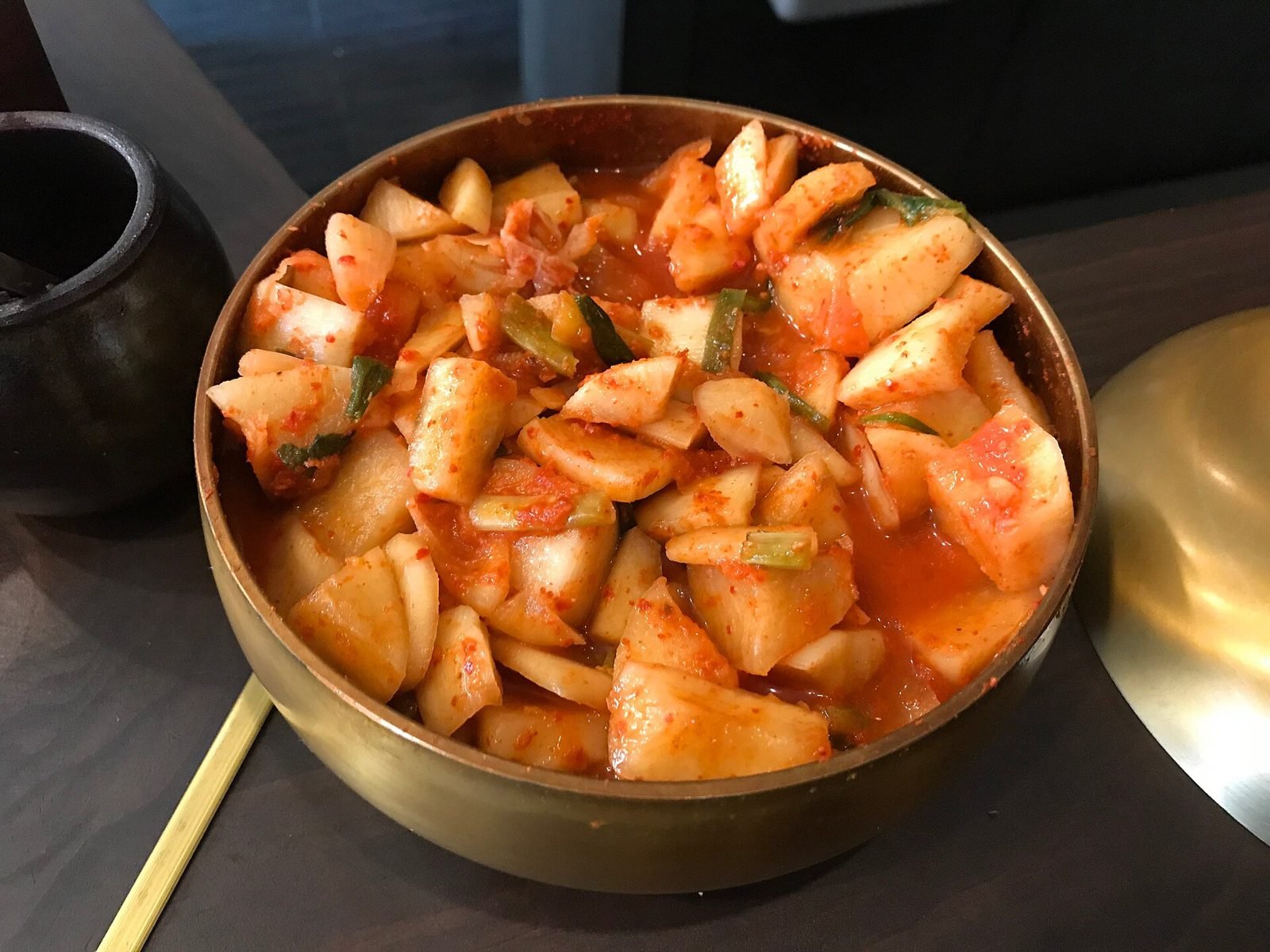

How a side dish settled into the soup house
The National Folk Museum’s encyclopedia entry on kkakdugi gives a plain, economic answer. Radish kimchi is far easier than the cabbage kind, needing fewer ingredients and less labour, so it could be made whenever the jar ran low. A big cut of radish also suits a broth. Those two facts made kkakdugi the standard side dish of the seolleongtang restaurants that led Seoul’s eating-out culture in the early twentieth century, and the entry adds that most Koreans still name kkakdugi as the kimchi that goes with soups and stews.
The soup itself explains the rest. According to the encyclopedia’s seolleongtang entry, the bowl is served unseasoned, and each diner adds salt, pepper and chopped scallion to taste. Kkakdugi or another kimchi comes alongside, and some people pour a little of the kkakdugi brine into the soup to season it. Seolleongtang also carries more bone than gomtang, which is why its broth is so milky. A cold, sour, crunchy cube is the opposite of that bowl in every respect, a contrast that is easy to taste. One practical consequence is that a jar in the fridge needs no timing to be ready whenever the pot is. The same logic invites a cube beside other clear or hearty broths, such as a pot of galbitang or hand-torn sujebi.
A cube with a legend attached
The name appears in writing earlier than most people expect. The folk entry places its first appearance in an eighteenth-century pansori text, in a line about a meagre meal, spelled a little differently from today. The same entry traces radish pickled with seasoned shrimp sauce to an eighteenth-century book, and shows that the late-nineteenth-century cookbook Siuijeonseo gives a method for “jeotmu”, radish dressed with shrimp, chili, scallion and garlic, in which cucumber pickle and cabbage hearts also appear as extras. The Encyclopedia of Korean Culture adds that a 1913 cookbook already lists kkakdugi alongside cucumber, oyster, boiled and chicken variants.
Then there is the legend. A cookbook from 1940, Hong Seon-pyo’s Joseon yorihak, says the dish was first made for the king in the reign of Jeongjo by a woman of the royal household, under the name gakdokgi, and that a retired minister who settled in Gongju carried it to ordinary kitchens, which is how “Gongju kkakdugi” got its name. A story set down in 1940 about the late eighteenth century is folklore rather than court record, and the dated sources above are the safer footing. It does show how old the dish is felt to be.
The folk entry also complicates the idea that kkakdugi was always radish alone. Into the early twentieth century, cookbooks often mixed cabbage into it, and one family recipe handed down in Daejeon still keeps cabbage and radish at about half and half. Because cabbage cost much more than radish, the mixed version was probably a dish of better-off households. The pieces were also larger then. Today the cubes run from about 2.5 cm to 4.5 cm, a finger joint to two, while early recipes asked for the chunkiest cut possible.
Radish, chili and shrimp, counted out
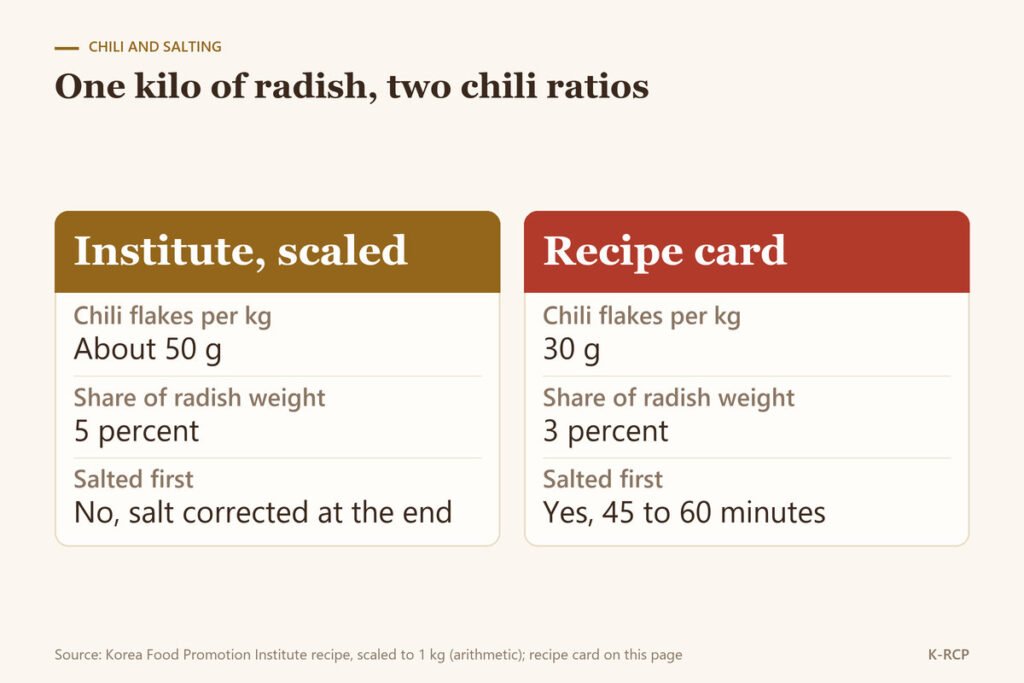
The Korea Food Promotion Institute’s kkakdugi recipe is written for a large batch: three radishes weighing 6 kg, cut into 2.5 cm dice, with 180 g of thin scallions. The seasoning is 100 g of minced garlic, 30 g of ginger, 300 g of gochugaru, 60 g of chopped salted shrimp, and a spoonful each of sugar and salt. Scaled to the 1 kg of radish on the card below, that comes to roughly 50 g of chili, 17 g of garlic, 10 g of shrimp and 5 g of ginger. Those are simple arithmetic conversions, not figures the Institute publishes.
The card here is milder. It calls for 1/3 cup, about 30 g, of gochugaru for 1 kg of radish, which is roughly 3 percent of the radish by weight against the Institute’s 5 percent. It also salts the cubes first, for 45 to 60 minutes, while the Institute’s short recipe goes straight to the chili and corrects the salt at the end. The folk encyclopedia’s definition describes salting the radish before dressing it, so the card follows the classic order. Pick the card for a gentle jar to serve beside soup, and the Institute’s ratio when you want more heat.
The Institute’s own note lists the usual choices of fermented seafood: salted shrimp, anchovy sauce or sand lance sauce. Oysters, it says, give a cool, deep savour but make the kimchi ripen faster. Korean radish (mu) is sold at Korean and pan-Asian grocers, and daikon is the common stand-in elsewhere. Whichever radish you use, judge the salting by the look of the cubes, with faintly translucent edges and a pool of liquid underneath, and not by the clock. Without shrimp, add an extra teaspoon of fish sauce.
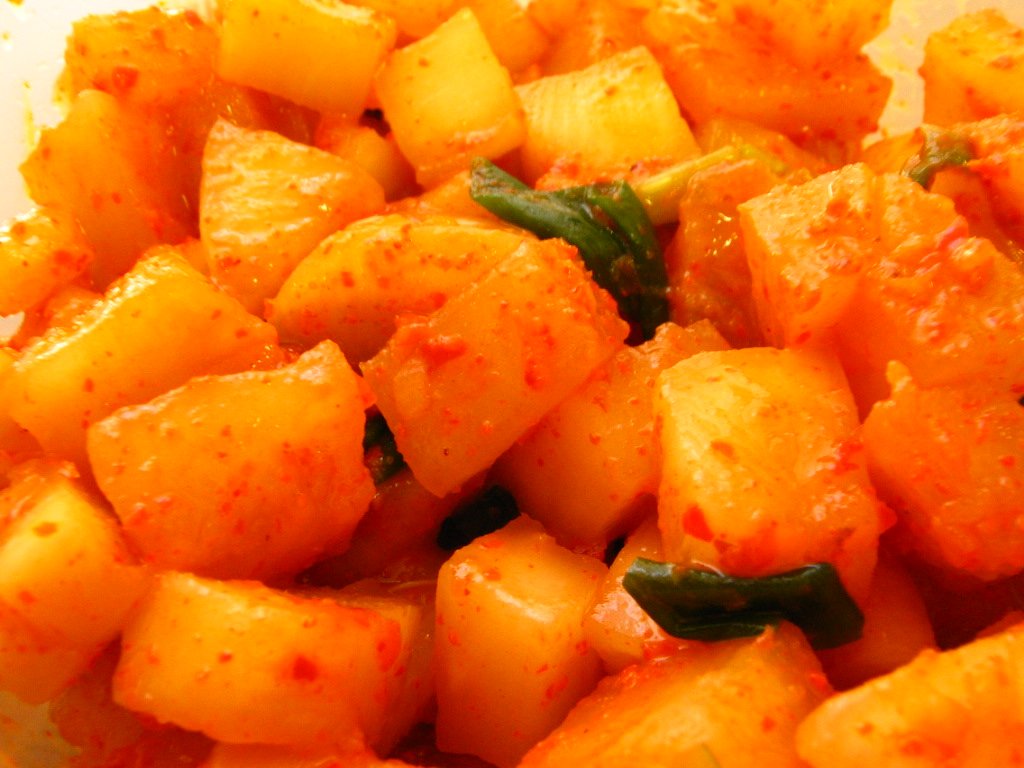
Kkakdugi Recipe
Ingredients
Method
- Peel the radish and cut it into even 2 cm / 3/4 in cubes. Even cubes matter here more than in most kimchi — uneven pieces salt and ferment at different rates.
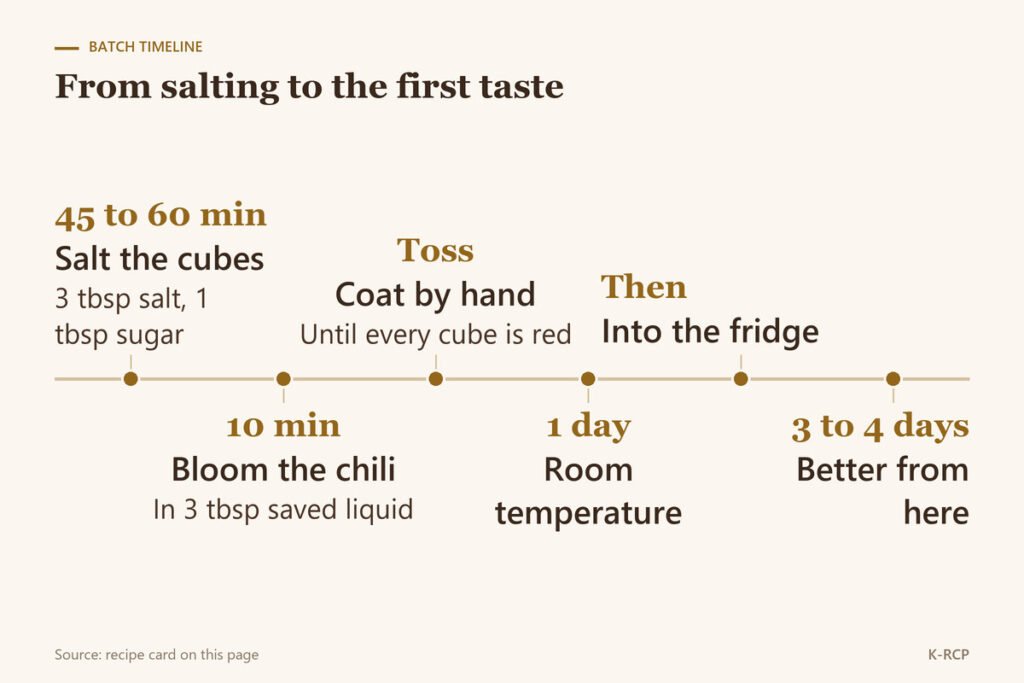
- Toss the cubes with 3 tbsp salt and 1 tbsp sugar in a large bowl. Let them sit 45 to 60 minutes, tossing once halfway, until the edges look slightly translucent and a pool of liquid has collected at the bottom.
- Drain the radish in a colander set over a bowl, and keep that drained liquid. Do not rinse the cubes and do not discard the liquid — both go back in later.
- Whisk the gochugaru into 3 tbsp of the reserved radish liquid and let it sit 10 minutes to bloom into a deep red paste.
- Stir the fish sauce, salted shrimp, garlic, ginger, and the second tsp of sugar into the bloomed gochugaru paste.
- Add the drained radish cubes and scallions to the paste. Toss by hand, gloved if you’d rather not smell like chili, until every cube is coated red.
- Pack the kimchi into a clean container, pressing down so the liquid it releases rises close to the top of the solids.
- Leave it at room temperature for 1 day, then move it to the refrigerator. It’s edible right away, but better after 3 to 4 days.
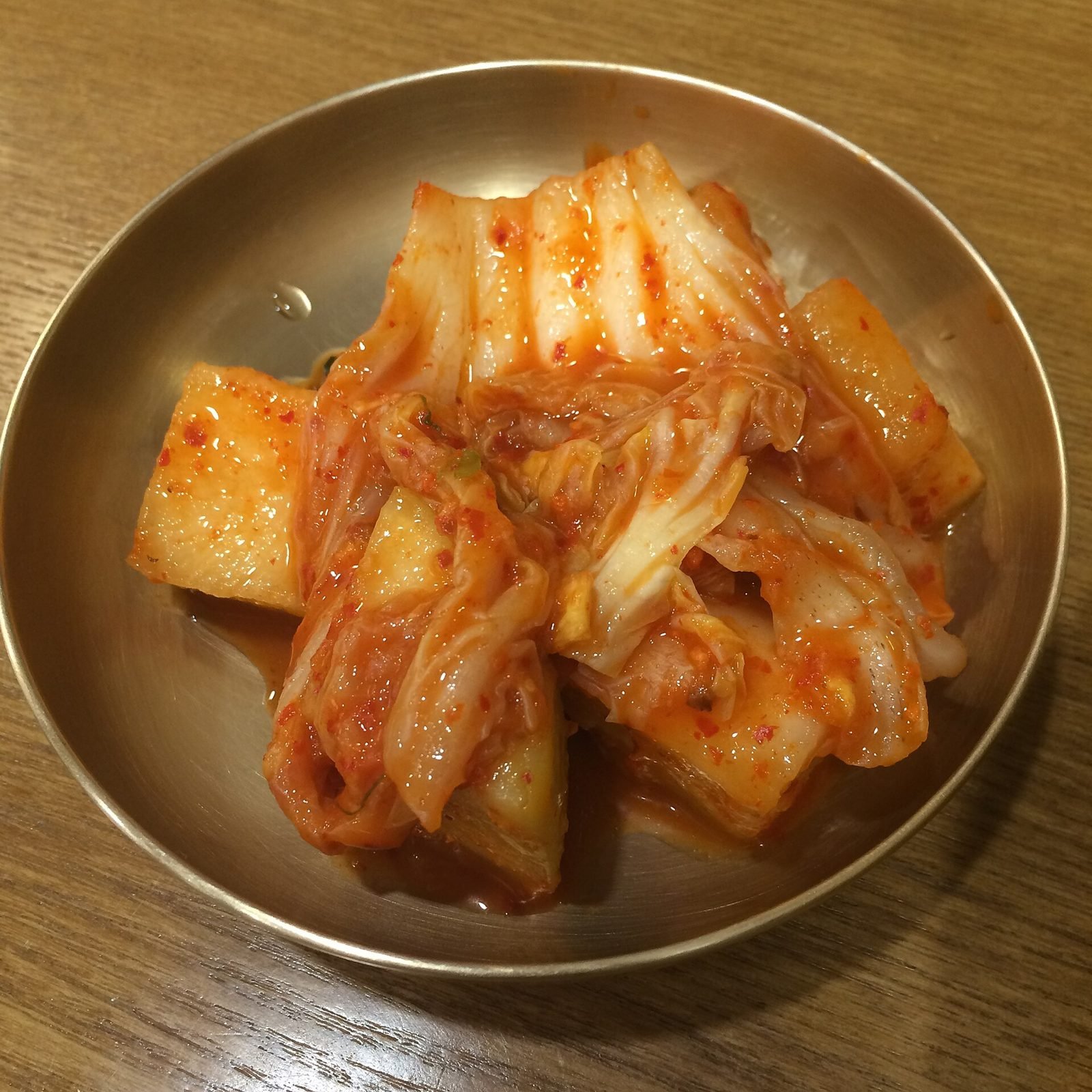
Recipe card photo: Korean.food-kkakdugi-01.jpg by milkchug, CC BY 2.0, via Wikimedia Commons.

Salting, the saved liquid and the first day
Keep the brine, skip the rinse
Cut the radish into even 2 cm cubes first. Uneven pieces salt and ferment at different speeds, and that matters more here than in most kimchi. Toss them with 3 tablespoons of salt and 1 tablespoon of sugar, leave them 45 to 60 minutes, and toss once halfway. When the edges look faintly translucent and a pool of liquid has formed underneath, drain the cubes over a bowl and keep what drips out. That liquid is already seasoned and carries the radish’s own sugar, so blooming the gochugaru in 3 tablespoons of it for ten minutes gives a rounder paste than plain water. Do not rinse the cubes, because the salt that clings to them is part of the final seasoning.
Stir the fish sauce, shrimp, garlic, ginger and a little sugar into the paste, add the radish and scallions, and toss by hand until every cube is red. Pack the mixture into a clean container and press down so the liquid it releases rises close to the top. The card then leaves it out for one day before it goes into the refrigerator, which matches the Institute’s instruction to hold the jar at about 20 degrees C for roughly a day, until a ripe smell appears, and then move it to the fridge.
Three habits that spoil a batch
Cutting the salting short leaves the radish wet, which dilutes the paste and turns the cubes soft in the fridge. Rinsing them, a habit carried over from salted cabbage, leaves the batch short of both salt and flavour. Uneven cubes ripen at different speeds, so one jar holds both raw and sour pieces. If a batch comes out watery, look upstream at the salting, not at the paste.
Young crunch or a sour jar
The card calls the kimchi edible at once and better after three or four days in the fridge. The Institute draws the line a little earlier, at the first ripe smell after about a day at room temperature. These instructions differ because fermentation speed depends on the temperature of the kitchen and on how sour you like the cubes. Taste a cube each morning instead of following the clock, and when it reaches the point you like, keep the jar cold. To settle the argument between young and sour, split one batch between two containers and open the second a week or so later, so a single cooking session gives you both the crisp cube and the sharper one.
The folk entry lists the family that grew out of this one dish. Oyster, salted-shrimp and salted-pollock-tripe kkakdugi change with the fermented seafood used, and a version made with the coarse local radish of Yeoju, in Gyeonggi Province, is well known. The royal court served a dainty, thinly diced form called songsongi, so that nobody had to open their mouth wide. In Hamgyeong Province the radish was too firm to cut into cubes, so it was sliced lengthwise into strips, and the result still went by the name kkakdugi. The word has even escaped the kitchen: in children’s games, a player who can join either team is called a kkakdugi.

Kkakdugi, napa kimchi and dongchimi: where each fits
If you already know one kimchi, this table shows where kkakdugi sits among the others. The dongchimi column draws on the folk encyclopedia’s dongchimi entry, which describes a whole or large-cut radish salted briefly and then covered in a mild brine, eaten mainly as a winter water kimchi.
| Kkakdugi | Napa cabbage kimchi | Dongchimi | |
|---|---|---|---|
| Main vegetable | Radish in cubes of roughly 2 to 4.5 cm | Napa cabbage | Whole or large-cut radish |
| How it is made | Radish salted, then mixed with chili, scallion, garlic, ginger and salted shrimp | More ingredients and steps; in the early 1900s the cabbage cost much more than radish | Salted briefly, then covered with a mild brine and left to ripen |
| Where it shows up | The standard side in Seoul soup houses | The general-purpose kimchi | A cold winter kimchi eaten in its liquid |