The train from Seoul to Chuncheon takes about an hour, runs along a river most of the way, and empties out into a small city that would be a fairly quiet regional stop if it weren’t for one very specific reason people make the trip: a street of restaurants doing the same dish, all clustered within a few blocks of each other, that a lot of Koreans will tell you is worth an hour on the ITX just by itself.
I’m not going to point you to one restaurant on that street and call it the best, because that’s a game with no honest winner — the alley has dozens of shops, ownership changes, favorites shift by generation and neighborhood loyalty, and anyone claiming to have found “the one” is usually just describing the place they went first. What I can do is explain how the street works, what you’re ordering, and how to tell a solid shop from a mediocre one once you’re standing in front of a menu.
What dakgalbi actually is, and why Chuncheon specifically
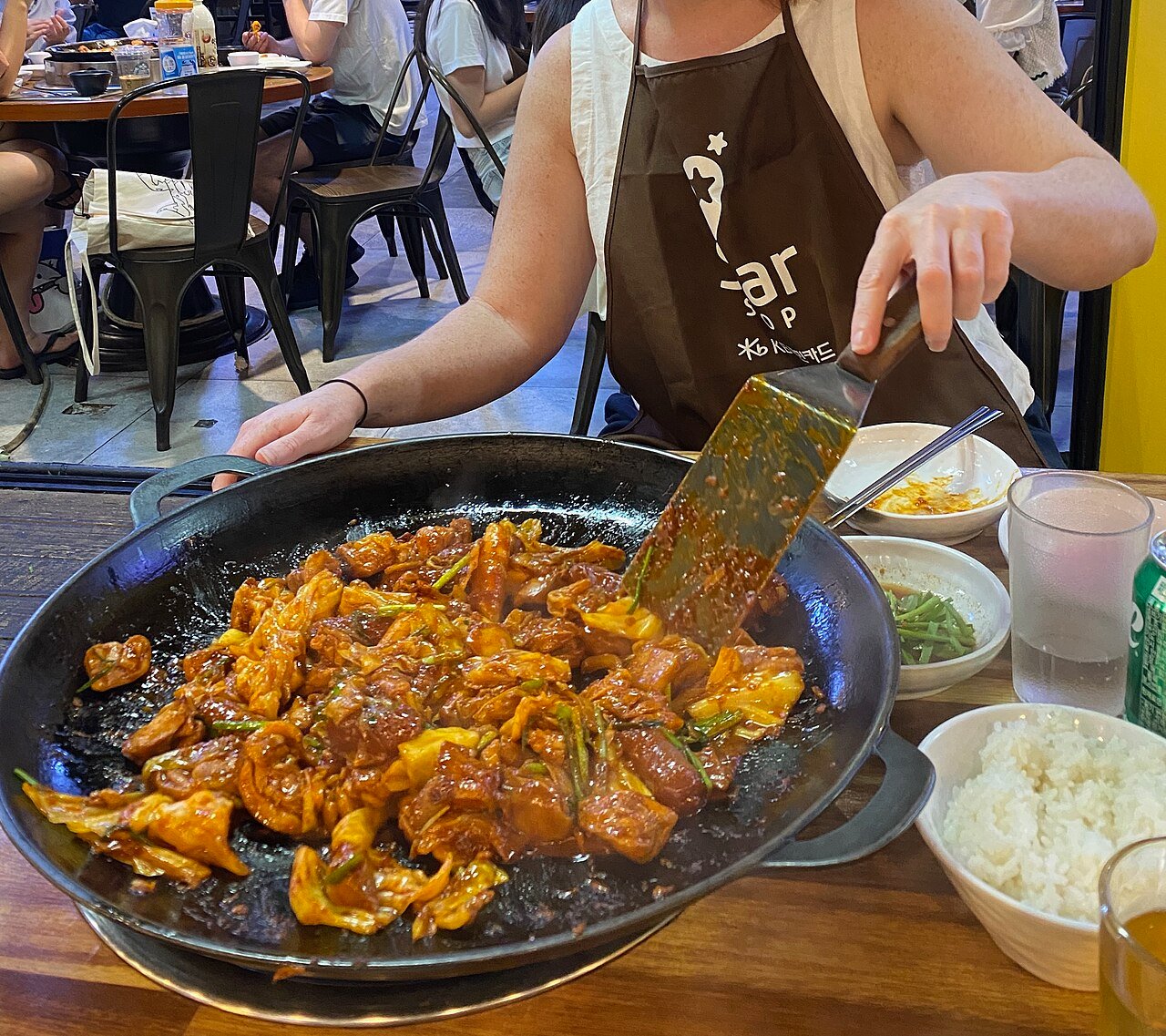
Dak-galbi (닭갈비) is boneless chicken thigh, heavily marinated in a gochujang-based sauce, stir-fried at the table with cabbage, sweet potato, rice cake and perilla leaves on a large flat pan set over a built-in burner. It’s cheap, filling, and shareable — traditionally a dish for students and workers rather than a special-occasion meal, which is part of why it took off in a university town.
The Chuncheon connection dates back to the dish’s origins in the city in the mid-20th century, when cheap cuts of chicken were stretched with vegetables and a spicy marinade to feed people on a tight budget. The alley — centered around Myeongdong-gil in downtown Chuncheon, not to be confused with the much larger Myeongdong shopping district in Seoul — grew up around that history, and it’s still where the highest concentration of dakgalbi restaurants in the country operates within walking distance of each other.
How the alley itself works
This isn’t one restaurant or even one clearly superior handful — it’s a genuine cluster, block after block of dakgalbi shops with red signs, sizzling pans visible through the windows, and staff calling out to passersby during peak hours. Most are family-run, several going back decades, and a lot of them look near-identical from the street: plastic stools, laminated menus, a stack of gas burners built into every table.
Given that sameness, judging by name alone is close to useless unless you’ve done specific research beforehand. What actually separates a good shop from a mediocre one, standing on the street, comes down to a few visible things: a genuinely full pan of vegetables rather than one padded mostly with cabbage and little chicken, a marinade color that’s deep red rather than pale orange (a sign of a thinner sauce), and — the most reliable tell — whether the place is busy with actual locals at an odd hour, like 2pm on a weekday, rather than only ever full at obvious meal times when tour groups pass through.
How to order once you’re seated
Dakgalbi is sold per portion, and most restaurants have a minimum order of two portions even for a solo diner — this is a stir-fry meant to fill a hot pan, and one portion alone doesn’t generate enough volume to cook properly. If you’re traveling alone, plan on eating more than you’d expect, or ask if a smaller solo portion is available; some shops accommodate this and many don’t.
Standard add-ons worth asking for if they’re not already included: extra rice cake (tteok) for more chew, cheese sprinkled over the finished stir-fry for a richer, milder version that’s become popular with younger diners, and extra perilla leaves, which cut through the spice more than people expect for something that looks like a garnish.
The defining move, and the one first-timers most often miss entirely, comes at the end. Once the chicken and vegetables are mostly gone, you ask for bokkeumbap — rice fried right in the same pan with the remaining sauce, sometimes with a sheet of gim (dried seaweed) crumbled over the top and a fried egg. Skipping this is the single biggest missed opportunity of a dakgalbi meal; the pan at that point is carrying more concentrated flavor than at any earlier stage, and the rice soaks all of it up.
A number of shops on the street also serve makguksu, Chuncheon’s regional cold buckwheat noodle dish, either as a starter or a cooling finish alongside the rice. If chewy cold noodles sound appealing after a spicy stir-fry, it’s worth asking whether the restaurant offers it — not every shop does, and it’s usually a side order rather than the main event. If it’s not on the menu, our naengmyeon recipe covers the closely related cold buckwheat noodle dish you’ll find in most other regions instead.
Getting there from Seoul
The ITX-Cheongchun train runs from Yongsan or Cheongnyangni Station to Chuncheon Station in roughly an hour, with frequent departures throughout the day — no reservation required for most trains, though buying ahead during peak weekend hours avoids standing the whole ride. From Chuncheon Station, the dakgalbi alley is a fifteen to twenty minute walk, or a short taxi ride if you’d rather not deal with the hill sections on foot.
Most people treat this as a day trip from Seoul rather than an overnight stay, and that’s a reasonable way to do it — eat, walk around Chuncheon’s lakeside a bit if there’s time, and catch a train back in the evening. Budget roughly ₩12,000 to ₩16,000 ($9 to $12) per portion of dakgalbi, with the minimum two-portion order meaning a solo diner should expect to spend closer to ₩25,000 to ₩30,000 all in, drinks included.
Questions people ask
Is there one specific restaurant everyone recommends?
Not really, and treat any list claiming there’s a single definitive shop with some skepticism — the alley works as a cluster, ownership and quality shift over time, and locals tend to have their own long-standing favorite rather than agreeing on one best option. Walking the street and picking a busy, full-panned shop serves you better than chasing a specific name.
Can I get dakgalbi outside Chuncheon?
Yes — it’s sold all over Korea and it’s a straightforward dish to make at home, which is what our dakgalbi recipe walks through. The Chuncheon version isn’t secretly different in ingredients so much as it is in density of competition and, for a lot of Koreans, the nostalgia of the specific place.
How spicy is Chuncheon dakgalbi compared to what I’ve had elsewhere?
It runs a similar heat level to dakgalbi anywhere else — a solid medium by Korean standards, roughly comparable to a mild-to-moderate curry for most non-Korean palates — though individual restaurants vary the gochujang ratio, and some on the street will adjust the spice level on request, particularly for larger orders.
Planning the rest of the day
If Chuncheon is going to be a stop on a longer trip rather than a single day out, our Korean BBQ restaurant guide covers the etiquette and ordering system for grilled meat in case your itinerary includes both styles of tabletop cooking back to back — they work differently enough that it helps to know which rules apply where.