At a table of four, ask for three portions of pork belly to start and plan to order again when the grill thins out.
The mistake to avoid is the opposite one: a big first order of several cuts that crowds the grill, so some of it sits raw while the rest overcooks, and nobody can tell when to flip what. Everything after the order, from the price of a portion to the wrap and the bowl that closes the table, follows the same habit of small rounds.
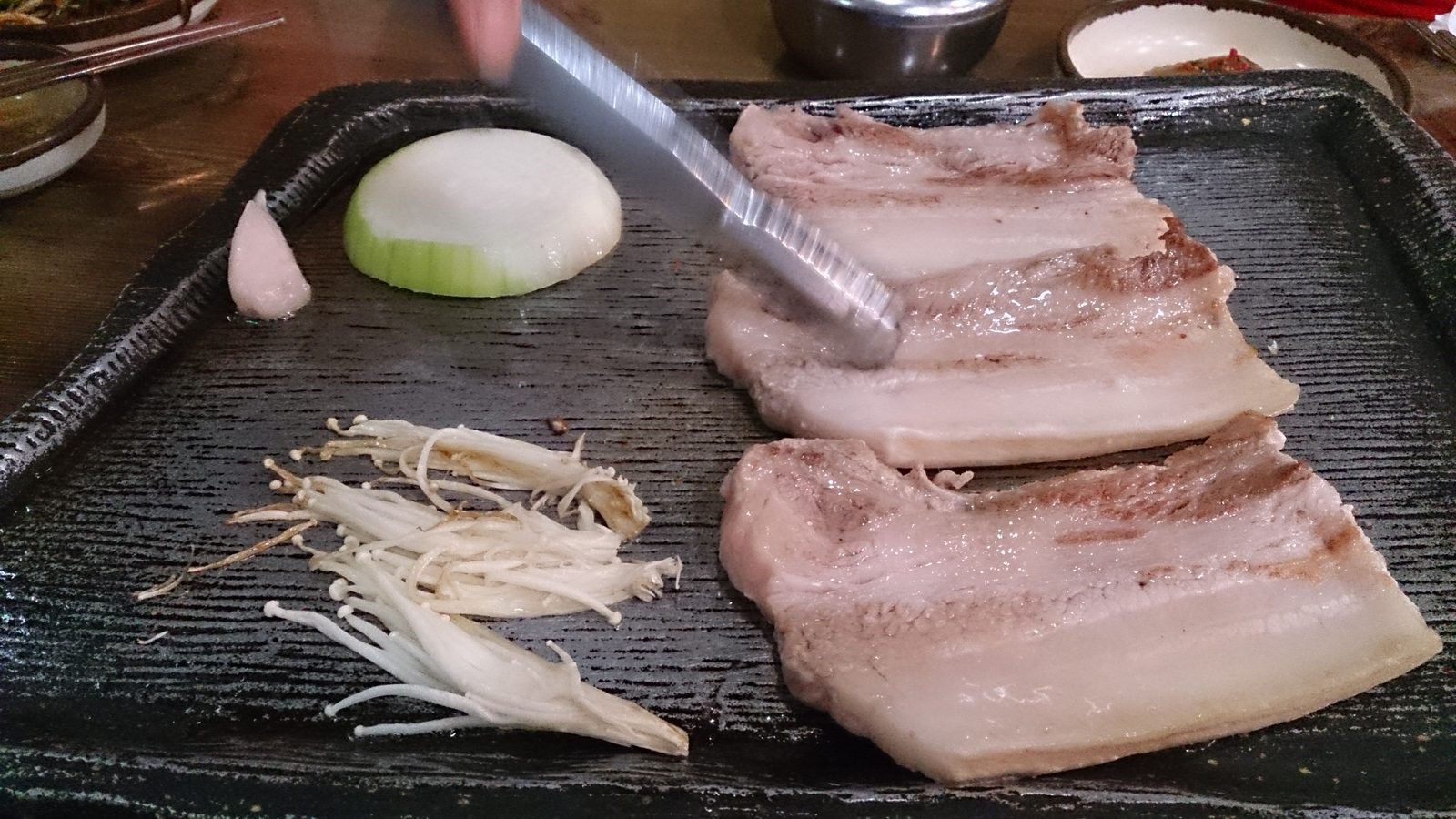

How much meat a first round needs
Korean barbecue restaurants sell meat by the inbun (인분), a serving, and a restaurant decides how much meat that is. The English-language travel guide Seoulstart, which says it checked its figures against six primary sources, reports that most restaurants set a minimum of two portions per table, even for a diner eating alone. It calls this a house policy, not a legal requirement, and says some restaurants post it near the entrance while others raise it only when you order. Side dishes come free, and the staples such as kimchi and pickled radish can be refilled at no charge.
Prices are quoted for a standard 200 g portion. The Korea Consumer Agency’s price portal put the average restaurant samgyeopsal in Seoul at 21,321 won per 200 g in June 2026, up 4.3 percent on the same month a year earlier, with a first-half average of 21,230 won, as reported by the Asia Business Daily. Treat that 200 g as a yardstick for comparing prices, not as a promise about the plate that arrives.
The 200 g figure also helps with the opening order. The Korea Food Promotion Institute’s samgyeopsal recipe uses 800 g of pork belly for four people, along with mushrooms, chives, onion and kimchi. Three 200 g portions for four people sit under that home quantity and leave room for a second round, which is a judgement of the author and not a rule from any of these sources.
Samgyeopsal, pork belly, is the default and the safe first order. The institute’s tip for choosing it is practical: fresh belly shows clear stripes of white fat and bright pink lean. Beef is a separate price tier, and Seoulstart notes that restaurants are required by law to label beef as Korean hanwoo or imported. Marinated cuts such as galbi are a different cooking job, covered in how marinated beef is seasoned and grilled, and a home version of the same dinner shows how the table is set up without a restaurant’s extractor fan.
Seoulstart’s menu primer is the quickest map of the cuts, and the table below picks five from its list. Beyond them, jowl (hangjeongsal) is a small-yield premium pork cut with a chewy texture, and offal cuts such as small and large intestine belong to specialist restaurants. Shaved brisket comes in paper-thin slices that cook in seconds and are dipped in sesame oil and salt rather than ssamjang.
| Cut | Korean | What the guide says |
|---|---|---|
| Pork belly | 삼겹살 (samgyeopsal) | Thick layered belly, the default order, cooked unmarinated |
| Pork neck | 목살 (moksal) | Leaner than belly, often a little cheaper |
| Marinated pork ribs | 돼지갈비 (dwaeji-galbi) | Usually marinated in soy sauce or chili paste |
| Shaved brisket | 차돌박이 (chadolbaegi) | Paper-thin, cooks in seconds, dip in sesame oil and salt |
| Beef short ribs | 갈비 (galbi) | Premium bone-in ribs, typically marinated |
Beef raises two more questions. Hanwoo, domestic beef, is graded from 1++ for the heaviest marbling down to 3 on a marbling score of 1 to 9, and the criteria were revised in December 2019, the same guide adds. Seoulstart says the way to ask the grade at a premium beef restaurant is 몇 등급이에요 (myeot deunggeub-ieyo). Diners eating alone should know that the two-portion minimum applies to them as well, and that solo-friendly restaurants are a minority; the guide suggests calling ahead or looking for a sign reading 1인 가능, solo dining allowed. It says these are likelier near office districts at lunch, and that in the evening a single counter seat at a neighbourhood moksal or samgyeopsal specialist is the easiest route.
Tongs, plain pork first and the fresh plate
The table already has a built-in gas or charcoal grill in the middle, and the staff light it. At a neighbourhood restaurant you grill your own meat, and Seoulstart says that by informal custom the youngest person at the table manages the tongs and watches the grill. Mid-range and premium restaurants often send staff to cook or at least to start the meat. The guide’s advice if you are unsure is to watch the next table or let the staff take the lead.
The institute’s recipe gives the basic method: lay the belly on a very hot pan and cook both sides evenly, then cook the mushrooms, vegetables and kimchi alongside it. The institute’s prep sizes show how a home table cuts things: belly strips 4 cm wide, king oyster mushrooms 0.6 cm thick, onion in 1 cm rounds, chives and squeezed kimchi cut to 5 cm. It is served with a sesame oil dip seasoned with salt and pepper. The tip at the bottom of the page adds a reminder to prepare plenty of bean sprouts and chives and to eat the meat wrapped in leaves with ssamjang.
Cut order matters for the plate. Seoulstart says the sugar in a marinade burns quickly on a plate coated in old residue, so when the plate is heavily charred, or when the table switches from unmarinated to marinated meat, ask for a replacement. The phrase is 불판 갈아주세요 (bulpan garajuseyo). Cooking plain belly first and marinated meat last cuts the number of times the question comes up.

The wrap, the side dishes and how the meal closes
The default way to eat grilled meat is ssam. The standard dictionary defines ssam as rice, meat or side dishes wrapped in leaves such as lettuce, napa cabbage, crown daisy, perilla, wild greens or pumpkin leaves. The Folk Encyclopedia entry shows how old the habit is. A Joseon writer, Yu Mong-in, describes a lettuce leaf in the palm with rice, sweet red paste and a grilled fish, wrapped like a bundle and eaten with a hugely open mouth, while another writer, Yi Deok-mu, advised readers not to make the wrap so large that the cheeks bulge.
The entry also records, through the Joseon scholar Yi Ik, a Yuan-era poet’s remark that Goryeo people wrapped rice in raw greens, and it says that wrapping rice and meat in vegetable leaves with garlic, chili and a paste is one of the most distinctive Korean ways of eating. It adds that the habit has spread abroad since the 2000s on the back of Hallyu, and that ssamjang, developed along the way, is the sauce that seasons the wrap. A good rule from that history is to wrap small: one leaf, one piece of meat, a dab of paste, one bite.
The modern version is easy to assemble. Most tables come with a plate of lettuce and perilla leaves, and Seoulstart’s sequence is a piece of grilled meat on a leaf, a little ssamjang (a thick paste of fermented soybean and chili), a slice of garlic and some scallion salad, folded into a parcel. The Folk Encyclopedia quotes the poet Jeong Yak-yong describing barley rice rolled in lettuce and eaten with chili paste and scallion roots, so the plain version has a long pedigree too.
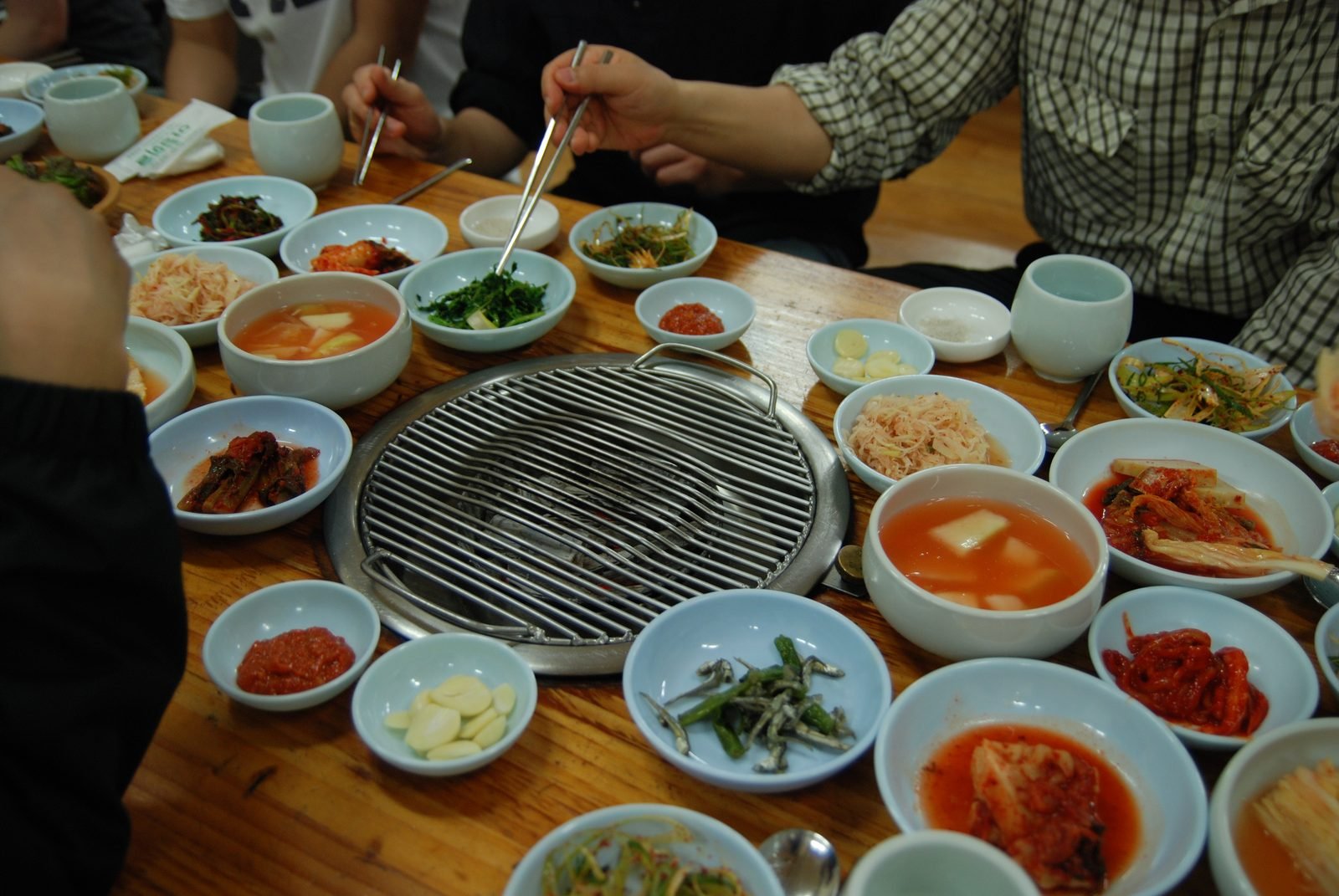

The small dishes, banchan, arrive with the order. Seoulstart gives the phrases for asking for more: 이거 더 주세요 (igeo deo juseyo), or 리필 가능해요 (ripil ganeunghaeyo), which asks whether a refill is possible. Specialty sides may cost extra, so ask before assuming.
The meat is rarely the end. Seoulstart names three common closers: fried rice cooked on the still-hot grill, cold buckwheat noodles, or a fermented soybean stew, and stresses that these are common but not universal, so the menu or the server settles it. The cold noodles have their own recipe in buckwheat noodles in icy dongchimi broth. The same source says there is no tipping in Korea and that money should not be left on the table.
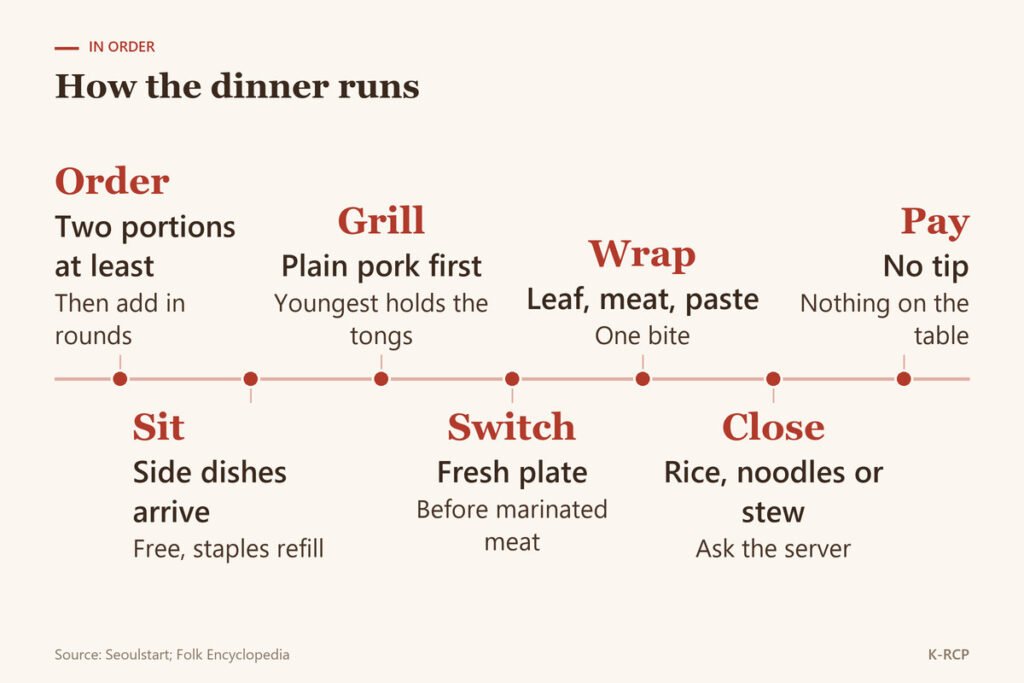
Five slips at a first barbecue table, and how to undo each
The five slips below are the author’s reading of the sources above, not a list printed in any of them.
The first is running dry at the wrong moment, which comes from ordering only the minimum and then waiting. Reorder before the last piece comes off the grill, because a new plate takes time to arrive. The second is a blackened plate, which comes from marinated meat going on first or from one plate being used across very different cuts. Ask for a fresh plate with the phrase above and cook unmarinated meat first.
The third is a crowded grill. Too many pieces on the plate at once lower its temperature and make it hard to tell which piece is done, so cook in small batches and leave each piece until it releases. The fourth is the oversized wrap, which the Joseon advice about bulging cheeks already warned against, and the fix is the same: smaller leaves, smaller bites.
The fifth is the money. Reading the portion price as a per-person price misleads, because the minimum is two portions per table, and leaving a tip does nothing since the practice does not exist. Order the minimum, add in rounds, and pay the check as it comes.
Thin cuts are the best argument for ordering in rounds. Brisket slices that cook in seconds cannot wait on a crowded plate, and a table that orders several cuts at once is left with food that cools while the grill catches up.