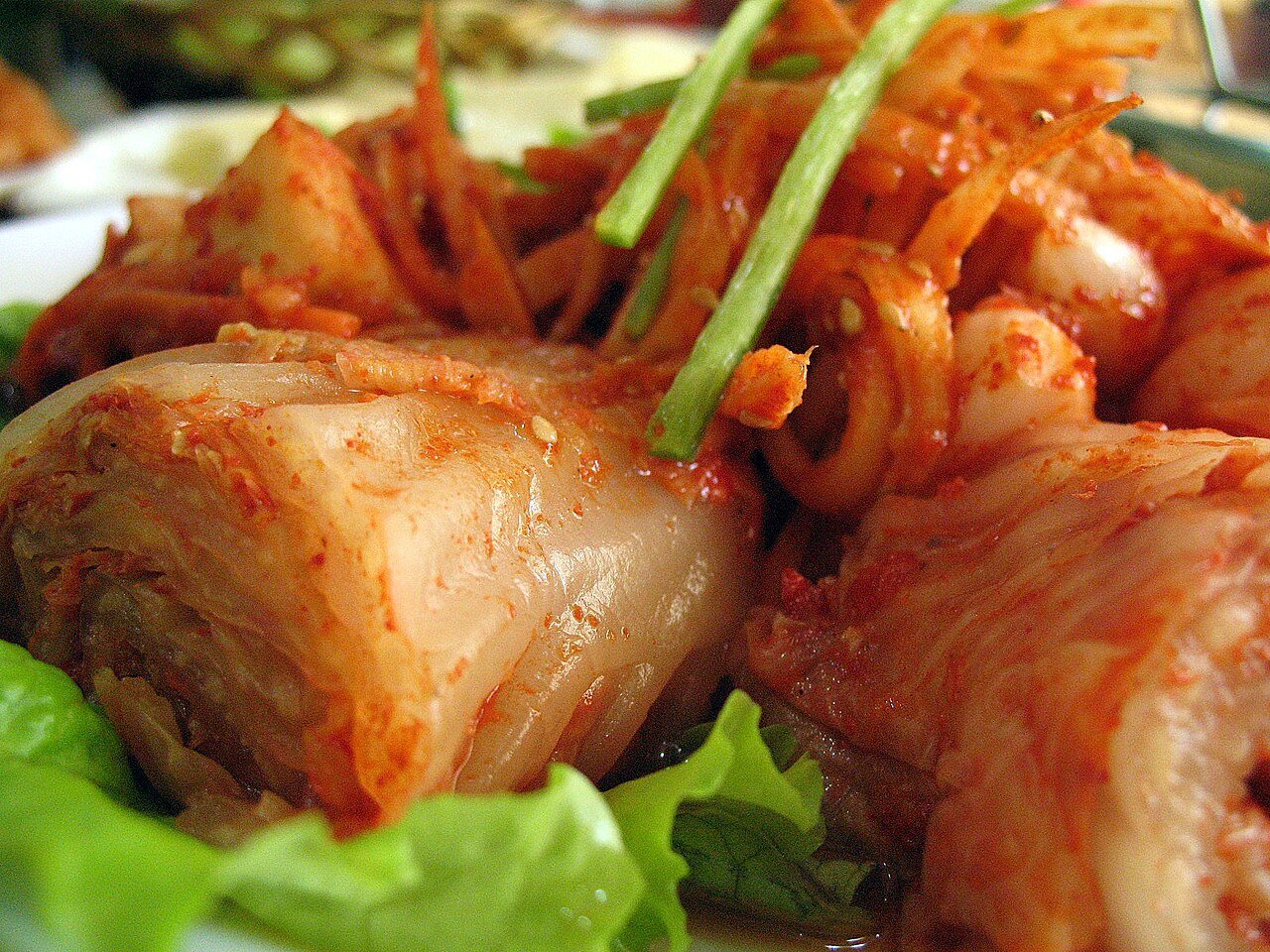
Is kimchi vegan? Mostly, no — and that surprises people who assume a jar of fermented vegetables must be. Most traditional kimchi is seasoned with fish sauce, salted shrimp, or both, stirred into the paste for exactly the reason you’d expect: they’re doing the savory, salty groundwork that the chili and garlic build on top of. Pull them out and replace them with nothing, and you get kimchi that tastes thin and one-note, spicy without being deep. The fix isn’t skipping that layer of flavor. It’s replacing it with something else that does the same job.
This recipe uses dried shiitake mushrooms and kelp, and it uses them properly — not just as a soaking liquid stirred in at the end, but blended straight into the paste, caps and all. That’s the part most vegan kimchi recipes skip, and it’s the part that actually matters.
Quick facts
- Total time: about 2 hours active and waiting, plus 1 to 2 days to start fermenting
- Makes: one large jar, roughly 1.3 kg / 2.9 lb finished
- Difficulty: medium — no single hard step, several stacked together
- Spice level: 3 out of 5, adjustable by how much gochugaru you use
- Vegan: yes, entirely, with no substitutions needed beyond what’s already in the ingredient list
What’s actually missing without fish sauce, and how to replace it
Fish sauce and salted shrimp contribute glutamates — the compounds behind what’s generally called umami, the same savory quality that makes a good broth taste like more than salt water. Soy sauce has glutamates too, which is why almost every vegan kimchi recipe leans on it, but soy sauce alone is thinner and more one-dimensional than fish sauce, missing the slow-built depth that comes from fermented seafood.
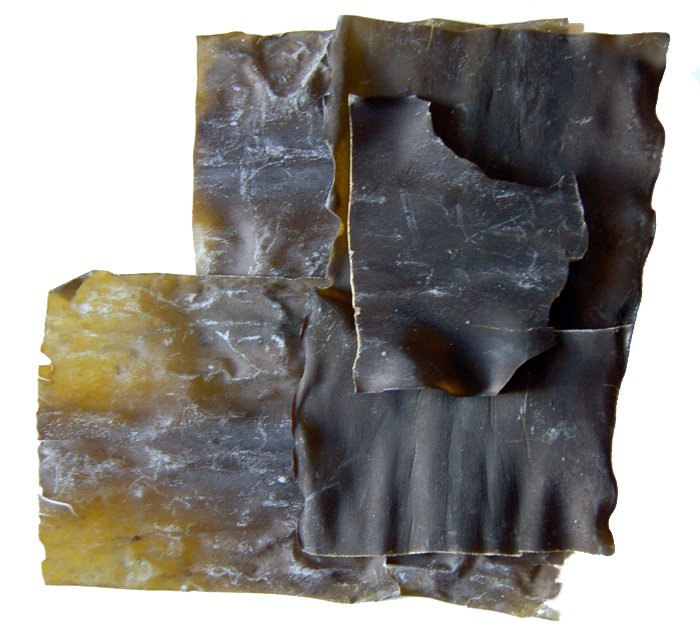
Dried shiitake and kelp both carry serious glutamate content of their own — it’s the same reason they’re the backbone of Japanese dashi. Simmering them together makes a stock that’s genuinely savory on its own, not just salty. The mistake most recipes make is treating that stock as the whole contribution and discarding the rehydrated mushrooms. Don’t. Chop the softened shiitake caps fine and stir them directly into the seasoning paste, and you get little pockets of dense, meaty flavor scattered through the finished kimchi — closer to what salted shrimp gives regular kimchi than anything a liquid alone can manage.
Ingredients, and what to use instead
| Ingredient | Where to get it, or what to use instead |
|---|---|
| Napa cabbage, 1.5 kg | Any supermarket |
| Dried shiitake + kelp, 4 caps / 10 g | Asian grocers, sold cheaply in bulk bags. Substitute: 2 tsp white miso or doenjang stirred into water — quicker, less complex, but still savory |
| Gochugaru, 1/3 cup | Sold online everywhere. No real substitute for the color and fruity heat together |
| Soy sauce, 3 tbsp | Any brand. Coconut aminos work, slightly sweeter — use a little less |
| Asian pear or apple, 1 | Adds body and a rounded sweetness. Skip it and add an extra tablespoon of sugar instead |
| Daikon, garlic, ginger, onion, scallions | Standard supermarket items |
Vegan Kimchi Recipe
Ingredients
Method
- Cut the cabbage into bite-size pieces. Toss with the salt in a large bowl and let it sit 1 hour, tossing every 20 minutes, until the pieces bend without snapping and have released noticeable liquid.
- Meanwhile, simmer the dried shiitake and kelp in the water for 15 minutes. Remove the kelp and set the stock aside. Finely chop the softened shiitake caps — don’t discard them, they’re doing most of the savory work here.
- Rinse the salted cabbage twice in cold water and drain well in a colander, pressing gently.
- Whisk the rice flour into 1 cup / 250 ml of the mushroom-kelp stock and simmer 3 to 4 minutes, stirring, until it thickens into a thin, glossy porridge. Cool it before using.
- Stir the cooled porridge together with the chopped shiitake, gochugaru, soy sauce, sugar, grated pear, onion, garlic, and ginger into a thick, spreadable paste.
- Fold the radish and scallions into the paste.
- Add the drained cabbage and toss by hand, gloved if you’d rather not smell like chili, until every piece is coated.
- Pack tightly into a clean container, pressing so the released liquid rises above the solids. Leave at room temperature 1 to 2 days, until small bubbles appear at the edges, then refrigerate.
How to make it
- Cut the cabbage into pieces and salt it for an hour, tossing occasionally, until the pieces bend without snapping.
- Simmer the shiitake and kelp for 15 minutes. Remove the kelp, keep the stock, and finely chop the softened mushrooms.
- Rinse the cabbage twice and drain it well.
- Make a thin porridge with the rice flour and 1 cup of the mushroom-kelp stock, then cool it.
- Stir the porridge together with the chopped shiitake, gochugaru, soy sauce, sugar, pear, onion, garlic, and ginger into a thick paste.
- Fold in the radish and scallions.
- Toss the drained cabbage with the paste until every piece is coated.
- Pack into a container, leave at room temperature 1 to 2 days, then refrigerate.
Where this goes wrong
Using the mushroom-kelp liquid but throwing away the mushrooms themselves is the single biggest miss. The stock alone gives you a savory base note, but the rehydrated shiitake, chopped and worked into the paste, is what gives the finished kimchi texture and pockets of real depth rather than a uniformly thin savoriness.
Over-relying on soy sauce as the sole umami source is the second common issue. It’s salty, but it’s flat compared to a proper stock, and kimchi made with soy sauce alone tends to taste more like seasoned cabbage than fermented kimchi. Building in the mushroom and kelp stock, even briefly, closes most of that gap.
Does vegan kimchi ferment the same way?
Yes, more or less. Fermentation here is driven by naturally occurring bacteria on the cabbage and in the environment, working on the sugars from the pear, onion, and any residual sugar in the vegetables — none of that depends on fish sauce or shrimp. Vegan kimchi ferments on roughly the same timeline as traditional kimchi, though some people notice it turns sour slightly faster, since fish sauce and salted shrimp add a bit of extra salt that traditionally slows things down.
Using it once it’s fermented
Aged vegan kimchi behaves the same way aged regular kimchi does, which is worth knowing if you’re used to treating it only as a fresh side dish. Once it’s a few weeks old and properly sour, it cooks the same way in a pot — it works in a vegetable kimchi jjigae, in kimchi fried rice, or folded into a pancake batter, and the mushroom and kelp base actually holds up well under heat, since both ingredients are already built to carry a stew’s savory backbone. Don’t reserve it only for eating straight from the jar; the sourer it gets, the more useful it becomes as a cooking ingredient rather than a side dish.
Frequently asked questions
Is all kimchi vegan by default?
No. Most kimchi, homemade or store-bought, contains fish sauce, salted shrimp, or both. Vegan-labeled kimchi is a real and growing category in Korea, not a Western invention, but you do need to check the label — plenty of jars sold as “vegetarian” still contain fish sauce.
Will vegan kimchi taste noticeably different?
A little. It’s slightly less funky and a touch less salty than versions made with fish sauce and shrimp, but with the shiitake and kelp built in properly, it isn’t thin or one-note. Most people eating it without being told wouldn’t immediately flag it as missing anything.
Can I just buy vegan kimchi instead of making it?
Yes — several Korean brands now sell dedicated vegan kimchi, usually labeled clearly, and it’s a fine shortcut. Check the refrigerated case rather than the shelf-stable aisle either way, since pasteurized jarred kimchi never develops real sourness regardless of what’s in the seasoning.
Where to go from here
This recipe follows the same three-stage logic as our full baechu kimchi method — salt, season, ferment — just with the seasoning built around mushrooms and kelp instead of fish sauce and shrimp. If a full afternoon of cabbage isn’t what your week has room for, easy mak kimchi uses the same vegan swap and gets you there in about half the time. And if gochugaru or dried shiitake are new to your kitchen, our Korean pantry starter kit covers what’s worth buying first and what can wait.