Why does the dubu jorim at a Korean restaurant come out glazed and glossy, holding its shape under a spoon, while the version made at home so often ends up as tofu cubes sitting in a thin, watery, soy-colored puddle? It’s not the sauce recipe. Most home versions get the ratio of soy sauce to sugar to water roughly right. It’s a step that happens before any sauce touches the pan at all: frying the tofu first.
Dubu jorim (두부조림) is tofu, braised in a soy-based sauce until the sauce reduces into a glaze that clings rather than pools. It’s the first of two jorim — braised dishes — in this pair, the second being gamja jorim, braised potatoes. Both work on the same principle, reducing a liquid until it concentrates into a coating, but they get there by two different routes, because tofu and potato behave completely differently in a pan.
Quick facts
| Time | 15 min prep, 20 min cook |
| Makes | 4 side-dish portions |
| Difficulty | Easy |
| Spice level | 1 / 5, adjustable with more gochugaru |
| Vegan? | Yes, with plain water or a shiitake broth instead of fish-based stock |
What jorim means, and what it’s asking the sauce to do
Jorim (조림) describes a cooking method more than a specific dish: something simmered in a seasoned liquid — usually soy sauce, sugar, and water or broth — until the liquid reduces down to a small amount of thick, sticky sauce that coats rather than surrounds the main ingredient. It’s the same word behind gamja jorim and a whole family of Korean home-style braises. The goal in every version is the same: start with enough liquid to actually cook the ingredient through, and finish with almost none of it left, concentrated into a glaze.
That’s a balancing act. Too much reduction and the sauce scorches on the bottom of the pan before it’s had time to distribute evenly. Too little and you end up with soup instead of a glaze — tofu or potato sitting in a thin, watery sauce that never thickened past “seasoned broth.”
Why frying the tofu first is the actual technique
Potatoes release starch as they cook, and that starch is what naturally thickens a gamja jorim sauce from the inside as it simmers — more on that in the gamja jorim piece. Tofu does the opposite. It releases almost no starch, so there’s nothing in the braising liquid itself to help it thicken, and a raw tofu cube simmered directly in sauce also tends to break down at the edges and shed water of its own, which thins the sauce even further rather than reducing it.
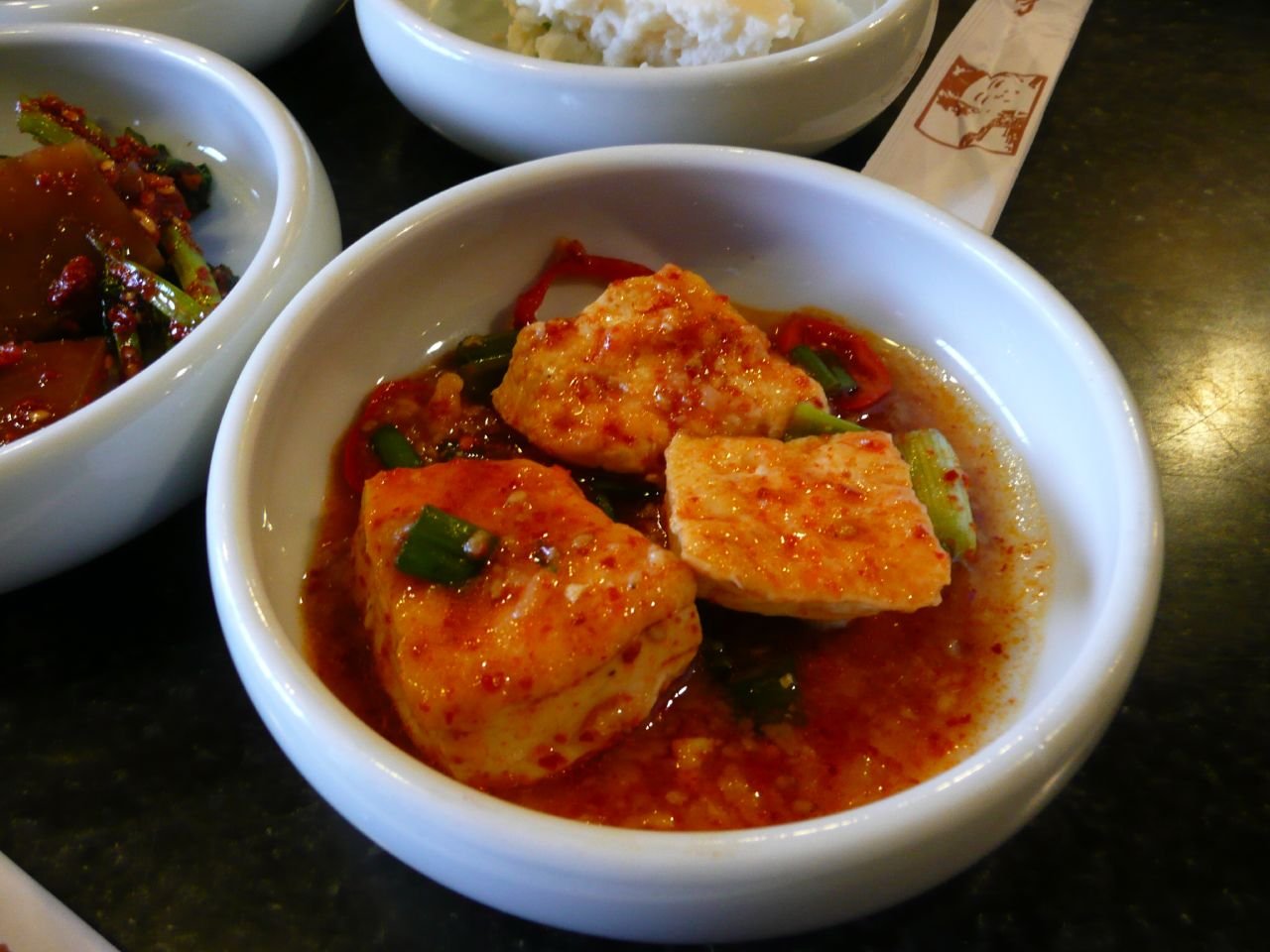
Frying the tofu first solves both problems. A hot pan sears the surface, driving off surface moisture and building a light golden crust through the Maillard reaction — the same browning that gives seared meat its flavor. That crust does two things: it firms up the tofu enough that it holds its shape through ten more minutes of simmering, and it gives the sauce something textured to cling to rather than a wet, slippery surface it slides off of. This is the same underlying idea used for the tofu in our bibimbap recipe, where pressing tofu before frying is described as “the difference between tofu that browns and tofu that steams.” Here, that browning step is doing even more work, because the tofu also has to survive a simmer afterward.
Ingredients and substitutes
| Ingredient | Where to get it, or what to use instead |
|---|---|
| 400 g / 14 oz firm tofu | Extra-firm is the safer choice for beginners — it holds together through frying and simmering. Silken tofu falls apart in this method; save it for soup. |
| 1 tbsp gochugaru | Paprika plus a pinch of cayenne gets the color and heat close, though flatter in flavor. See the Korean pantry starter kit for more on this swap. |
| Anchovy-kelp broth | Plain water works, just slightly less savory. A dried shiitake or two simmered briefly in the water gives a vegan version real depth. |
| Sugar or rice syrup | Honey diluted with a little water works, though it adds its own flavor — noticeable here since the sauce is otherwise fairly plain. |
| Toasted sesame oil | The dark, toasted bottle only; pale sesame oil won’t carry the aroma this dish depends on. |
Dubu Jorim Recipe
Ingredients
Method
- Slice the pressed tofu into slabs about 1.5 cm / 1/2 inch thick and pat them very dry.
- Heat oil in a wide pan over medium-high and fry the tofu 2-3 minutes per side, until golden and firm to the touch.
- Whisk soy sauce, gochugaru, sugar, sesame oil, garlic, and water or broth into a sauce.
- Arrange the fried tofu in the pan in a single layer, scatter the onion over it, and pour the sauce around the tofu rather than directly on top.
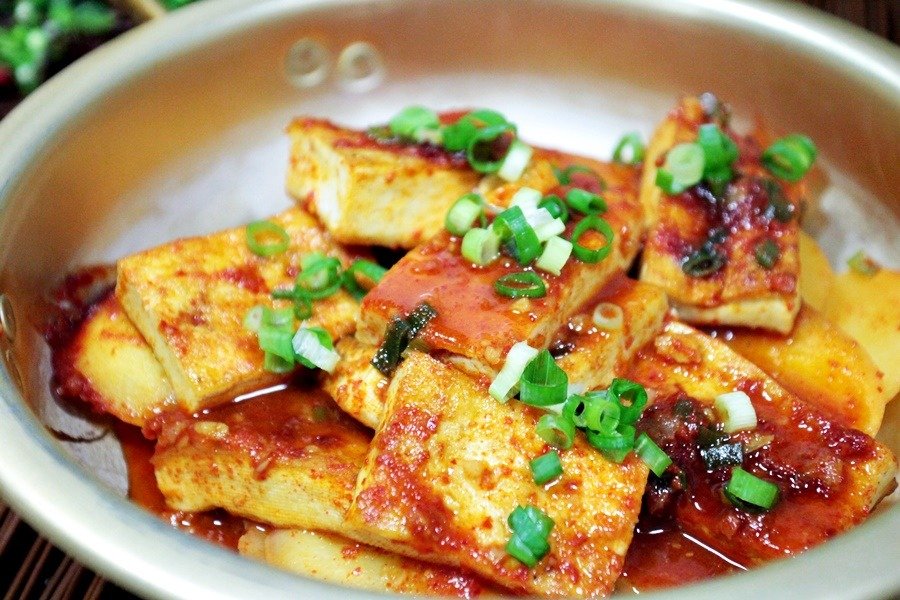
- Simmer uncovered over medium-low, spooning sauce over the tofu every couple of minutes, for 8-10 minutes, until the sauce has reduced by about half and coats the back of a spoon.
- Scatter scallion and sesame seeds over in the last minute of cooking.
- Turn off the heat and let it sit 5 minutes before serving — the glaze thickens further as it cools slightly.
Why the sauce goes around the tofu, not over it
Pouring the sauce directly over freshly fried tofu washes the crust you just built right back off before it’s had a chance to set. Pouring it around the tofu instead, then spooning it over gradually as it simmers, lets the crust stay intact while the tofu still absorbs flavor from repeated basting. It’s a small adjustment in the physical choreography of the dish, and it’s the difference between tofu that stays textured through the whole cook and tofu that reverts to soft as soon as liquid touches it.
Basting every couple of minutes, rather than once at the start and once at the end, matters for the same reason spooning sauce over gamja jorim potatoes matters: even, repeated contact builds flavor into the surface gradually, rather than dumping it all at once and hoping it sinks in.
Tips and storage
Watch the pan in the final two to three minutes. Once the sauce has reduced most of the way, it moves quickly from “coats the spoon” to “scorching at the edges,” especially once sugar starts to concentrate. Pull it a shade early rather than late — it thickens further off the heat as it cools, so slightly loose in the pan is usually right by the time it hits the table.
Dubu jorim keeps 3 to 4 days refrigerated in a sealed container and reheats well in a pan over low heat with a splash of water to loosen the glaze back up — a microwave works too, though it softens the fried crust more than a stovetop reheat does.
Frequently asked questions
Can I make dubu jorim without frying the tofu first?
You can, but expect a thinner, wetter sauce and tofu that’s softer and more prone to breaking apart as you serve it. If you skip the frying step, press the tofu especially well beforehand to remove as much water as possible, and expect to simmer a little longer to compensate for the extra liquid the tofu itself releases.
Can I make dubu jorim vegan, without any fish-based broth?
Yes — this is the default version of the recipe here. Use plain water, or water with a dried shiitake mushroom simmered in it for a few extra minutes of depth, in place of anchovy-kelp broth or fish sauce.
How long does dubu jorim keep, and what’s the best way to reheat it?
Three to four days refrigerated. Reheat gently in a pan with a splash of water over low heat, spooning the sauce back over the tofu as it warms, rather than blasting it in a microwave, which tends to dry out the edges that took the longest to fry.
Related
Dubu jorim pairs naturally with a bowl of plain rice and something brothy alongside it, like doenjang jjigae. If you want to see the same tofu-pressing principle used in a completely different dish, the tofu module in our bibimbap recipe covers it from another angle, and dubu-kimchi shows what happens when tofu is simply boiled and paired with stir-fried kimchi instead of braised. For the other jorim in this pair, gamja jorim uses the same reduction principle with an ingredient that behaves in almost the opposite way. And if gochugaru or rice syrup aren’t already in your kitchen, the Korean pantry starter kit is the place to start.