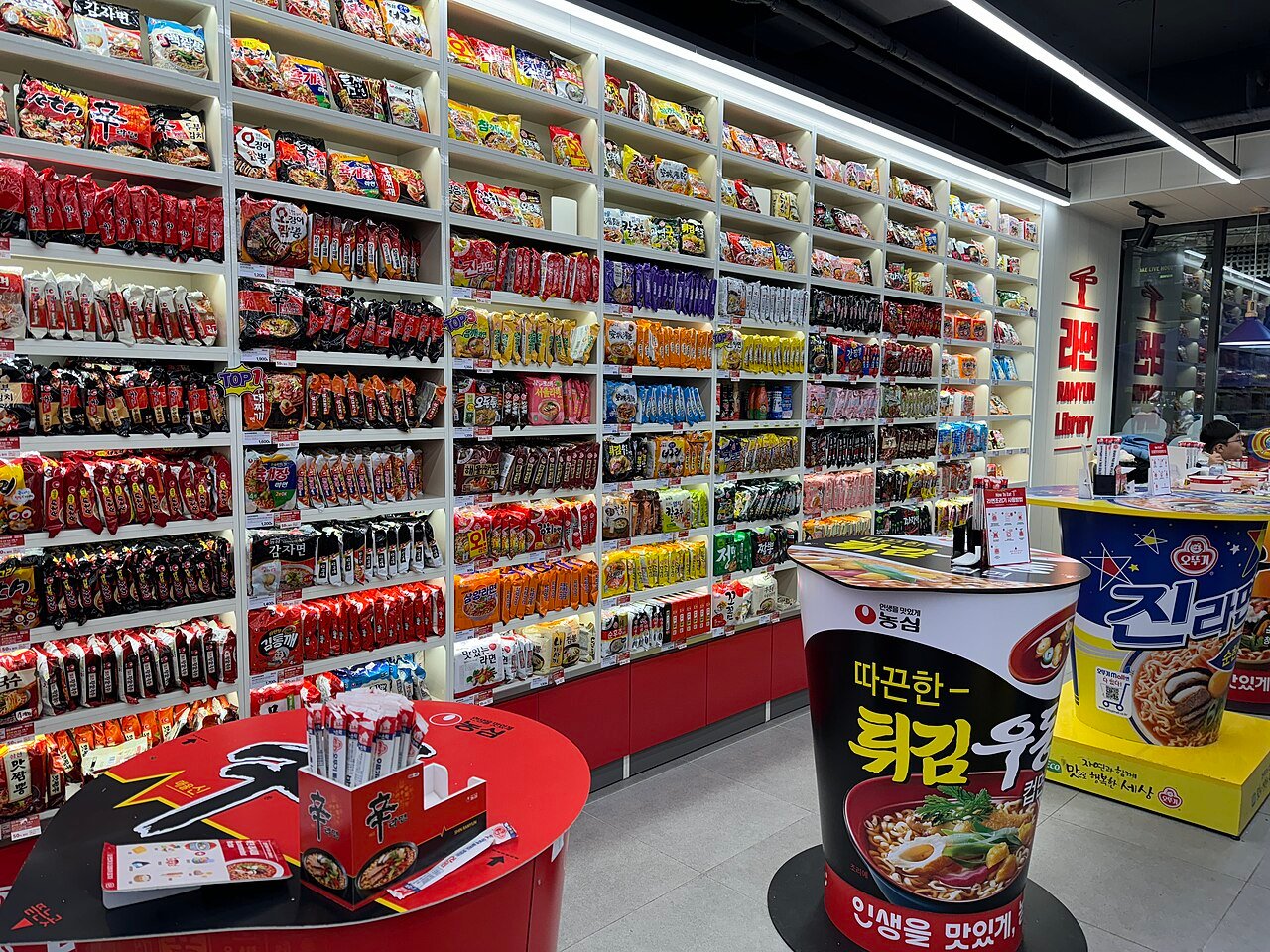
Walk into any Korean convenience store at eleven at night and the ramyeon shelf takes up a whole wall. Not a section. A wall. Thirty-odd packets in red and black and orange, arranged by brand loyalty rather than by flavor, and in the corner there’s a hot water dispenser, a stack of plastic forks, and a narrow counter facing the window where somebody is already eating.
That wall is the reason this list exists. These are the Korean ramen hacks that show up most often — the seven things I actually see people do, what each one needs, and which packet it suits. Instant noodles are a real cuisine here, not a shortcut, and every household has opinions about what goes in the pot.
Two rules that make every Korean ramen hack work
Use less water than the packet says. Most Korean packets call for 550 ml, and most Koreans I know pour something closer to 450 to 500 ml, because everything you’re about to add — egg, cheese, kimchi juice — thins the broth back out. A watery pot can’t be fixed later.
And cook it fast. Korean instant noodles are built for a hard rolling boil, four to five minutes, lid off, noodles lifted with chopsticks a few times to aerate them. Low and slow makes them swell and go soft. If you want them properly chewy, pull the pot off the heat thirty seconds before you think it’s done.
South Korea gets through more than four billion servings of instant noodles a year, according to the World Instant Noodles Association’s demand figures, which is roughly what you’d guess from that convenience store wall.
A quick map of the packets
If you’re new to this aisle, here’s the shorthand most of these upgrades assume.
| Packet | What it is | Heat |
|---|---|---|
| Shin Ramyun | The default spicy beef-and-mushroom broth | Medium-hot |
| Neoguri | Thick chewy noodles, seafood-and-kelp broth | Medium |
| Jin Ramen | Milder, rounder broth; comes in mild and spicy | Mild to medium |
| Chapagetti | Black bean sauce, no soup at all | None |
| Buldak | Fire chicken sauce, no soup, extremely hot | Very hot |
1. The egg, and the argument about how
An egg is the first thing almost everyone adds, and Koreans split into two camps about it. The first camp cracks it in whole during the last minute and doesn’t touch it, so the white sets in one piece and the yolk stays runny to break over the noodles. The second camp beats the egg in a bowl and pours it in a slow circle while stirring, which clouds the broth and turns it silkier and slightly sweeter.
Whole egg suits the clear-ish spicy broths where you want the yolk as a cooling counterweight — Shin Ramyun above all. Beaten egg suits milder packets like Jin Ramen, where the extra body actually registers instead of getting buried.
2. One slice of cheese
Processed cheese singles, the orange kind, laid flat on the noodles the moment the pot comes off the heat. Don’t stir it in while the burner’s on or it turns stringy and separates; let the residual heat melt it down over about thirty seconds, then fold it through once.
The fat blunts capsaicin, which is exactly why this became the standard fix for anything painfully spicy. On Buldak it’s less a garnish than a safety measure. It’s also good on Shin Ramyun, and pointless on Chapagetti, which is already rich.
3. Sour kimchi, plus its juice
Old kimchi that’s gone properly sour is better here than fresh — that’s the whole trick. Chop about half a cup, add it with the water at the very start so it has four or five minutes to soften and give up its flavor, and pour in two or three tablespoons of the juice from the jar as well. The juice is doing more work than the cabbage.
This turns a mild packet into something that tastes like it was cooked from scratch, so it belongs with Jin Ramen or Neoguri. On an already-sour or already-fiery broth it just muddles things. If you like where this goes, kimchi jjigae is the same idea with the training wheels off.
4. Scallion oil, made first
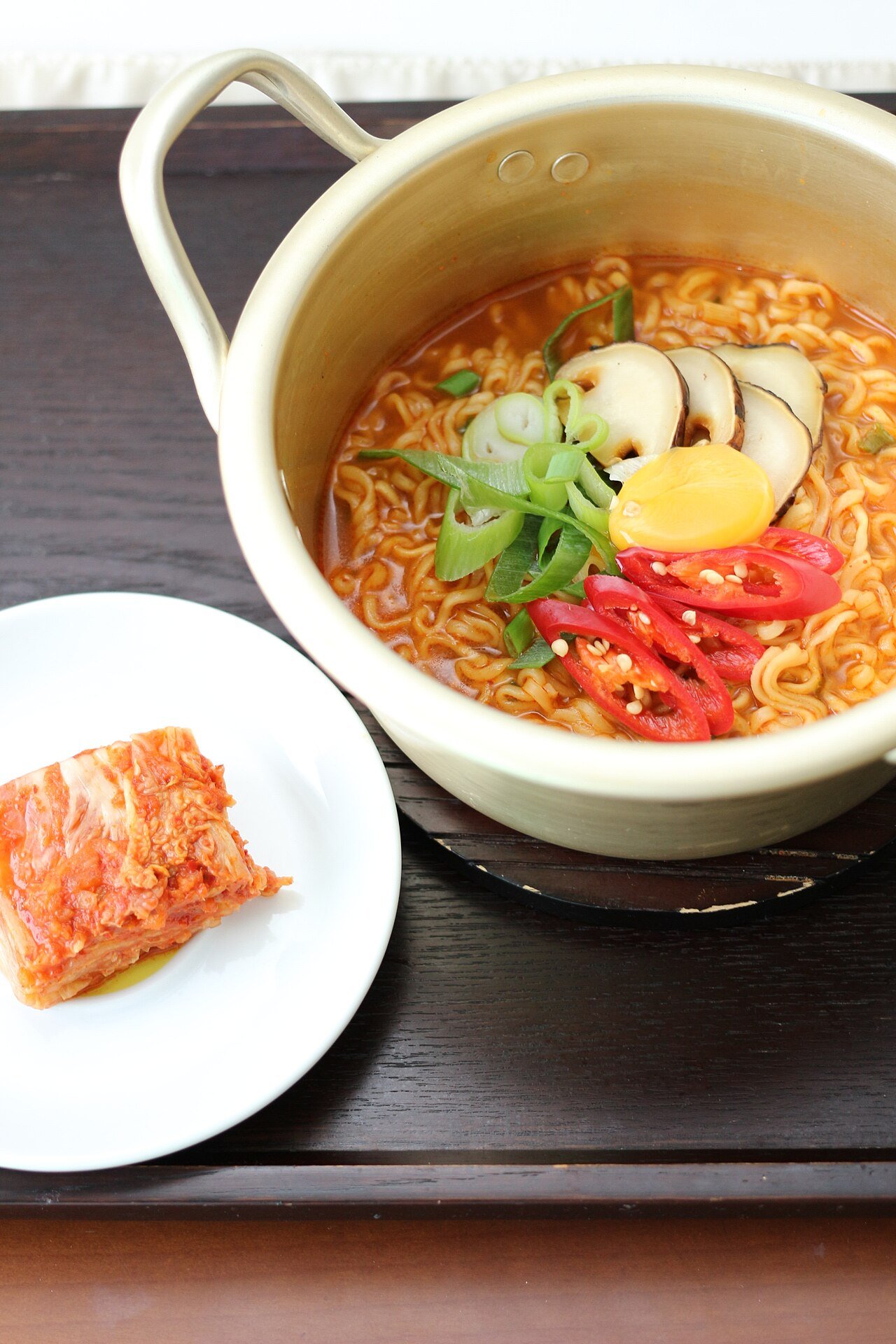
This one takes ninety seconds and changes the pot more than anything else on the list. Before you add any water, heat a teaspoon of neutral oil in the empty pot and fry a whole chopped scallion, white parts included, until the edges brown. Half a teaspoon of gochugaru in the oil at the end is optional and very good. Then add the water and carry on as normal.
Koreans call the result pa-gireum, scallion oil, and it gives the broth a toasted savory base that instant seasoning powder can’t produce on its own. Best on seafood-leaning broths like Neoguri, where it fills in the gap underneath. Skip it for Buldak — there’s nothing in that sauce subtle enough to notice.
5. A handful of bean sprouts
Soybean sprouts or mung bean sprouts, a generous handful, dropped in for the last two minutes so they keep their snap. Don’t add them earlier or they go limp and start smelling sulfurous. A few sliced mushrooms alongside them work on the same timing.
This is the version people make the morning after drinking, because the sprouts cut the heaviness and give the bowl something crunchy to push against. It suits any soup packet, and it’s the one upgrade that makes a pot of instant noodles feel like an actual meal rather than a snack.
6. Sari: dumplings, rice cakes, extra noodles
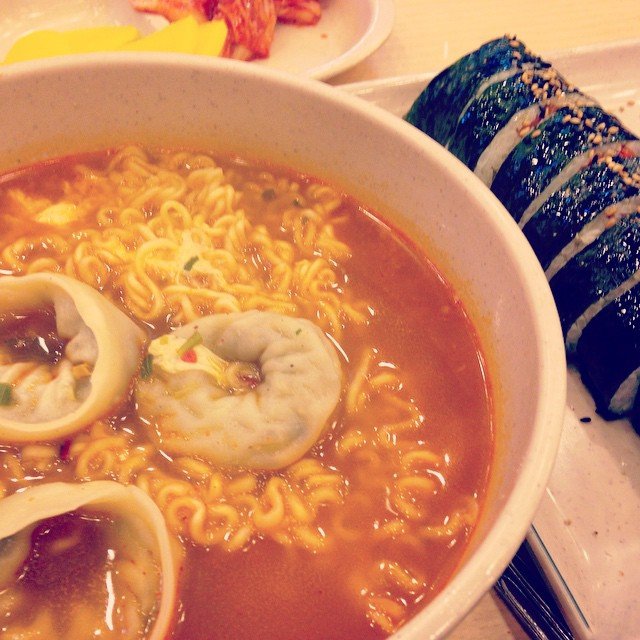
Sari means the things you throw into a shared pot, and ramyeon takes all of them. Four or five frozen mandu dumplings go in with three minutes left. A small handful of tteok, the cylindrical rice cakes, needs five to six minutes and should go in with the noodles. A second block of noodles from another packet — noodles only, no seasoning — bulks it out without doubling the salt.
Dumplings are the classic and they work with anything, though the pork filling sits best in a spicy broth like Shin. Rice cakes turn the pot into something close to tteokbokki with noodles in it, which Koreans call rabokki and consider a legitimate dish in its own right.
7. Rice in what’s left
Not an addition so much as a second course. When the noodles are gone and there’s a centimeter of concentrated broth in the bottom of the pot, tip in half a bowl of cooked rice, stir it around over low heat for a minute, and eat it straight out of the pot. Some people crack an extra egg in and scramble it through, some add a spoonful of the rice cooker’s leftover crust.
This works with every soup packet and it’s genuinely the best part on the spicy ones, where the reduced broth has gone thick and salty enough to season a whole bowl of rice. Nobody in Korea considers this optional.
The K-drama part
If you’ve watched Hospital Playlist, you’ve watched a lot of people eat quickly between shifts. The show’s whole texture is built out of small meals grabbed in hallways and staff rooms, and instant noodles turn up in that rotation the way they do in any Korean workplace — the thing you eat because it takes four minutes and nobody has more than that. It’s an unusually accurate detail for a television show.
Ramyeon shows up constantly in Korean film and television for the same reason, and the most famous example is Parasite, where two packets get combined into one bowl. That one has its own recipe, because combining brands is a whole separate discipline.
Common questions
Do I really need to use less water than the package says?
Not the first time, no — cook one packet exactly as instructed so you know the baseline. But once you start adding cheese, kimchi juice or an egg, the extra liquid and fat thin the broth noticeably, and there’s no way to recover it short of boiling the pot down and overcooking the noodles. Take about 50 to 100 ml off the stated amount and adjust from there.
Which Korean ramyeon should I start with if I can’t handle much spice?
Jin Ramen mild is the gentlest of the common ones, and Chapagetti isn’t spicy at all since it’s a black bean sauce rather than a soup. Neoguri sits in the middle. If you land on something too hot anyway, the cheese slice from number two genuinely helps, and so does an egg — fat and protein both blunt the burn in a way that drinking water does not.
Can I do these with Japanese or Chinese instant noodles instead?
Mostly yes. The egg, cheese, sprouts and dumpling tricks are about texture and richness and they transfer fine. The kimchi and scallion oil ones assume a broth with some chili and fermented depth already in it, so on a light shio or shoyu packet they’ll taste like two separate dishes in one pot. Korean packets are also engineered for firmer, chewier noodles, which is why the hard-boil method matters more here.
Where to go next
If none of these ingredients are in your kitchen yet, the Korean pantry starter kit sorts out what’s worth buying first — gochugaru and a jar of kimchi cover most of this list on their own.
And if you’re heading to Korea, the convenience store ramyeon counter is a real thing you can use: pick a cup, hit the hot water dispenser, eat standing at the window. How ordering food works in Korea on k-trips covers the rest of it, including the parts of a restaurant meal that nobody explains to you in advance.