Fresh kimchi and old kimchi come out of the same tub, weeks or months apart, and the stew wants only one of them. Fresh kimchi is a crunchy side dish; the old kind is the base of a pot. Treating the two as interchangeable gives a stew that tastes like hot cabbage water.
The cooking is the short part, and the card on this page takes about half an hour. The long part happens in the tub, weeks before the pot goes on the stove, and a jar that is too young can be nudged toward ripeness.

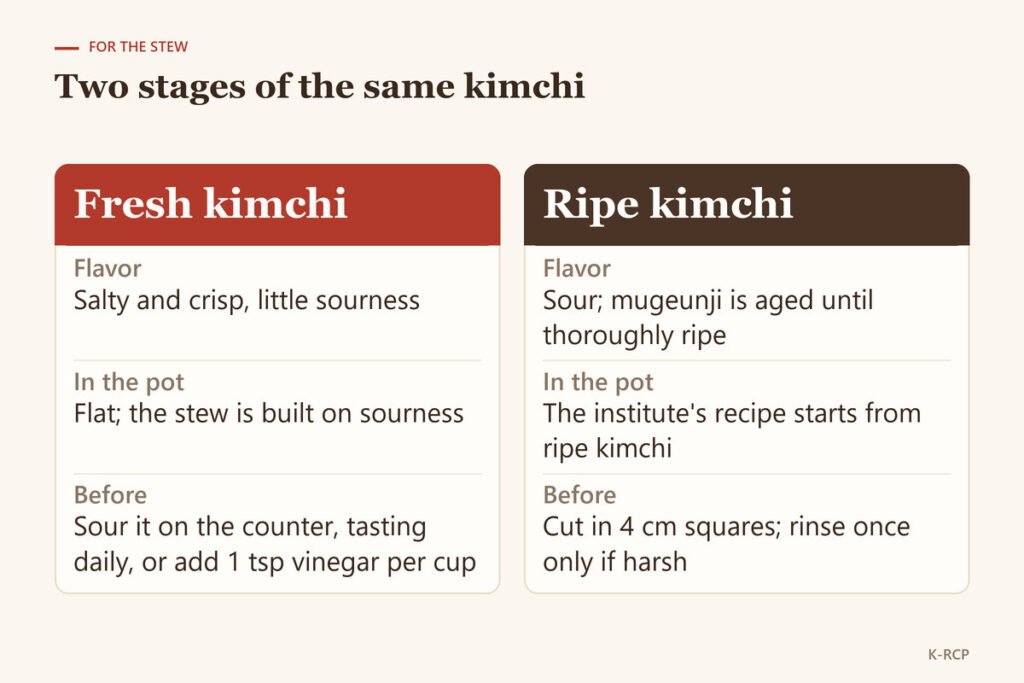
A young tub gives a flat pot
Kimchi is cabbage, radish and other vegetables that are salted, dressed with seasoning and left to ferment. The Encyclopedia of Korean Culture defines it as vegetables that are salted, seasoned and fermented, and quotes an ancient Chinese dictionary on why salted vegetables keep: fermenting them produces lactic acid. A tub opened the day it was made has had little time to ferment, so the liquid is salty and the leaves are crisp, with almost none of the sourness a stew is built on.
Korean has a word for the far end of the process. The standard dictionary defines mugeunji as kimjang kimchi that has aged a long time until it is thoroughly ripe. The institute’s stew recipe does not ask for mugeunji by name, only for well-ripened cabbage kimchi, which its first instruction cuts into 4 cm squares. The point holds either way. The stew starts from kimchi that has already soured.
The encyclopedia’s entry on the stew itself says kimchi jjigae is thought to have started as a way to use kimchi people no longer wanted to eat raw, such as leftovers or kimchi that had gone sour. It adds that today’s red kimchi arrived only after chili peppers came to Korea in the middle of the Joseon period, which suggests the stew in its present form began then. Sour kimchi is therefore the original ingredient of the dish, not a cook’s trick.
The folk encyclopedia’s kimchi jjigae entry puts a number on the far end. It says kimchi kept cold for six months or more becomes mugeunji, with less sourness and a strong fermented taste, and that this is the kimchi behind the recent craze for mugeunji stews built on thick pork or on fish such as saury and mackerel. The same entry adds a cooking rule: water poured in at the start turns the kimchi mushy, so the pot begins with a little oil over strong heat, and the water goes in only after the kimchi has softened. It also seasons with the kimchi liquid, which deepens the broth, and ginger is said to improve the pot. Saury and mackerel are the entry’s examples, so pork is not the only protein the stew has carried.


Souring kimchi that is too young
The slow fix is a short stay on the counter. Leave a sealed container of fresh kimchi at room temperature and taste it daily until it is clearly sour; no source gives a fixed number of days, because the answer depends on the kimchi and on how warm the kitchen is. Then refrigerate it to stop the change.
The fast fix is a workaround: for each packed cup of fresh kimchi, stir in 1 teaspoon of rice vinegar and a pinch of sugar before it goes in the pot, and simmer a few minutes longer than usual. The result is sharper and a little one-dimensional compared with real ripening, because vinegar supplies sourness without the savory depth that fermentation builds. It is still a good stew, and it is the honest answer for a dinner that cannot wait.
The shortcut is to buy kimchi that is already sour: ask a Korean grocer for aged kimchi, mugeunji, and read the production date, since time in the cold is what you are paying for.
The standard pot and the card’s pot, amount by amount
The institute’s kimchi jjigae recipe for four people uses 500 g of ripe cabbage kimchi, 200 g of pork belly (or 400 g of pork ribs), 4 tablespoons of cooking oil, 4 cups (1 L) of water, one 300 g block of tofu, about 45 g of thin scallions, 2 tablespoons of soup soy sauce and a tablespoon of sugar, with salt to finish. The card on this page is written for two: 300 g of sour napa cabbage kimchi, 120 ml of kimchi juice, 150 g of pork belly, half an onion, three cloves of garlic, 1 tablespoon of gochugaru, a teaspoon of gochujang, a tablespoon of soup soy sauce, a teaspoon of sugar, 500 ml of anchovy-kelp broth, 200 g of tofu, two scallions and a teaspoon of sesame oil.
The ratios are closer than the ingredient lists suggest. The institute uses 1 liter of water for 500 g of kimchi, or 2 ml of liquid per gram. The two-serving pot uses 120 ml of juice and 500 ml of broth for 300 g, about 2.1 ml per gram. Both land on a stew with the solids just standing in the liquid, which is the right shape for a dish eaten with rice: a thin soup would drown the kimchi, and too little liquid would fry it.
To feed four from the two-serving version, double everything and keep the liquid in proportion: the same 2 ml per gram of kimchi holds at any size, and the pot should grow deeper rather than wider so the solids still stand in the broth.
The card itself names four stand-ins: the white part of a leek for the onion, jarred minced garlic, Korean rice syrup or honey for the sugar, and silken tofu, which goes in for the last 2 minutes. Two more swaps are the author’s suggestions. Pork shoulder is leaner than belly and still browns well, and if the tub has little juice, 120 ml of water with 1 teaspoon of rice vinegar and 1/2 teaspoon of sugar fills the gap.
Browning the kimchi in pork fat before any water goes in
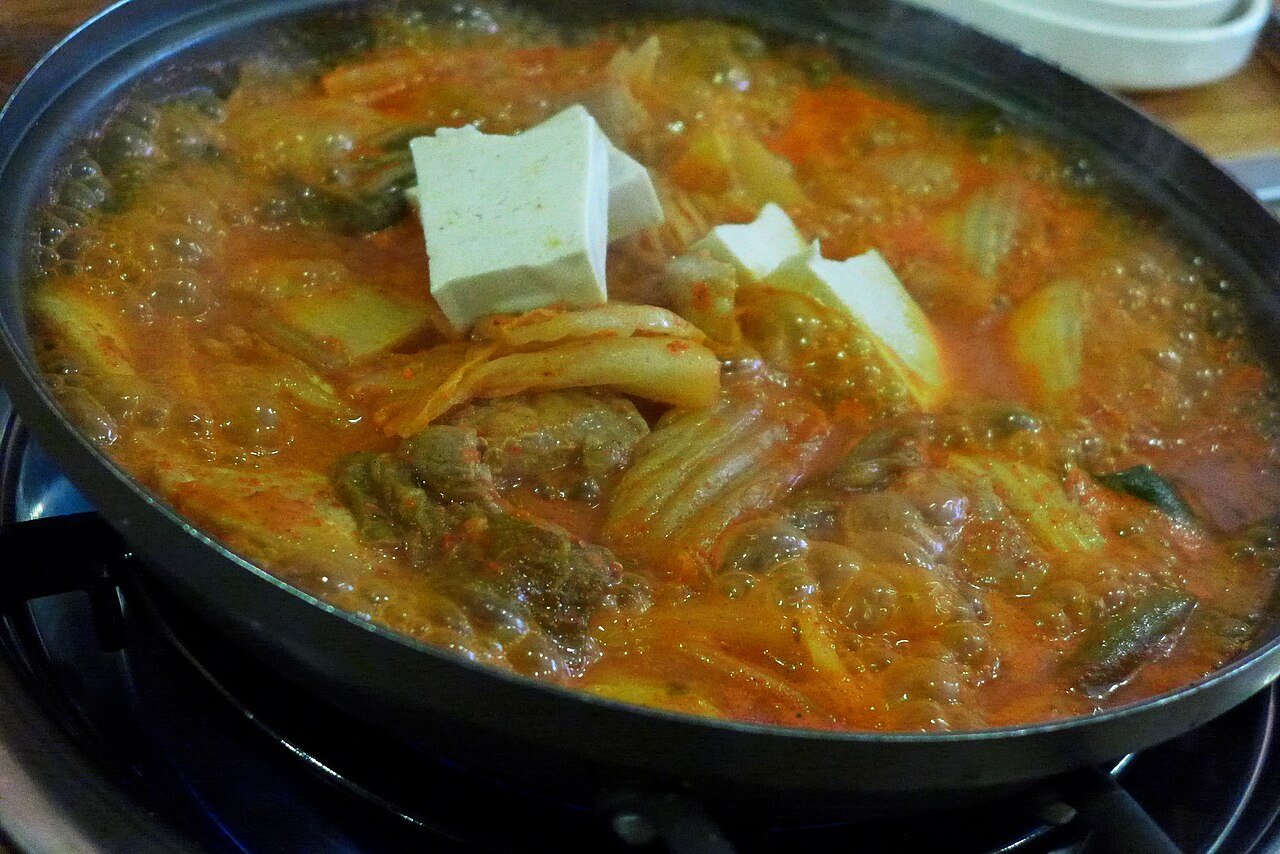
Kimchi Jjigae Recipe: The Fix for Bland Kimchi Stew
Ingredients
Method
- Cut the kimchi into bite-size pieces and reserve 120 ml / 1/2 cup of juice from the container.
- Fry the pork belly in a dry heavy pot over medium-high heat until the edges brown and fat renders, about 4 minutes.
- Add the kimchi, onion, garlic, gochugaru, and sugar. Stir-fry for 5 minutes, until the kimchi darkens and smells toasty rather than raw.
- Stir in the gochujang and guk-ganjang and cook for 30 seconds.
- Pour in the kimchi juice and broth. The liquid should sit about 2 cm below the top of the solids.
- Bring to a boil, then simmer uncovered for 10 minutes so the broth reduces and concentrates.
- Lay the tofu slices on top and simmer 3 minutes more without stirring.
- Scatter the scallions, take the pot off the heat, add the sesame oil, and serve straight from the pot with rice.
Recipe card photo: File:Gimchi-jjigae 1.jpg by travel oriented, CC BY-SA 2.0, via Wikimedia Commons.

Both recipes start the same way: fry the pork, add the kimchi, and cook until the meat is brown. That is where most of the flavor comes from, so the five minutes of stir-frying in the recipe should not be shortened.
Pork first, then kimchi
Fry the pork belly in a dry, heavy pot over medium-high heat until the edges brown and some fat has rendered, about 4 minutes. Add the kimchi, onion, garlic, gochugaru and sugar and stir-fry for 5 minutes, until the kimchi darkens and smells toasty rather than raw. Stir in the gochujang and soup soy sauce for 30 seconds, just long enough to coat the pieces.

The simmer, the tofu and the finish
Pour in the kimchi juice and the broth so the liquid sits about 2 cm below the top of the solids. Simmer uncovered for 10 minutes, lay the tofu on top and cook 3 minutes without stirring, then take the pot off the heat, scatter the scallions and add the sesame oil. The institute simmers its pot for 20 minutes, adds the tofu and seasoning, and cooks 10 minutes more, and it notes that kimchi can be cooked until it still has some bite or until it is completely soft. The two-serving pot sits at the crisper end of that range, so give it more time if you like the kimchi limp.
Two things are worth watching. The first is too much liquid: a wide pot with three cups of water gives a thin red broth, so use a small, deep pot and stop adding water while the solids are still showing above the surface. The second is skipping the stir-fry. Kimchi simmered raw in water tastes sharp and slightly grassy, while five minutes in rendered pork fat changes its whole character. If the pot ends up too salty, a little more tofu and a splash of water soften it more reliably than sugar.
Leftovers improve overnight, and the stew thickens as it sits. Reheat gently with a splash of water. Leftover kimchi juice is also an add-in for instant noodles, one of several in a list of packet upgrades.
Pork, rinsing and other loose ends
Can the stew be made without pork? Yes. The institute’s recipe notes that some cooks use dried anchovy in place of pork or beef, and the card already uses anchovy-kelp broth. For a vegetarian pot, use vegetable stock with a small piece of kelp, add sliced shiitake with the onion, and check the kimchi label, since many tubs contain fish sauce or salted shrimp.
Should the kimchi be rinsed first? Only if it is very sour. The encyclopedia’s description of the traditional method squeezes the kimchi out or rinses it once in water to remove a stale smell, and the institute’s recipe skips the step. Taste a piece first, and if it is unpleasantly harsh, rinse it briefly and add a little less sugar.
How the institute, the encyclopedia and the card each build the stew
The stew has no single construction, and comparing the institute’s recipe, the encyclopedia’s traditional method and the card shows which choices are fixed and which are habit. For another stew built around tofu rather than kimchi, see the silken tofu stew recipe.
| Institute recipe | Encyclopedia’s traditional method | This page’s card | |
|---|---|---|---|
| Kimchi | Ripe, cut into 4 cm squares | Winter whole kimchi, squeezed or rinsed once, roughly cut | Sour napa kimchi plus 120 ml juice |
| Meat | Pork belly 200 g or ribs 400 g | Beef, sliced boiled meat or pork | Pork belly 150 g |
| Liquid | 4 cups (1 L) water | Water, seasoned with thin soy sauce | 500 ml anchovy-kelp broth plus juice |
| Method | Fry meat, add kimchi, add water, simmer 20 minutes, then tofu and seasoning 10 minutes | Earthenware pot, steamed in a rice cooker or simmered long until soft | Fry pork dry, stir-fry kimchi 5 minutes, simmer 10, tofu 3 |
The shared skeleton is kimchi, fat and a modest amount of liquid. Everything else, the choice of meat, the broth, the pot, is a household decision, and the potato-and-bone stew gamjatang shows how far a different pot can drift from this one.