Jokbal used to be cheap for a reason nobody liked to say out loud. Pig’s trotters were the part of the animal left over after the more obviously edible cuts were sold, and in leaner decades they were priced accordingly — a way to get meat, or at least the idea of meat, onto a table that couldn’t afford much else. What changed that reputation is the same thing that saves most humble cuts everywhere: a long, patient braise turns something tough and unglamorous into something people now specifically go out drinking to order. Jokbal today shows up on anju menus next to fried chicken and grilled meat, and it isn’t a budget stand-in for anything. It’s its own dish.
Front feet or back feet
Korean butchers distinguish between wonjok, the front trotters, and hujok, the back ones, and the difference actually matters at the cutting board. Front feet carry more muscle relative to bone, so you get more actual meat in each slice. Back feet are almost entirely skin, tendon, and fat, with very little muscle at all — more collagen, more gelatin once braised, and a stickier, richer mouthfeel that some regulars specifically ask for. If your butcher gives you a choice, front feet make a slightly more generous dish for a first attempt; back feet are the ones to chase once you know you like this.
Finding trotters outside Korea
This is the actual obstacle for most people trying to cook jokbal at home, and it’s worth being direct about it: pig’s feet are not a standard cut at most Western supermarkets, and you’ll rarely find them just sitting in the meat case. Three places reliably have them. Korean and other East or Southeast Asian grocery stores almost always stock them frozen, often already split lengthwise for braising. Latin American markets carry pig’s feet too, usually fresh, since they’re a staple in several Latin cuisines. And any full-service butcher can order them for you even if they don’t keep them in stock — it’s an inexpensive, unglamorous cut, and most butchers are used to the request. Ask for them split in half lengthwise if they’ll do it; it cuts your braising time and makes slicing much easier later.
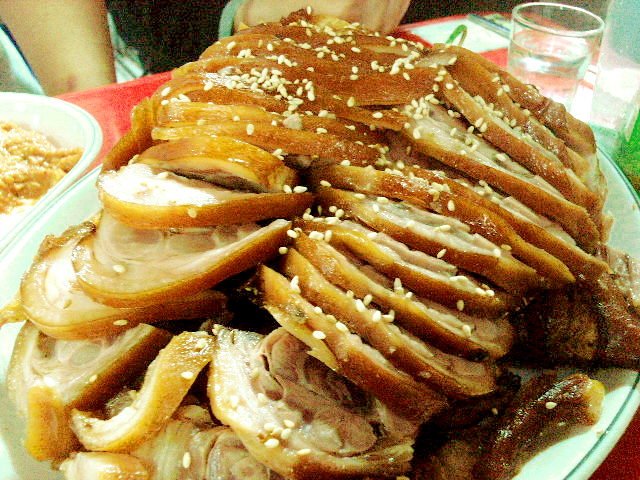
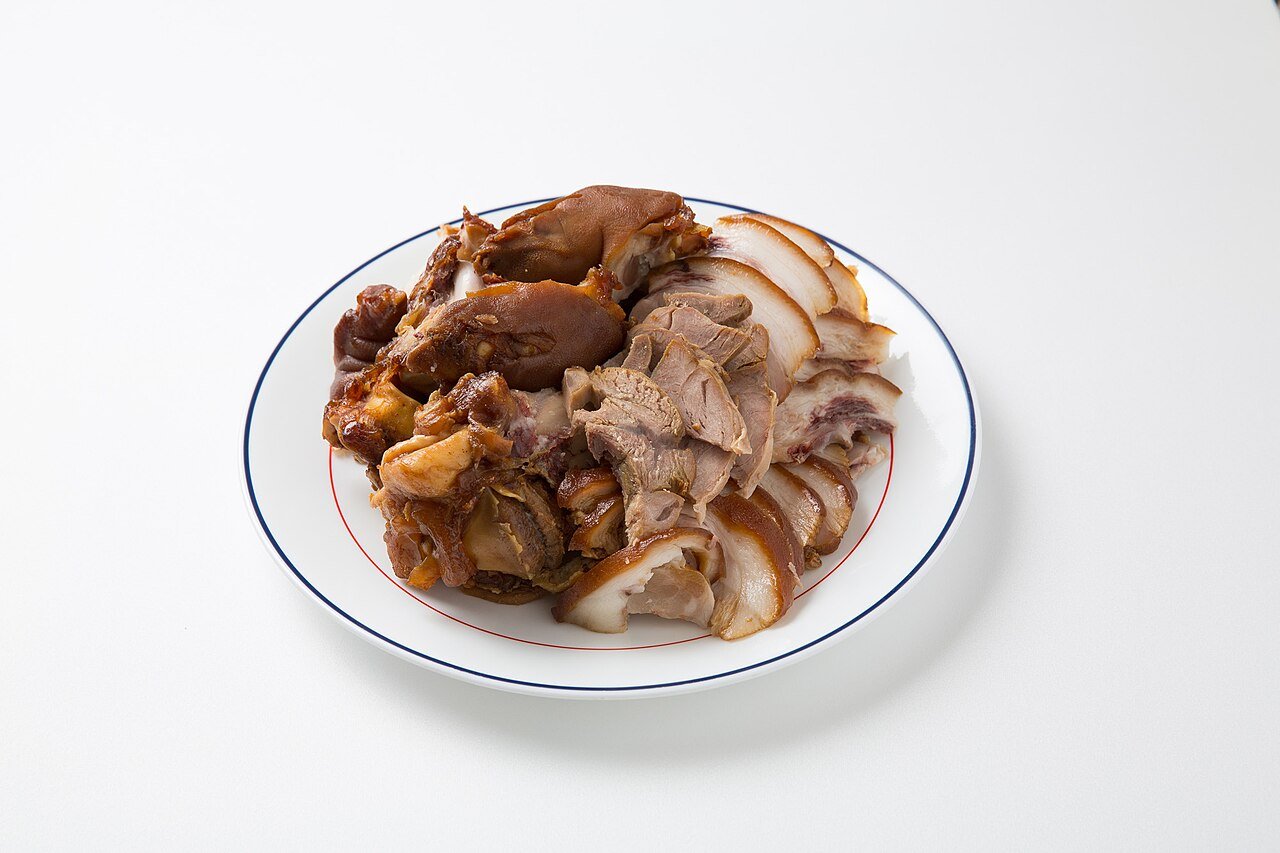
Jokbal Recipe
Ingredients
Method
- Soak the trotters in cold water for 1 hour, changing the water once, to draw out surface blood.
- Blanch in boiling water with the peppercorns and bay leaves for 5 minutes, then drain and rinse off any scum clinging to the skin.
- Combine the soy sauce, water, onion, garlic, ginger, scallions, coffee grounds, cinnamon, star anise, chilies, and sugar in a heavy pot and add the trotters.
- Bring to a boil, then reduce to a low, steady simmer, cover, and cook for 2 hours.
- Stir in the doenjang (and gochugaru, if using), then continue simmering uncovered for 20 to 30 minutes to reduce and darken the liquid, until the skin looks glossy and a chopstick passes through the thickest part easily.
- Lift the trotters out and let them firm up for 10 minutes before slicing crosswise into 1.5 cm / half-inch pieces.
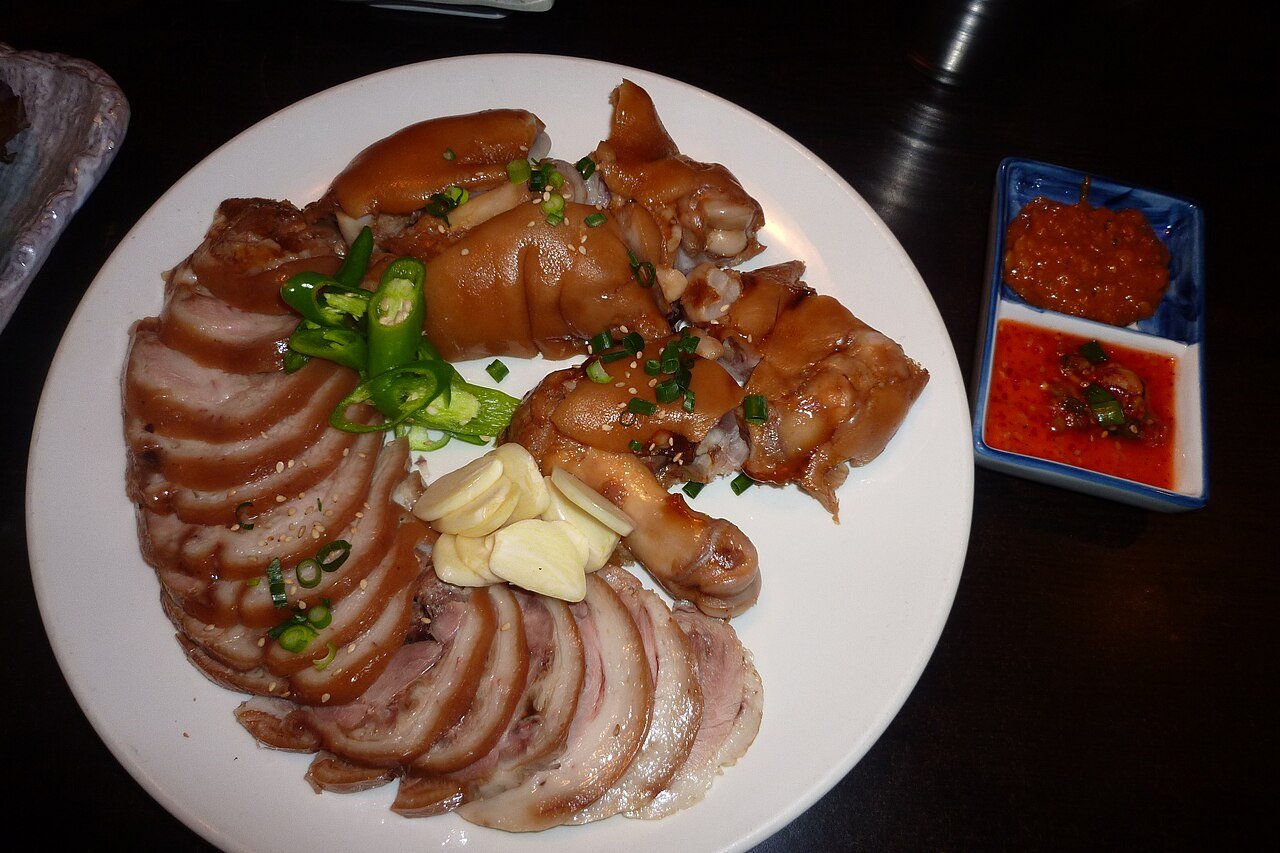
- Arrange on a plate and serve with lettuce, saeujeot or ssamjang, garlic slices, and kimchi for wrapping.
Why the braise takes two hours, not one
Trotters are mostly skin, tendon, and connective tissue wrapped around a small amount of muscle and bone, and that connective tissue is where jokbal’s entire texture lives. Collagen doesn’t soften the way muscle fiber does. It needs sustained heat, somewhere around a steady simmer just below boiling, held for a long time, to slowly break down into gelatin — the same transformation that makes braised short ribs or oxtail worth the wait. Rush it at a hard boil for 45 minutes and you’ll get trotters that are cooked through but still bouncy and faintly rubbery, because the collagen hasn’t had time to convert.
Two hours at a gentle simmer is the point where that conversion is mostly done: the skin turns from tight and pale to loose, dark, and glossy, and a chopstick pushed into the thickest part meets no resistance. The last 20 to 30 minutes, uncovered, aren’t about doneness anymore — they’re about reducing the braising liquid so it clings to the skin as a thin, dark glaze instead of sitting thin and watery on the plate.
The blanching step at the start earns its place too. Trotters carry a fair amount of surface blood and impurities, and simmering them straight in the braising liquid without blanching first clouds the whole pot and can leave a faintly livery off-taste. Five minutes in plain boiling water, then a rinse, and the braising liquid stays clean.
The spice mix, and the coffee trick again
The aromatics here — cinnamon, star anise, garlic, ginger, scallion — are doing double duty: they perfume the meat the way any braise’s aromatics would, and they help mask the stronger smell that a fattier, skin-heavy cut naturally carries more of than lean pork does. Coffee grounds or black tea do the same odor-absorbing job here that they do in bossam, which uses many of the same techniques on a different, leaner cut of pork. If you’ve made bossam before, jokbal will feel familiar with the volume turned up: longer cook, richer cut, deeper color.
Ingredients, and what to use instead
| Ingredient | Where to get it, or what to use instead |
|---|---|
| Pig’s trotters, 1.2 kg | Korean, Southeast Asian, or Latin American grocers; or ask any butcher to order them. Front feet (wonjok) for more meat, back feet (hujok) for more collagen |
| Star anise, 2 whole | Asian grocers, spice shops. Substitute: 1/2 tsp fennel seeds, for a lighter, less licorice-like note |
| Coffee grounds or black tea | Used grounds from your own pot are fine. Skip if you’d rather not, and lean a little harder on the soy sauce and sugar for color |
| Doenjang, 2 tbsp | Substitute: white miso, for a milder, less funky depth |
| Saeujeot (salted shrimp), to serve | The traditional dip. If you can’t find it, a good ssamjang covers the same role, just without the briny hit |
Serving it right
Jokbal is drinking food first and dinner second, which shapes how it’s served: sliced thin, laid out with lettuce or perilla leaves for wrapping, a bowl of saeujeot or ssamjang, raw garlic slices for anyone who wants the heat, and kimchi on the side. A quick, barely-fermented radish or cabbage kimchi — the kind covered in our easy mak kimchi guide — is closer to what most jokbal restaurants actually put on the table than a long-aged kimchi would be; its brightness cuts the richness without competing with the braise’s own spice.
If jokbal is going into regular rotation, Manjok Ohyang Jokbal in Myeongdong is one of the restaurants k-trips covers in its guide to where locals actually eat around Myeongdong, and it’s a reasonable benchmark for what braised, five-spice trotters are supposed to taste like.
Frequently asked questions
Is jokbal the same as bossam?
They’re close cousins and often ordered together as a combination plate, but they’re not the same dish. Bossam uses pork belly or shoulder simmered plain for about an hour. Jokbal uses pig’s trotters braised roughly twice as long in a soy-based liquid, which gives it a darker color, a stickier glaze, and a noticeably more gelatinous texture from all that collagen.
My supermarket doesn’t sell pig’s feet. Now what?
Check a Korean, Southeast Asian, or Latin American grocery store first — trotters are a staple cut in several cuisines, and they’ll almost always have them frozen or fresh. If none of those are nearby, ask a regular butcher to special order a few pounds; it’s an inexpensive cut and most butchers can get it within a few days.
Can I make a spicy version?
Yes — stir in a tablespoon of gochugaru along with the doenjang near the end of cooking, as noted in the ingredient list. This gives you maeun-jokbal, a common variation with real heat, without changing the braising time at all.
Related reading
Once you’ve got a braise like this in your repertoire, dubu kimchi — cold tofu next to hot stir-fried kimchi — makes a good lighter second dish on the same table, the same way it’s often served alongside bossam and jokbal at Korean drinking spots.