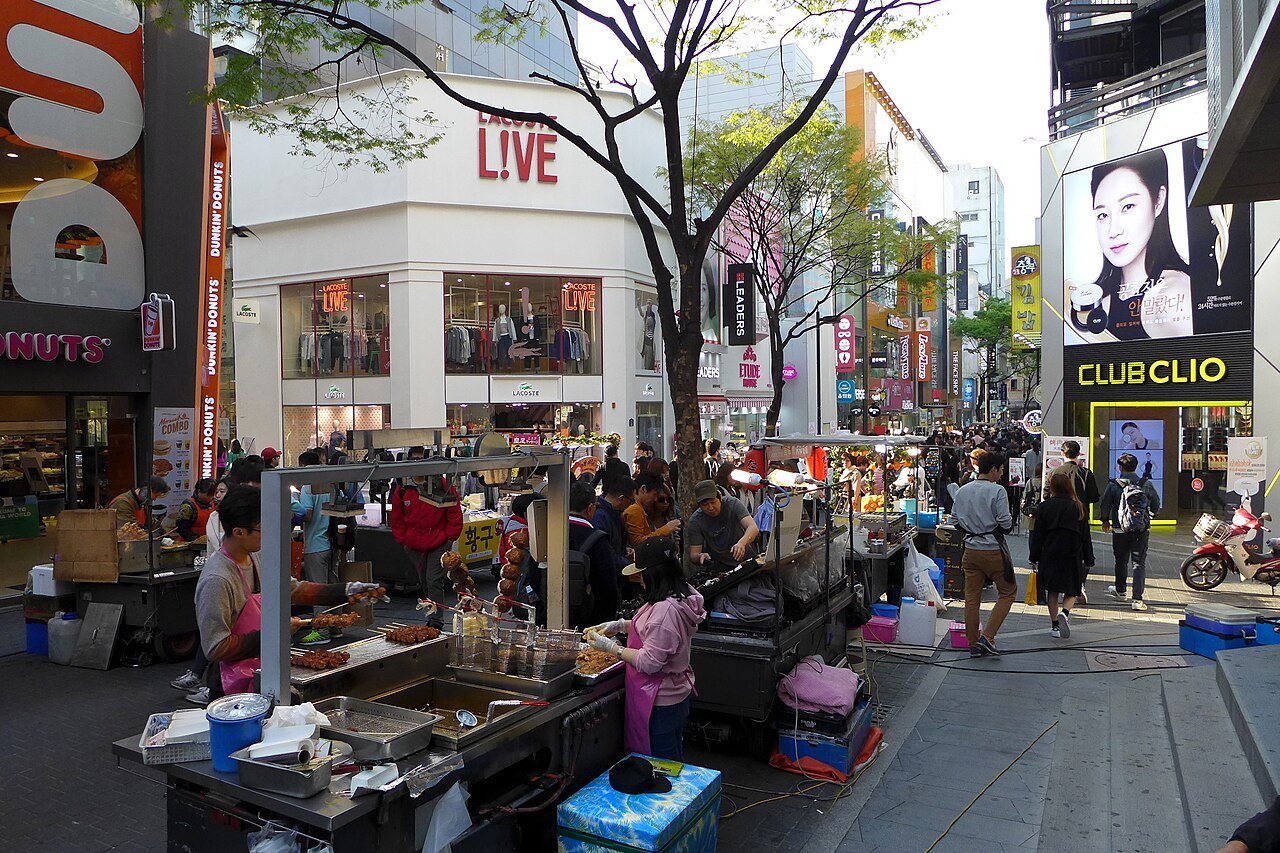
Walk down the main pedestrian stretch of Myeongdong on almost any evening and you’ll smell this before you see it: hot frying oil, sugar catching slightly at the edges, and the specific sweetish smoke of a street vendor’s stall pumping out corn dogs one at a time from a vat by the sidewalk. Myeongdong is a shopping district first, all cosmetics shops and hanbok rental storefronts, but the street food carts wedged between them get their own queues, and the Korean corn dog is one of the two or three items you’ll see in nearly every tourist’s hand as they walk.
It shares a name with the American county-fair corn dog and almost nothing else about how it’s built.
The dish traces back to Korean street vendors in the 1980s adapting the American corn dog — likely introduced through US military bases — into something built around ingredients that were cheap and available locally at the time: wheat flour instead of cornmeal, and, before mozzarella was common, a plain sausage on a stick. The potato-cube version and the cheese-stuffed version both came later, sometime in the 1990s and 2000s depending on which vendor you ask, and neither fully replaced the other — both are still sold side by side on the same carts today, along with newer variants coated in crushed ramen noodles or rice cake cubes.
Quick facts
| Time | 40 min prep, 20 min frying |
| Makes | 4 corn dogs |
| Difficulty | Medium — a batter, a fryer, and some multitasking |
| Spice level | 0 / 5 |
| Vegan? | Not as written; a plant-based sausage and dairy-free cheese stick both work if you want to try |
What’s actually different from an American corn dog
Three things, and they’re the whole reason this tastes and looks like a different food entirely, not a regional variant.
The batter isn’t cornmeal. American corn dogs get their name and their slightly gritty, faintly sweet crunch from a cornmeal-based batter. The Korean version uses a plain wheat-flour dough, closer to a yeasted bread batter than a cornbread one, which fries up smoother and chewier rather than crumbly. Some vendors let it rise properly with yeast; the quick home version above works fine with baking powder if you don’t want to wait.
The coating is diced potato, not more batter. This is the single most recognizable difference, and it’s specific enough that the dish has its own name for it: gamja hotdog (감자핫도그), literally “potato hot dog.” Small cubes of raw or lightly par-boiled potato get pressed into the wet batter before frying, and as the whole thing fries, the cubes crisp up individually on the outside while staying soft where they meet the dough — a texture no cornmeal coating produces. Rice-cake cubes, ramen noodle bits, and panko crumbs are all common variations sold on the same carts, but potato is the original and still the most common.
Sugar goes on after frying, not into the batter. The corn dog comes out of the oil and gets rolled immediately in granulated sugar while it’s still hot enough to melt it slightly onto the surface. It’s not a heavily sweet snack — closer to a light sugared crust than a dessert — but that final dusting is standard, and skipping it is the fastest way to make this taste like a plain fried hot dog rather than the street food it’s supposed to be.
The cheese, and the photo everyone takes
Most Korean corn dogs today are half sausage, half low-moisture mozzarella, skewered end to end so you get a bite of each as you eat down the stick. Bite into the cheese half while it’s fresh out of the fryer and it stretches into a long, slow-breaking pull before it separates — it’s the single most photographed moment of eating one of these, and street vendors know it. If you’re taking a picture of your own batch, the angle that works is close and slightly from below, right as the cheese half is pulled apart, catching the steam still coming off it. All-cheese sticks and all-sausage sticks both exist too, for people who’d rather not split the difference.

Korean Corn Dog Recipe
Ingredients
Method
- Skewer each hot dog half and cheese half together lengthwise onto a stick, leaving a bare handle of skewer at the bottom to hold.
- Whisk the flour, sugar, yeast, and salt together. Add the milk and egg and whisk into a thick, smooth batter, roughly the consistency of pancake batter. If using yeast, let it sit in a warm spot for 20 to 30 minutes until slightly puffed; if using baking powder, skip the wait and use it right away.
- Pat each skewered stick dry with paper towel — a dry surface is what the batter actually sticks to.
- Dip each stick into the batter, turning to coat it in a thick, even layer all the way down.
- Immediately roll the battered stick in the drained potato cubes, pressing gently so they stick to the batter on every side.
- Heat the oil to 170°C / 340°F. Fry one or two sticks at a time, turning occasionally, for 5 to 6 minutes, until the potato cubes are deep golden and the batter underneath is cooked through.
- Drain on a rack for a minute, then roll the hot corn dog in the granulated sugar while it’s still warm enough for the sugar to stick.
- Serve immediately, with ketchup and mustard drizzled over or on the side.
Getting the fry right
Oil temperature matters more here than in most home frying, because the potato coating needs enough time at the right heat to cook through without the batter underneath burning first. Too hot, and the outside browns before the potato cubes have softened; too cool, and the whole thing soaks up oil and turns greasy rather than crisp. A thermometer clipped to the pot is worth the trouble — 170°C / 340°F is the number to hold, and it will dip when you add a cold stick, so give it a minute to recover between batches rather than frying all four at once.
Patting the stick dry before it goes into the batter is the small step that’s easy to skip and easy to regret. A wet skewer means the batter slides rather than clings, and you end up with bald patches where the potato has nothing to stick to.
Serving and reheating
These are a stand-up, eat-immediately street food, and that’s genuinely the best way to have one — the cheese pull only happens in the first few minutes, and the potato coating is at its crispest the moment it comes out of the oil. If you’re frying a batch at home for more than one or two people, keep the finished ones warm on a rack in a low oven rather than stacked on a plate, where trapped steam will soften the coating before everyone’s ready to eat.
Leftovers reheat reasonably in an air fryer or a hot oven for five minutes, which brings back some crispness the microwave never will — a microwave will heat the inside but leaves the coating chewy rather than crisp, and the cheese tends to turn rubbery rather than pulling. They don’t freeze especially well raw or cooked; the potato coating gets soggy on thawing, so this is one to make in a quantity you’ll actually finish within a day.
Frequently asked questions
Can I make Korean corn dogs without deep-frying?
You can shallow-fry in about 2 cm / an inch of oil, turning frequently so all sides get contact, though the coating browns less evenly than in a full deep-fry. An air fryer gets the potato cubes crisp but tends to leave the batter underneath a little pale and doughy — brushing the outside with oil first helps, but it’s a genuine trade-off, not an equal swap.
What’s the difference between this and a regular Korean hot dog on a stick?
“Hot dog” on a Korean menu can mean several things — a plain battered sausage with no potato, a cheese-only stick, or the classic potato-coated version above. If a menu just says hotdog without specifying, it’s worth asking, since the plain version skips the texture that makes this dish distinctive.
Can I make the batter without yeast?
Yes — baking powder works as a same-day substitute and needs no rise time, though the texture comes out slightly denser and less airy than a properly rested yeasted batter. For a quick home batch, it’s a fair trade for not waiting half an hour.
Where to eat the real thing
If tteokbokki and Korean corn dogs are already on your radar, tteokbokki is the other essential from the same street-cart family, usually sold from the exact same stalls. Dalgona, the honeycomb candy from Squid Game, turns up at a lot of the same markets too, for anyone building a full afternoon of Korean street snacking. And Myeongdong’s food-filming reputation isn’t just tourist marketing — it shows up often enough on screen that it’s covered in our guide to K-drama filming locations in Seoul.
For an actual plan of where to eat once you’re on the ground, k-trips has a local’s guide to where locals eat around Myeongdong, which covers the stalls worth the wait and the ones that are mostly there for foot traffic.