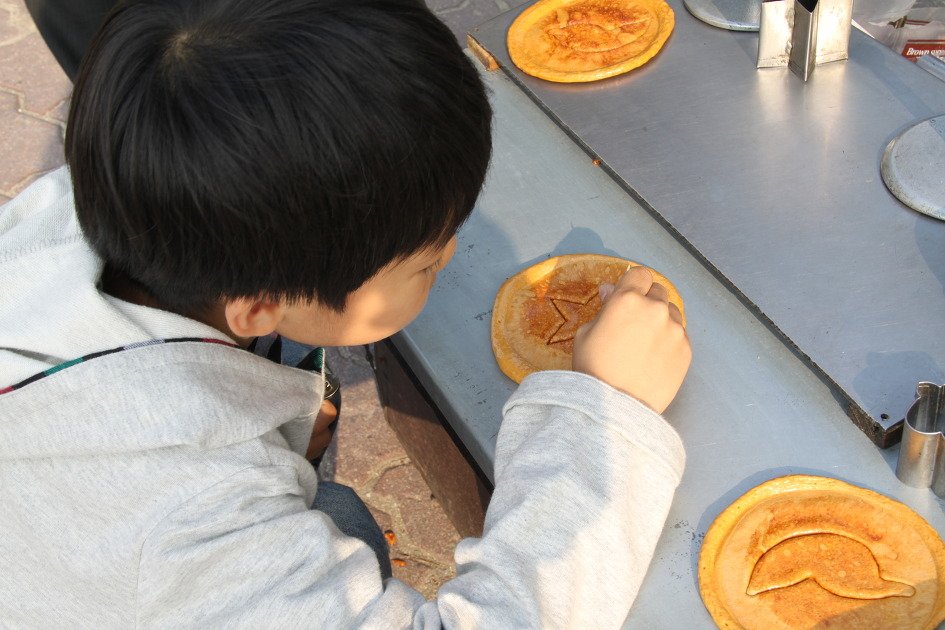
On a sidewalk outside a Korean school gate, a vendor holds a small steel ladle over a burner. The sugar goes clear, a pinch of baking soda drops in, and half a minute later a child is pressing a star into a honey-colored disc and wondering whether the needle will get it out whole. For decades that was an ordinary after-school treat. Since 2021 it has also been the test in Netflix’s Squid Game, where players have to carve a stamped shape out of the disc without cracking it.
The street candy behind the needle challenge
Dalgona (달고나) is a Korean street snack made by melting glucose or sugar in a ladle over a flame and then adding soda, which is how the National Folk Museum’s encyclopedia defines it. That entry calls the origin unclear, though a photograph taken in Daegu between 1953 and 1955 already shows a dalgona stall. Sugar was imported entirely until the 1950s and prized as a gift, so the candy became a mass street food only in the 1960s, once domestic output rose and the price fell. The name is said to come from “sweeter than sugar” (설탕보다 달구나).
Regional names show how far it spread. Seoul, Incheon and Gyeonggi say dalgona or ppopgi (뽑기), Chungcheong and Jeolla say ttigi, Jeju says ttegi, and Daegu says gukja, which simply means ladle. The museum entry also records that unregulated, substandard food was named a social problem in 1969, after which street stalls came to be seen as unhygienic and became targets of crackdowns. Dalgona belongs to the same family of sugar-based stall snacks as hotteok, the sugar-filled griddle pancake.
The two words once meant different sweets. The entry says a dalgona used to be a cube of glucose melted over a coal brazier, puffed with soda and eaten straight off bamboo chopsticks. A ppopgi (뽑기) was melted sugar pressed flat on an iron plate and stamped with a mold, usually bought finished, and a buyer could pick the stamped shape out with a needle. A clean cut earned a prize or a second piece. By that old definition, what appeared in Squid Game was a ppopgi, but abroad it was introduced as Korea hokey pokey, honeycomb toffee and dalgona, and dalgona became the accepted name. The entry adds that in February 2024 dalgona was reported to be under review for the Oxford English Dictionary, and the recipe card below carries the older word in brackets.
A Reuters report from a Seoul stall, run by The Korea Times in 2021, adds that dalgona sellers were a fixture in front of schools until the early 2000s.
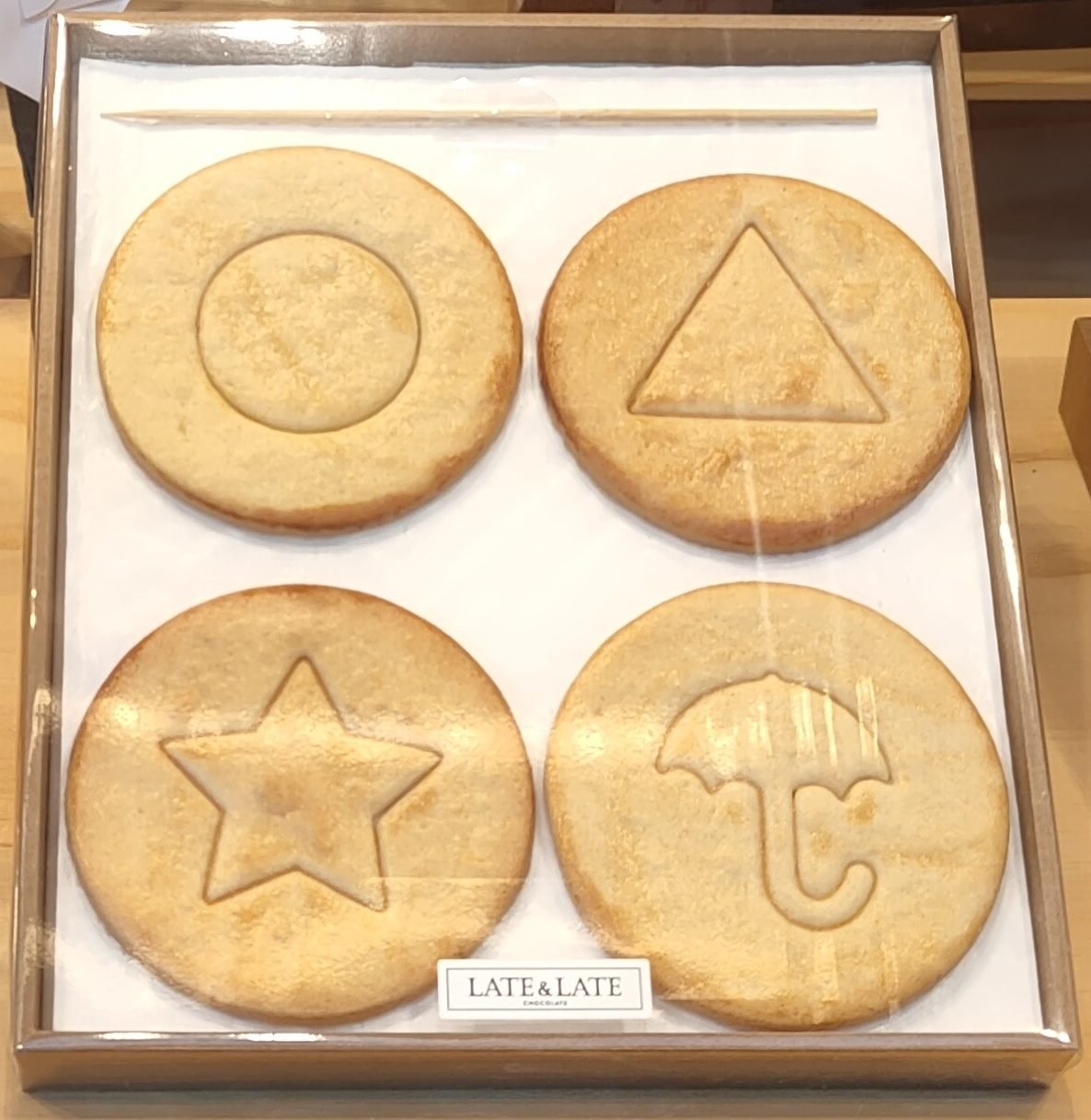
Netflix’s Squid Game page lists “equal doses of sweet and deadly” for the third episode, “The Man with the Umbrella.” The Reuters report adds that the challenge uses four shapes, a triangle, a circle, a star and an umbrella.
Reuters also visited a 2-square-meter stall in a Seoul university district, where the owner said he and his co-workers used 15 kg of sugar to make 700 candies for the June 2020 shoot of the third episode, and that sales had risen from about 200 a day before the premiere to more than 500. A piece cost about 2,000 won, and a second was free if the first did not crack, a bonus that mirrors the prize or extra piece the folk museum describes for a clean cut. Another famous Korean film gave the world ram-don and jjapaguri, and K-drama food spots in Seoul shows where other on-screen meals were set.
Why baking soda turns syrup into honeycomb
Sugar alone melts into a clear syrup and cools into a hard, glassy sheet. Baking soda changes the outcome. Heated, it gives off carbon dioxide, and the thick syrup traps the gas as bubbles while it sets, so the finished candy is brittle and full of tiny holes, much like the honeycomb toffee other kitchens make.
The same reaction explains the bitterness people complain about. Too much soda leaves a faintly soapy taste, so the amount is a measurement and not a matter of preference.
Sugar, soda and a ladle that can take the heat
Use a long-handled stainless steel ladle: thin aluminum scorches in patches, and a coated ladle can be damaged over a bare flame and by metal tools. Stir with a wooden chopstick or bamboo skewer, which pulls less heat out of such a small amount of syrup than metal does.
| Ingredient | If you are short |
|---|---|
| Granulated white sugar, 4 tbsp (50 g) in total | Raw or turbinado sugar works but darkens fast, so the stamped line vanishes and the flavor turns molasses-like. Powdered sugar usually contains starch and tends to come out cloudy and sandy. |
| Baking soda, 1/2 tsp (2 g) in total | Baking powder at double the amount gives a smaller rise and a denser, chewier candy that is less bitter. |
| Neutral oil, 1 tsp | Greases the press and the cutter. Butter works but browns on contact and can grab. |
Each cookie uses one tablespoon of sugar and is cooked as its own small batch. Melted sugar is far hotter than boiling water and sticks to skin, so keep children at the pressing stage and have a bowl of cold water close by.
Squid Game Dalgona Recipe (Ppopgi) – Just 2 Ingredients
Ingredients
Method
- Cut four squares of parchment paper about 15 cm (6 in) across. Lightly oil the flat base of a heavy mug and one side of a metal cookie cutter. Set them next to the stove with a needle or toothpick.
- Put 1 tbsp (12 g) sugar in a long-handled stainless steel ladle. Set it over low heat.
- Stir slowly with a wooden chopstick or bamboo skewer as the sugar melts. It goes from grainy to cloudy to clear. Stop when it is a clear syrup just turning pale gold, about 1 to 2 minutes — roughly 175°C / 350°F on a thermometer.
- Take the ladle off the heat. This matters: leave it on and the next step burns.
- Add a scant pinch of baking soda, about 1/8 tsp. Stir hard for 5 to 10 seconds. The syrup turns pale, thickens and rises up the ladle like foam.
- Pour it onto a parchment square in one motion. Wait about 10 seconds.
- Press it flat with the oiled base of the mug to a disc roughly 10 cm (4 in) wide and 5 mm thick.
- Immediately press the oiled cookie cutter into the center, about halfway through the candy. Do not cut all the way to the parchment.
- Lift the cutter straight up and leave the disc alone for 3 minutes to harden. Wash the ladle in hot water and repeat for the next cookie.
Recipe card photo: Dalgona 2.jpg by 동운맘, CC BY 4.0, via Wikimedia Commons.

Melting, foaming and pressing, in order
Set everything out before lighting the stove, because once the sugar melts there are no free hands.
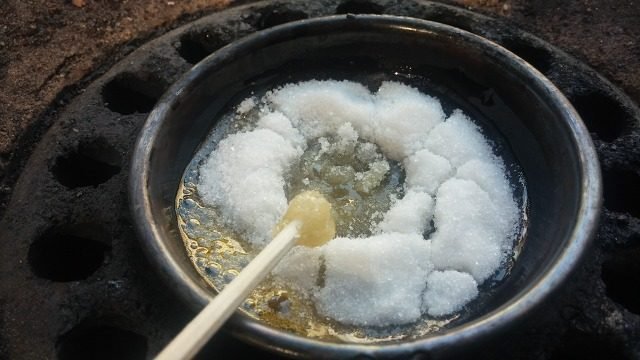

- Melt 1 tbsp sugar in the ladle over low heat, stirring slowly. It turns grainy, then cloudy, then clear. Stop at the first pale gold tint, usually after 1 to 2 minutes.
- Lift the ladle off the heat onto a trivet or a cold burner. The baking soda goes in only after this step.
- Add a scant 1/8 tsp baking soda and stir hard for 5 to 10 seconds, until the foam is an even beige with no dark streaks.
- Pour onto parchment in one go and do not scrape the ladle, because whatever clings to the metal is the overcooked part.
- Count to ten, then press the oiled mug base down until the disc is about 10 cm (4 in) wide and 5 mm thick. A crack at this point means you waited too long.
- Press the oiled cutter about halfway in, so it leaves a clear groove without cutting through, and lift it straight up.
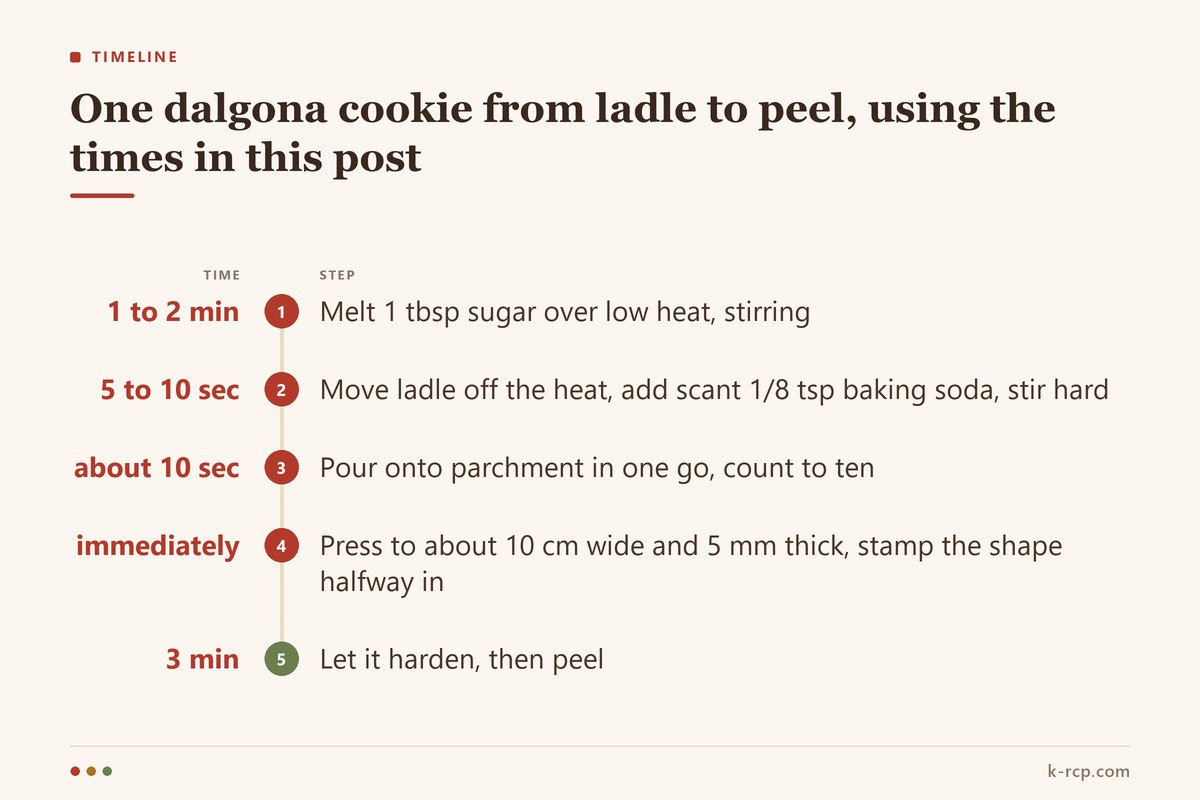
- Leave the disc for 3 minutes to harden, then peel it off the parchment and start the next one. Fill the empty ladle with hot water and the glassy shell dissolves by itself.
Playing the umbrella round at the table
The four shapes differ in difficulty. The circle is a warm-up, the triangle has three corners where cracks begin, and the star has five sharp points. The umbrella adds a thin curved handle, only a couple of millimeters of candy at its narrowest, which is why one careless press ends the round.

Agree the rules before pressing a shape: only a needle or toothpick, a time limit (ten minutes is generous, five makes a tense table), and a shape counts as won only if it comes out whole with no crack crossing the outline.
Licking along the groove melts the line instead of cutting it, and warm breath on the back softens the disc for a few forgiving seconds. Scratch along the groove with the needle almost flat and never stab straight down, which is the quickest way to snap an umbrella handle.
Four failures and what causes each
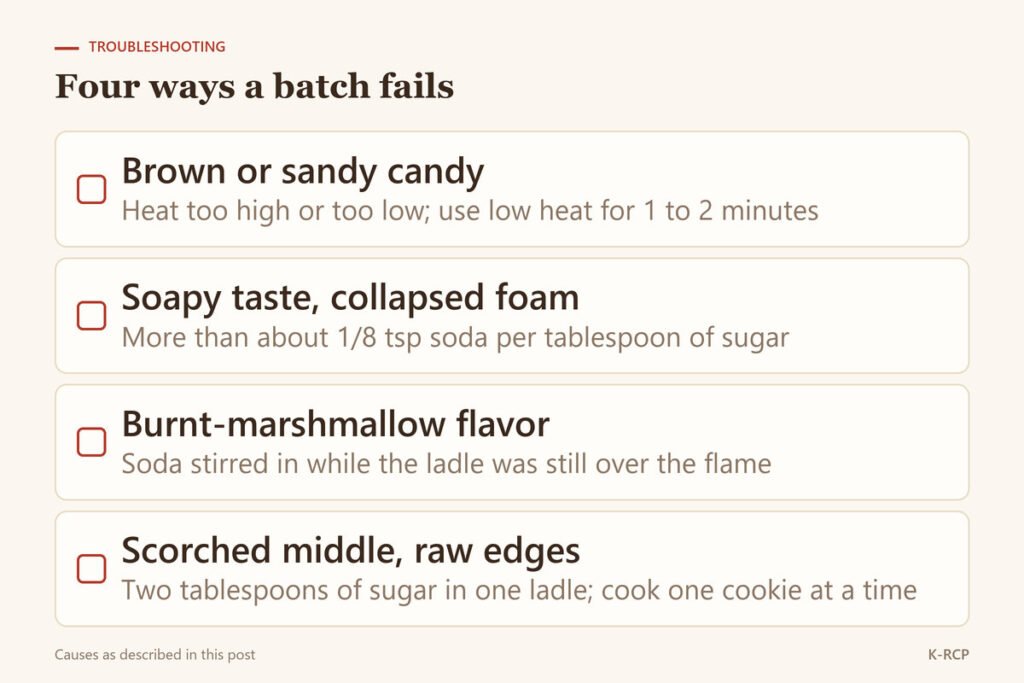
Nearly every bad batch traces back to one of four causes.
Heat that is off in either direction
This is the largest single cause. On medium heat the sugar at the bottom of the ladle passes gold and turns brown before the top has melted, and brown sugar syrup tastes bitter. On heat that is too low the sugar never fully liquefies, and the candy comes out sandy and dull instead of glassy.
Too much baking soda
A quarter teaspoon per tablespoon of sugar is about double what the recipe card uses. The excess gives a soapy aftertaste, a foam that rises and then collapses into a dense puck, and large ragged holes that leave the needle nothing solid to follow. About 1/8 tsp per tablespoon is right, and a slightly denser, sweeter candy is easier to play with anyway.
Soda stirred in over the flame
The ladle stays hot after it leaves the burner, and soda stirred into syrup that is still over the flame cooks several shades darker in seconds. That is where the burnt-marshmallow taste comes from. Move the ladle off the heat first and add the soda second.
A doubled batch
Two tablespoons of sugar in one ladle scorch in the middle before the edges melt. Four cookies means four small batches, and scraping leftover film from the metal into a good disc ruins the good disc.
How long a dalgona disc keeps its snap
The first 3 minutes. The pressed disc is soft enough to stamp, then it hardens quickly. Wait the full three minutes before peeling.
The first few hours. Dalgona turns soft and tacky in humid air, so it is best played the same day it is cooked.
The first few days. Once fully cool, store the discs in an airtight container with parchment under and between them, somewhere dry. Skip the refrigerator, because condensation makes the surface sticky.
After that. A soft disc will not reliably regain its snap, so eat it and cook a fresh batch for the game.