My first bossam smelled like a locker room by the time it hit the table.
I’d bought a nice piece of pork belly, dropped it in a pot of water with some garlic, and boiled it until it looked done. That was the whole method, as far as I knew. What came out was gray, faintly sour-smelling, and nobody at the table reached for a second piece. It took an older cousin tasting it and asking, flatly, “Did you put anything in the water?” for me to understand that bossam isn’t really a pork recipe. It’s a boiling-liquid recipe that happens to have pork in it, and the liquid is doing almost all of the work.
What actually removes the smell
Pork belly, boiled in plain water, carries a specific off-note — Koreans call it japnyeo-namsae, roughly “miscellaneous odor,” and it comes from compounds in the fat and connective tissue that plain heat doesn’t touch. The fix isn’t longer cooking. It’s what goes into the water alongside the meat.
Doenjang is the first line of defense. Fermented soybean paste is alkaline and full of enzymes and aromatic compounds that bind to and mask sulfurous smell molecules as the pork simmers — the same reason it shows up in almost every serious Korean pork-boiling recipe, not just bossam. Coffee grounds do something similar and slightly stranger: they’re a genuinely traditional addition in Korean home kitchens, not a modern trick, and the tannins and roasted compounds absorb odor the same way a box of coffee grounds absorbs smell in a refrigerator. Green tea leaves work by the same logic if coffee sounds odd to you.
Then there’s the aromatics doing the more familiar job — onion skin and all, smashed garlic, ginger, bay leaves, peppercorns. None of these are optional garnishes here. Skip two or three of them and you’re most of the way back to my first attempt.
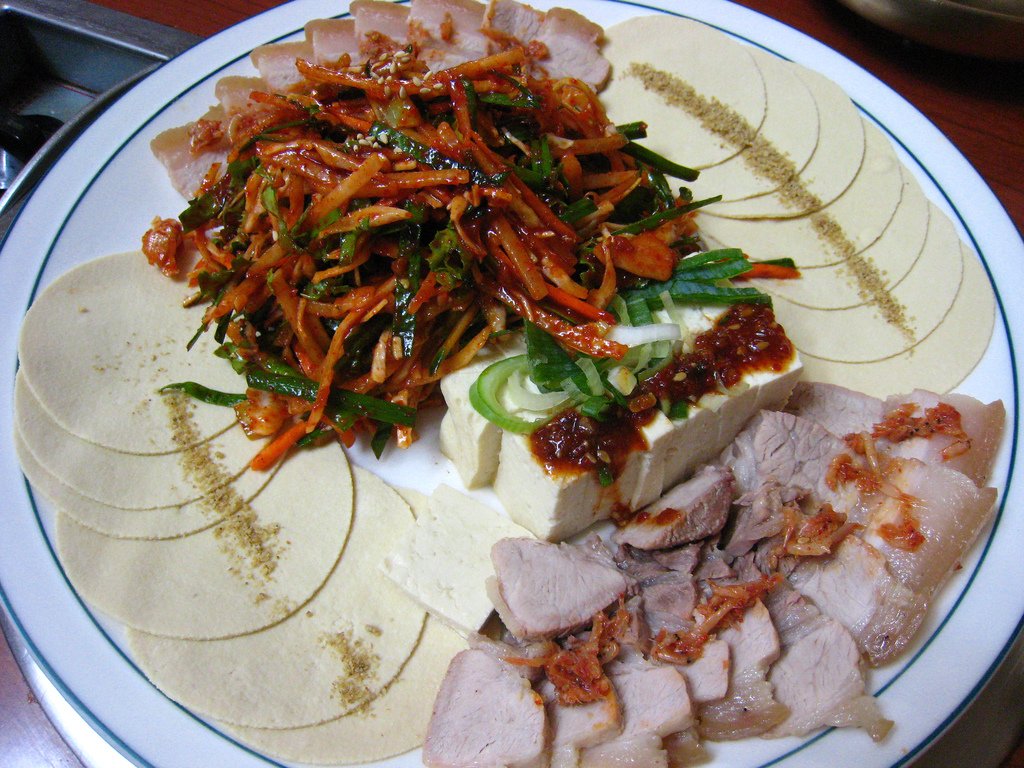
The cut, and what to ask your butcher for
Classic bossam uses pork belly, skin-on if you can get it, in one whole piece rather than sliced — a single 1 kg / 2.2 lb block is the right size for four people. The whole-piece part matters more than people expect. A big surface-to-volume ratio means more of the meat dries out during the long simmer, and belly sliced thin for stir-frying will fall apart into shreds long before it’s tender.
If belly isn’t available or feels too rich, boneless pork shoulder (sometimes labeled butt) is the standard substitute, and it’s what a lot of Korean households actually use for weeknight bossam — leaner, a little less silky on the tongue, but it takes the same treatment and comes out just as fork-tender. What you don’t want is a lean cut like loin. There’s not enough fat to carry through an hour of simmering, and it turns dry and stringy well before the connective tissue has had a chance to soften.
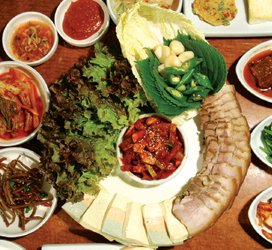
Bossam Recipe
Ingredients
Method
- Submerge the pork belly in a pot just large enough to hold it, cover with cold water by 5 cm / 2 inches, and add the doenjang, coffee grounds, onion, garlic, ginger, scallion whites, bay leaves, peppercorns, and soju.
- Bring to a boil uncovered, skimming off any gray foam that rises in the first 5 minutes.
- Drop the heat to a bare simmer — small bubbles, not a rolling boil — cover partially, and cook 50 to 60 minutes for a 1 kg piece, until a chopstick slides through the thickest part with no resistance.
- Turn off the heat and let the pork rest in the hot broth, uncovered, for 10 minutes. This keeps the outer slices from drying out while you get everything else ready.
- Lift the pork out, let it firm up for 5 minutes on a cutting board, then slice against the grain into pieces about 5 mm / 1/4 inch thick.
- Stir together the ssamjang ingredients in a small bowl.
- Arrange the pork on a platter with the lettuce, cabbage, and kimchi alongside, and serve everyone a spoon of ssamjang for building their own wraps.
Boiling temperature is the actual recipe
This is the part that gets skipped even by people who’ve nailed the aromatics. A rolling boil toughens the outside of the meat before the inside catches up, because the proteins on the surface seize and squeeze out moisture faster than gentle heat lets them relax. What you want, after the initial boil to bring everything up to temperature, is the kind of quiet simmer where you have to lean in to see the bubbles at all.
At that gentler heat, roughly 50 to 60 minutes gets a 1 kg piece to the point where a chopstick or skewer slides through the center with no resistance. That’s well past any food-safety minimum — bossam is meant to be cooked through completely, unlike a seared steak — but the goal past that point is texture, not just doneness. Overcooked belly does exist; past about 75 minutes at a hard simmer, even fatty belly starts drying at the edges while the center is fine. Pull it the moment the chopstick test passes.
Letting the cooked pork rest in the hot broth for 10 minutes before you lift it out matters almost as much as the simmer itself. Cut into it straight from the pot and the outer slices weep and dry within a few minutes on the plate. Ten minutes off the heat, still submerged, lets the juices redistribute the same way they would in a rested roast.
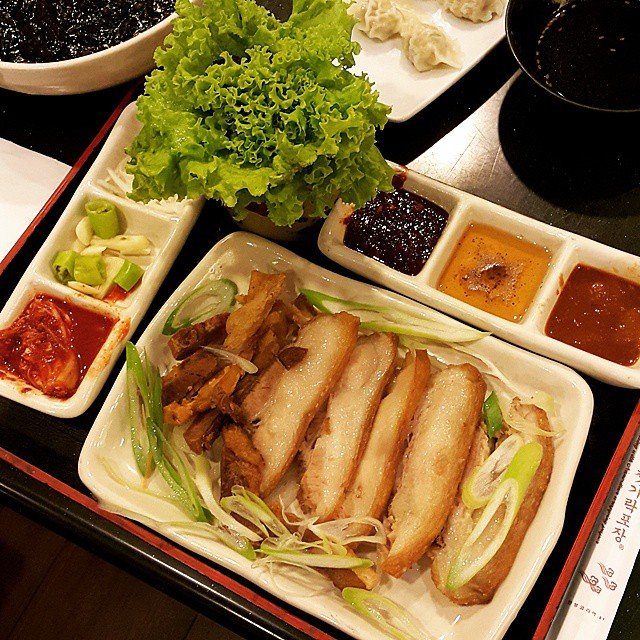
Slicing and the wrap
Slice against the grain, about 5 mm / a scant quarter-inch thick — thin enough to fold into a lettuce leaf without tearing it, thick enough that you still get a proper bite of fat and meat together. Slicing with the grain instead of across it is a common, invisible mistake; the pork looks identical on the plate but chews like rubber bands.
Bossam is built to be wrapped, not plated and eaten with a fork. A piece of pork goes into a lettuce or napa cabbage leaf, topped with a smear of ssamjang, a sliver of raw garlic if you like heat, and a forkful of kimchi, then folded and eaten in one or two bites. This is the whole reason kimchi is served alongside rather than mixed in — the acidity and crunch are there to cut the richness of the fat, the same job kimchi does in kimchi jjigae, just raw instead of simmered. Some households make a specific fresh, barely-fermented kimchi just for this — called bossam-kimchi, often mixed with pear or chestnut for sweetness — but a good scoop from your everyday kimchi container, made the traditional way, works fine.
Ingredients, and what to use instead
| Ingredient | Where to get it, or what to use instead |
|---|---|
| Pork belly, 1 kg, whole piece | Ask a butcher for a single skin-on block rather than pre-sliced. Substitute: boneless pork shoulder — leaner and slightly firmer, still tender |
| Doenjang, 2 tbsp | Korean grocer or well-stocked Asian aisle. Substitute: white miso plus a splash of soy sauce — milder, less funky, still does the odor-cutting job |
| Coffee grounds, 2 tbsp, or a green tea bag | Used coffee grounds from your own pot work fine. No coffee or tea in the house: an extra bay leaf and a few more peppercorns, though the smell control won’t be quite as strong |
| Ginger, 1 thumb | Any Asian grocer or supermarket produce aisle. Substitute: 1/2 teaspoon ground ginger |
| Ssamjang components | Doenjang and gochujang are both increasingly common in regular supermarkets now. In a pinch, a mix of miso and a little chili-garlic sauce gets you close |
Where it goes wrong
Skipping the doenjang and coffee is the single biggest failure point, and it’s an easy one to fall into because neither looks essential written down in a list. The second is heat — a hard boil the whole time instead of dropping to a simmer once the pot comes up to temperature. The third is slicing too thick; anything over about 1 cm doesn’t fold into a lettuce leaf and turns the meal into knife-and-fork eating, which isn’t wrong exactly, just not bossam.
Leftover pork keeps well. Cool it in its own broth, refrigerate up to 4 days, and reheat gently by dropping cold slices into a little simmering broth for a minute rather than microwaving them dry.
Frequently asked questions
Can I make bossam without pork belly?
Yes — pork shoulder is the standard substitute and plenty of Korean households prefer it for being less rich. Avoid loin or other lean cuts; without enough fat, the long simmer dries them out before the texture turns tender.
Do I really need coffee grounds in the pot?
It’s traditional, not a gimmick, and it noticeably cuts the gamey smell along with the doenjang. If the idea puts you off, a green tea bag does a similar job, and skipping both entirely still gives you an edible bossam — just a slightly stronger-smelling one.
What’s the difference between bossam and jokbal?
Both are boiled or braised pork served with lettuce wraps and ssamjang, which is why they’re often ordered together as a combination plate at Korean restaurants. Bossam uses pork belly or shoulder simmered plain in an aromatic broth for about an hour. Jokbal uses pig’s trotters braised much longer in a soy-based liquid until the skin turns glossy and gelatinous — a different cut, a different cooking time, and a noticeably different texture.
What to serve alongside
A wrap of bossam and kimchi is rich enough that most tables balance it with something lighter. Dubu kimchi — cool tofu next to hot stir-fried kimchi — follows the same logic of pairing fat with acid and is often served at the same meal as a second, smaller dish. If bossam becomes a regular thing in your house, it’s worth working through a full batch of properly fermented baechu kimchi rather than buying it fresh every time; the extra weeks of souring make the wrap taste noticeably better.