Here’s where kalguksu actually goes wrong for most people who try to make it from scratch: the dough tears the moment you try to roll it thin, or it springs back so aggressively that you can’t get it any thinner than a shoelace, or the noodles you do manage to cut turn into a single fused sheet the second they touch water. None of that is a sign you’re bad at this. It’s a sign the dough didn’t rest long enough, and it’s the single most skippable-looking, least skippable step in the whole recipe.
Kalguksu — literally “knife noodles” — is simple in concept: a wheat dough, rolled thin and cut by hand rather than extruded, dropped straight into a light broth. The technique is genuinely approachable once you know where it fails and why. This recipe is built around fixing exactly that.
Quick Facts
| Total time | 1 hour (dough resting included) |
| Serves | 3 |
| Difficulty | Medium — one technique (the dough) to get comfortable with |
| Spice level | 0 of 5 |
| Vegan? | Yes, as written — no meat in the base recipe |
What Is Kalguksu?
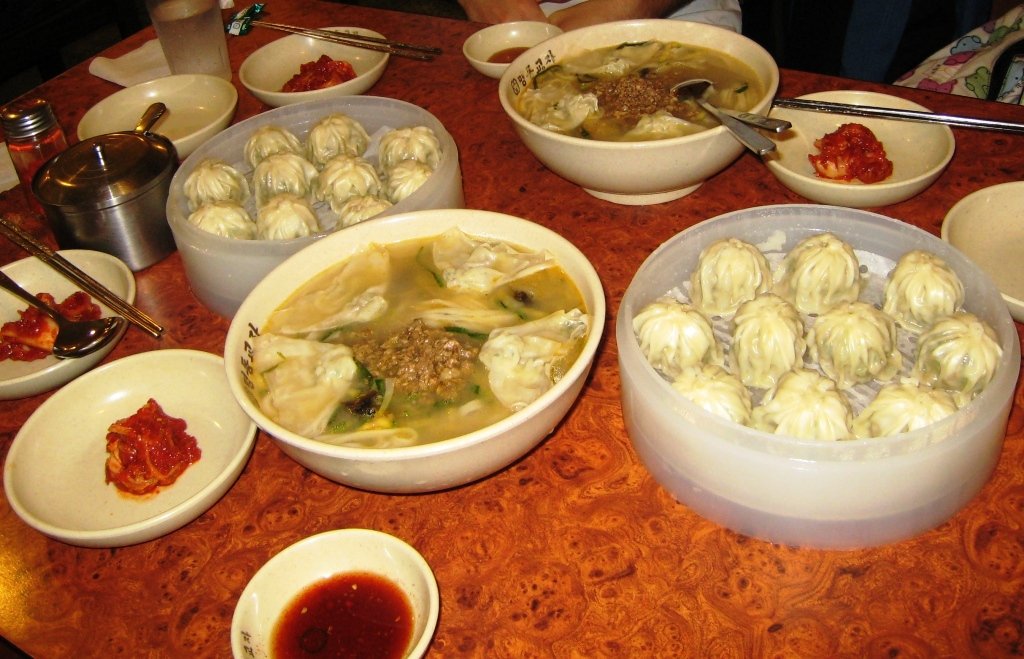
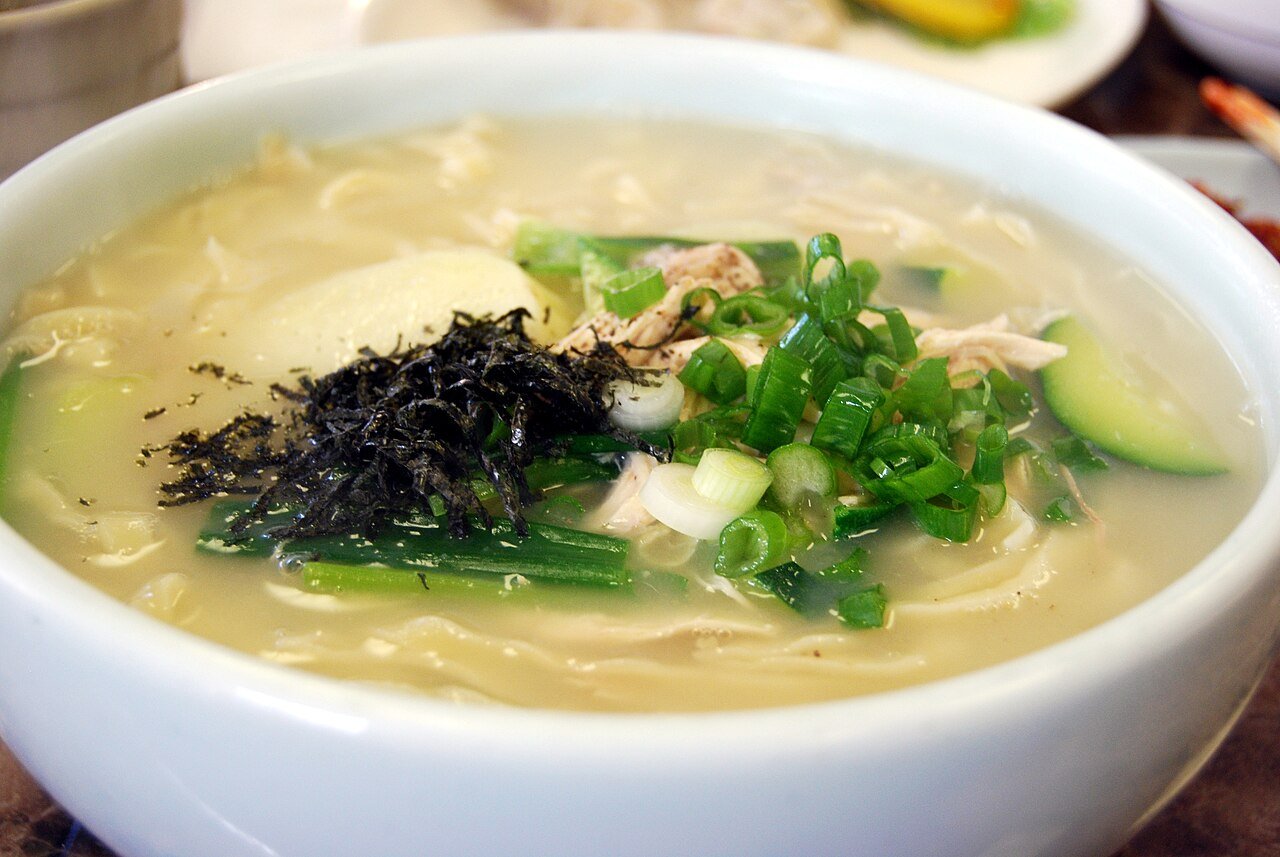
Kalguksu (칼국수, roughly kahl-gook-soo) means knife noodles, and the name is literal: the noodles are rolled into a sheet and sliced with a knife rather than pulled, pressed or extruded through a machine. They cook in a light broth, usually anchovy-and-kelp based, sometimes chicken-based (dak-kalguksu), occasionally built around clams and other shellfish for a seafood version (haemul-kalguksu).
What sets kalguksu apart from most noodle soups is that the noodles go directly from the cutting board into the simmering stock, dusted in flour and all, rather than being boiled separately and rinsed clean. That flour coating dissolves slightly into the broth as the noodles cook, thickening it just a little and giving kalguksu its characteristic soft cloudiness — a texture that would read as a mistake in most other noodle soups and is the whole point here.
The Dough: Where Everything Actually Goes Wrong
Three problems account for nearly every failed batch, and all three trace back to the same cause.
The dough tears when you try to roll it thin. This is gluten that hasn’t had time to relax. Fresh-kneaded dough is tight and elastic — that’s what kneading is for — but that same tightness fights you when you try to stretch it thin. A minimum 30-minute rest at room temperature, wrapped so it doesn’t dry out, lets the gluten network loosen enough to roll without ripping. An hour is better if you have it.
The noodles clump into one solid sheet the moment they hit water. This is almost always a flour problem, but in the opposite direction from what people assume — under-flouring the rolled and folded dough before slicing, so the cut strands stick to each other before they even reach the pot. Dust generously between folds and after cutting, and shake the noodles loose with your hands before they go anywhere near the stock.
The broth turns starchy in a way that looks like a mistake. It isn’t. That’s the flour coating on the noodles doing exactly what it’s supposed to do. If you rinse your kalguksu noodles before cooking, the way you might with other noodles, you lose the texture that makes this dish recognizable as kalguksu at all — a completely clear broth here is actually the sign something’s off, not the goal.
Ingredients
| Ingredient (for 3) | Where to get it, or what to use instead |
|---|---|
| All-purpose flour, 300 g / 2 1/2 cups | Any standard flour works. If the dough-and-knife process isn’t for you today, a package of fresh kalguksu noodles from a Korean grocery, or dried linguine as a pantry substitute, gets you a real bowl of noodle soup with none of the technique — linguine is springier and less silky, but it’s not a bad soup by any measure. |
| Dried anchovies, 8 to 10 | For the stock. Instant dashi powder, 1 teaspoon per 1.4 L of water, is the honest fast substitute and tastes closer to the real thing than most people expect. |
| Dried kelp (dasima) | One piece, about a palm’s width. Adds a background savoriness (umami) to the stock. Skip it if you can’t find it — the soup loses a little depth but is still entirely recognizable. |
| Potato, zucchini | Standard produce, sliced thin so they cook in the same window as the noodles. |
| Soy sauce, sesame oil, garlic, scallions | Standard pantry items. |
Kalguksu Recipe
Ingredients
Method
- Mix the flour and salt, then add the water gradually, stirring with chopsticks or a fork until it comes together into a shaggy mass.
- Knead 8 to 10 minutes until the dough is smooth and springs back slowly when you press it. Rub the surface with the oil, wrap tightly, and rest it at room temperature for at least 30 minutes.
- Simmer the anchovies and kelp in the 1.4 L water for 15 minutes, then strain and discard the solids.
- Roll the rested dough out thin, about 2 mm / 1/16 in, dusting with flour as you go so it doesn’t stick to itself.
- Fold the sheet loosely into thirds and slice crosswise into noodles about 4 mm / 1/6 in wide. Shake them apart with a little extra flour so they separate instead of clumping.
- Bring the strained stock back to a boil, add the garlic and potato, and simmer 5 minutes until the potato is nearly cooked through.
- Shake the excess flour off the noodles and drop them straight into the boiling stock — that flour coating is exactly what gives kalguksu broth its characteristic light cloudiness, so don’t rinse it off first.
- Add the zucchini and cook 4 to 5 minutes, stirring occasionally so the noodles don’t settle and stick to the bottom of the pot.
- Season with soy sauce and salt to taste, finish with sesame oil, and top with scallions.
How to Make It
- Mix flour and salt, then add water gradually. Stir with chopsticks or a fork rather than your hands at first — it keeps the dough from turning into a sticky mess before it’s had a chance to come together.
- Knead 8 to 10 minutes. You’re looking for a dough that’s smooth on the surface and springs back slowly, not instantly, when you poke it with a finger.
- Rest it, minimum 30 minutes, rubbed with a little oil and wrapped tightly in plastic so the surface doesn’t dry out and crack. This is the step to not skip, covered above in detail because it’s the one people cut corners on.
- Make the stock while the dough rests. Anchovies and kelp, 15 minutes at a simmer, then strain and discard the solids.
- Roll the dough thin, about 2 mm, dusting with flour continuously so it never sticks to the rolling pin or itself.
- Fold loosely into thirds and slice into noodles about 4 mm wide. Unfold and separate the strands with a shake and a little more flour dusted over them.
- Bring the stock to a boil, add garlic and potato, and give it 5 minutes before the noodles go anywhere near the pot.
- Add the noodles straight from the board, flour and all. Don’t rinse them first. Stir occasionally over the next 4 to 5 minutes so they don’t settle and stick to the bottom, where they’ll scorch.
- Add the zucchini in the last few minutes, just long enough to lose its raw bite.
- Season with soy sauce and salt, finish with sesame oil, and top with scallions before serving.
FAQ
Can I use store-bought noodles for kalguksu?
Yes. Fresh kalguksu noodles are sold at most Korean groceries and are a completely legitimate shortcut — plenty of Korean households buy them rather than rolling dough on a weeknight. Dried linguine is the nearest pantry substitute if a Korean grocery isn’t an option; it’s springier and less silky than a proper hand-cut noodle, but it makes a genuinely good bowl.
Why is my kalguksu broth cloudy — is that a mistake?
No, it’s meant to be that way. The flour dusting on the freshly cut noodles dissolves slightly into the broth as it cooks, giving kalguksu its characteristic soft, faintly starchy body. A perfectly clear kalguksu broth is actually the unusual result, not the goal.
Can I make kalguksu with chicken broth instead of anchovy stock?
Yes — that’s a real, named regional variation called dak-kalguksu, and it’s arguably milder and easier for a first-time cook to like. Simmer chicken thighs or a small whole chicken in water with a few slices of ginger and garlic for about 40 minutes, shred the meat back in at the end, and follow the rest of this recipe as written.
Related Recipes and Where It Goes
Kalguksu’s opposite number on a hot day is kongguksu, the chilled soy-milk noodle soup — worth reading together if you’re deciding which noodle soup fits the season. For another cold noodle option, naengmyeon covers the buckwheat version. Restaurants that serve kalguksu very often serve haemul pajeon alongside it, a pairing worth knowing if you’re building out a full meal. And if the dried anchovies and kelp here are new to your pantry, the Korean pantry starter kit explains what they’re for and where to buy them.