You watched somebody in a green tracksuit sweat over a honeycomb-colored disc with a sewing needle, and now you want to know two things. Can I make that at home, and is the umbrella actually as bad as it looked.
Yes. And yes — but for a reason nobody explains on screen.
This Squid Game dalgona recipe is sugar and baking soda in a ladle. There is no third ingredient, no corn syrup, no candy mold you have to order. What there is, instead, is a narrow window of about fifteen seconds where everything is decided, and three specific ways people blow it. I’ll get to all three.
Quick facts
Makes 4 cookies. About 5 minutes of prep and 15 minutes at the stove. Difficulty: easy to make, medium to make well. Not spicy, obviously. Vegan as written. One safety note before anything else — melted sugar sits around 175°C (350°F) and it sticks to skin. Keep children at the pressing stage, not the ladle stage, and have a bowl of cold water within reach.
What dalgona actually is
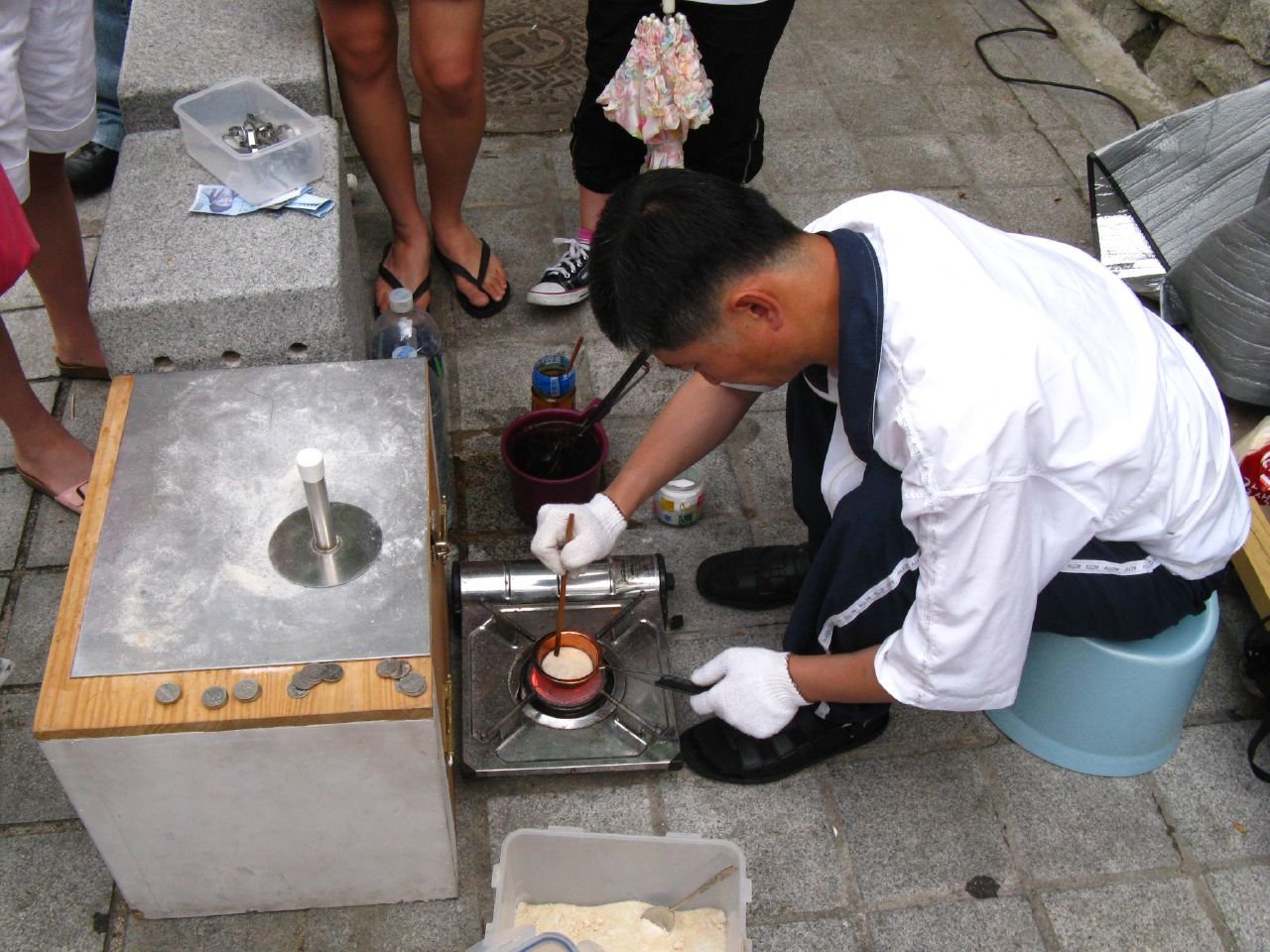
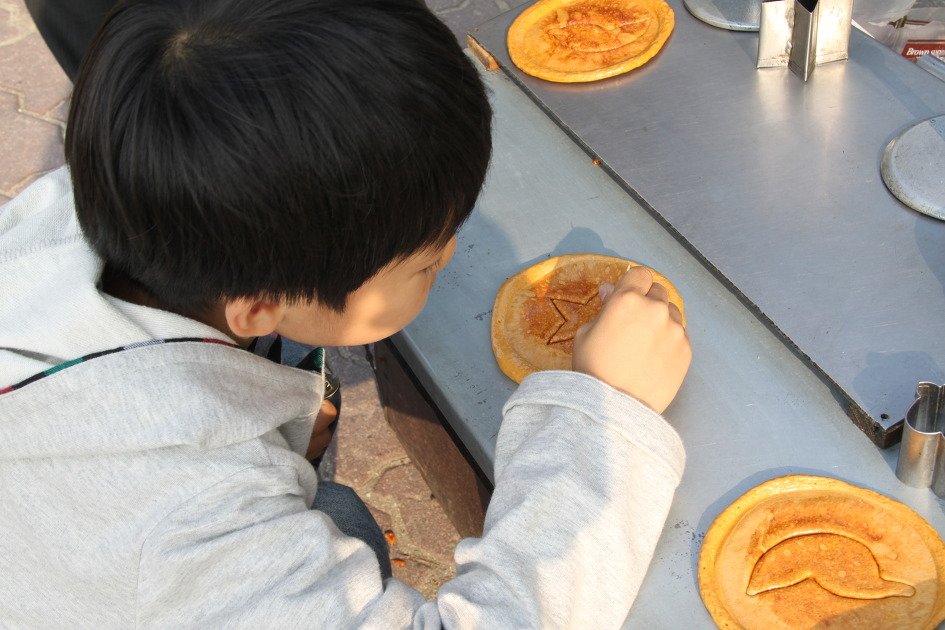
Dalgona (달고나, pronounced roughly dal-go-na) is Korean sugar candy, sold outside school gates for decades before Netflix found it. Its other name is ppopgi (뽑기), which means “to pull out” or “to draw” — and that name is the game, not the candy. Vendors stamped a shape into each disc, and if a kid picked the whole shape out without cracking it, they got a second one free. That’s the entire origin story of the challenge you saw. It was a marketing gimmick aimed at eight-year-olds.
The texture is the interesting part: brittle, airy, full of tiny holes, snapping like very thin toffee. English speakers usually land on “honeycomb toffee,” which is close enough.
Why it puffs up (the one paragraph of science)
Sugar on its own just melts into clear syrup and cools back into a hard flat sheet. Baking soda is what changes it. When you stir baking soda into syrup that hot, it breaks apart and releases carbon dioxide gas — the same gas that puts bubbles in soda. The gas has nowhere to go, so it inflates the syrup into a foam right there in the ladle, and because the syrup is already thick and cooling fast, it sets with all those bubbles frozen in place. That’s your honeycomb. It also explains the faint bitterness people notice: what’s left behind after the gas escapes is a salt that tastes slightly soapy, which is why the amount of baking soda you add is not a “roughly, whatever” situation.
What you need
Equipment first, because this is where most home attempts go wrong. You want a long-handled stainless steel ladle — not nonstick, the coating isn’t rated for this heat, and not thin aluminum, which scorches in spots. A wooden chopstick or bamboo skewer to stir, because metal pulls heat out of a very small amount of syrup. Parchment paper, cut into squares. Something flat and heavy to press with: the base of a ceramic mug is ideal. A metal cookie cutter for the shape. And a sewing needle or toothpick for the game itself.
| Ingredient | Where to get it, or what to use instead |
|---|---|
| Granulated white sugar, 4 tbsp (50 g) total | Any supermarket. Raw or turbinado sugar works but darkens much faster, so the stamped line disappears into the color and the flavor goes molasses-ish. Powdered sugar does not work — the cornstarch in it makes the candy cloudy and sandy. |
| Baking soda, 1/2 tsp (2 g) total | Any supermarket. Baking powder is the fallback: use double the amount, expect a smaller rise and a denser, chewier candy, though it’s noticeably less bitter. Do not substitute cream of tartar or yeast. |
| Neutral oil, 1 tsp | For greasing the press and the cutter. Butter works but browns on contact and can grab. |
Four cookies, one tablespoon of sugar each. Do them one at a time. Doubling the batch in one ladle is the single most common reason people end up with a burnt puddle — the middle scorches before the edges melt.
Squid Game Dalgona Recipe (Ppopgi) – Just 2 Ingredients
Ingredients
Method
- Cut four squares of parchment paper about 15 cm (6 in) across. Lightly oil the flat base of a heavy mug and one side of a metal cookie cutter. Set them next to the stove with a needle or toothpick.
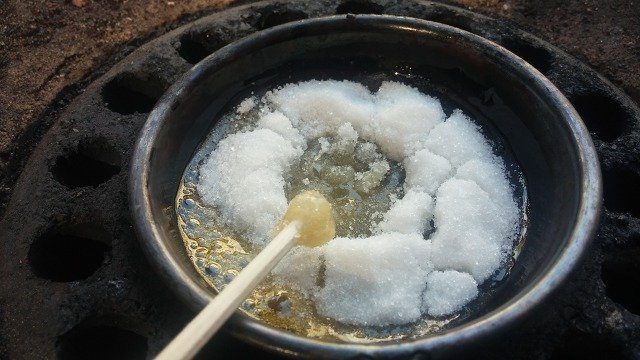
- Put 1 tbsp (12 g) sugar in a long-handled stainless steel ladle. Set it over low heat.
- Stir slowly with a wooden chopstick or bamboo skewer as the sugar melts. It goes from grainy to cloudy to clear. Stop when it is a clear syrup just turning pale gold, about 1 to 2 minutes — roughly 175°C / 350°F on a thermometer.
- Take the ladle off the heat. This matters: leave it on and the next step burns.
- Add a scant pinch of baking soda, about 1/8 tsp. Stir hard for 5 to 10 seconds. The syrup turns pale, thickens and rises up the ladle like foam.
- Pour it onto a parchment square in one motion. Wait about 10 seconds.
- Press it flat with the oiled base of the mug to a disc roughly 10 cm (4 in) wide and 5 mm thick.
- Immediately press the oiled cookie cutter into the center, about halfway through the candy. Do not cut all the way to the parchment.
- Lift the cutter straight up and leave the disc alone for 3 minutes to harden. Wash the ladle in hot water and repeat for the next cookie.
How to make dalgona, step by step
- Set up before you turn on any heat. Cut four parchment squares. Oil the mug base and one side of the cookie cutter. Line them up beside the stove with the needle. Once the sugar melts you have no free hands.
- Melt 1 tbsp sugar in the ladle over low heat. Low. Not medium, not “medium-low because I’m in a hurry.” Stir slowly and constantly with the wooden stick.
- Watch the color, not the clock. The sugar goes grainy, then cloudy, then clear. When it’s clear syrup with no crystals left and just beginning to take on a pale gold tint, it’s done — usually 1 to 2 minutes. If you have a thermometer, around 175°C / 350°F.
- Take the ladle off the heat. Move it to a cold burner or a trivet. Do this before the baking soda goes in, not after.
- Add a scant 1/8 tsp of baking soda and stir hard for 5 to 10 seconds. The syrup goes pale, swells and climbs the sides of the ladle. Stir until the color is even — you’re looking for a uniform beige foam, no dark streaks.
- Pour it onto parchment in one go. Don’t scrape the ladle. Whatever clings to the metal is the overcooked part.
- Count to ten, then press. Bring the oiled mug base down flat and steady until the disc is about 10 cm (4 in) across and 5 mm thick. Even pressure. If it cracks under the mug, you waited too long.
- Stamp the shape immediately. Press the oiled cutter about halfway into the candy — you want a clear groove, not a cut. Lift straight up.
- Leave it for 3 minutes. It sets hard as it cools. Then peel it off the parchment and start the next one.
The ladle will have a glassy shell in it. Fill it with hot water and it dissolves on its own in a few minutes. Don’t scrub it.
The umbrella challenge, and how it’s actually scored
Traditionally there were four shapes, in order of difficulty: circle, triangle, star, umbrella. The circle is a warm-up. The triangle has three corners where cracks start. The star has five, all of them acute. The umbrella has a thin curved handle attached to a wide canopy, and that handle is maybe two millimeters of candy at its narrowest — one careless press and it’s gone.
The rules, as they’re actually played:
You pick your shape before you see which disc you get. You may use only a needle or toothpick — no snapping the shape out with your fingers, no biting it free from behind. Set a timer for ten minutes, as the show does, or five if your group is competitive. You win if the stamped shape comes out whole, with no crack crossing the outline. A chipped edge outside the line doesn’t count against you.
The two legitimate techniques are both about softening the sugar rather than forcing it. Licking along the groove works because saliva dissolves sugar; you’re melting the line, not cutting it. Breathing warm air onto the back of the disc softens the whole thing slightly, which buys you a few forgiving seconds. Then you scratch — always along the groove, always with the needle nearly flat, never stabbing straight down. Straight down is how the umbrella handle snaps.
Make an extra cookie or two. Somebody will want a rematch.
Three ways this goes wrong
1. The heat
By a wide margin the biggest one. On medium heat, the sugar at the bottom of the ladle passes gold and goes brown before the sugar on top has melted at all, and brown sugar syrup is bitter — caramelization keeps running whether you want it to or not. Too low and the opposite happens: the sugar never fully liquefies, stays grainy, and the finished candy comes out sandy and dull instead of glassy. Low heat plus constant stirring is the answer, and it should take a minute or two, not fifteen seconds.
2. Too much baking soda
Recipes floating around call for a quarter teaspoon per tablespoon of sugar. That’s roughly double what you want. Overdo it and you get three problems at once: a soapy, bitter aftertaste; a foam that rises dramatically and then collapses into a dense puck as it cools; and a candy so full of large ragged holes that the needle has nothing solid to work along. A scant pinch — about 1/8 tsp — is right. Less baking soda makes a denser, sweeter, easier-to-play cookie, which is honestly what you want for the game.
3. Burning it after you think you’re done
The ladle stays hot after it leaves the stove, and adding baking soda to syrup that’s still over a flame cooks it several shades darker in the seconds you’re stirring. That’s the scorched taste people describe as “burnt marshmallow.” Off the heat first, then the soda. Same goes for scraping the ladle out onto your parchment — the film stuck to the metal is always the darkest, most bitter part of the batch, and stirring it into a good disc ruins the good disc.
Keeping it
Dalgona goes soft and tacky in humid air within a few hours, which is why street vendors make it to order. Once it’s fully cool, store the discs in an airtight container with the parchment still under them, separated by more parchment, somewhere dry. They’ll stay crisp for about a week. Don’t refrigerate — condensation on the surface turns them sticky. If they do soften, three or four minutes in a 100°C (210°F) oven, then cool completely, brings most of the snap back.
Questions people ask
Can I make dalgona without baking soda?
Not really — without it you get flat hard sugar candy, which is fine to eat but has no honeycomb structure and nothing to play with. Baking powder is the only workable substitute: use double, and accept a denser, chewier result.
Why does my dalgona taste bitter?
Almost always one of two things. Either the sugar went past gold into brown, or you used too much baking soda. Both are fixable on the very next cookie, which is the advantage of making them one at a time.
Do I need a special dalgona kit?
No. The kits sold online are a ladle, a press and some stamps — all things you can substitute from your own kitchen with a mug and a cookie cutter. The one thing worth buying, if you plan to make these more than once, is a cheap stainless ladle you don’t mind dedicating to sugar.
Is dalgona the same as dalgona coffee?
Different thing entirely, confusingly. Dalgona coffee is the whipped instant-coffee drink that went viral in 2020, named because its foam looks like this candy’s honeycomb color. This recipe is the candy — sugar and baking soda in a ladle, nothing whisked, nothing brewed.
What to make next
If Squid Game is what brought you here, the other great drama-to-kitchen project is ram-don, the jjapaguri from Parasite — two instant noodle packets and a steak, and about eight minutes of work. For something to feed people rather than compete with them, tteokbokki is the Korean snack most likely to become a regular. And if you’re building out a Korean shelf from scratch, our Korean pantry starter kit covers what’s worth buying first.
In Seoul, dalgona has quietly come back — the market alleys downtown now have vendors pressing it to order for visitors who grew up with the show rather than the school gate. If you’re planning a trip, our sister site’s walkthrough of Gwangjang Market’s food stalls is a good place to start, and we’ve mapped out the Seoul neighborhoods behind the K-drama food scenes if you want to build a route around it.
Squid Game Dalgona Recipe (Ppopgi) – Just 2 Ingredients
Ingredients
Method
- Cut four squares of parchment paper about 15 cm (6 in) across. Lightly oil the flat base of a heavy mug and one side of a metal cookie cutter. Set them next to the stove with a needle or toothpick.
- Put 1 tbsp (12 g) sugar in a long-handled stainless steel ladle. Set it over low heat.
- Stir slowly with a wooden chopstick or bamboo skewer as the sugar melts. It goes from grainy to cloudy to clear. Stop when it is a clear syrup just turning pale gold, about 1 to 2 minutes — roughly 175°C / 350°F on a thermometer.
- Take the ladle off the heat. This matters: leave it on and the next step burns.
- Add a scant pinch of baking soda, about 1/8 tsp. Stir hard for 5 to 10 seconds. The syrup turns pale, thickens and rises up the ladle like foam.
- Pour it onto a parchment square in one motion. Wait about 10 seconds.
- Press it flat with the oiled base of the mug to a disc roughly 10 cm (4 in) wide and 5 mm thick.
- Immediately press the oiled cookie cutter into the center, about halfway through the candy. Do not cut all the way to the parchment.
- Lift the cutter straight up and leave the disc alone for 3 minutes to harden. Wash the ladle in hot water and repeat for the next cookie.