You don’t need a bingsu machine to make patbingsu. You need a flat container, a freezer, and either a sturdy spoon or a food processor. That’s the entire equipment list, and it’s worth saying upfront because most English-language recipes for this dish either assume you own a dedicated ice shaver or quietly give up and tell you to use crushed ice from a bag, which isn’t the same dessert at all.
Patbingsu (팥빙수, pat meaning red bean, bingsu meaning shaved ice) is built on ice shaved fine enough to be closer to snow than to crushed ice, and in most Korean households and cafés, that ice isn’t even plain water — it’s frozen sweetened milk, which shaves into something with real body and a faint creaminess rather than just cold crystals. Getting that texture without a machine comes down to one decision: freeze the milk flat, not in cubes.
Quick facts
- Total time: 20 minutes active work, plus overnight freezing
- Serves: 2 generously, or 1 if you’re not sharing
- Difficulty: easy
- Spice level: none
- Vegan-friendly: not as written, but oat or soy milk plus a plant-based condensed milk work as a direct swap
Getting shaved ice without a bingsu machine
The trick is in how you freeze it, not what you freeze it in. A block of milk frozen in a deep container, like an ice cube tray or a loaf pan, is thick enough that a spoon barely scratches the surface — you end up gouging chunks instead of shaving flakes. Poured into something wide and shallow, a small baking dish or even a large plate with a raised edge, the same milk freezes into a layer thin enough that a firm, repeated scraping motion with the edge of a metal spoon peels off genuinely fine, snow-like ribbons.
If scraping by hand sounds like too much arm work for two bowls of dessert, a food processor gets there faster. Break the frozen sheet into rough two-inch chunks first, then pulse — not run continuously — in short bursts, scraping down the sides between pulses. Continuous blending turns it to slush within seconds; pulsing keeps it as separate, fluffy crystals. Either method gets you something closer to the real thing than store-bought crushed ice ever will, because the milk fat and sugar keep the shavings from melting into a puddle the moment they hit the bowl.

Ingredients, and what to use instead
| Ingredient | Where to get it, or what to use instead |
|---|---|
| Whole milk, 2 cups, frozen with sugar | Any supermarket. For a richer shave, swap in a quarter of the milk for sweetened condensed milk and skip the added sugar |
| Sweetened red beans, 1 1/2 cups | Canned “sweet red bean” from an Asian grocer is the fastest option. Cooking dried azuki beans with sugar from scratch takes about an hour but keeps better texture |
| Injeolmi rice cake, 1 cup | Korean grocer, refrigerated or frozen section. Any mochi or plain rice cake cubes work, dusted with roasted soybean powder or crushed peanuts if you have them |
| Roasted soybean powder | Korean grocer. Crushed graham crackers give crunch without the same flavor, which is a fair trade if this isn’t a pantry item you’ll use again soon |
| Condensed milk, fresh fruit | Any supermarket |
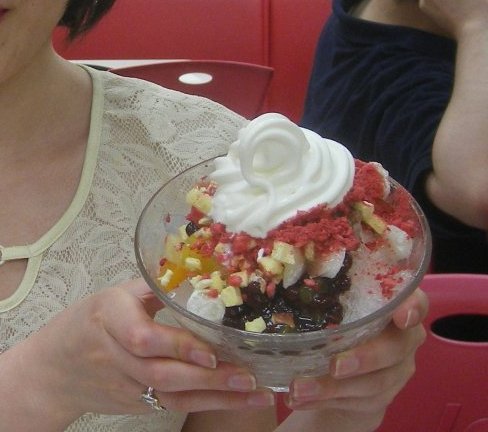
Patbingsu Recipe
Ingredients
Method
- The day before, stir the sugar into the milk until dissolved, pour it into a shallow, flat container — a small baking dish works well — and freeze it solid overnight.
- If using canned red beans, taste them; add a pinch more sugar if they’re mild, or leave as is.
- To shave the frozen milk, run the underside of a heavy metal spoon firmly across the surface, working in short strokes, to scrape off fine, snow-like flakes into a bowl. Alternatively, break the frozen block into rough chunks and pulse them in a food processor in short bursts until they turn to snow rather than slush.
- Mound the shaved milk ice into two wide, shallow bowls.
- Spoon the sweetened red beans generously over the top of each mound.
- Scatter the rice cake cubes and fruit, if using, over the beans.
- Drizzle with condensed milk and dust with roasted soybean powder.
- Serve immediately with a long spoon, and mix everything together before eating rather than eating it in layers.
How to make it
- The day before, stir sugar into the milk and freeze it in a shallow, flat container.
- Shave the frozen block with a spoon, working in firm strokes, or break it into chunks and pulse it in a food processor until snow-like.
- Mound the shaved ice into bowls.
- Top generously with sweetened red beans.
- Add rice cake cubes and any fruit.
- Drizzle with condensed milk and dust with soybean powder.
- Serve immediately, and stir it together at the table rather than eating around the toppings.
Where this goes wrong
Freezing the milk in a deep container is the most common reason home attempts fail before they start — a thick block simply won’t shave, whatever tool you use. Flat and shallow is the whole trick.
Running a food processor continuously instead of pulsing is the second issue. It feels faster, but a continuous blend heats the ice slightly through friction and turns it to slush in under thirty seconds. Short pulses, checking the texture each time, keep it fluffy.
Making it too far ahead is the third. Shaved milk ice starts melting the moment it’s out of the freezer, faster than a cocktail on ice, since it’s already so finely divided. Shave and assemble right before serving, not while other dishes are still cooking.
Overloading the bowl before adding the ice is a smaller, easier mistake to avoid. Put the shaved ice in first, mounded loosely rather than packed down, and add toppings on top rather than trying to fold them in — pressing the ice flat while mixing in beans and fruit collapses the fluffy texture you just spent effort creating.
Topping variations worth trying
Once the base method is down, patbingsu is really a template rather than a fixed recipe, and Korean cafés treat it that way. Fruit-forward versions swap most of the red beans for diced mango, strawberry, or melon piled generously over the shaved ice, with just a spoonful of beans kept for tradition’s sake. Coffee versions drizzle espresso or cold brew over the ice instead of condensed milk, and skip the rice cake for coffee jelly cubes. A cheese-topped version, genuinely popular in Seoul cafés over the last decade, adds a light dusting of grated hard cheese for salt and richness against all that sweetness, which sounds unlikely until you’ve actually had it. None of these change the underlying technique — the shaved milk ice is still the foundation everything else sits on.
Frequently asked questions
Can I make patbingsu with plain water ice instead of milk?
Yes, and it’s the older, more traditional base — plain shaved ice with red beans on top, which is how the dish is described historically before milk versions became common in cafés. It’s lighter and less rich, and it’s a fair option if you don’t want the dairy.
Do I have to use red beans?
They’re the defining ingredient the dish is named for, but plenty of modern versions lean on fruit, condensed milk, and mochi instead and barely feature beans at all. If you’re not a fan, a smaller portion pushed to one side rather than mixed through is a reasonable compromise.
What can I use instead of injeolmi if I can’t find it?
Any soft rice cake or mochi cut into small cubes works structurally. The distinct flavor comes from the roasted soybean powder it’s traditionally coated in, so dusting plain rice cake with that powder separately gets you most of the way there even without true injeolmi.
What to make next
If shaved ice becomes a regular summer thing, naengmyeon, Korea’s cold buckwheat noodle dish, runs on the same logic of icy food built for hot weather, and it’s a genuine meal rather than a dessert. And if you want something to serve after a big Korean meal instead of during it, sikhye, a sweet fermented rice drink, is the other classic cold finish to a summer table.