Why does homemade sikhye refuse to turn sweet? Most likely the rice never stayed inside the band of warmth the malt works in. The Encyclopedia of Korean Culture is blunt about both edges of that band: too cool and the rice sours, too hot and the starch does not convert well.
Sikhye (식혜) is sweetened by malt, not by cooking, and a rice cooker on its keep-warm setting is an easy way to hold the warm band without a thermometer, which is why the recipe on this page uses one.
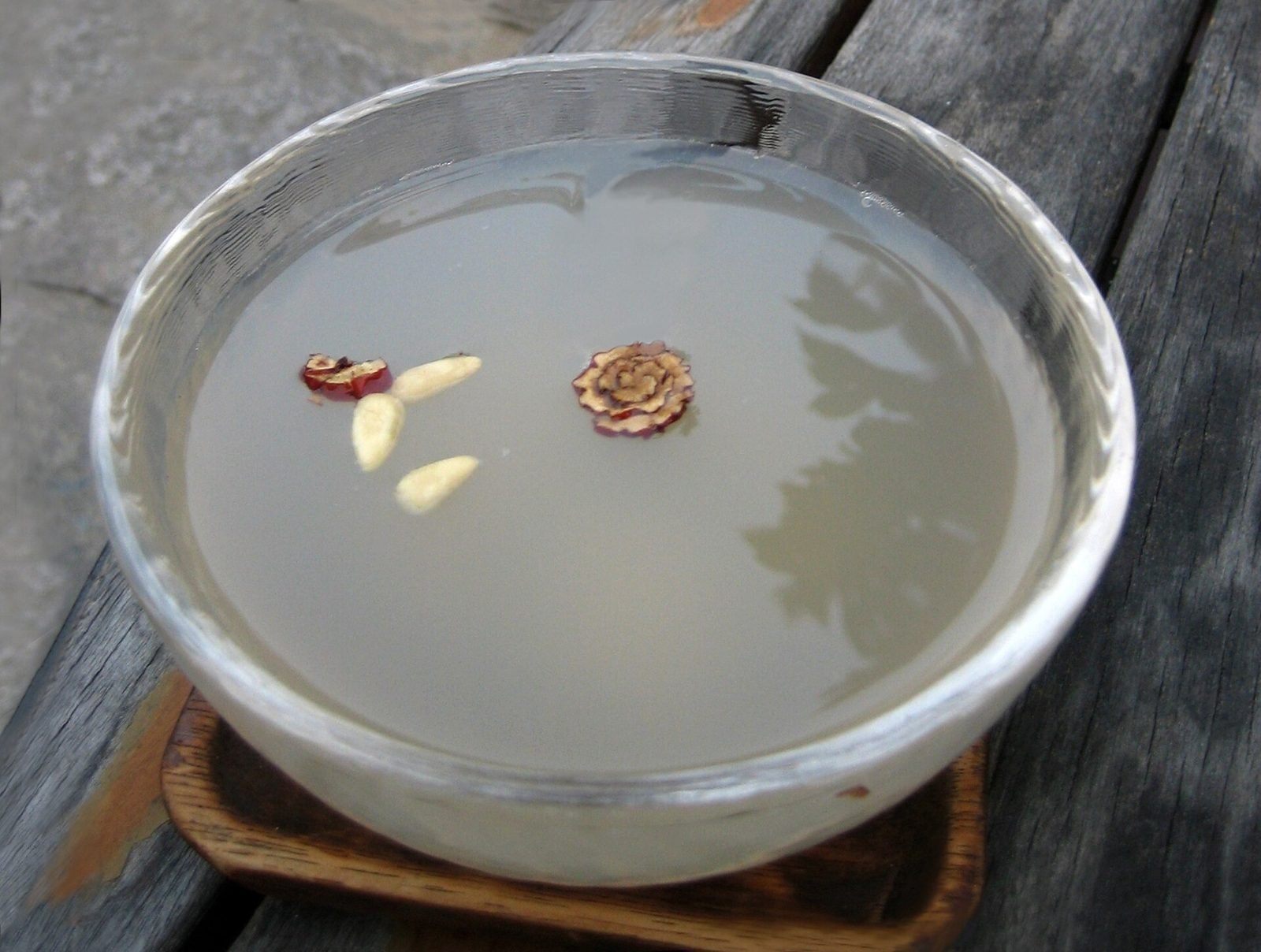

Sweetness from malt, not from sugar
The Encyclopedia of Korean Culture entry on sikhye describes the drink as rice that has been broken down by malted barley until it turns sweet. Malt, it explains in a note, is barley that has been soaked, sprouted and dried. Its method holds the rice and malt water at 60 to 70 °C for 4 to 5 hours. It warns that if the temperature is too low the rice sours and the drink fails, and that if it is too high the starch does not convert well.
The Korea Food Promotion Institute gives a lower and longer range. Its sikhye recipe uses a keep-warm rice cooker: malt water warmed to 40 °C is poured over the rice, and the pot is held at 50 to 60 °C for 5 to 6 hours. The two ranges touch only at 60 degrees. The method below goes with the institute’s range, since the card is built around keep-warm, and it leaves the exact temperature to your cooker: you taste at hour four and decide.
What sikhye was before sugar
Nobody knows when sikhye was first made, according to the encyclopedia. Some scholars read a term in a Goryeo-period text as an early sikhye or gamju-type drink, and the first concrete record is in a Joseon-era book from the reign of King Yeongjo. A 1996 study in the Korean Journal of Food and Nutrition found that traditional sikhye was made with malt and rice alone, recorded since 1740, and that the first record of sugar being added is from 1924. The same study reports that factory sikhye uses about 3 percent cooked rice and 10 percent sugar.
The encyclopedia makes a similar complaint about the present: sikhye used to be drunk in autumn and winter, and today’s versions are often so sweet with added sugar that they taste less of malt sugar. The institute’s recipe lists 2 cups of sugar for 3 L of liquid but leaves it to taste, and the page’s own recipe does the same, so sweeten after straining and tasting. The encyclopedia also separates two related drinks: in sikhye the floating rice grains are lifted out, the liquid is boiled and chilled, and the grains are added back, while gamju is held until the grains dissolve and is boiled thick and drunk hot.
Malt, rice and the rest of the pantry
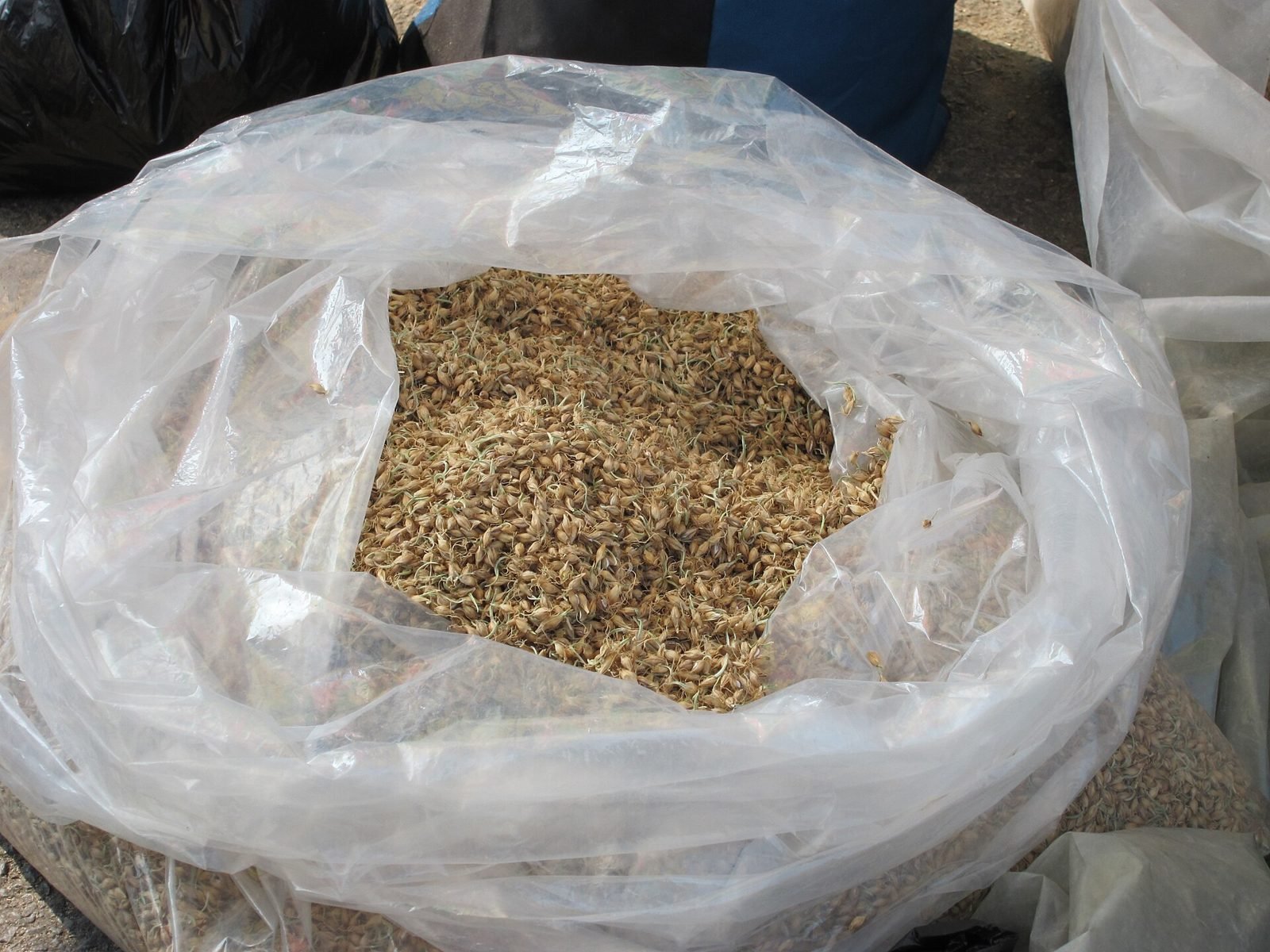
Malt powder
Malt powder is sold as yeotgireum or sikhyegaru at Korean grocers and online. There is no real substitute, because it is the ingredient doing the conversion; leave it out and nothing happens to the rice. The institute’s recipe uses 180 g of malt powder for 3 L of water, about 60 g per liter, and the card uses 100 g in 2 liters, about 50 g per liter, so the two are close to each other. Keep the powder dry.

Rice, sugar and garnish
The institute uses 300 g of glutinous rice. This page’s version uses 2 cups (about 400 g) of cooked short-grain rice, a day old if you can, because slightly firm rice holds its grains through hours of warm soaking. The encyclopedia notes a trade-off: non-glutinous rice floats better, while glutinous rice turns mushy and looks untidy but gives a slightly sweeter drink. Either way, add sliced ginger with the sugar when you boil the liquid, and garnish with pine nuts or slivers of dried jujube. The institute adds that pomegranate seeds or a spoonful of yuja syrup also work.
Holding the temperature in a rice cooker
The card below lists the full amounts for six servings. The notes after it explain what each step is doing and where the sources agree or disagree.
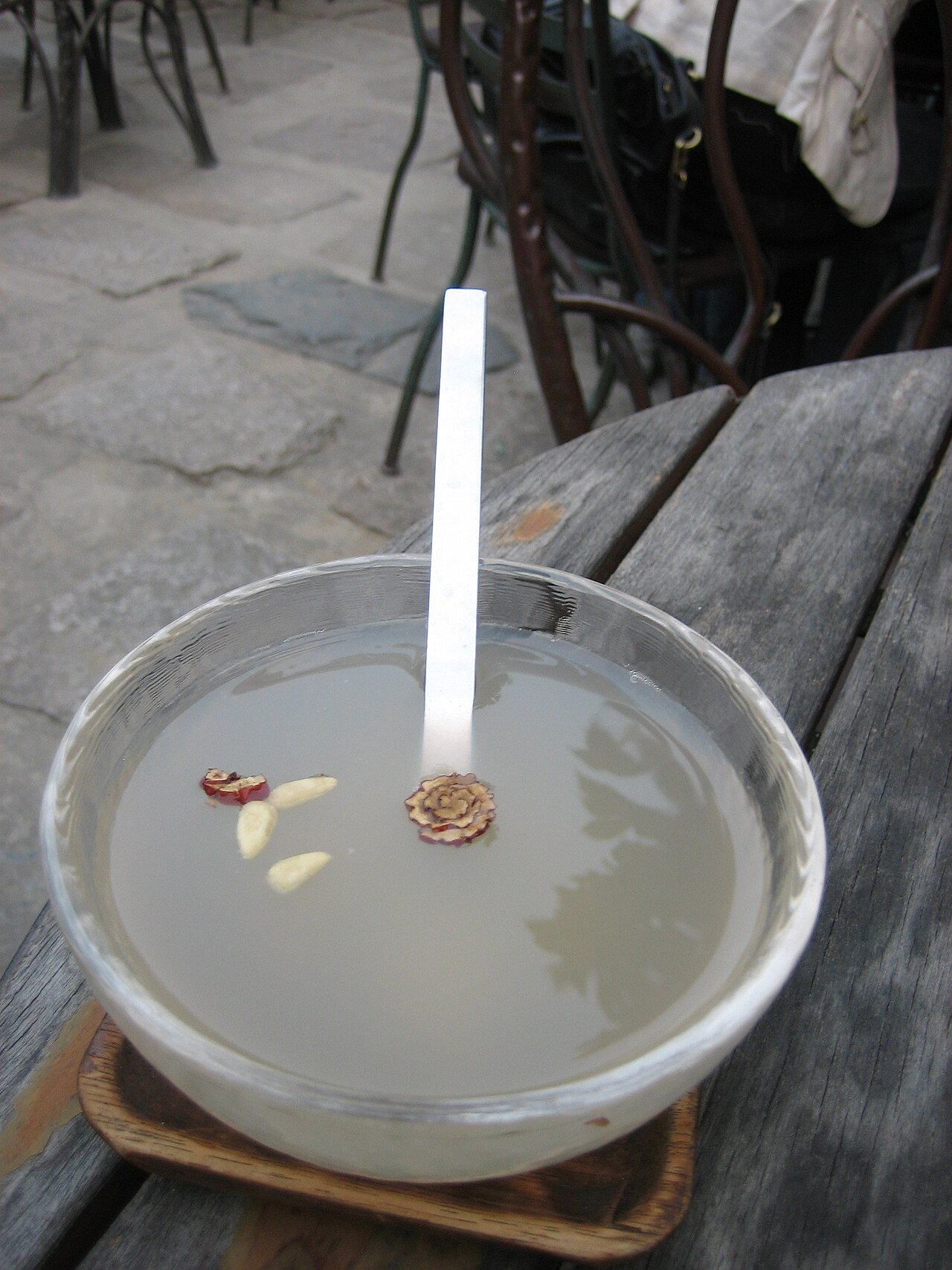
Sikhye Recipe
Ingredients
Method
- Whisk the malted barley powder into the warm water. Let it sit 20 minutes, stirring once or twice, so the starch-digesting enzymes release into the water.
- Strain the mixture through a fine sieve lined with cheesecloth, or an ordinary clean dish towel, squeezing firmly to push out as much cloudy liquid as possible. Discard the coarse bran left behind. This liquid is your malt water.
- Pour the malt water into the rice cooker insert along with the cooked rice.
- Set the rice cooker to its keep-warm function, not the cook setting, and leave the lid propped very slightly open with a chopstick. Let it sit 4 to 6 hours.
- Check it after 4 hours: the liquid should taste distinctly, unmistakably sweet, and a few grains of rice should be floating on the surface rather than sitting on the bottom. If it still tastes mostly like water, give it another hour.
- Scoop out about 1/2 cup of the floating rice grains and set them aside in a bowl of cold water. Pour the rest of the liquid into a saucepan, leaving the remaining softened rice behind or straining it out.
- Add the sugar and sliced ginger to the saucepan. Bring to a boil, skimming off any foam, then simmer 5 minutes.
- Cool the liquid completely, then refrigerate until cold. Serve in cups or bowls with a few of the reserved floating rice grains and pine nuts on top.
Recipe card photo: File:Korean rice punch-Sikhye-01.jpg by gliuoo, CC BY-SA 2.0, via Wikimedia Commons.

Soaking and straining the malt
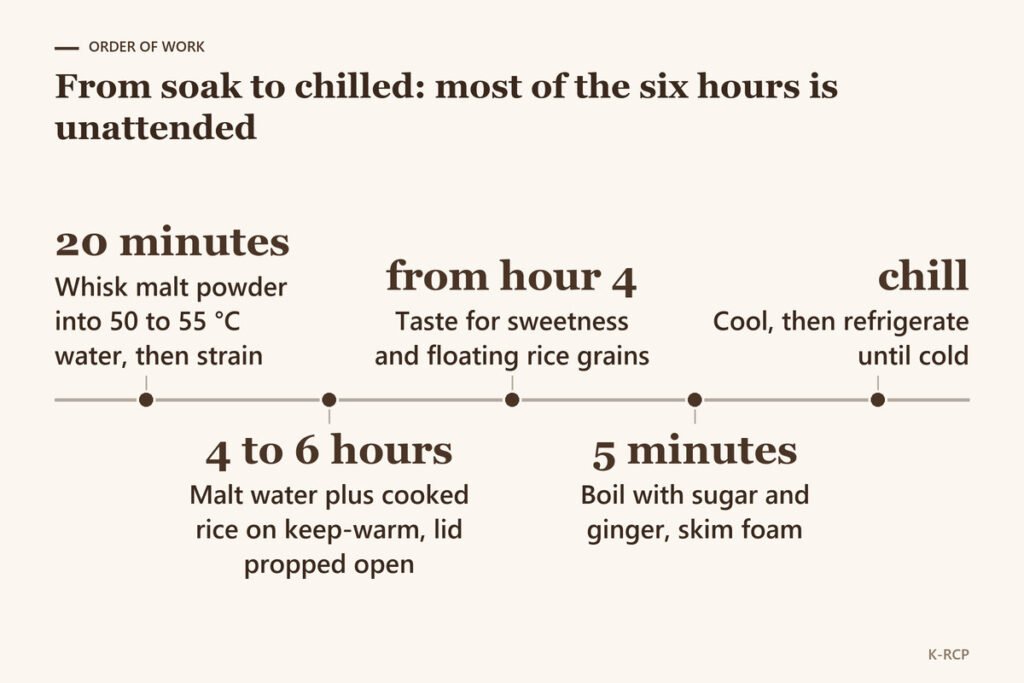
Whisk the malt powder into 2 liters of warm water at about 50 to 55 °C and let it stand for 20 minutes, stirring once or twice. Without a thermometer, mixing three parts just-boiled water with four parts cold tap water gives roughly 50 to 55 °C when the tap runs 15 to 20 °C; for 2 liters that is about 850 ml boiled and 1.15 liters cold. That is mixing arithmetic, not a measured result, so lean toward the cool side: the institute’s own malt water starts at only 40 °C. The institute soaks in lukewarm water for about an hour, kneads, strains, and lets the liquid settle for 2 to 3 hours before using only the clear top. Straining through fine cloth and squeezing hard is this page’s shortcut to the same end. Discard the coarse bran.
The warm hold
Pour the malt water into the rice cooker insert with the cooked rice, set the cooker to keep-warm and prop the lid slightly open with a chopstick. Let it sit 4 to 6 hours. After 4 hours, taste: the liquid should be unmistakably sweet and some grains should be floating. If it still tastes mostly like water, give it another hour and taste again. The encyclopedia gives the same check: after about 4 hours, lift the lid, and if the rice is floating, scoop the grains out and rinse them in cold water.
Then pour the rest of the liquid into a saucepan, add the sugar and sliced ginger, bring it to a boil, skim the foam and simmer for 5 minutes. The institute boils it over high heat and skims, and the encyclopedia asks for the foam to be skimmed gently so the liquid stays clear. Cool completely, chill, and add a few of the saved grains and pine nuts to each cup.
Why a batch stalls, sours or stays bland
Two things are worth checking when a batch is weak. The first is water that is too hot at the start. This page’s malt water is 50 to 55 °C and the institute’s is 40 °C, both well below a kettle’s, and the encyclopedia warns that too much heat stops the conversion.
The second is a cooker that holds the wrong temperature. Keep-warm settings differ between models, and the sources themselves disagree on the best range, so the card’s 4 to 6 hours is a starting point. Taste at hour four and every hour after until the liquid is clearly sweet. A cooker that runs cool leaves rice sitting in barely sweet water, and the encyclopedia’s warning applies: a hold that is too cool can sour the rice. A cooker that runs hot can stall the conversion. If the grains never float after six hours, the mixture did not stay in the warm band, or it overshot it: start again with fresh malt water rather than boiling the batch in the hope of rescuing it, and keep the lid propped open with a chopstick as in the method above.
Andong sikhye, sujeonggwa and the plain version
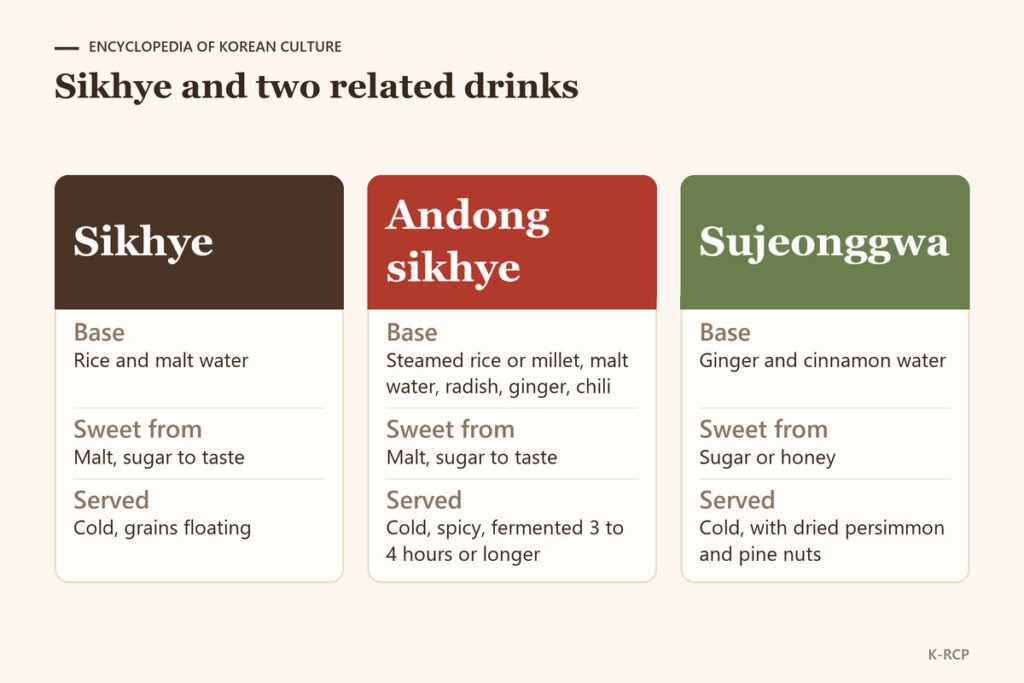
Andong sikhye is a regional cousin built on the same malt-and-rice idea. The encyclopedia’s Andong sikhye entry describes a drink from the Andong area made with steamed rice or millet, malt water, sliced radish, ginger juice and chili. The entry gives fermenting times from 3 to 4 hours up to two to three days in a cool place, calls the drink refreshing and spicy, and says it helps digestion. Its date is estimated at the mid-eighteenth century or later.
Sujeonggwa, in the encyclopedia’s sujeonggwa entry, is another cold drink but starts from different material, with no malt and no rice: water in which ginger and cinnamon have been boiled, sweetened with sugar or honey, with dried persimmon and pine nuts added. The entry says to boil the ginger and cinnamon separately, because together they dull each other, and that the drink was a favorite from the time dried persimmons were ready until the first or second lunar month, especially for New Year guests.
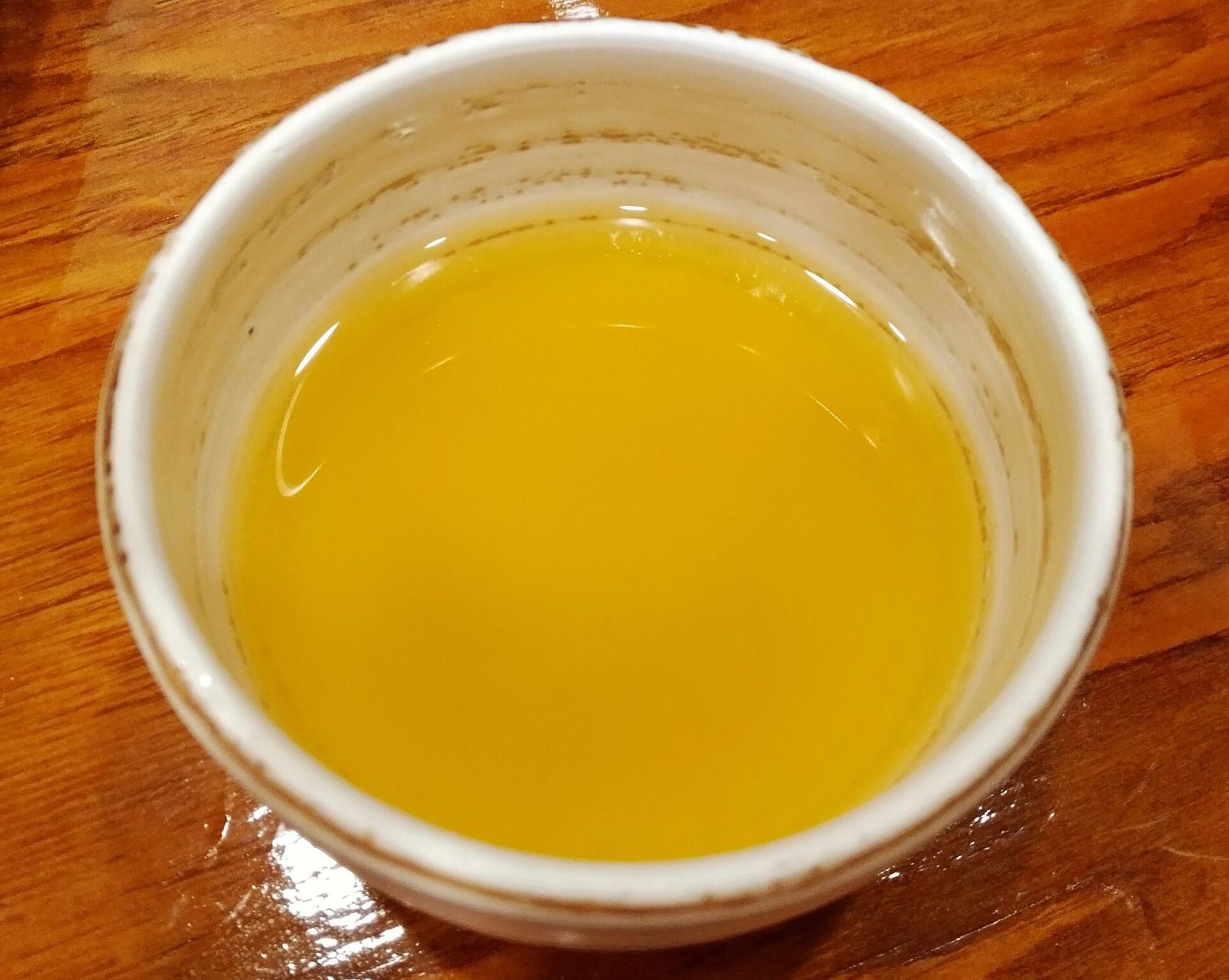
Pumpkin versions such as hobak-sikhye exist as well, and one is pictured below. A plain sikhye batch is still the best place to start, because the other drinks ask you to manage radish and chili or two separate decoctions.

A timetable that fits around the rest of the day
Most of the work is waiting, so plan it backward from when you want a cold cup. The steps below assume you start after breakfast.
- Hour 0: whisk the malt powder into 50 to 55 °C water, wait 20 minutes, strain, and move the malt water and rice into the cooker.
- Hours 0.5 to 4.5: keep-warm with the lid propped open. First taste at 4 hours into the hold.
- Hours 4.5 to 6.5: if it is not clearly sweet, continue and taste hourly. When the grains float, lift out about 1/2 cup and keep them in cold water.
- Mid-afternoon: boil the rest with sugar and ginger for 5 minutes, skimming the foam, then let it cool completely.
- Overnight: refrigerate, and add the saved grains and pine nuts to each cup when serving.
The institute’s recipe ends at refrigerating and gives no keeping time, so treat this as a drink made for the next day or two rather than a pantry staple, and taste it before serving. Sikhye is served cold, in cups or bowls with a few of the saved grains on top. If a six-hour wait is more than the evening allows, the midnight convenience store guide covers what the shelves offer instead. For a hot, sweet contrast, there is hotteok, the filled pancake, and the chestnut tiramisu write-up covers a cold sweet that is not a drink.