There’s a question Korean adults ask each other every January, usually half-joking: “How many bowls of tteokguk have you had?” It isn’t really about the soup. In the traditional way of counting age in Korea, everyone turns a year older together on the first day of the lunar calendar, not on their own birthday, and the ritual that marks it is a bowl of white rice cake soup on New Year’s morning. Eat your tteokguk, and you’ve officially aged a year — whether you wanted to or not.
That’s the whole reason this dish exists in the form it does: clean broth, pale rice cake sliced into coins that are said to resemble old Korean coins (a nod to prosperity for the year ahead), and a garnish laid on top rather than stirred in, so the bowl looks tidy and a little ceremonial even on a weekday. None of that makes it complicated to cook. It’s a beef broth, some sliced rice cake, and five minutes of simmering.
Quick Facts
| Total time | 40 minutes |
| Serves | 4 |
| Difficulty | Easy |
| Spice level | 0 of 5 — this is not a spicy dish |
| Vegan? | Yes, with the beef swap below |
What Is Tteokguk?
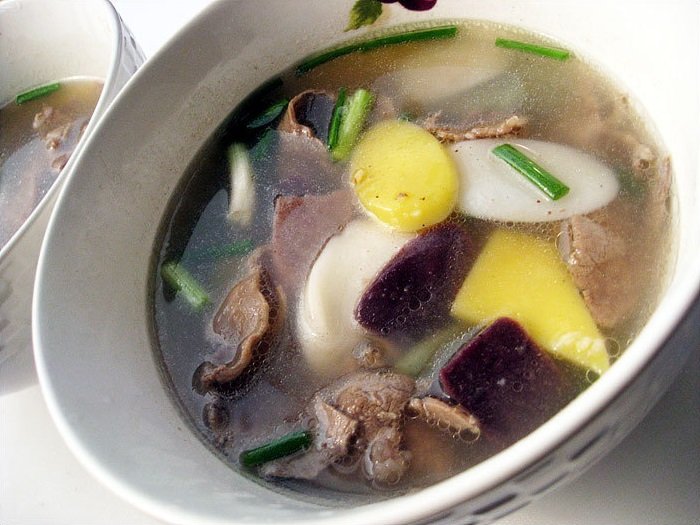
Tteokguk (떡국, roughly tuck-gook) means, plainly, rice cake soup. It’s built from garae-tteok, a long white cylinder of pounded rice cake that gets sliced into thin oval coins before cooking. Those coins go into a clear broth, traditionally simmered from beef brisket or shank, though an anchovy-and-kelp version is just as common and a little lighter.
What makes it recognizable on sight is the garnish: thin ribbons of fried egg white and yolk, laid separately rather than scrambled together, plus a scatter of shredded seaweed and scallion. It’s the one Korean soup where the presentation is part of the point — you’re meant to look at it for a second before you eat it.
Outside the New Year, tteokguk shows up as a fast, plain, cold-weather lunch, the sort of thing a Korean household makes on a Tuesday with whatever tteok is sitting in the freezer. But its cultural weight is real. Ask a Korean person their age indirectly and you might hear “I’ve eaten forty-some bowls of tteokguk,” which is a genuinely normal way to talk about it.
Ingredients
| Ingredient (for 4) | Where to get it, or what to use instead |
|---|---|
| Sliced rice cake, 600 g / 4 cups | Sold refrigerated or frozen as tteokguk-tteok at any Korean grocery, usually pre-sliced into coins. If your store only stocks the cylindrical tteok meant for tteokbokki, slice it yourself on a steep diagonal — the flat oval shape is what lets it cook evenly and look right in the bowl. |
| Beef brisket or shank, 200 g / 7 oz | Thin-sliced. Skip it entirely for a lighter broth: 1.4 L of anchovy-kelp stock (simmer 8 to 10 dried anchovies and a palm-sized piece of dried kelp for 15 minutes, then strain) makes a completely legitimate, faster pot. |
| Eggs, 2 | For the jidan garnish. If you’d rather not bother with the separate white-and-yolk technique, one whole egg soft-scrambled into the finished broth still tastes like tteokguk, just less photogenic. |
| Roasted seaweed (gim), 1 sheet | The kind sold for wrapping kimbap or as seasoned snack sheets both work, cut or crumbled into strips. |
| Garlic, soy sauce, sesame oil, scallions | Standard pantry items. |
A note on the rice cake itself. Fresh tteok dries out and turns hard within a day at room temperature, which is why it’s almost always sold refrigerated or frozen. Frozen rice cake needs the cold-water soak in step one — skip it and the pieces go into the broth still frozen solid in the center, cooking unevenly and turning gluey on the outside before the middle catches up.
Tteokguk Recipe
Ingredients
Method
- Soak the sliced rice cake in cold water for 20 to 30 minutes if it’s been refrigerated or frozen, until the pieces separate easily and feel pliable rather than stiff.
- Marinate the beef 10 minutes in 1 tbsp of the soy sauce, half the garlic, and the sesame oil.
- Brown the beef in a dry pot over medium heat for 2 to 3 minutes, then add the water and bring to a boil.
- Skim the foam that rises in the first few minutes, then lower the heat and simmer 15 minutes so the broth takes on the meat’s flavor.
- Meanwhile, make the jidan: fry the egg whites and yolks separately in a barely-oiled pan, as thin as you can manage, then stack and slice into fine strips.
- Add the remaining garlic and the drained rice cake to the simmering broth and cook 4 to 5 minutes, until the pieces float and turn tender but still chewy at the center.
- Season with the remaining soy sauce, salt and pepper to taste.
- Ladle into bowls, top with the egg strips, seaweed and scallions, and serve right away, while the rice cake is still soft.
How to Make It
- Soak the rice cake. Cold water, 20 to 30 minutes, until the coins bend without cracking. This step matters more than it looks like it should — under-soaked rice cake cooks unevenly.
- Marinate the beef in a tablespoon of soy sauce, half the garlic, and the sesame oil, while the rice cake soaks.
- Brown the beef in a dry pot, no added oil, over medium heat for 2 to 3 minutes. The fat that renders out is doing real work for the broth’s flavor.
- Add the water and bring to a boil. Skim the grey foam that rises in the first few minutes — it’s mostly protein and it clouds the broth if you leave it. Then drop the heat and let it simmer, uncovered, for 15 minutes.
- Make the jidan while the broth simmers. Beat the whites and yolks in separate bowls. Fry each, one thin layer at a time, in a barely oiled nonstick pan over low heat — you’re aiming for something closer to a crepe than a fried egg. Stack the sheets once they’ve cooled slightly and slice into fine strips with a sharp knife.
- Add the garlic and the drained rice cake to the simmering broth. Cook 4 to 5 minutes. You’ll see the pieces puff up slightly and start to float — that’s your sign they’re close. Pull one out and bite it: it should give easily but still have a slight chew at the core, not the soft give of an overcooked dumpling.
- Season at the end. The remaining soy sauce, then salt and pepper to taste. Beef broth needs less salt than you’d expect once the meat and soy sauce are in.
- Serve immediately. Rice cake keeps absorbing broth and softening even off the heat, so ladle it out, top with the egg strips, seaweed and scallion, and get it to the table while the texture is still right.
Where It Goes Wrong
The single most common failure is rice cake that turns mushy and starts to dissolve at the edges, leaving the broth cloudy and thick instead of clear. That’s almost always either over-soaked, over-old rice cake, or simply left in the pot too long after it’s done. Tteokguk doesn’t reheat gracefully for this reason — the rice cake keeps softening in the fridge overnight and there’s no fixing it once it’s gone that far. If you’re making a big pot ahead, keep the broth and the rice cake in separate containers and combine them only when you’re about to eat.
The second failure is broth that tastes flat. Beef broth built in 15 minutes doesn’t have the depth of an all-day bone broth, and that’s fine — it’s supposed to be a quicker, cleaner-tasting soup than something like samgyetang — but it does need real seasoning at the end. Taste before you serve, not just while you’re cooking.
Tteokguk and Manduguk: Cousins, Sometimes Combined
If you’ve been anywhere near a Korean New Year table, you’ve probably also seen manduguk, the same idea but built from dumplings instead of rice cake, and often served alongside tteokguk rather than instead of it. Plenty of Korean families — especially those with roots in the northern regions, where dumplings feature more heavily in everyday cooking — go a step further and make one pot with both rice cake and mandu simmered together, called tteok-manduguk. If you’ve got mandu in the freezer already, there’s no reason not to drop a handful into this same broth in the last five minutes; just don’t crowd the pot, or neither the rice cake nor the dumplings cook quite right.
FAQ
Do I have to use beef broth for tteokguk?
No. Anchovy-kelp stock is a real, traditional alternative, not a compromise — it’s the everyday version a lot of households actually use, and it’s considerably faster. Simmer dried anchovies and a piece of dried kelp for 10 to 15 minutes, strain, and proceed with the recipe from there.
Why is my tteokguk gummy instead of chewy?
Almost always over-soaked or overcooked rice cake. Soak just until the pieces bend without cracking, not longer, and pull the pot off the heat the moment they float and taste right — a minute or two of carryover cooking is enough to push chewy into gummy.
Can I make tteokguk without the egg garnish?
Yes. It’s traditional and it’s what makes the bowl photograph well, but plenty of home cooks skip the separate white-and-yolk strips on a regular Tuesday and either leave the egg out entirely or scramble one whole egg into the broth at the very end.
Related Recipes
Tteokguk and manduguk are the two dishes of the Korean New Year table, and they’re genuinely meant to be understood as a pair — read the manduguk recipe next if you’re planning a proper Seollal breakfast. If you want a side of something fermented and sharp to cut the plainness of the broth, a bowl of baechu kimchi is the traditional pairing. And if this is your first stop before a Korean grocery run, the Korean pantry starter kit covers which soy sauce and sesame oil are actually worth the extra dollar.