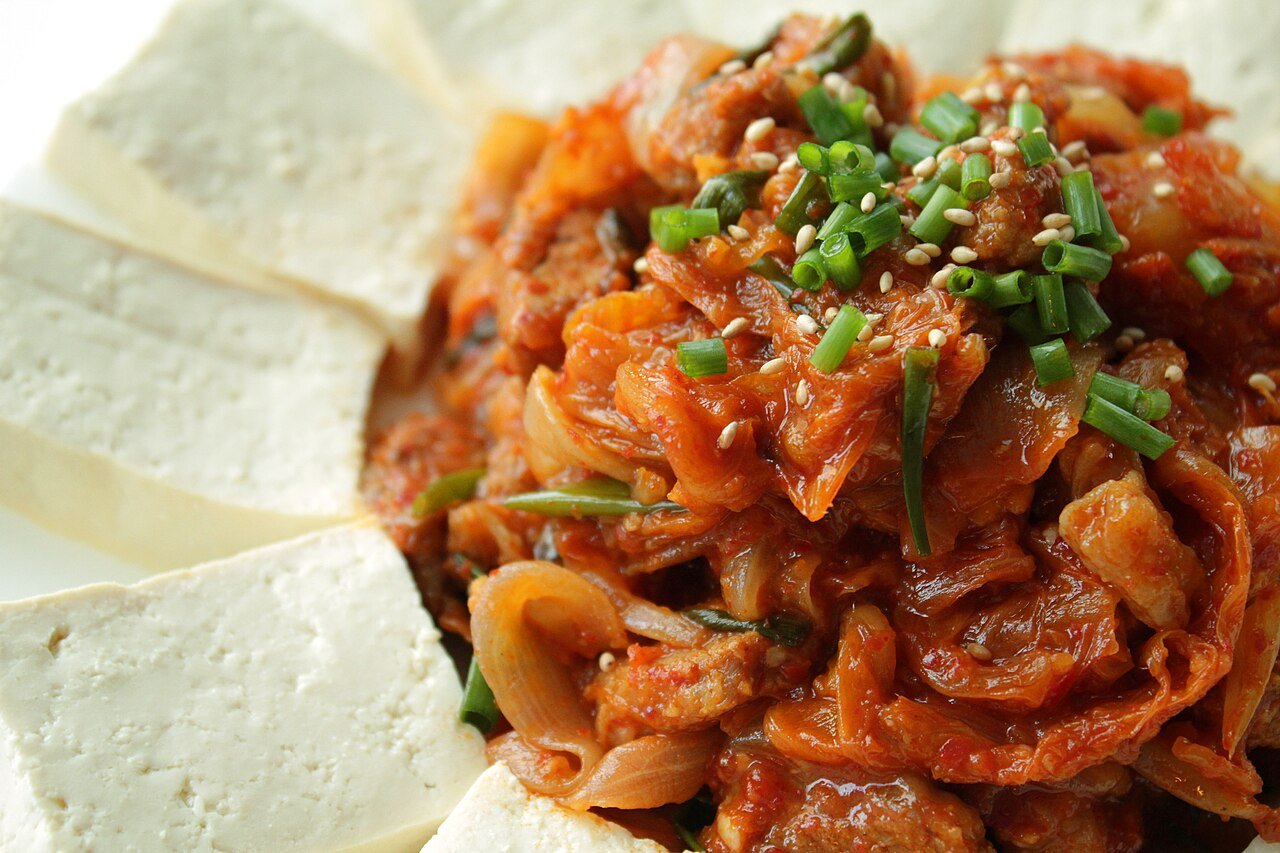
Three ingredients, fifteen minutes, one pan. That’s the whole dubu kimchi recipe: a block of tofu warmed through, kimchi stir-fried in a little oil with a pinch of sugar, and the two piled on the same plate so you eat them together in one bite. There’s no marinade, no batter, no resting time. If you have kimchi in the fridge and tofu in the cold case at your corner store, dinner is basically already made.
I make this on the nights I don’t want to cook. It’s the recipe I’d hand to someone who has never made Korean food before, because there is almost nothing to get wrong.
Quick Facts
| Korean name | 두부김치 (dubu-kimchi) |
| Say it | DOO-boo KIM-chee |
| Active time | 15 minutes |
| Serves | 2 as a share plate |
| Heat level | Mild to medium, depending on your kimchi |
| Skill needed | Almost none |
What Is Dubu Kimchi?
Dubu (두부) is tofu. Kimchi is kimchi. The name is the entire ingredient list, which tells you something about how Koreans think about this dish — nobody bothered inventing a poetic name for it because the point was never cleverness.
In practice it’s plain tofu, either simmered in water until it’s hot and silky or lightly pan-fried until the outside firms up, laid alongside kimchi that’s been stir-fried in oil until it’s soft, dark, and a little sweet. Sometimes there’s pork belly in the kimchi. Sometimes there isn’t. Both versions are correct.
Culturally, dubu kimchi lives in the anju category — the Korean word for food eaten alongside drinks, the kind of thing a neighborhood bar brings out on a wide plate for a table to share. That’s just where it sits on the menu in Seoul, the same way chips and salsa sit on a menu in the States. What matters for our purposes is that anju dishes tend to be salty, shareable, and fast to fire, and dubu kimchi is all three. It’s also a perfectly ordinary weeknight dinner over rice, which is how it shows up in my kitchen most often.
The contrast in texture is the actual engineering here. Hot tofu is bland, soft, and faintly sweet. Stir-fried aged kimchi is sour, salty, chewy, and sharp. Neither one is interesting alone. Put a slab of tofu under a tangle of kimchi and the tofu turns into a cushion that absorbs the sourness and stretches it out. It works the way plain rice works next to a salty stew.
Why This Dubu Kimchi Recipe Is the Easiest Thing on This Site
I want to be blunt about the skill ceiling, because I think it’s the selling point rather than a caveat.
Compare it to something like tangsuyuk, where you’re managing batter hydration, double-frying, and oil temperature across two separate stages, and a thirty-second lapse in attention turns crisp into soggy. Dubu kimchi has no equivalent failure mode. The tofu gets hot. The kimchi gets cooked. If you overshoot the kimchi by a minute, it just gets a little softer and sweeter. If you undershoot, it’s a little sharper. Both are edible. Both are, honestly, fine.
There’s no browning window to hit, no sauce to emulsify, no dough to rest. The only two decisions that meaningfully change the result are how sour your kimchi is and whether you add pork. That’s it. That’s the whole decision tree.
So if you’re new to Korean cooking and you want a first win, start here rather than with something that punishes you for looking away.
Ingredients
| Ingredient | Amount & notes |
|---|---|
| Firm tofu | 1 block, ~300 g (10.5 oz), cut into 1 cm (1/2 in) slabs |
| Sour, well-fermented kimchi | 250 g (about 2 packed cups, 9 oz), chopped |
| Kimchi brine | 2 tbsp (30 ml), from the jar |
| Neutral oil | 1 tbsp (15 ml) |
| Sugar | 1 tsp |
| Gochugaru | 1 tsp |
| Toasted sesame oil | 1 tsp, off the heat |
| Pork belly or bacon | 100 g (3.5 oz), optional |
| Scallion | 1, sliced thin |
| Toasted sesame seeds | 1 tsp |
A note on the kimchi, since it’s doing most of the work: you want the jar that’s been open for three or four weeks and has gone properly sour, the one that fizzes slightly and smells assertive when you open it. Fresh kimchi from this week is crisp and mild and it won’t give you much once it hits the pan. If mild kimchi is all you have, add 1 tsp rice vinegar and bump the sugar to 1½ tsp. It’ll taste brighter and thinner than the real thing, but it’ll taste like something.
Gochugaru is the one item that might mean a trip to a Korean grocer or an online order. It’s coarse-ground Korean chili, more fruity than hot, and there’s no perfect stand-in — Aleppo pepper with a pinch of sweet paprika gets you similar heat and color but reads flatter. If you’re building out a shelf of Korean staples, my Korean pantry starter kit covers what’s worth buying first.
Dubu Kimchi Recipe
Ingredients
Method
- Drain the tofu block and pat it dry on both sides with paper towels.
- Slice the tofu crosswise into slabs about 1 cm (1/2 inch) thick.
- Squeeze the kimchi lightly over a bowl, saving 2 tbsp of the brine, then cut it into bite-size pieces.
- Bring a wide pan of water to a gentle simmer, slide in the tofu slabs, and heat for 4 to 5 minutes until they are hot all the way through; lift them out with a slotted spatula and drain.
- Alternatively, pan-fry the slabs in 1 tsp oil over medium heat for 3 minutes per side, until the surfaces firm up and turn pale gold.
- Heat 1 tbsp oil in a skillet over medium-high heat until it shimmers.
- If using pork belly or bacon, add it now and cook for 3 to 4 minutes, until the edges are browned and the fat has rendered.
- Add the chopped kimchi and stir-fry for 4 minutes, until it darkens from bright red to a deeper brick color and stops smelling raw.
- Stir in the sugar, gochugaru, and reserved kimchi brine, and cook 2 minutes more until the liquid mostly cooks off and the pan sizzles rather than bubbles.
- Taste and add a pinch of salt only if the kimchi was mild.
- Turn off the heat and stir in the sesame oil.
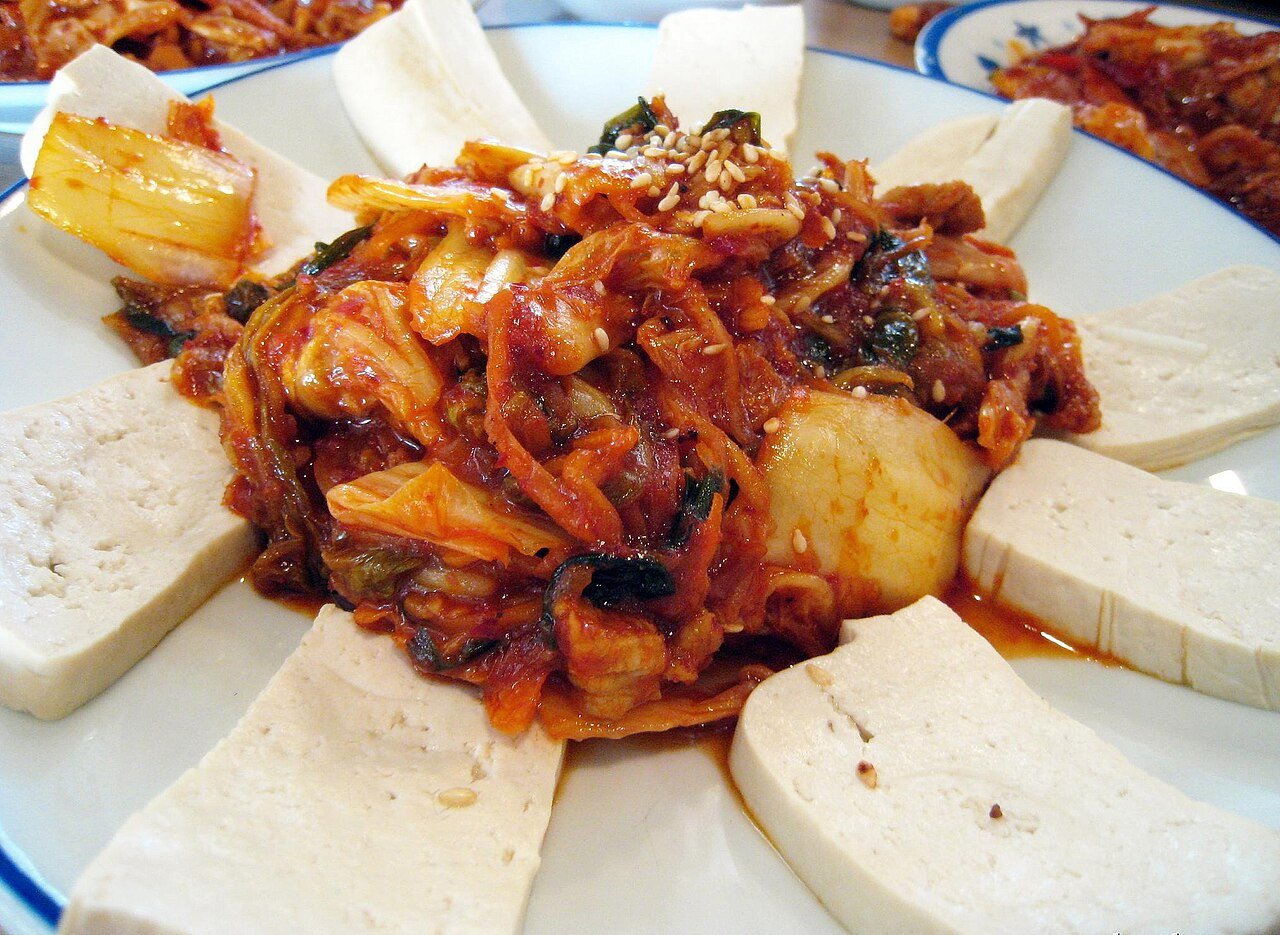
- Fan the warm tofu slabs around the edge of a plate and pile the kimchi in the center.
- Scatter scallion and sesame seeds over the top and serve immediately, while the tofu is still hot.
How to Make It
- Dry the tofu. Drain the block, pat both faces with paper towels, and slice it into slabs about 1 cm (1/2 in) thick. Thinner and they tear when you move them.
- Warm the tofu. Two options, both valid. Simmering: bring a wide pan of water to a bare simmer, slide the slabs in, and leave them 4 to 5 minutes until they’re hot through — they’ll look slightly plumper and feel heavy on the spatula. Pan-frying: 1 tsp oil, medium heat, 3 minutes per side, until the surface tightens and goes pale gold and stops sticking to the pan. Simmered is softer and more traditional; pan-fried has a bit of chew.
- Prep the kimchi. Squeeze it gently over a bowl and keep 2 tbsp of the brine. Cut into bite-size pieces — roughly 3 cm (about 1 in), nothing precise.
- Render the pork, if using. Heat 1 tbsp oil over medium-high until it shimmers, add the pork belly or bacon, and cook 3 to 4 minutes until the edges brown and fat pools in the pan. Don’t drain it. That fat is the seasoning.
- Stir-fry the kimchi. In it goes. Cook 4 minutes, stirring often. Watch for the color shift — bright red turns to a deeper brick, and the raw, pickled smell gives way to something rounder and toastier. That smell change is your signal.
- Season. Add sugar, gochugaru, and the reserved brine. Cook 2 more minutes until the liquid has mostly cooked away and the pan sizzles instead of bubbling. Taste. Add a pinch of salt only if your kimchi was on the mild side.
- Finish off the heat. Kill the flame, then stir in the sesame oil. Adding it while the pan is hot burns off the aroma you paid for.
- Plate it. Fan the tofu slabs around the rim of a plate, pile the kimchi in the middle, scatter scallion and sesame seeds. Serve right away — this dish is at its best in the first five minutes, while the tofu is still hot.
The Pork Version
Adding pork belly turns a light plate into a full dinner, and it takes one extra minute of cooking. Thin-sliced pork belly, the kind sold pre-cut for Korean barbecue, is ideal because it renders fast. Bacon works and is easier to find — just accept that it drags the dish toward smoky and salty, so cut the sugar to ½ tsp and skip any added salt entirely.
The order matters slightly: pork first, kimchi second, into the fat the pork left behind. If you dump them in together the kimchi steams instead of frying and you lose the browning.
I’d say I make the plain version about two-thirds of the time. It’s cleaner, and the tofu-to-kimchi contrast comes through more clearly without pork competing for attention.
Tips and Storage
Squeeze, don’t rinse. Rinsing kimchi washes away the fermentation flavor that makes this dish work. A gentle squeeze is enough.
Don’t crowd the pan. If you’re doubling the batch, stir-fry the kimchi in two rounds. Piled up, it releases water and simmers.
Tofu goes in last, always. Warmed tofu cools fast. Get the kimchi finished, then plate the tofu, then combine.
Leftovers: the stir-fried kimchi keeps 4 days in a sealed container in the fridge and reheats well in a pan. Leftover tofu does not — it turns spongy and weeps water. Warm fresh tofu the next day instead; it takes five minutes.
Kimchi that’s gone past sour — the jar that’s tipped from tangy into genuinely aggressive — is too far gone for a fresh stir-fry but perfect for kimchi jjigae, where long simmering mellows it out. That’s the standard rotation in Korean home kitchens: fresh kimchi eaten as a side, sour kimchi stir-fried like this, extremely sour kimchi cooked into stew. Nothing gets thrown away. It also works stirred into instant noodles, which I cover in ramyeon upgrades.
FAQ
Can I make dubu kimchi without gochugaru? Yes. Kimchi is already seasoned with chili, so leaving out the gochugaru gives you a milder plate rather than a broken one. You’ll lose a bit of color depth and that specific fruity-red note, but the dish still holds together. Don’t substitute cayenne one-for-one — it’s much hotter and will overwhelm everything.
What kind of tofu should I use for dubu kimchi? Firm. Look for packages labeled 부침용 (buchim-yong, “for pan-frying”) at a Korean market. Extra-firm holds its shape best but eats drier. Silken tofu is the wrong choice here — it collapses when you move it. Save that for sundubu jjigae, where softness is the entire point.
Is dubu kimchi vegetarian? The plain version has no meat, but most commercial kimchi contains salted shrimp or fish sauce, so check the label if that matters to you. Vegan kimchi exists at Korean groceries and health-food stores and works fine here — it tends to taste a little cleaner and less savory, so a splash of extra brine or a pinch of salt helps.
More From the Kitchen
- Kimchi Jjigae — where your too-sour kimchi should end up
- Sundubu Jjigae — the soft-tofu stew, at the other end of the tofu spectrum
- Korean Pantry Starter Kit — gochugaru, sesame oil, and what else is worth the shelf space
- Tangsuyuk — for when you want the opposite of an easy recipe
- Ramyeon Upgrades — more things to do with a jar of aging kimchi
Sources: Dubu-kimchi (Wikipedia) · Kimchi (Wikipedia)