There is one question that can split a Korean dinner table faster than politics, and it arrives the moment the fried pork lands: pour the sauce, or dip it?
부먹 (bumeok, short for 부어 먹다, “pour and eat”) means the sweet-sour sauce goes straight over the whole platter. 찍먹 (jjikmeok, from 찍어 먹다, “dip and eat”) means the sauce sits in its own bowl and every piece gets dunked one at a time. Nobody has ever won that argument, which is the fun of it — so this tangsuyuk recipe is written to work either way. There are polls. There have been variety-show segments. I’m not about to settle it in a blog post.
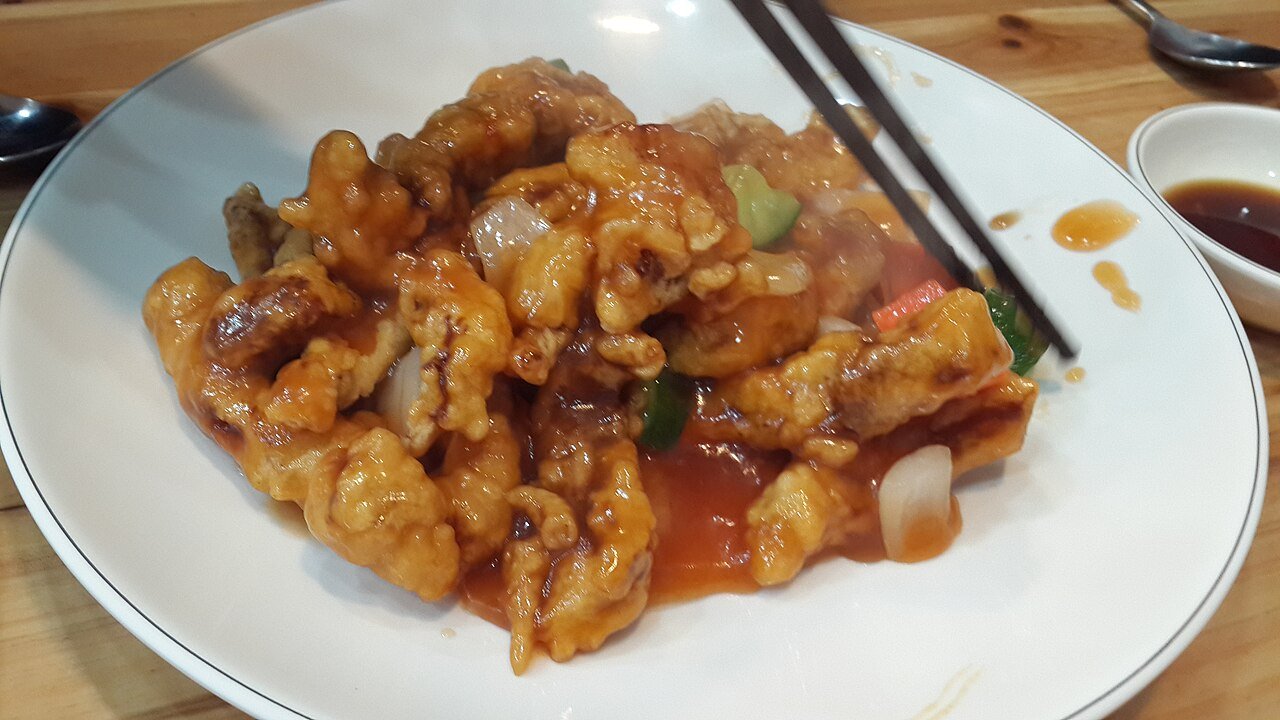
Quick Facts
| Korean name | 탕수육 |
| Pronounced | tang-soo-yook |
| What it is | Battered, double-fried pork with a sweet and sour sauce |
| Where you eat it | Korean-Chinese restaurants (중국집), almost always shared |
| Active time | About 70 minutes, most of it hands-off |
| Serves | 4 as part of a bigger meal, 2 if you’re being honest |
| Key ingredient | Potato starch (감자전분) |
What is tangsuyuk?
Tangsuyuk is the Korean member of the sweet-and-sour-pork family. The name comes from the Chinese 糖醋肉 — sugar, vinegar, meat — which is about as literal as a dish name gets. It arrived with Chinese immigrants who settled in Incheon in the late 1800s and built what Koreans now call 중국집: Korean-Chinese restaurants that serve a menu you won’t find in China or anywhere else.
Say it as three even beats. Tang, like the drink. Soo, like the name Sue. Yook, rhyming roughly with “book.” No stressed syllable, which is the part most English speakers overcorrect.
What separates it from the Cantonese-style sweet and sour pork you might know is the crust. Korean tangsuyuk is battered in potato starch rather than a flour-and-egg coating, which gives you a pale, blistered, glassy shell instead of a bready one. The sauce is also thinner and more translucent — closer to a clear glaze than a thick red gravy — and it usually carries chunks of carrot, onion, cucumber, and often pineapple.
Bumeok vs jjikmeok: both sides deserve a hearing
Let me make the case for each, fairly.
Team bumeok argues that the sauce is not a condiment, it’s the dish. Pouring it hot over the whole platter means every piece gets fully coated, the vegetables end up distributed instead of stranded in a bowl, and the crust goes from crunchy to that specific half-softened, sauce-logged texture that a lot of Koreans genuinely prefer. It’s also less fuss: no double-dipping negotiations, no sauce dripping across the table. You put it down and everyone eats.
Team jjikmeok argues that you deep-fried this pork twice for a reason. Sauce on the side means the last piece is as crisp as the first, and each person controls their own ratio — light dip if you want to taste the pork, heavy dip if you want candy. This camp points out that pouring is irreversible. You can always add sauce; you can never take it back.
My compromise, and the way the recipe below is written: serve it jjikmeok by default, with the sauce hot in a bowl. Anyone at the table who wants bumeok can ladle it over their own portion. Peace in our time.
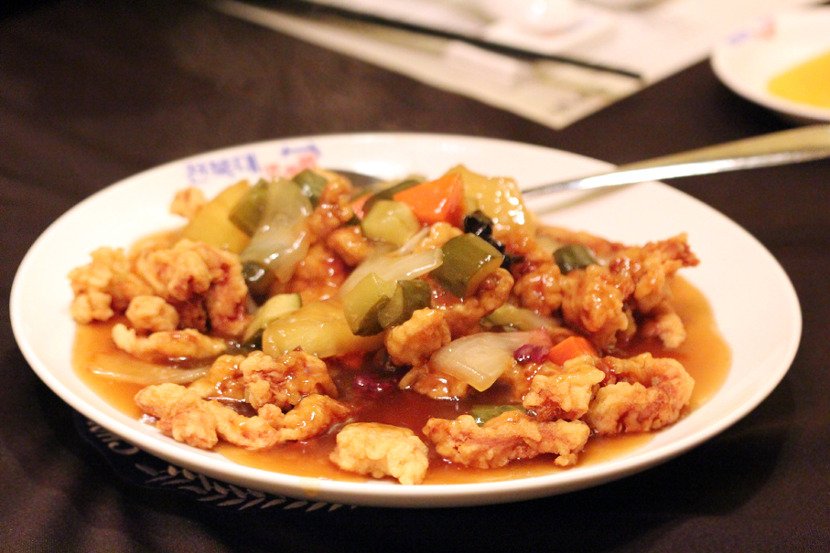
Tangsuyuk Recipe
Ingredients
Method
- Cut the pork into strips about 1.5 cm x 5 cm (1/2 in x 2 in), trimming off silverskin.
- Toss the pork with soy sauce, rice wine, grated ginger, and black pepper. Let it sit 20 minutes at room temperature.
- Stir the potato starch into the cold water in a bowl until it looks like thin cream. Leave it undisturbed for 30 to 60 minutes.
- Pour off the clear water that has risen to the top, leaving the thick white paste settled at the bottom.
- Add the egg white, if using, and the 1 tbsp oil to the starch paste and stir until it falls off a spoon in a slow, heavy ribbon. Add the poured-off water back a teaspoon at a time if it is too stiff.
- Drain any liquid from the pork and fold the strips into the batter, coating each piece completely.
- Heat the frying oil to 160°C (320°F) in a deep pot, filling it no more than halfway.
- Lower the pork in one piece at a time, frying in two or three batches so the oil temperature does not drop. Fry 3 to 4 minutes, until pale gold and cooked through.
- Lift the pork onto a rack and rest it 5 minutes. Steam will escape and the surface will look dry and matte.
- Raise the oil to 190°C (375°F). Fry the pork again in batches for 1 to 2 minutes, until deep gold and audibly crackly. Drain on the rack.
- For the sauce, combine the water or stock, sugar, rice vinegar, soy sauce, ketchup, salt, and pineapple juice in a saucepan and bring to a boil.
- Add the onion, carrot, wood ear mushrooms, and pineapple. Simmer 2 minutes until the carrot is just tender.
- Stir the cornstarch slurry again, then pour it into the simmering sauce while stirring. Cook 30 to 60 seconds until the sauce turns glossy and coats a spoon.
- Turn off the heat and stir in the cucumber or bell pepper so it keeps its crunch.
- Pile the pork on a platter and serve the sauce in a separate bowl for dipping (jjikmeok). To serve bumeok-style, pour the hot sauce over the pork at the table and eat right away.
Why potato starch is the whole tangsuyuk recipe
If you take one thing from this post, take this. The crust is not about technique first — it’s about which starch you put on the pork.
Potato starch (감자전분) has very large granules and almost no protein. When it hits hot oil, it gelatinizes fast, then dries into a thin, brittle, glass-like shell full of tiny air pockets. That structure has two useful properties: it shatters instead of bending, and it absorbs moisture slowly. That’s why a proper tangsuyuk can sit under sauce for several minutes and still crack when you bite it.
Cornstarch works, and it’s the substitute I’d reach for if potato starch isn’t available. The crust comes out harder and a little sandy, and it browns less, so the pork can look underdone when it isn’t. Perfectly good. Just not as light.
All-purpose flour is the one to avoid. Flour has gluten-forming protein, so the coating turns into a thin bread rather than a glass shell, and bread does exactly what bread does with liquid. A flour-battered tangsuyuk goes soft in about two minutes. If flour is all you have, cut it half-and-half with cornstarch and serve it jjikmeok, no exceptions.
The soaked-starch trick
Korean cooks rarely just whisk dry starch into water. Instead you stir the starch into cold water, walk away for half an hour, then pour off the clear layer that separates on top and use the dense paste underneath. What you’re left with is starch that’s already fully hydrated, with barely any free water in it — so less moisture hits the oil, the batter clings better, and the crust comes out thinner. It costs you nothing but a wait, and you can do it while the pork marinates.
Double-frying, and why the rest matters
The two-stage fry is not a gimmick.
The first fry at 160°C (320°F) is about cooking. Lower oil lets heat travel to the center of the pork without scorching the outside, and it drives moisture out of the coating slowly.
The rest, 5 minutes on a rack, is the step people skip and shouldn’t. Steam trapped inside the crust escapes instead of soaking back into it. You’ll see the surface go from shiny to matte. That’s the sound of it drying.
The second fry at 190°C (375°F) for 60 to 90 seconds is about the shell. High heat flashes off the last surface moisture and puffs the starch. The pork is already cooked, so you’re only listening — when the sizzle goes from a low churn to a lighter, faster crackle, it’s done.
A digital thermometer makes this trivial. Without one, drop a bead of batter in: at 160°C it sinks and rises slowly; at 190°C it stays up and fizzes hard immediately.
Keeping it crisp if you’re pouring
Bumeok people, this is for you. Three things help. First, make the sauce slightly thicker than you think you want, since a thin sauce runs into the crust instead of sitting on it. Second, pour at the table, not in the kitchen — every thirty seconds counts. Third, don’t toss. Ladle the sauce over the top and leave the pile alone; the pieces underneath stay crisp and get sauced as people dig in.
Notes on the sauce
The vinegar-to-sugar ratio here is 1:1 by volume, which lands sharper than most American sweet and sour. Taste it before the slurry goes in and adjust — more sugar if it makes you squint, more vinegar if it tastes like syrup.
Ketchup is optional and slightly controversial. Plenty of Korean-Chinese restaurants use it for color and body, and I’m not going to pretend otherwise. Leave it out for a paler, cleaner sauce that tastes more of vinegar and stock.
Add the cucumber or bell pepper off the heat, always. Thirty seconds of simmering is enough to turn cucumber limp and grey.
Storage and reheating
Fried tangsuyuk keeps 2 days in the fridge, sauce stored separately in its own container. Reheat the pork in a 200°C (400°F) oven or air fryer for 5 to 7 minutes — it comes back genuinely well, which is more than you can say for most fried food. Warm the sauce in a small pan and whisk; it will have set into a jelly and loosens right back up. Microwaving the pork is a waste of your afternoon.
You can also freeze the pork after the first fry only. Cool it completely, freeze flat on a tray, then bag it. Go straight from frozen into 190°C (375°F) oil for 3 to 4 minutes for the second fry.
Tangsuyuk on screen
If you want to see this world on television, Wok of Love (2018, SBS) is set almost entirely inside a struggling Korean-Chinese restaurant called Hungry Wok, where a former hotel chef, a bankrupt heiress, and the restaurant’s ex-gangster owner try to keep the place alive. It ran 38 episodes. The wok work and the shabby, steam-filled kitchen are the real draw — it’s the closest a drama has come to showing what a neighborhood 중국집 actually looks like from the inside.
The jjajangmyeon question
You cannot write about tangsuyuk without writing about jjajangmyeon. 짜장면 + 탕수육 is the order at a Korean-Chinese restaurant — the set that shows up on every delivery menu, at every office lunch, on every moving day.
The complication is that tangsuyuk is a sharing dish. A small order still lands as a full platter, which is why eating alone at a 중국집 forces a real decision: get the noodles and skip the pork, or commit to the pork and eat it for two days. Koreans genuinely argue about this. Delivery apps have responded with 1인 (single-portion) tangsuyuk, and it is not the same thing, but it exists. The jjajangmyeon post covers the noodle half of the pairing, including how to make the black bean sauce without it tasting raw.
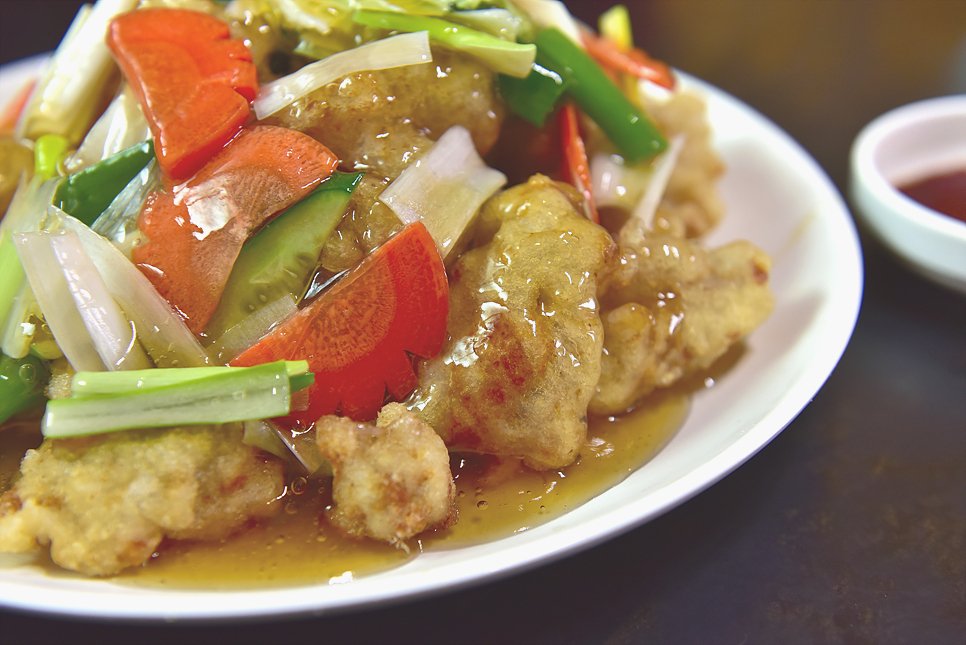
Above is 찹쌀탕수육 (chapssal-tangsuyuk), a common variation where glutinous rice flour goes into the batter. The crust puffs thicker and chewier rather than shattering. Worth knowing about, though the potato starch version is the one I’d learn first.
FAQ
Why is my tangsuyuk soggy?
Almost always one of three things: flour in the batter, oil that wasn’t hot enough on the second fry, or draining on paper towels instead of a rack. Paper traps steam against the bottom of the pieces and softens them from below. Use a wire rack every time, and never stack the pork while it’s hot.
Can I make tangsuyuk in an air fryer?
Partly. A wet starch batter doesn’t set properly in an air fryer — it drips and goes patchy. What works is skipping the slurry and dredging the marinated pork in dry potato starch, spraying it well with oil, and cooking at 200°C (400°F) for 12 to 14 minutes, shaking halfway. The result is good but it’s a crunchy coated pork rather than that blistered tangsuyuk shell. The sauce recipe works exactly as written either way.
What cut of pork should I use?
Tenderloin (안심) gives the most tender result and is what I use most often. Pork loin (등심) is cheaper, slightly firmer, and holds up better if you’re reheating leftovers. Shoulder works too and has more flavor, but cut it smaller and expect a chewier bite. Whichever you pick, slice with the grain into strips rather than against it — the coating needs something to hold onto.
More Korean cooking
- Jjajangmyeon — the black bean noodles that complete the classic Korean-Chinese order
- Korean pantry starter kit — where to find potato starch, rice wine, and the rest without a specialty store nearby
- Dakgalbi — another big-platter dish built for a table of people
- Hotteok — sweet filled pancakes that also came to Korea with Chinese merchants, and a good way to end this meal
Further reading: Tangsuyuk on Wikipedia and Wok of Love.