Show up at a Korean birthday table, a Chuseok spread, or a potluck at someone’s apartment, and there’s a good chance a big bowl of japchae is sitting somewhere in the middle of it. It’s not the centerpiece exactly — that’s usually the meat — but it’s the dish people quietly go back for seconds of. This japchae recipe isn’t really about the celebration angle, though. It’s about the fact that japchae is one of the only stir-fries that’s actually better suited to a party than to a quiet weeknight dinner, because you can make it hours ahead and it won’t suffer for it.
Quick facts
- Total time: about 1 hour (30 minutes prep, 30 minutes cooking)
- Serves: 4 as a side dish, or 2 to 3 as a main
- Difficulty: medium — no single step is hard, but you’re managing several pans
- Spice level: 0 out of 5, no chili at all in the traditional version
- Vegan-friendly: yes, with two swaps noted below
Why this is the dish you actually make ahead
Most stir-fries are a countdown against the clock. Cook it, plate it, eat it — leave a stir-fried vegetable sitting on the counter for two hours and it turns into a wet, gray version of itself. Japchae doesn’t play by that rule, and the reason comes down to what’s actually in the bowl. There’s no delicate leafy vegetable trying to stay crisp, no sauce that needs to be piping hot to taste right. The noodles are already a little chewy and a little glossy at room temperature, and the vegetables are cut into sturdy strips that don’t wilt the moment they cool.
That’s the whole practical case for cooking this the morning of a gathering instead of twenty minutes before people arrive. You lay it out on a platter, cover it loosely, and it’s just as good two hours later as it was fresh off the stove — arguably better, since the noodles finish soaking up the sesame oil and soy sauce as they sit. Korean households already treat it this way. It’s a standard item on a jesa ancestral-rites table and a Chuseok spread precisely because it holds while everything else is still being cooked.
What is japchae?
Japchae (잡채, roughly jahp-chey) literally translates to “mixed vegetables” — jap meaning mixed or assorted, chae meaning vegetable. That name is a small clue to its history: the dish existed for centuries before glass noodles were ever added to it. Sweet potato starch noodles only became common in Korea in the early twentieth century, and once they showed up, cooks folded them into the existing vegetable dish and the noodles quietly took over as the star. These days most people think of japchae as a noodle dish that happens to have vegetables in it, which is backward from how it started.
Getting the noodles right, which is where most attempts go wrong
Dangmyeon, the sweet potato starch glass noodles this dish is built on, are unforgiving in a specific way. Undercook them and they’re stiff and starchy in the middle. Overcook them by even a minute or two and they turn gluey, sticking to themselves and to the pan in a solid clump that no amount of tossing fixes. There isn’t a lot of middle ground, but the window is easy to hit once you know what you’re aiming for.
Soak the dry noodles in warm water — not boiling, just warm from the tap — for a full 30 minutes before they touch a pot. Skipping the soak and throwing them straight into boiling water is the single most common way people ruin this dish; the outside cooks fast while the inside stays hard, and you end up fishing out noodles that are soft on one end and crunchy on the other. Once they’ve soaked and bend without snapping, boil them for 5 to 6 minutes. You’re looking for fully translucent strands with a chewy, slightly springy bite, not the opaque white-gray they start out as.
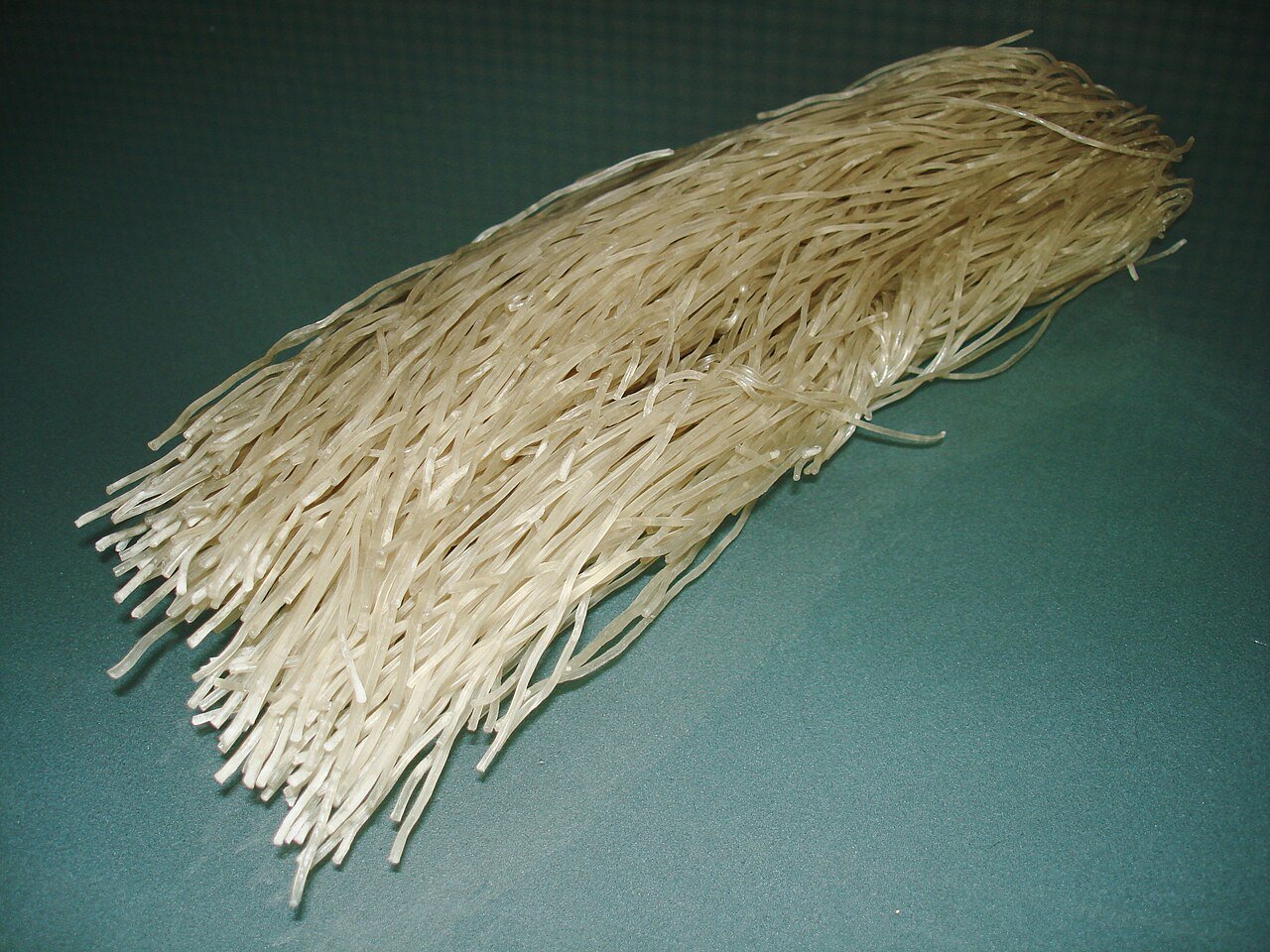
The step people skip is what happens right after draining. Rinse briefly under cold water to stop the cooking, then toss the noodles immediately with a tablespoon of sesame oil while they’re still warm. Do this before you even start on the vegetables. Left bare and wet, dangmyeon noodles clump into a single mass within minutes, and pulling apart a cold, seized clump of glass noodles is nobody’s idea of a good time.
Ingredients, and what to use instead
| Ingredient (for 4) | Where to get it, or what to use instead |
|---|---|
| Dangmyeon, 200 g / 7 oz | Korean grocer, dry noodle aisle. No dangmyeon nearby: mung bean glass noodles or plain cellophane noodles work, but they cook faster and go soft and a little slick rather than staying springy — pull them earlier than the recipe says |
| Beef sirloin or ribeye, 150 g / 5 oz, thinly sliced | Ask a butcher to slice it thin, or freeze it 20 minutes first for easier slicing at home. Substitute: thin pork shoulder, or skip meat entirely and double the mushrooms |
| Dried shiitake mushrooms, 4, soaked | Korean or Asian grocer. Substitute: 150 g / 5 oz fresh cremini or button mushrooms — no soaking, but milder and less woodsy |
| Carrots, onion, red bell pepper | Any supermarket. The bell pepper is a modern, optional add for color, not traditional |
| Baby spinach, 150 g / 5 oz | Any supermarket. Regular spinach works; trim thick stems |
| Soy sauce, 3 tbsp (sauce) plus 1 tbsp (marinade) | Standard. For gluten-free: tamari or a labeled gluten-free soy sauce |
| Toasted sesame oil, 3 tbsp | Asian grocery aisle of most supermarkets now. No good substitute — this is the flavor the whole dish is built on, and plain oil leaves it tasting flat |
| Sugar, 2 tbsp (sauce) plus 1 tsp (marinade) | Standard. Honey or rice syrup gives a rounder sweetness |
| Eggs, 2, for garnish | Optional. Skip for a vegan version |
For a fully vegan pot: drop the beef and the egg garnish, use tamari if you need it gluten-free too, and lean on the mushrooms and a slightly heavier hand with sesame oil to make up the richness you’d otherwise get from the beef.
Why every vegetable gets its own pan
This is the part that separates a good japchae from a forgettable one, and it has nothing to do with the sauce. Every vegetable and the beef get stir-fried alone, in the same pan, one after another, and only combined with the noodles at the very end.
The reason is timing and moisture, not tradition for its own sake. Spinach releases water the moment it hits heat; thrown in with carrots and onion, that water turns the whole pan into a shallow braise, and the noodles you add later drink up vegetable runoff instead of the seasoning you actually want them to taste like. Carrots and onion need real time over heat to lose their raw edge; mushrooms need to sit in the pan long enough to release their liquid and then brown, which spinach can’t survive sitting through. Cook everything together in one crowded pan and you get a single average outcome — everything a little soggy, a little pale, seasoned unevenly because whatever’s on the bottom of the pile gets more contact with the pan than whatever’s on top.
Keeping things separate protects the color as much as the texture. Part of what makes a bowl of japchae look like a celebration dish is the contrast: dark green spinach, orange carrot, white and brown mushroom, all distinct instead of stewed into one muddy shade. Combine everything at once in a hot pan and the vegetables bleed into each other visually as much as they do in flavor. Five or six short passes through the same pan, wiped clean or not between vegetables, gets you there — it’s a few extra minutes of dishes, not a few extra skills.
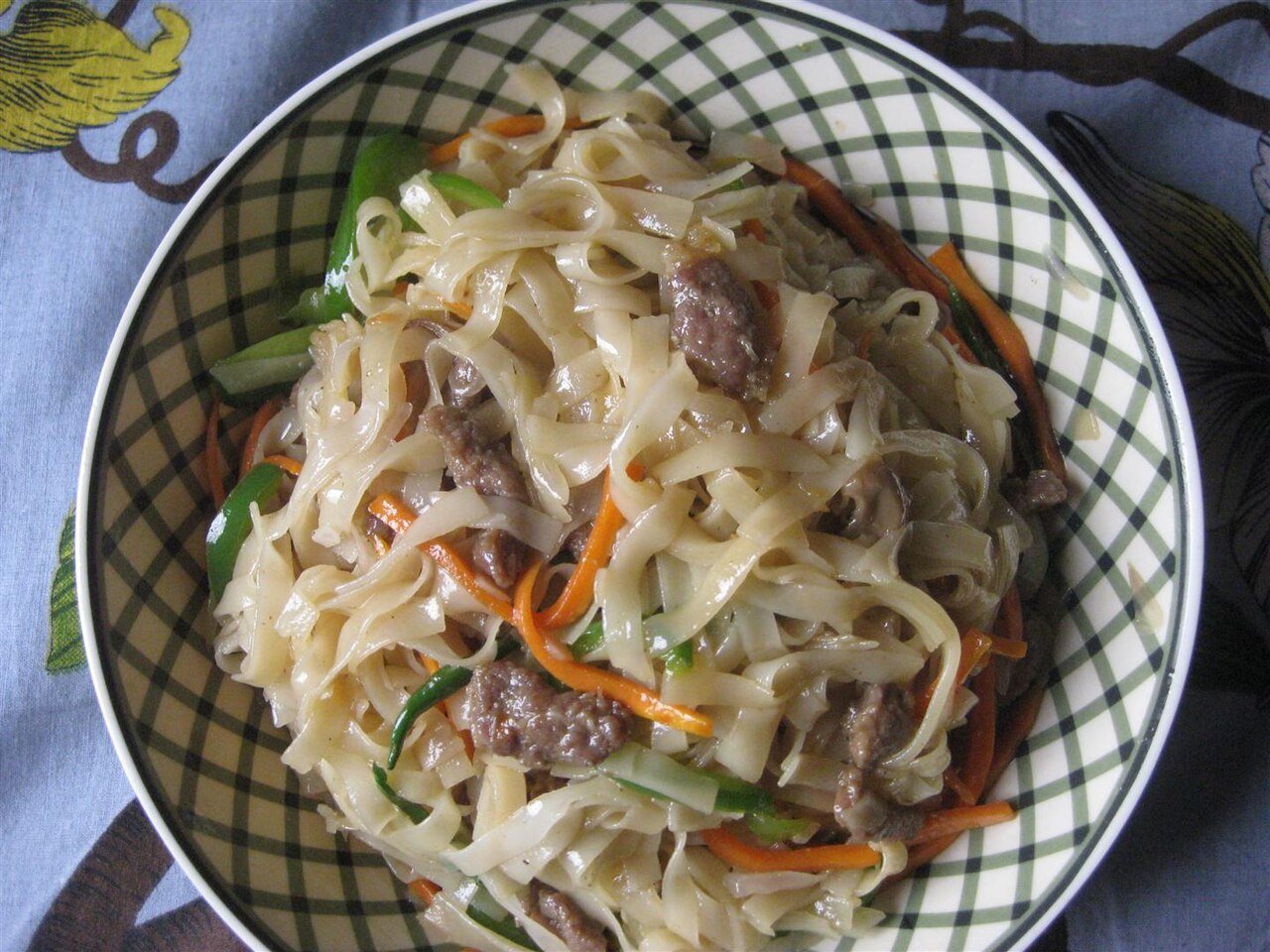
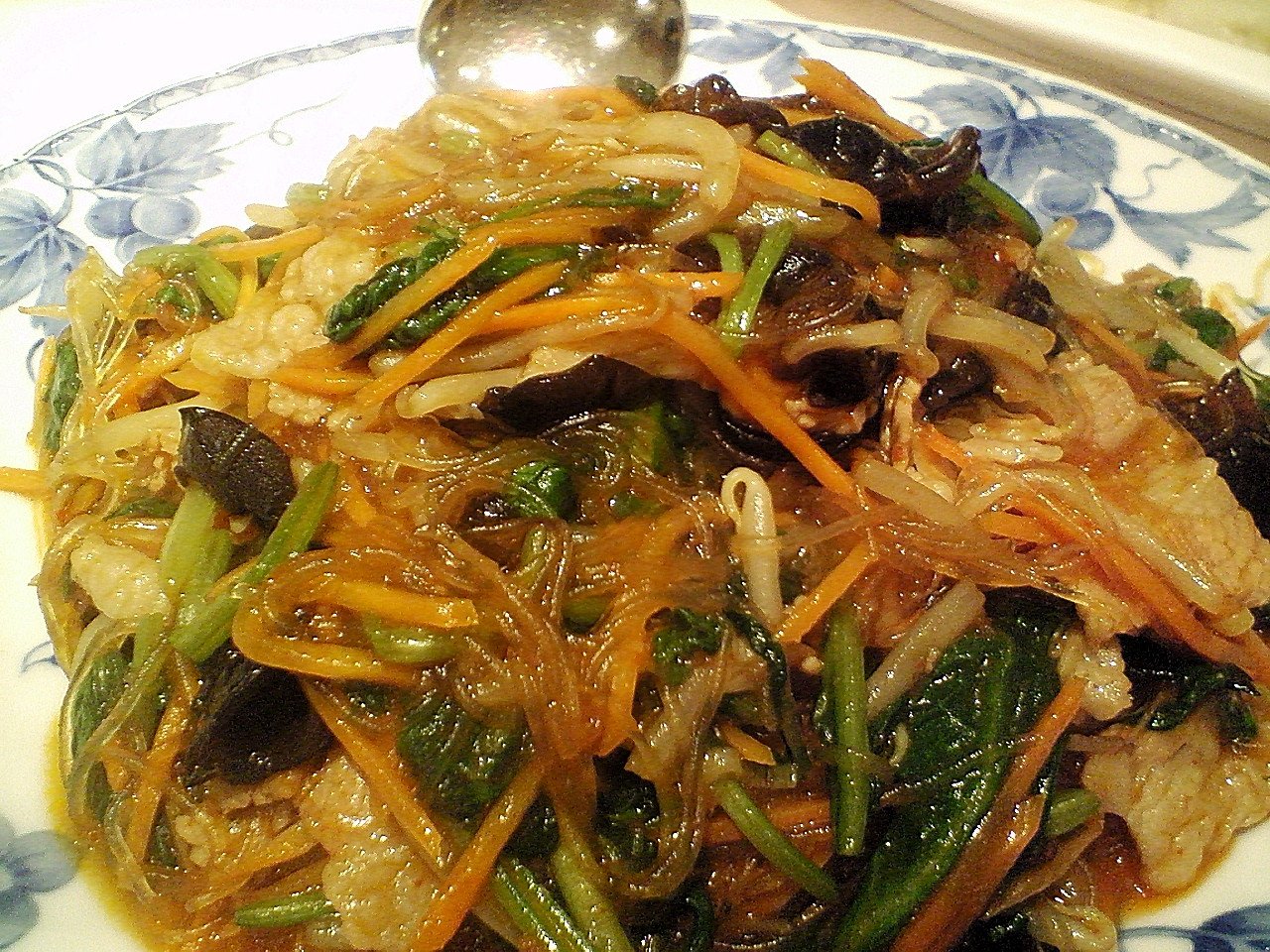
Japchae Recipe
Ingredients
Method
- Soak the dangmyeon in warm, not hot, water for 30 minutes, until a strand bends without snapping.
- Combine the sliced beef with the marinade ingredients and set it aside for at least 10 minutes while you prep the vegetables.
- Bring a pot of water to a boil. Drain the soaked noodles and boil them for 5 to 6 minutes, until they’ve turned fully translucent and taste chewy rather than starchy.
- Drain the noodles, rinse briefly under cold water, and toss immediately with 1 tablespoon of the sesame oil so they don’t clump together while everything else cooks.
- Wipe out a wide pan or wok. Cook the spinach alone over medium heat for about 1 minute, just until wilted, season with a pinch of salt, and move it to its own bowl.
- In the same pan, stir-fry the carrots alone for 2 to 3 minutes, until just tender with a little bite left, then move them to their own bowl.
- Stir-fry the onion alone for 2 minutes until soft and starting to turn gold, then the bell pepper alone for about 1 minute, keeping each one in a separate bowl.
- Stir-fry the mushrooms alone for 3 minutes, until they’ve released their liquid and started to catch a little color at the edges.
- Cook the marinated beef alone over medium-high heat for 3 to 4 minutes, until just cooked through and slightly caramelized at the edges.
- If using the egg garnish, fry the whites and yolks separately into thin sheets, let them cool flat, then slice into fine strips.
- Return the noodles to the pan or a large mixing bowl with the remaining soy sauce, sugar, and 1 tablespoon of sesame oil. Toss over low heat for 1 minute so the noodles absorb the sauce.
- Add the beef and every vegetable back in and toss everything together for 1 minute, just until combined and warmed through. Finish with sesame seeds and the egg strips.
How to make it
- Soak the dangmyeon in warm water for 30 minutes, until a strand bends without snapping.
- Combine the sliced beef with the marinade ingredients and set aside for at least 10 minutes.
- Boil the drained noodles for 5 to 6 minutes, until fully translucent and chewy.
- Drain, rinse briefly under cold water, and toss immediately with 1 tablespoon sesame oil so they don’t clump.
- Cook the spinach alone for about 1 minute, just until wilted, season with a pinch of salt, and set aside in its own bowl.
- Stir-fry the carrots alone for 2 to 3 minutes, until just tender, then set aside separately.
- Stir-fry the onion alone for 2 minutes, then the bell pepper alone for 1 minute, each in its own bowl.
- Stir-fry the mushrooms alone for 3 minutes, until they release their liquid and start to brown.
- Cook the marinated beef alone for 3 to 4 minutes, until just cooked through.
- If using the egg garnish, fry the whites and yolks separately into thin sheets and slice into strips once cool.
- Toss the noodles with the remaining soy sauce, sugar, and 1 tablespoon sesame oil over low heat for 1 minute.
- Add everything back in and toss together for 1 minute, then finish with sesame seeds and the egg strips.
Tips and make-ahead storage
Cut the noodles a few times with kitchen scissors before serving. Dangmyeon strands are long, and a full bowl of uncut noodles turns into a wrestling match with chopsticks — a couple of passes shortens them without chopping them to mush.
For a party, this is genuinely a make-3-hours-ahead dish. Cook it, let it cool to room temperature uncovered for about 20 minutes so it doesn’t steam itself soggy under a lid, then cover loosely and leave it out. It’s traditionally served at room temperature anyway, not hot, so you’re not fighting the dish’s own nature here.
In the fridge, japchae keeps for 3 to 4 days in a sealed container. It firms up as it chills, so bring it back to room temperature or give it a very brief reheat — a minute in the microwave, or a quick toss in a dry pan — rather than serving it cold and stiff straight from the fridge. Don’t freeze it; the noodles turn spongy and separate from the sauce once thawed.
Frequently asked questions
Can I make japchae ahead of time for a party?
Yes, and it’s arguably the better way to serve it. Cook it up to a day ahead, store it covered in the fridge, and let it sit out at room temperature for 20 to 30 minutes before serving so the noodles loosen back up. It won’t taste like a reheated leftover — this is one of the few Korean dishes meant to be eaten at room temperature in the first place.
Is japchae gluten-free?
The noodles themselves are naturally gluten-free — dangmyeon is made from sweet potato starch, not wheat. The catch is the soy sauce, since most standard brands contain wheat. Swap in tamari or a soy sauce labeled gluten-free and the whole dish is safe, no other changes needed.
Can I make japchae without beef?
Easily. Leave the beef out, double the mushrooms so the pan still has something to chew on, and add an extra teaspoon of sesame oil at the end to make up the richness. It’s a completely normal way to make this at home, not a workaround.
What to eat with it, and where to find it in Korea
If half these ingredients are new to you, our Korean pantry starter kit covers what’s worth ordering first, dangmyeon and sesame oil included. The beef marinade here is close to a simplified version of the one in our bulgogi recipe, so if you like it, that’s a natural next dish to try. And for another party-table regular that travels well and holds up on a platter for hours, our kimbap recipe is cut from the same practical cloth.
In Korea, you’ll find tubs of ready-made japchae sold by weight at almost any market stall, usually sitting near the other cooked banchan rather than with raw ingredients. Gwangjang Market’s street food alley on k-trips is a good place to see that side of it in person, alongside a dozen other dishes worth trying in the same walk.