In 1950 bulgogi finally became a dictionary word. The Folk Encyclopedia names the third volume of the Korean Language Society’s Great Dictionary as the first to list it as a headword, and the first cookbook to use the word, in 1958, treated it as a colloquial name for neobiani, thin-sliced seasoned beef grilled over fire. It took until 1972 for a cookbook to give bulgogi its own entry as a dish.
That late paper trail sits oddly beside the dish’s reputation. The same Folk Encyclopedia entry calls bulgogi, together with galbi, the grilled meat Koreans like best, and the one foreigners like best, sometimes billed as Korean barbecue. The standard dictionary keeps the definition plain: beef or other lean meat sliced, seasoned, left to soak and grilled (Standard Korean Dictionary). The rest of this page deals with the practical side, which is what to slice, what the Korea Food Promotion Institute’s own marinade looks like, and how to cook it fast enough to caramelise instead of stew.
Where the name came from, and where it did not
Older dishes sit behind the name. Neobiani is described in the late-1800s cookbook Siui jeonseo as finely sliced meat, seasoned and grilled directly over fire, and a 1939 cookbook gives the recipe as thin slices mixed with soy sauce, chopped scallion, sesame, pepper and sugar. The Folk Encyclopedia says some people treat neobiani as the original bulgogi, though the method differs slightly.
Two accounts explain where bulgogi came from, one about the name and one about the dish. The first holds that bulgogi was a Pyongan dialect word that reached Seoul with refugees after 1945, and its evidence is a 1947 magazine essay by the poet Kim Ki-rim, who wrote that the word had spread through Seoul almost at once after coming up from Pyongyang. The second looks far back and traces Korean grilled meat to maekjeok, which the Jin-dynasty Chinese text Soushen ji records, in the encyclopedia’s reading, as a dish of the northern Goguryeo people, valued enough to open banquets. The encyclopedia itself says certainty is hard. This page treats maekjeok as an ancestor of Korean grilled meat in general, and the 1947 essay as the earliest firm evidence for the name bulgogi.
The line from maekjeok to bulgogi was not continuous. The same entry says the meat-grilling tradition faded when devotion to Buddhism discouraged eating meat in the Three Kingdoms and Goryeo periods, and returned late in Goryeo after the Mongol invasion. Gaeseong’s seolhamyeok then became a famous grilled dish and stayed popular in Joseon, and the table near the end of this page gives its recorded method.
The encyclopedia offers a reason for the late appearance in print. Bulgogi was a colloquial and somewhat coarse name for neobiani, so cookbooks avoided it. Dictionaries of the period defined the two differently, neobiani as thin seasoned beef that is grilled and bulgogi as the meat of an animal eaten grilled, yet cookbooks as late as 1967 and 1970 seem to describe the same food under both names, and bulgogi only stands alone from 1972, by which point the dish was popular everywhere. The grilled beef Koreans loved seems to have travelled in print under another name, or none at all.
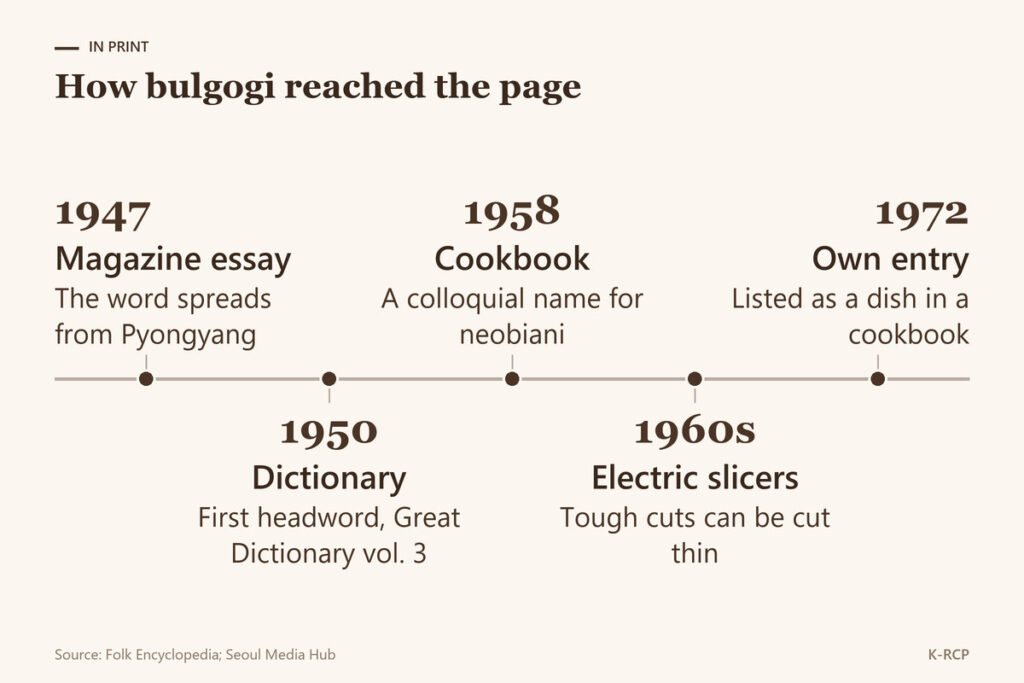
Technology then changed the dish. According to the Seoul city media hub, electric slicers became common after the 1960s, which let butchers cut tough parts thin enough to marinate and grill, and bulgogi became a heavily commercial food in the 1970s. The Folk Encyclopedia adds that bulgogi was food for special days and gatherings until it became popular after 1970.
Two millimetres of sirloin
The institute’s recipe calls for 500 g of tender sirloin cut 2 mm thick, with long slices shortened to bite size and any blood pressed out with paper towel. Its tip names sirloin, tenderloin and strip loin as the usual cuts, which in Korean butcher terms are deungsim, ansim and chaekkeut.
The recipe card on this page asks for ribeye or top sirloin sliced paper-thin against the grain, and for beef that is not pre-sliced it suggests freezing it for 45 minutes first so it firms up enough to cut evenly. The two sets of advice agree on the point that matters most. Thickness is decided before the marinade, and no seasoning can rescue a slice that is too thick.
The marinade in the institute’s proportions
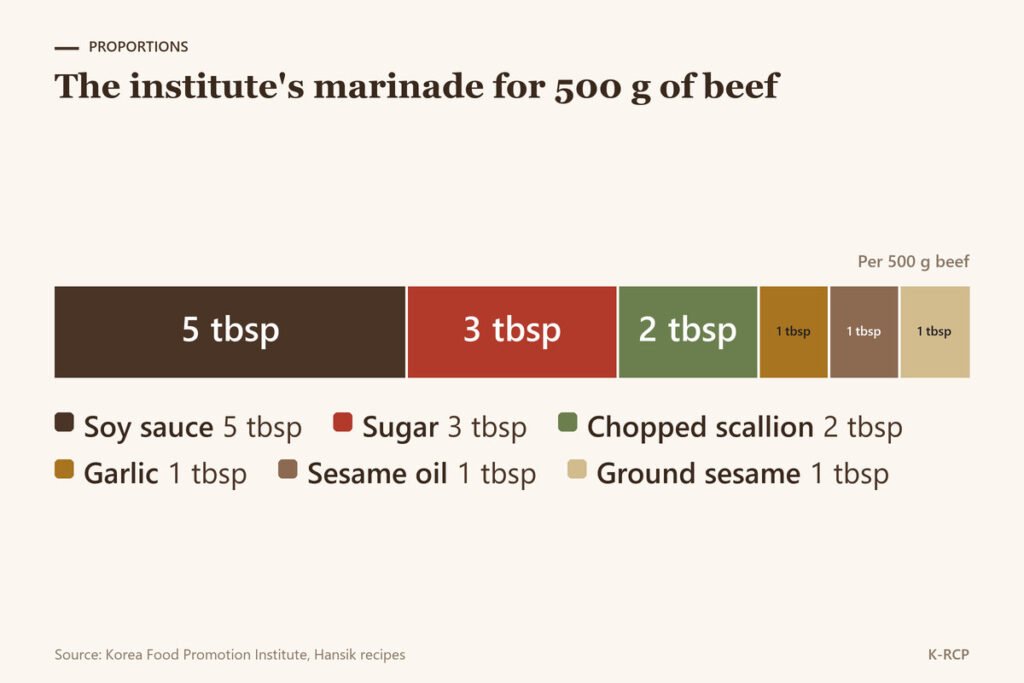
For 500 g of beef the institute marinates with 5 tablespoons of soy sauce, 3 of sugar, 2 of chopped scallion, 1 each of minced garlic, sesame oil and ground sesame, and half a teaspoon of pepper. Pear and rice wine (two tablespoons) are listed as optional extras. The Folk Encyclopedia describes the marinade as dark soy sauce, honey, minced scallion, garlic and pepper, which gives the dish its faintly sweet taste. The encyclopedia also sets the dish apart from similar Chinese ones: those are grilled without a prior soak, or mixed with seasoning after grinding, while bulgogi is steeped in its sauce before it meets the fire.
Read as ratios, the numbers say a good deal. Soy sauce and sugar sit at 5 to 3, so the sugar is a supporting part rather than a glaze, and the scallion is double the garlic. Sesame oil and ground sesame are single tablespoons, which keeps the nutty notes behind the soy. A cook who halves the beef halves every figure, and a cook who wants a sweeter dish raises the sugar, not the soy.
Pear, apple or nothing
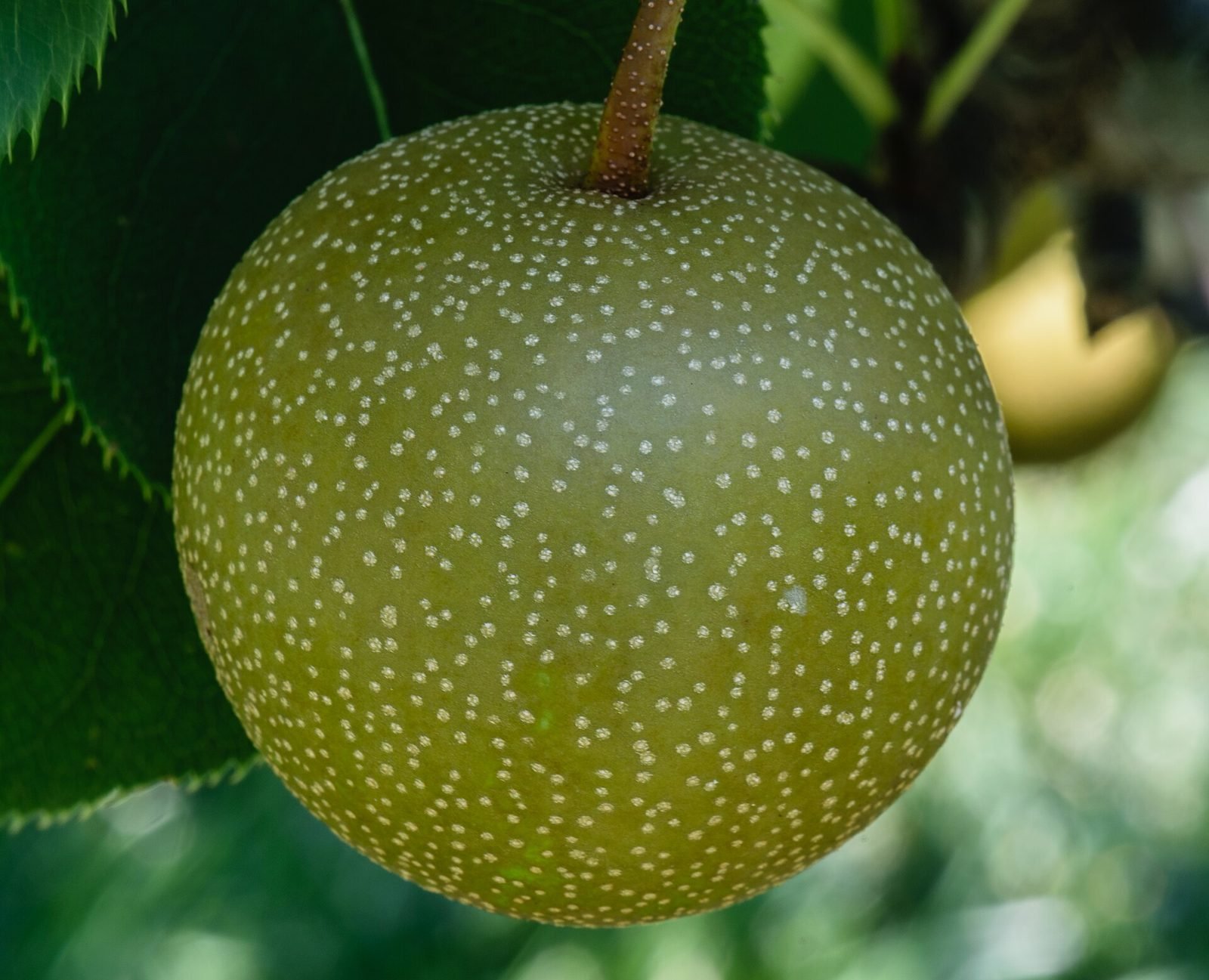
The institute lists a quarter of a pear, about 150 g, grated with its juice as an optional seasoning, and notes that fruit such as pear or apple in the marinade works as a meat tenderiser. Pear also adds some sweetness of its own, so the choice affects taste as well as texture. The card uses half a ripe Asian pear, about 100 g, grated together with half an onion.
_fruit_2_LR.jpg)
How long to marinate
The institute kneads the beef with the marinade by hand and leaves it for 20 minutes before the vegetables are folded in. The card says at least 30 minutes, with 2 to 4 hours better and overnight as the upper limit. Both are workable. The thinner the slice, the less time the seasoning needs to reach the middle, so a 2 mm cut forgives the short soak, while a thicker slice benefits from the longer one.
A hot pan and a single layer
The institute cooks bulgogi in a pan with a little oil, stir-frying the marinated beef evenly over high heat, and adds that grilling it over direct flame is also fine. The card puts numbers on the same idea. Heat a wide skillet until the oil just shimmers, lift the beef out of the marinade so the excess drips off, and lay it in one uncrowded layer, working in batches if needed. Sear it undisturbed for about 90 seconds, flip for 60 to 90 more, add sliced onion and any carrot or mushroom for a minute or two, and drop in the scallions for the last 30 seconds.
In the institute’s version the vegetables are not an afterthought. The onion is cut into strips along its length, the mushrooms are shredded fine, and the scallions are cut to 4 cm before all of them are tossed with the marinated beef and cooked together. The institute marinates the vegetables with the meat; the card adds them to the pan near the end to keep their bite.
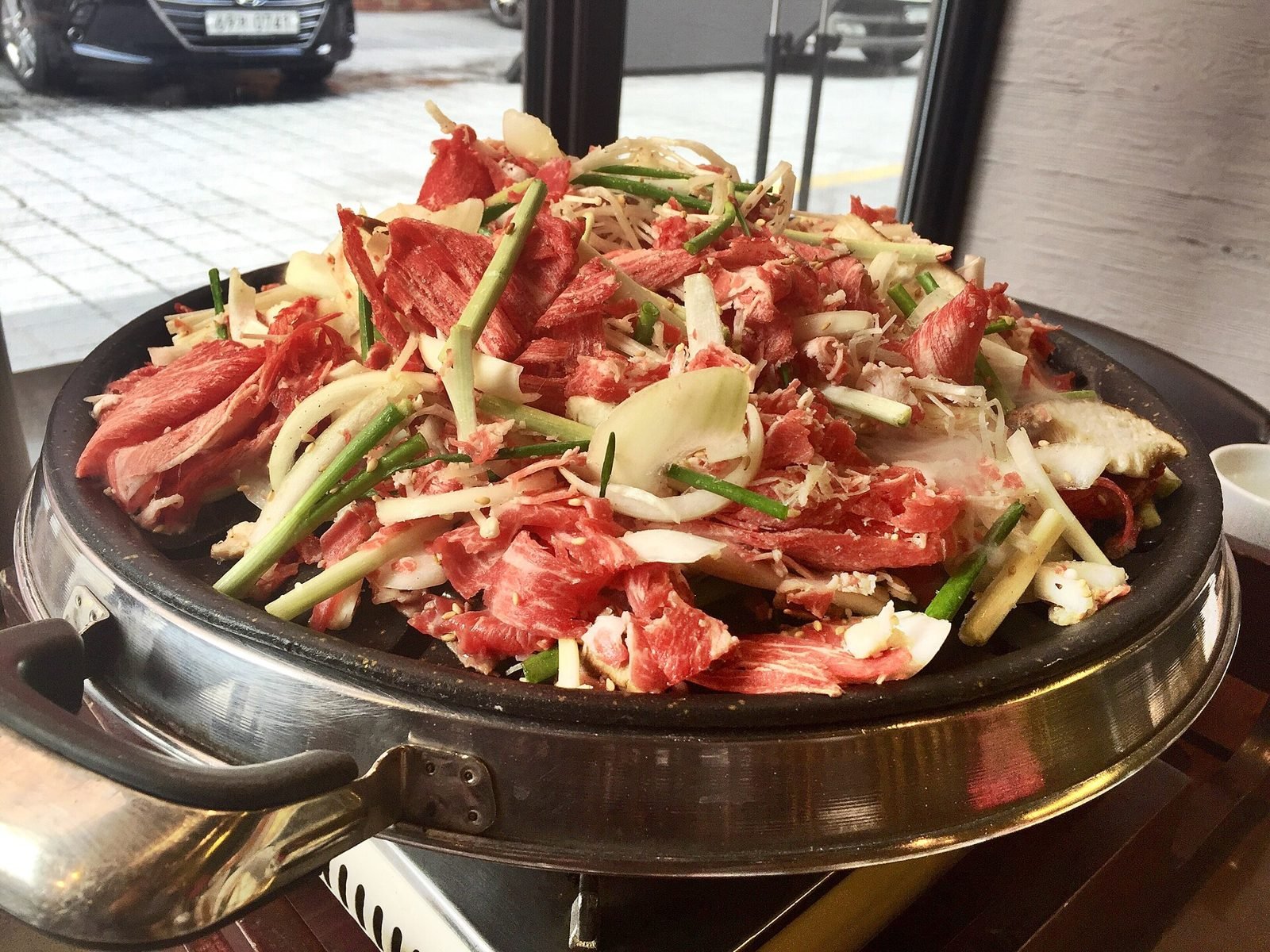
A single layer matters because thin beef holds little heat, and a heap of it releases liquid faster than the pan can evaporate it, so the meat stews in its own marinade and turns grey. A restaurant pan solves this by spreading raw beef over a large griddle as it cooks, which a home skillet cannot imitate in one go.


Bulgogi Recipe
Ingredients
Method
- Slice the beef paper-thin against the grain. If it’s not pre-sliced, freeze it for 45 minutes first so it firms up enough to cut thinly and evenly.
- Grate the Asian pear and half the onion straight into a mixing bowl, so you catch all the juice.
- Whisk in the soy sauce, sugar, mirin, garlic, ginger, sesame oil, and black pepper until the sugar dissolves.
- Add the beef, toss to coat every slice, and press it down so the marinade covers the surface.
- Cover and refrigerate for at least 30 minutes; 2 to 4 hours is better, and overnight is the upper limit before the texture turns mushy.
- Heat a wide skillet over high heat with the neutral oil until it’s just starting to shimmer.
- Lift the beef out of the marinade letting excess liquid drip off, and lay it in a single layer without crowding the pan; cook in batches if needed.
- Sear undisturbed for about 90 seconds until the edges char and curl, then flip and cook 60 to 90 seconds more.
- Add the sliced onion, carrot, and mushrooms if using, and toss everything for 1 to 2 minutes until the vegetables just soften.
- Scatter the scallions in during the last 30 seconds, then serve immediately over rice.
Recipe card photo: Korean.cuisine-Bulgogi-01.jpg by ayustety, CC BY-SA 2.0, via Wikimedia Commons.

Bulgogi in a dry pan, a clay pot and a pot of broth
The Folk Encyclopedia says that until two or three decades before the entry was written, bulgogi was often eaten in the style of a hot pot, on a bulgogi pan with vegetables in the hollow and seasoned meat around the edge, with rice stirred into the juices at the end. As diners drifted toward eating the meat alone, people who missed the broth ended up with tukbaegi bulgogi, beef simmered with plenty of stock in a clay pot that stays hot through the meal. Variants have multiplied since: gridiron bulgogi, briquette-grilled bulgogi and versions made with goat, duck, chicken or squid and pork.
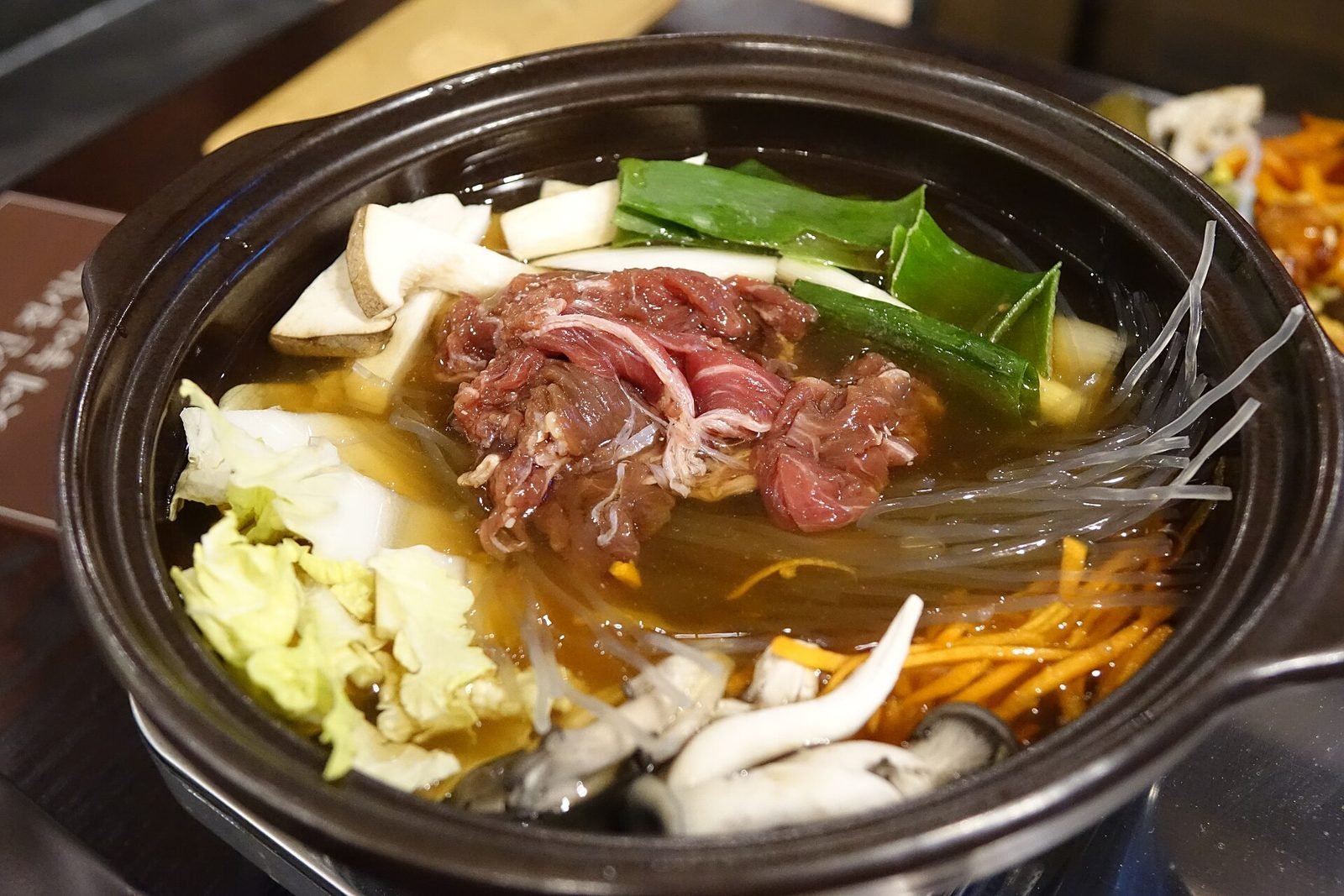

The Seoul media hub ties the clay pot to cheaper imported beef, which let lunch counters sell single portions of tukbaegi bulgogi at the price of a stew meal, put the dish into school meals and, by the 2000s, made it a choice for young people’s own gatherings. If you want to grill beef like this indoors, setting up a table barbecue indoors covers the equipment and the sides, and ordering at a barbecue restaurant explains how the portions work there. On the table, a thin, salty dipping sauce gives a fresher counterpoint to a sweet marinade.
The four ancestors of bulgogi compared
The Folk Encyclopedia’s history gives four named ancestors, each with its own record. The table sets them against the dish the dictionary eventually named.
| Dish | Earliest record in the encyclopedia’s account | Meat and seasoning | How it is cooked |
|---|---|---|---|
| Maekjeok | The Chinese text Soushen ji, from the Jin dynasty | Conjectured: meat mixed with jang, chives or garlic before grilling | Grilled |
| Seolhamyeokjeok | Sanlim gyeongje, around 1715 | Sliced beef pounded with the back of the knife, skewered, rubbed with oil and salt | Low heat, dipped in water, regrilled three times, finished with sesame oil |
| Seolyajeok | Haedong jukji, 1925, as a Gaeseong specialty | Ribs or heart seasoned with oil and aromatics | Grilled half done, dipped in cold water, regrilled over strong charcoal |
| Neobiani | Siui jeonseo, late 1800s; recipe in 1939 | Thin slices with soy sauce, scallion, sesame, pepper and sugar | Grilled directly over fire |
| Bulgogi | Great Dictionary, vol. 3, 1950 | Thin beef marinated in dark soy sauce, honey, scallion, garlic and pepper | Grilled on a griddle or gridiron; sweet |