Dakgangjeong and Korean fried chicken are not the same dish, even though most menus outside Korea list them like they’re interchangeable. The confusion is understandable — both are double-fried, both get tossed in a sweet-savory sauce, both show up next to beer at the same kinds of tables. But the sauces are built differently, they behave differently once they cool, and if you make dakgangjeong using a yangnyeom chicken sauce recipe, you’ll end up with something sticky and good but not actually dakgangjeong.
The glaze is the whole difference
Yangnyeom chicken — what most people abroad just call Korean fried chicken — is coated in a sauce built around gochujang, ketchup, and corn syrup, cooked down into something glossy and clingy that stays soft and a little tacky even after it cools. You can pick a piece up and the sauce moves with your fingers.
Dakgangjeong’s glaze is built around mulyeot, traditional Korean rice syrup, and that single ingredient swap changes everything downstream. Mulyeot has a different sugar structure than corn syrup — as it cooks down and then cools on the surface of the chicken, it sets into a thin, genuinely hard shell rather than staying soft and sticky. Bite into good dakgangjeong and there’s an actual crack before your teeth hit the chicken, the same way there’s a crack on good brittle or hard candy. That glassy set is the entire point of the dish, and it’s the single clearest way to tell whether what’s in front of you is dakgangjeong or yangnyeom chicken with a different name on the menu.
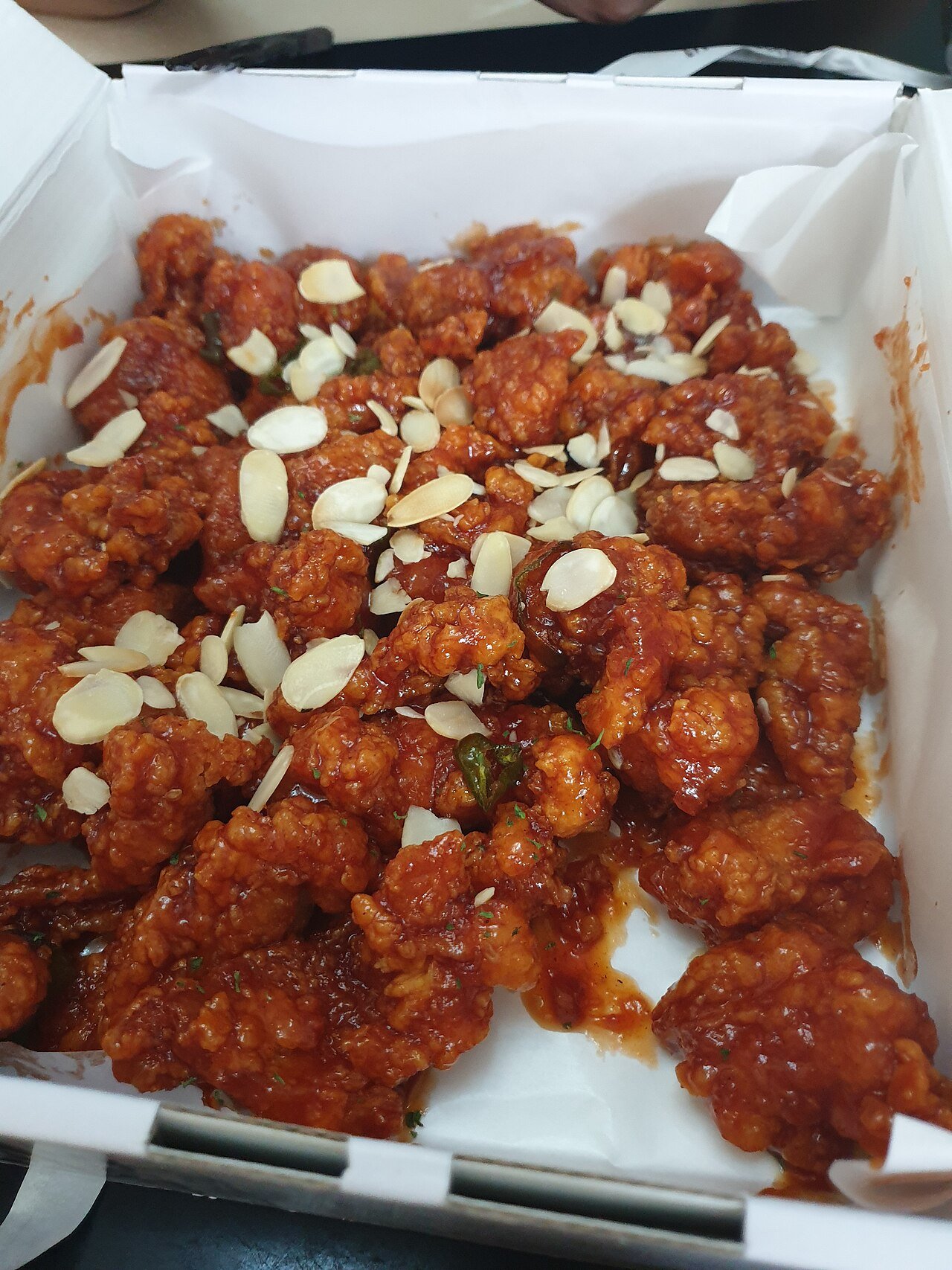
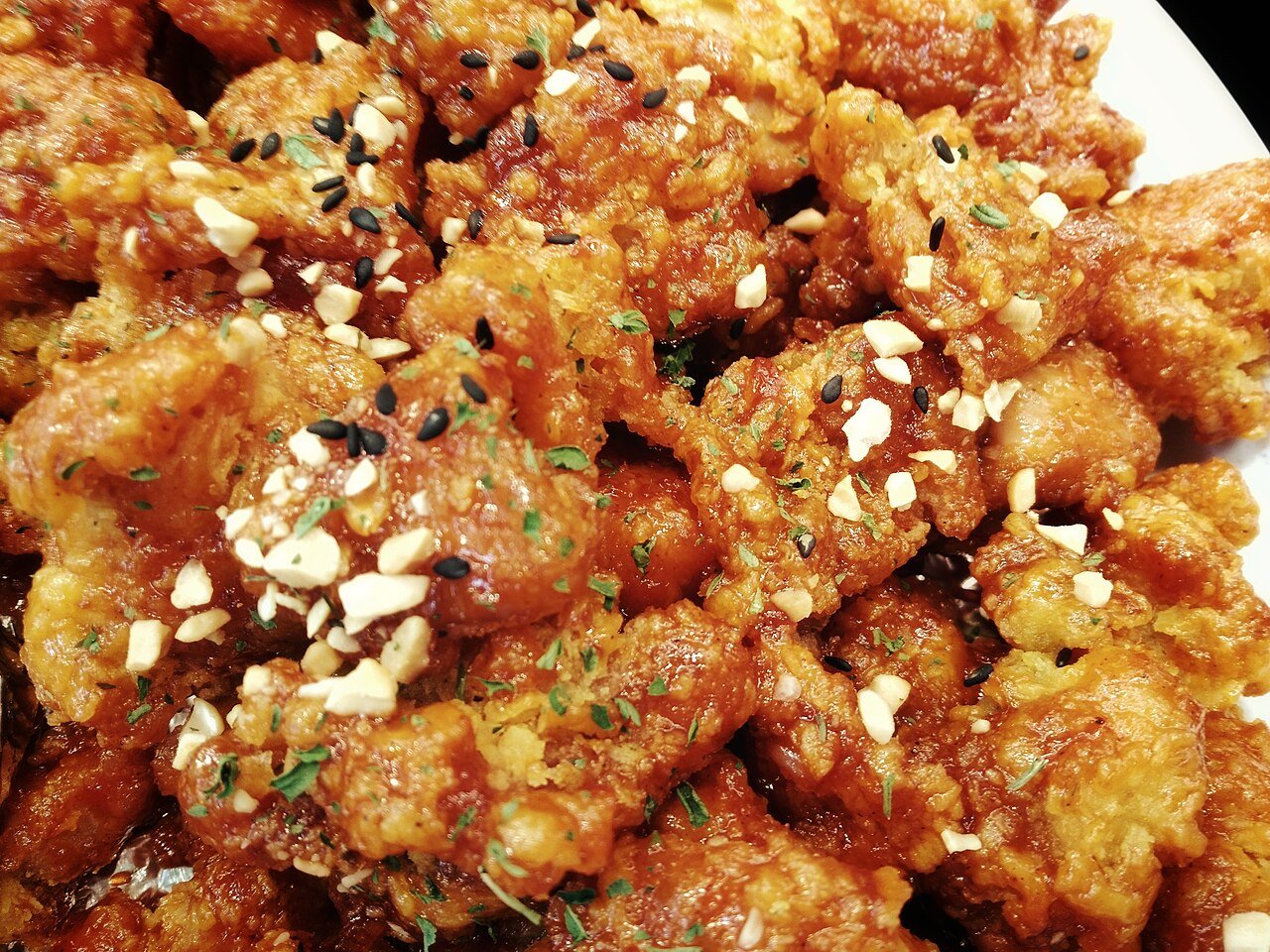
Dakgangjeong Recipe
Ingredients
Method
- Season the chicken pieces with salt, pepper, and soju, and let sit for 10 minutes.
- Toss the chicken in starch until evenly coated, shaking off the excess.
- Heat the oil to 160°C / 325°F. Fry the chicken in batches for 6 to 7 minutes, until pale gold and cooked through, then drain on a rack.
- Let the oil come back up to 190°C / 375°F, then fry the chicken again in batches for 2 to 3 minutes, until deep golden brown and audibly crisp when tapped.
- While the chicken rests, combine the mulyeot, soy sauce, brown sugar, garlic, ginger, gochujang, and water in a wide pan and simmer over medium heat for 2 minutes, until it thickens slightly and coats a spoon.
- Add the fried chicken to the pan and toss quickly over low heat until every piece is coated in the glaze.
- Transfer to a plate immediately, scatter with peanuts, chili, and sesame seeds before the glaze fully sets.
Cutting the chicken evenly matters more than usual
Uneven pieces are a bigger problem in this dish than in most fried chicken, because dakgangjeong pieces are meant to be small and roughly uniform — closer to the size of a walnut than a nugget. If some pieces are twice the size of others, the first fry cooks the small ones through while the large ones are still raw in the center, and pushing everyone to the same finish line means overcooking the small pieces to compensate. Take the extra two minutes to cut the thigh meat into pieces that are genuinely close in size before you season anything. It pays off twice — once in the fry, and again later, since a tray of even, bite-size pieces glazes far more evenly than a mix of odd shapes.
Why the double fry matters more here, not less
Every double-fried Korean chicken dish uses roughly the same logic: a first fry at a lower temperature to cook the meat through without over-browning, a rest, then a second fry at a higher temperature that drives off surface moisture and builds a genuinely crisp crust. Dakgangjeong depends on that crust surviving contact with a hot, wet glaze, which makes the double fry less optional than it is elsewhere.
A single fry leaves a crust with more residual moisture in it. Toss that into the glaze and the crust starts absorbing liquid on contact, turning soggy under the glaze within minutes — you’ll get sauce-coated chicken, but you won’t get the glassy crack. The second fry, at around 190°C / 375°F for just 2 to 3 minutes, matters specifically because it’s driving out the last of the surface moisture that would otherwise undercut the glaze. Frying temperature discipline here isn’t a nice-to-have; it’s the difference between a shell that holds and one that dissolves under its own sauce.
Where dakgangjeong actually comes from
Dakgangjeong is strongly associated with Sokcho, a city on Korea’s east coast, where Jungang Market has several long-running stalls built entirely around this dish — piled trays of glazed chicken pieces sold by weight, meant to be eaten while walking through the market rather than plated at a table. That market-stall origin explains a few things about the traditional form: bone-in wings and drumettes rather than boneless thigh, smaller pieces sized for eating with a toothpick, and a glaze thick enough to survive sitting out on a tray for a while without going soft. A home version with boneless thigh, like the one in this recipe, trades a little of that street-stall character for something faster to eat with chopsticks.
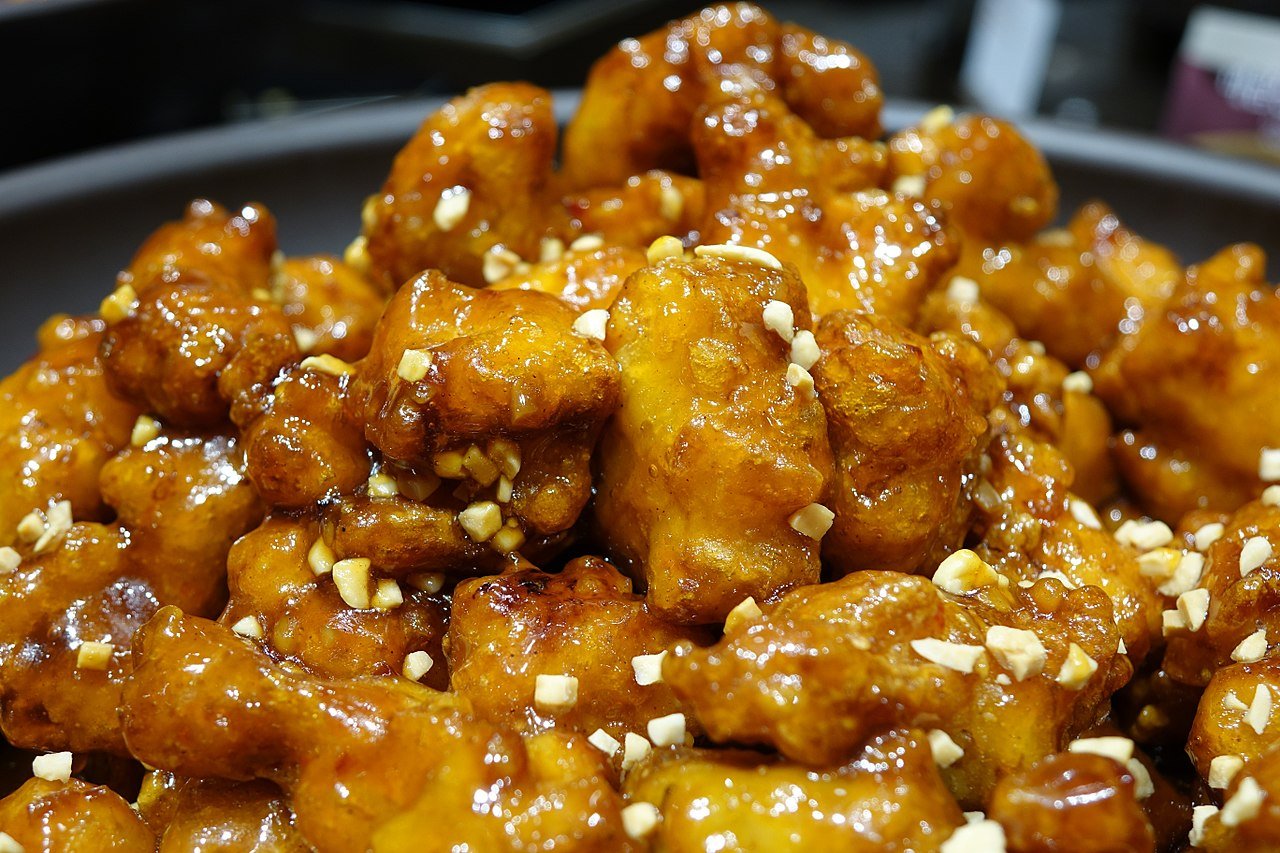
Mulyeot itself is worth a note, since the label can be confusing outside Korea. It’s sold in tubs or jars, usually translated as “rice syrup” or sometimes just “Korean syrup,” and it’s noticeably thicker and less sweet than Western corn syrup — closer in body to warm honey. If your Asian grocer stocks more than one brand, any of them will work here; the differences between brands are much smaller than the difference between mulyeot and a corn-syrup substitute.
Ingredients, and what to use instead
| Ingredient | Where to get it, or what to use instead |
|---|---|
| Mulyeot, 3 tbsp | Korean grocer, sold as “rice syrup” or “corn syrup” in Korean branding — check the label. Substitute: light corn syrup plus a little honey — close, but the set will be a shade less glassy |
| Potato starch, for dredging | Cornstarch works nearly identically. All-purpose flour is a last resort — the crust comes out softer and less prone to that hard crack |
| Chicken thigh, boneless, 600 g | Any supermarket. For a more traditional version, use bone-in wings and drumettes, which is what most Korean stalls actually sell |
| Gochujang, 1 tbsp, optional | Widely available now. Leave it out entirely for a version closer to the classic sweet, non-spicy dakgangjeong |
Timing the glaze
Toss the chicken in the glaze the moment it comes off the second fry, while it’s still hot enough to help the glaze set on contact, and get it onto a serving plate quickly rather than leaving it in the pan. Mulyeot glaze starts firming up within a minute or two off the heat, and if you let it sit too long in the pan it can seize into a solid mass around the chicken instead of coating each piece individually. Working fast here matters more than it does for a softer, corn-syrup-based sauce.
Frequently asked questions
Is dakgangjeong the same thing as Korean fried chicken?
No, even though they’re often lumped together outside Korea. Korean fried chicken, or yangnyeom chicken, uses a gochujang-and-corn-syrup sauce that stays soft and sticky. Dakgangjeong uses a rice-syrup glaze that sets into a thin, hard, glassy shell as it cools — a genuinely different texture, not just a different sauce recipe.
Can I make this less sweet or spicier?
Yes to both, and they’re separate knobs. Cut the brown sugar by half for a less sweet glaze without losing the hard set, since mulyeot itself still provides plenty of sugar. For more heat, increase the gochujang to 2 tablespoons, or add a teaspoon of gochugaru to the glaze along with it.
Why did my glaze come out soft and sticky instead of hard?
Almost always one of two causes: the chicken only got fried once, so residual moisture in the crust softened the glaze on contact, or the glaze itself didn’t reduce enough before the chicken went in — it should coat the back of a spoon and look slightly thickened, not still thin and runny.
What to eat alongside it
If chicken is the centerpiece of your table, dakgalbi is worth knowing as the other major Korean chicken dish, though it couldn’t be more different in method — stir-fried in a hot pan with vegetables and gochujang paste rather than fried and glazed. Between the two, you’ve got most of what Korean chicken cooking actually covers, from market-stall snack to sizzling communal skillet.