Which Korean fried chicken chain is the best? Visitors ask it at the counter, and the question is where the trouble starts, because the chains are not playing one game. One leads in store count, another in sales per store, a third in head-office revenue, and the styles on their menus barely overlap. The figures below can be verified, and they show why “best” has no single answer.

.jpg)
Three scoreboards, three different leaders
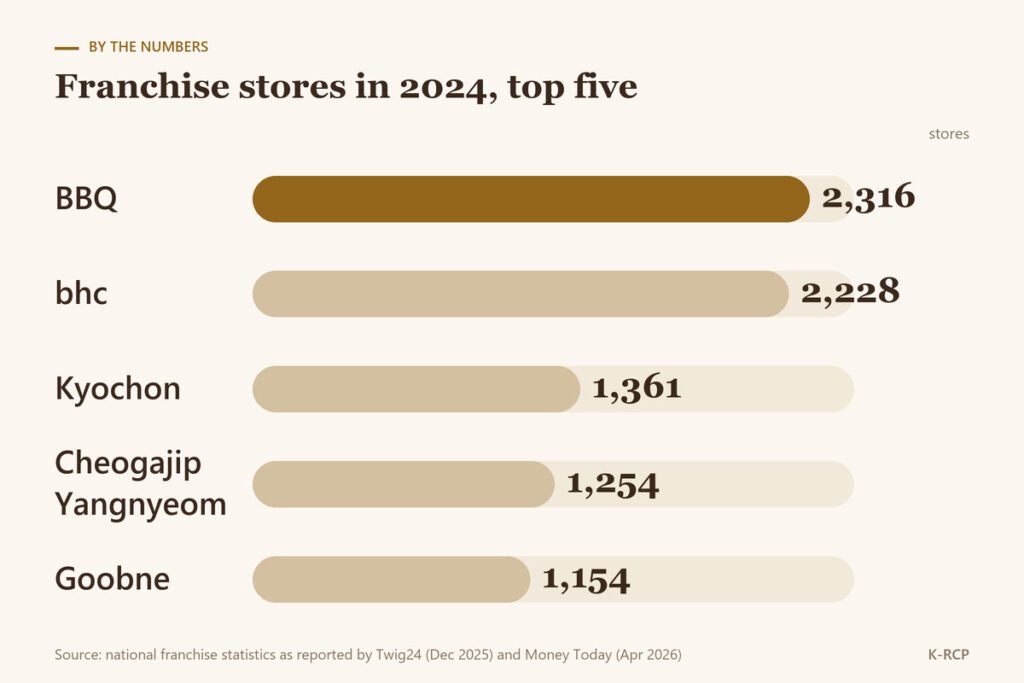
South Korea had 31,397 franchised chicken restaurants in 2024, up 5.3 percent from 29,805 a year earlier, in the national data office’s franchise statistics as reported by Twig24. It was the first time the count passed 30,000, and with 25,110 in 2018 the network has grown by roughly 1,000 shops a year. By store count the top five were BBQ with 2,316, bhc with 2,228, Kyochon with 1,361, Cheogajip Yangnyeom Chicken with 1,254 and Goobne with 1,154, and BBQ took first place back from bhc that year. Counts also depend on where they come from: Newsis takes Pelicana’s 1,042 from the company homepage and gives Cheogajip as 1,254 in its Fair Trade Commission disclosure but 1,260 on its homepage, so compare counts only within one kind of source.
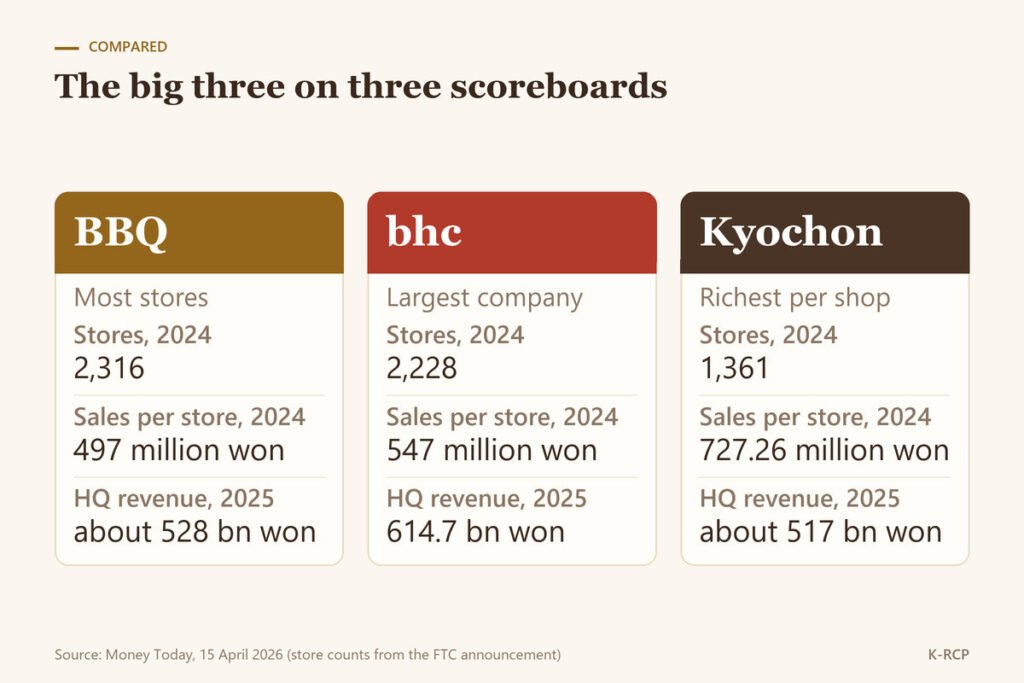
Size is only one yardstick. A Money Today comparison of the big three found each leading a different category. BBQ had the most stores in 2024, a figure from the Fair Trade Commission’s announcement. Kyochon had the highest annual sales per franchise store in 2024, at 727.26 million won, ahead of bhc at 547 million and BBQ at 497 million. bhc had the highest head-office revenue in 2025, 614.7 billion won, up about 20 percent and the first in the sector above 600 billion, roughly 97 billion more than Kyochon’s third-place 517.4 billion. Industry watchers quoted there put Kyochon’s per-store lead down partly to stricter rules on how close its shops may open to one another.
Multiplying stores by sales per store gives a rough sense of scale, ignoring shops that opened or closed during the year: about 1.22 trillion won for bhc, 1.15 trillion for BBQ and 0.99 trillion for Kyochon. On that rough measure bhc leads as well, and Kyochon’s lead per shop does not offset having almost 1,000 fewer shops than BBQ. For scale, the sector’s 8.779 trillion won across 31,397 outlets averages about 280 million won an outlet, well under any of the three.
The market itself is crowded. Revenue across the chicken franchise sector grew only 7.3 percent in 2024, behind coffee and non-alcoholic drinks at 12.8 percent, Korean food at 10.0 percent and pizza and burgers at 9.2 percent, while employment fell 2.4 percent to 65,373 people. An industry official in the Twig24 report reads that as saturation. Counting shops outside the franchise system too, Korea had 39,789 chicken restaurants in 2023, about 3,000 fewer than the 42,743 of 2020.
Money Today closes on a cautious note: with raw-material prices and delivery fees up, an industry expert expects 2026 to be an uncertain year, and each chain is pressing the strength it already has. For a visitor the practical meaning is simple: branches are plentiful, so the choice comes down to style. This guide ranks by store count, the one figure that is public, comparable and dated, and does not rank taste.
Five chains, and what the record says about each
These are the five largest networks by 2024 store count, and the notes follow what each one has left in print. The shape of the list matters: BBQ and bhc sit above 2,200 shops each, third place drops 867 stores below second, and third to fifth spans only 207, so the field is two giants and three mid-sized networks close together.
BBQ. The most shops, 2,316, and about 528 billion won in head-office revenue in 2025, up 4.3 percent. Money Today says its chairman, Yun Hong-geun, named 2026 the first year of a “new management” push: AI-assisted store-site analysis and cost systems, along with a plan to carry the North American model to Southeast Asia and Europe. BBQ and bhc are run by different groups, as Newsis notes.
bhc. bhc’s 2025 jump came from new menus: Gwasakking (콰삭킹) and Sweet Chili King (스윗칠리킹) lifted revenue to 614.7 billion won. Its sales per store, 547 million won, were second among the big three. It is the example of a chain growing through new flavors, and its own app reached 2.8 million cumulative orders in the first year, a way to depend less on delivery platforms and their intermediary fees.
Kyochon. The smallest of the big three networks, with 1,361 shops, and the one whose shops sell the most. Its 2025 head-office revenue of 517.4 billion won put it back above 500 billion, and it has begun placing cooking robots in franchise kitchens to ease labor costs and keep the taste consistent.
Cheogajip Yangnyeom Chicken. The name says seasoned chicken (yangnyeom, 양념). Newsis counts 1,254 stores in the Fair Trade Commission-registered disclosure for the end of 2024, and 1,260 on the company homepage in November 2025, or 1,318 with 58 overseas. Its operator, Hanguk Ilosam (한국일오삼), moved to a holding-company structure in May 2025, and Newsis lists the brand among the first-generation chains of the 1990s now growing again on a retro trend.
Goobne. Fifth with 1,154 stores, 100 behind Cheogajip and about half of BBQ’s network. Twig24’s table gives its count and rank and nothing more, so a menu guide for it has to come from the chain itself.
The first-generation brands. Below the top five, Newsis tracks the chains that sold Korea its first franchised chicken. Pelicana, covered below, started in 1979. Mexicana began in 1985 in Andong, started franchising in Daegu in 1989, passed 1,000 shops, and added a second brand, Chicken the Home, in 2007, but closed shops quickly in later years. Maxican peaked at around 600 and stood at 418 at the end of 2024, then absorbed Harim Distribution, a Harim Group affiliate, in June 2024. Newsis reads their recovery as a retro trend helped by the global spread of Korean chicken.
Where the red sauce came from
Two accounts of yangnyeom chicken compete. Newsis describes Pelicana, which began when founder Yang Hee-kwon opened a small chicken shop in front of Daejeon station in 1979, as the brand that developed yangnyeom chicken and made it popular. It once had more than 2,000 shops, fell from 1,056 in 2022 to 1,019 in 2023 and under 1,000 in 2024 (995 at year end), and was back to 1,042 in November 2025. SBS Biz, citing Yonhap, reported the death of Yun Jong-gye, who opened a shop called Gyeseong Tongdak in Daegu’s Hyomok-dong in the late 1970s. It credits him with the first red sauce made from corn syrup and chili powder, in 1980, with the first chicken radish pickle, and with a brining step in which the chicken is soaked in a salt, sugar and spice solution or rubbed with salt and seasoning to flavor and soften the meat. This guide does not decide between the two claims.
The obituary account has its own detail. Yun, born in Daegu in 1952, turned to chicken after a failed printing business. He recalled that chicken meat was dry, that kimchi seasoning failed no matter how he mixed it, and that a neighborhood grandmother suggested corn syrup, which made the flavor work after more than six months of trials. Early customers complained that the sauce stuck to their hands, then came from across the country. He built the Maxican Chicken brand in 1985, which SBS Biz separates from the similarly spelled Mexicana Chicken, the Andong-born chain of the same year that Newsis counts at about 790 shops, up from 738 at the end of 2024.
Questions that come up before the first order
Is Korean fried chicken always spicy? No. Yangnyeom is the seasoned, sweet-and-hot red style, and the sauce credited to Yun Jong-gye was built on corn syrup and chili powder. The Folk Encyclopedia describes the style as a gochujang-based sweet-hot seasoning with a separate soy-based salty one beside it. Plain fried chicken on menus is usually called huraideu (후라이드), and soy-based styles are sold as ganjang (간장). Because they are separate menu items, the box you want depends on the menu name more than on the chain name.


Which chain should a first-time visitor pick? Pick by style, not by rank. The rankings above measure how big a chain is, how well each shop sells and how large the company is. None of them measures taste. For the red sauce, look for a yangnyeom-named chain; for the shortest walk to a branch, one of the two largest networks; for something new this season, bhc.
Why do store counts and sales point to different winners? They measure different things. BBQ has the most stores, Kyochon the highest sales per store from fewer, more spaced-out shops, and bhc the largest company revenue. A chain can lead one scoreboard and trail another without contradicting itself. Kyochon is the clearest case: the fewest shops of the three, the most sales from each.
Since when has Korea eaten fried chicken? The Folk Encyclopedia’s entry on fried food says deep-frying only became easy once oil spread after the Korean War and bulk-produced soybean oil arrived in 1975. Fried chicken went on sale from the 1970s as oil got cheaper, at first whole, which is why it was called tongdak, and later cut into pieces. The entry even quotes a saying that fried food tastes good “even if you fry a shoe.” The Korean style took shape when the gochujang-based sweet-hot seasoning and the soy-based salty one were added.
What do banban and sunsal mean on the menu? Banban (반반) means half and half, so one box carries two flavors, usually a seasoned half and a plain half. Sunsal (순살) means boneless. The white cubes of pickled radish in the box are called chikin-mu (치킨무), and SBS Biz credits Yun Jong-gye with making the first one.
The red sauce in your own kitchen
If you want the idea without placing an order, crisp dakgangjeong is the sticky-glazed fried chicken cooked at your own stove. Its sauce starts from a tub of chili paste, and if a recipe asks for gochujang and you are unsure which tub to buy, what gochujang is and how to read the label covers the heat and the ingredient list. A restaurant yangnyeom sauce is its own thing, built on corn syrup and chili powder in the obituary account, so a home version will taste different, and that is fine. The Folk Encyclopedia notes that the usual coating for frying is a thin batter of flour, frying mix, glutinous rice flour or starch stirred with water, which is why the same home pantry can produce a crisp crust or a sticky glaze depending on what goes on top.
Matching a mood to a chain
This table maps styles to chains using only facts from the sections above. It is not a taste ranking, and each row is a starting point, not the only option.
| What you want | Where to start | The record behind it |
|---|---|---|
| Red, sweet-hot seasoned chicken | Cheogajip Yangnyeom or Pelicana | Yangnyeom is the style’s name, and Newsis describes Pelicana as the brand that developed it |
| A branch near wherever you are | BBQ or bhc | The two largest networks, with 2,316 and 2,228 stores |
| Whatever is new this season | bhc | 2025 growth credited to the Gwasakking and Sweet Chili King launches |
| Fewer, busier shops | Kyochon | Highest sales per store in 2024, at 727.26 million won |
| A first-generation brand | Pelicana, Cheogajip or Mexicana | Chains from the 1990s and earlier that Newsis says are growing again on a retro trend |
| Two flavors in one box | Any chain that offers banban | Half seasoned, half plain, on the menu |
Store counts and revenues move every year, so read the table as a snapshot of the 2024 and 2025 figures cited above. Sales per store can favor chains that space their shops widely, as Money Today’s industry sources suggest for Kyochon, store count favors the ones that expand fastest, and company revenue measures the head office and not the shop, so no single column settles which chain is best for you tonight.