Yun Jong-gye, the Daegu fried-chicken seller remembered as the creator of red yangnyeom chicken, said that it took him more than six months of failed batches, and that an older woman from the neighborhood, passing by, finally told him to try mulyeot, Korean starch syrup. After he died in December 2025, a Yonhap report carried by SBS Biz retold the account.
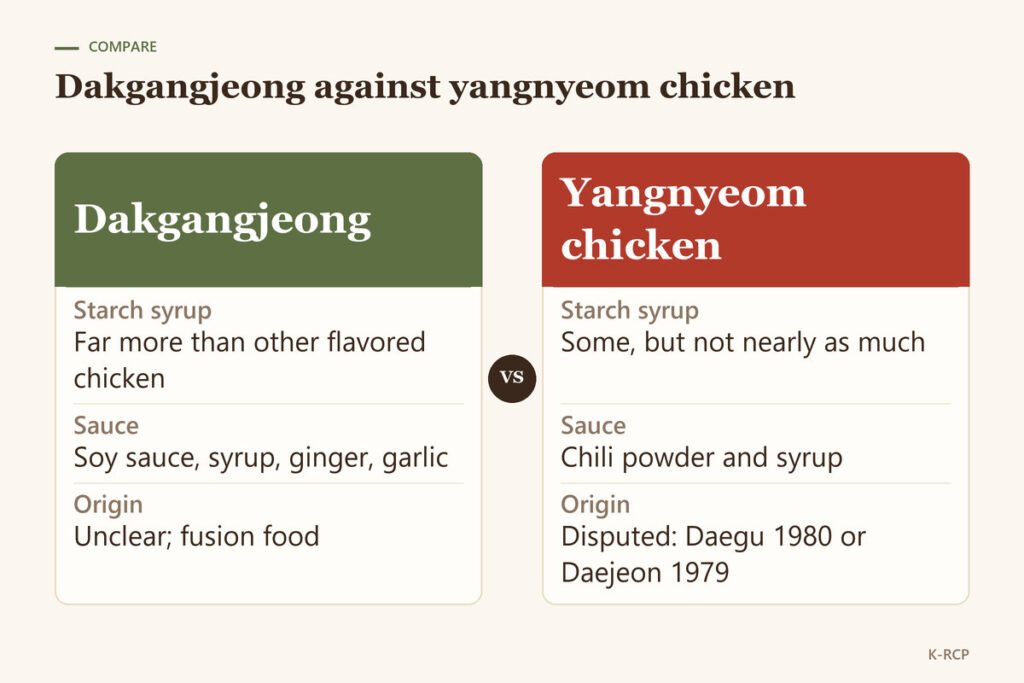
Dakgangjeong runs on the same syrup, only far more of it. The Korean Cultural Center webzine calls starch syrup the critical difference: ordinary fried chicken sags as it cools, while dakgangjeong gets crunchier and tastier.
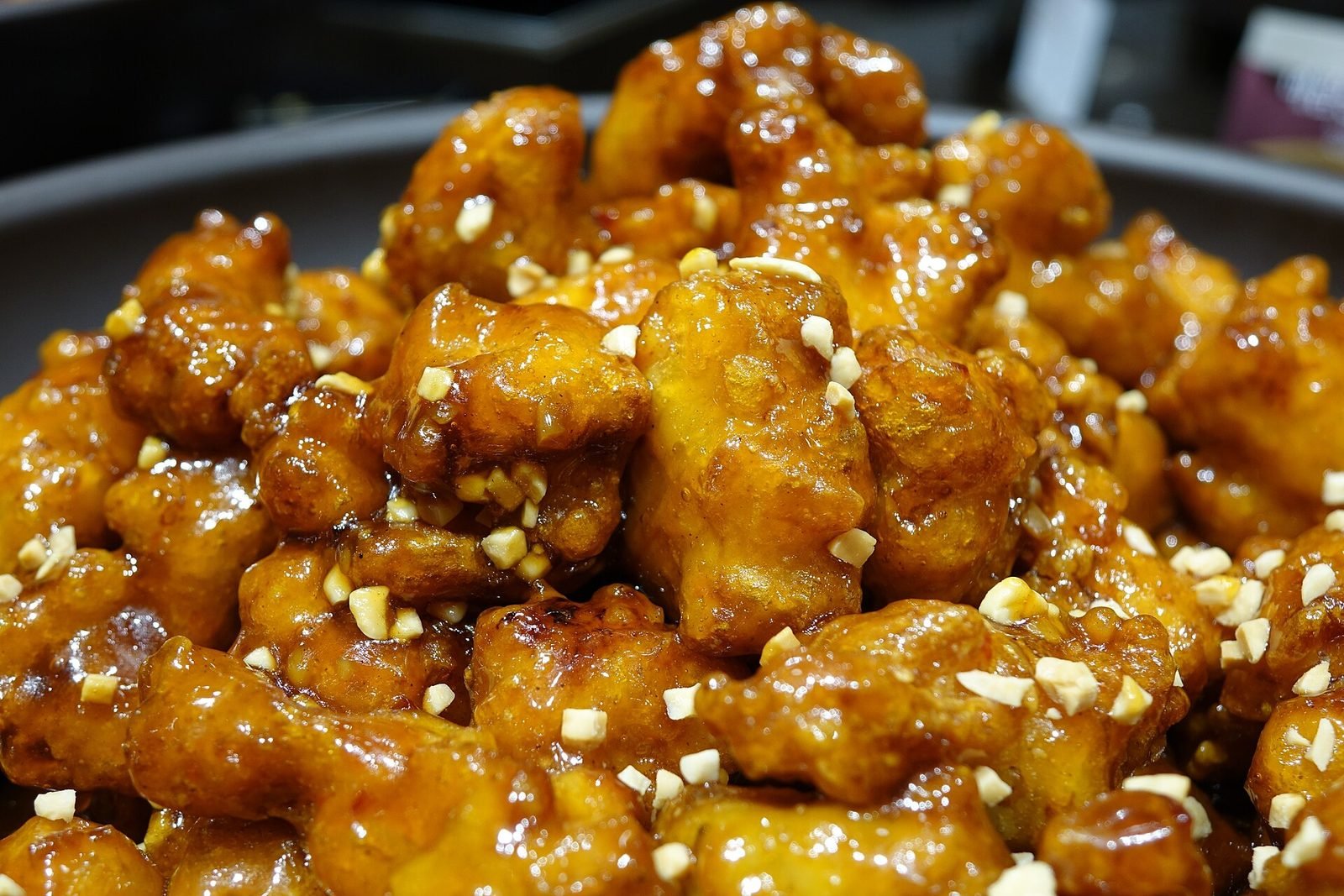

Starch syrup is the whole difference
Spicy and flavored fried chicken also contains syrup, the webzine says, but not nearly as much as is poured into dakgangjeong. Part of the name comes from gangjeong, fried glutinous rice crackers that use the same syrup to harden. The Standard Korean Language Dictionary defines dak-gangjeong as small pieces of fried chicken simmered in a sauce mixed from soy sauce, starch syrup, ginger, garlic and the like. The sauce, in other words, is the dish.
Mulyeot is sold in tubs and jars at Korean grocers and is translated as rice syrup, starch syrup or simply Korean syrup. It is thick, closer to warm honey in body than to a pourable syrup. The recipe card builds its glaze on 3 tablespoons of it, with 2 tablespoons of soy sauce, 2 tablespoons of brown sugar, 2 minced garlic cloves and 1 teaspoon of grated ginger, plus an optional tablespoon of gochujang (see a plain-language explainer on gochujang for what that paste adds). The card uses mulyeot, and the webzine credits starch syrup for the hardening glaze.
The pieces and the coating matter just as much. Cut boneless thigh into even bite-size pieces so a thick glaze coats them smoothly; uneven ones leave bare patches. The dredge is the same thin starch coating described in the twigim notes on batter and oil: the card uses 100 g (3/4 cup) of potato starch or cornstarch for 600 g of chicken, after the chicken has rested for 10 minutes with salt, pepper and an optional tablespoon of soju. A thin starch shell fries to a light, brittle crust, which is what the glaze needs to cling to.
A market snack from Sokcho and Incheon
Where dakgangjeong began is unclear. The webzine says only that it is generally known as fusion food, with gochujang and chili powder from the Korean side and toppings such as crushed nuts and rice cake, and that whether Chinese and Western fried chicken inspired it remains unknown. It adds that the dish appeared in the K-drama Mystic Pop-up Bar.
What is clear is where it became famous. Sinpo International Market in Incheon and Sokcho Central Market in Gangwon-do Province are named as the two most famous places for it. Sinpo teems with dakgangjeong vendors and long lines, and certain brands that are now national chains started in the Sokcho market. Markets differ by style: at Ganseok Free Market in Incheon the version leans on more soy sauce, a variant uses garlic cream sauce, and toppings include fries, cheese and sweet potato.
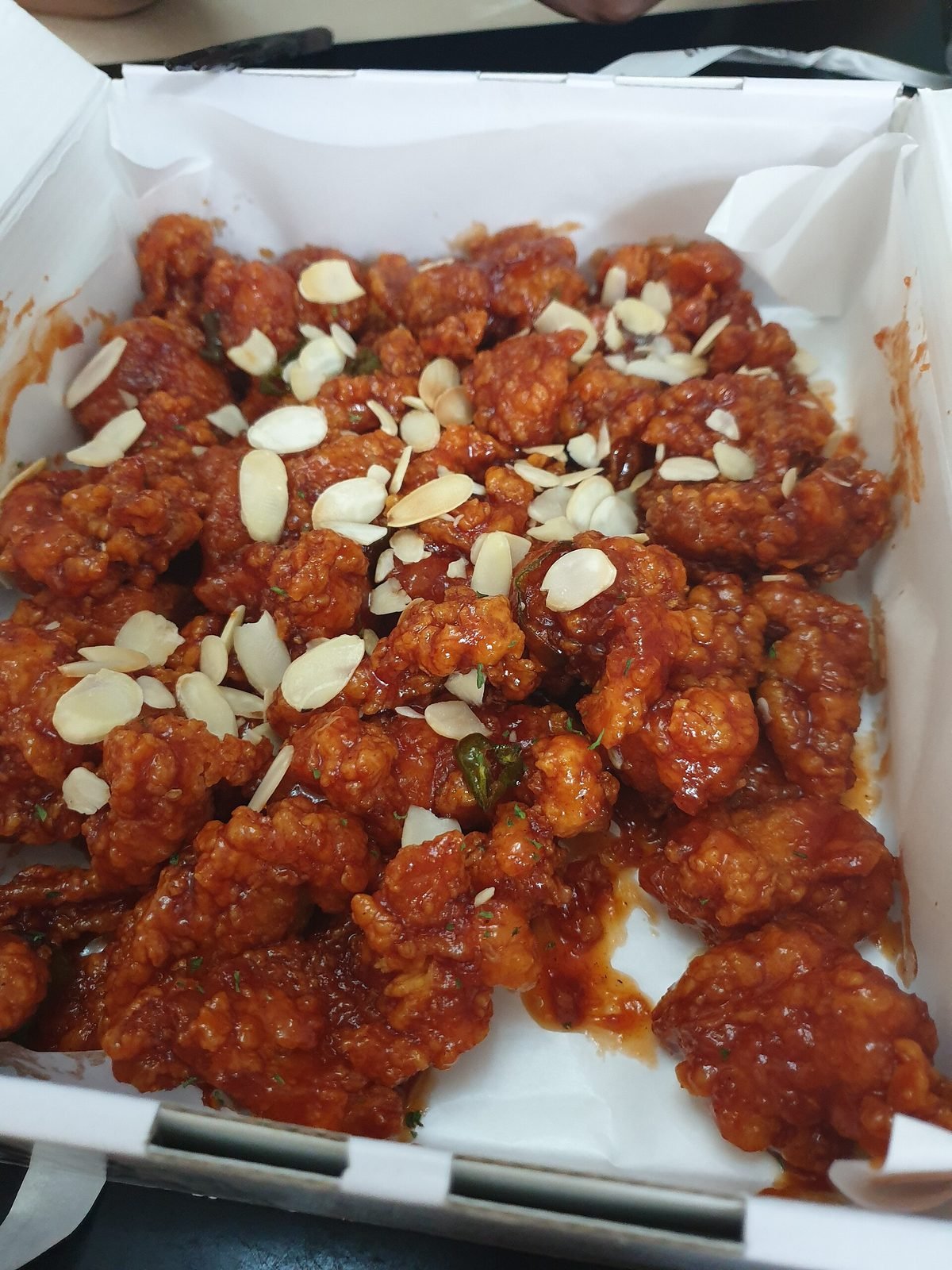

It has also gone mainstream, sold at convenience stores and snack kiosks near schools. The webzine’s warning is worth keeping: many such places reheat in a microwave, which undoes the crunch the syrup built. For the oil, use any neutral frying oil with a high smoke point, about 1 liter (4 cups) in a pot deep enough that the oil stays well below the rim. A wide pan for the glaze, separate from the fryer, makes the final toss quick.
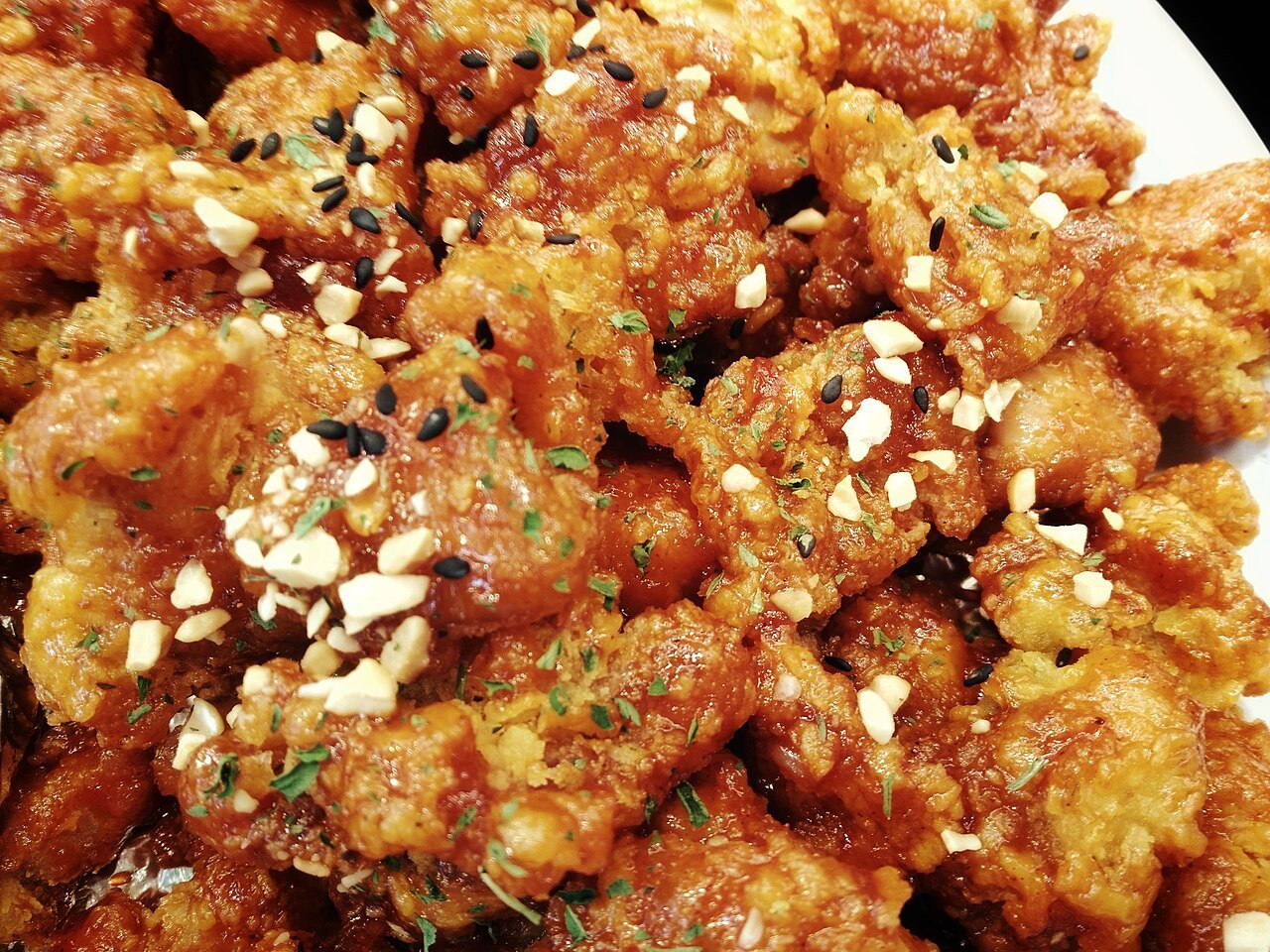
The toppings on the card follow the market style the webzine describes: 2 tablespoons of roasted peanuts or cashews, roughly chopped, 1 teaspoon of toasted sesame seeds and, if you like heat, 1 sliced dried red chili. They go on while the glaze is still wet, which is why the card says to measure them first. The whole recipe is written for 4 servings and takes about 45 minutes, 20 of preparation and 25 of cooking.
Dakgangjeong Recipe
Ingredients
Method
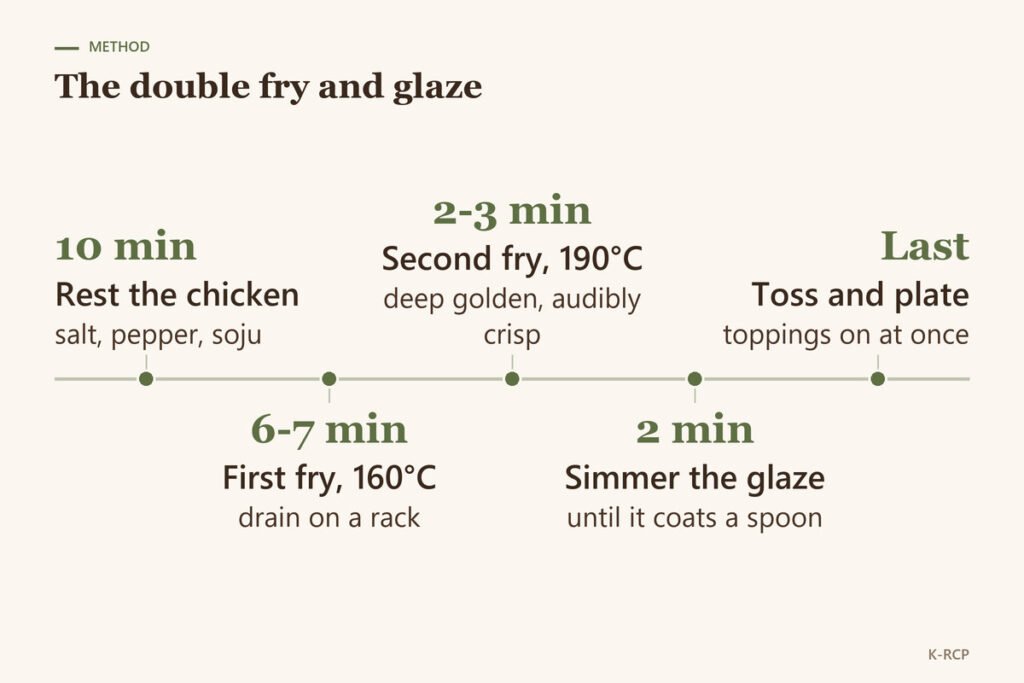
- Season the chicken pieces with salt, pepper, and soju, and let sit for 10 minutes.
- Toss the chicken in starch until evenly coated, shaking off the excess.
- Heat the oil to 160°C / 325°F. Fry the chicken in batches for 6 to 7 minutes, until pale gold and cooked through, then drain on a rack.
- Let the oil come back up to 190°C / 375°F, then fry the chicken again in batches for 2 to 3 minutes, until deep golden brown and audibly crisp when tapped.
- While the chicken rests, combine the mulyeot, soy sauce, brown sugar, garlic, ginger, gochujang, and water in a wide pan and simmer over medium heat for 2 minutes, until it thickens slightly and coats a spoon.
- Add the fried chicken to the pan and toss quickly over low heat until every piece is coated in the glaze.
- Transfer to a plate immediately, scatter with peanuts, chili, and sesame seeds before the glaze fully sets.
Recipe card photo: Dak-gangjeong 1 by Ajumeoni, CC0 1.0, via Wikimedia Commons.

Sweetness, heat, cuts and timing, answered before you fry
The comparison below sets dakgangjeong beside yangnyeom chicken; the other answers are practical.
Is dakgangjeong the same as Korean fried chicken?
No. Yangnyeom chicken, the red sauced kind, is built on a chili-and-syrup sauce (mulyeot and chili powder, in Yun’s telling), and who made it first is disputed, and the table shows both claims. Yun said he made the first batch in Daegu in 1980, while a 2025 Newsis report describes the chain Pelicana, which Yang Hee-kwon started in Daejeon in 1979, as the brand known for developing and popularizing it. Dakgangjeong is a different format: small pieces, much more syrup, and a coating that hardens. For the chain versions of the red kind, see how the big Korean fried chicken chains stack up.
Can I make it less sweet or spicier?
Those are separate adjustments. For less sweetness, trim the brown sugar from 2 tablespoons to 1 and keep the mulyeot, since the syrup is what sets the glaze. For heat, raise the gochujang from 1 tablespoon to 2, or add a teaspoon of gochugaru alongside it.
Which part of the chicken should I use?
Boneless thigh, as the card does. Both fries are short, and thigh has enough fat to forgive them. Breast dries out in the minutes between the two fries; if breast is all you have, cut the pieces slightly larger and take them out the moment they turn deep golden.
Can I make it ahead?
Better than most fried chicken, because the glaze hardens as it cools, which is the webzine’s whole point about the dish. Let it cool for a few minutes before eating, and pack leftovers in a box lined with paper rather than a sealed tub, so steam does not collect and soften the coating. Do not reheat in a microwave.
Why a glaze goes soft, seizes, or never sets
Almost every failure comes from three places. The method depends on two oil temperatures, 160°C (325°F) for the first fry and 190°C (375°F) for the second, so keep a thermometer in about 1 liter (4 cups) of oil and do not guess.
The glaze stays soft and sticky. Either the chicken was fried only once, so moisture left in the crust softens the glaze on contact, or the glaze did not reduce enough. The first fix is the second fry. After 6 to 7 minutes at 160°C, drain on a rack, let the oil recover to 190°C, and fry again for 2 to 3 minutes, until deep golden and audibly crisp when tapped. For the second cause, simmer the glaze for about 2 minutes, until it coats the back of a spoon.
The glaze seizes into a lump. Mulyeot glaze starts to firm up quickly once it is off the heat. If the chicken sits in the pan, the glaze sets around the whole batch instead of each piece. Toss over low heat until every piece is coated, move it to a plate straight away, and scatter the chopped peanuts, chili and sesame seeds before the surface hardens. Measure the toppings before you start.
The crust is crisp in the pan but limp once glazed. Drain the first fry on a wire rack, not paper towels, so steam escapes from underneath. Have the glaze simmering and the wide pan ready before the second fry ends, because the gap between fryer and glaze is where crispness is lost.