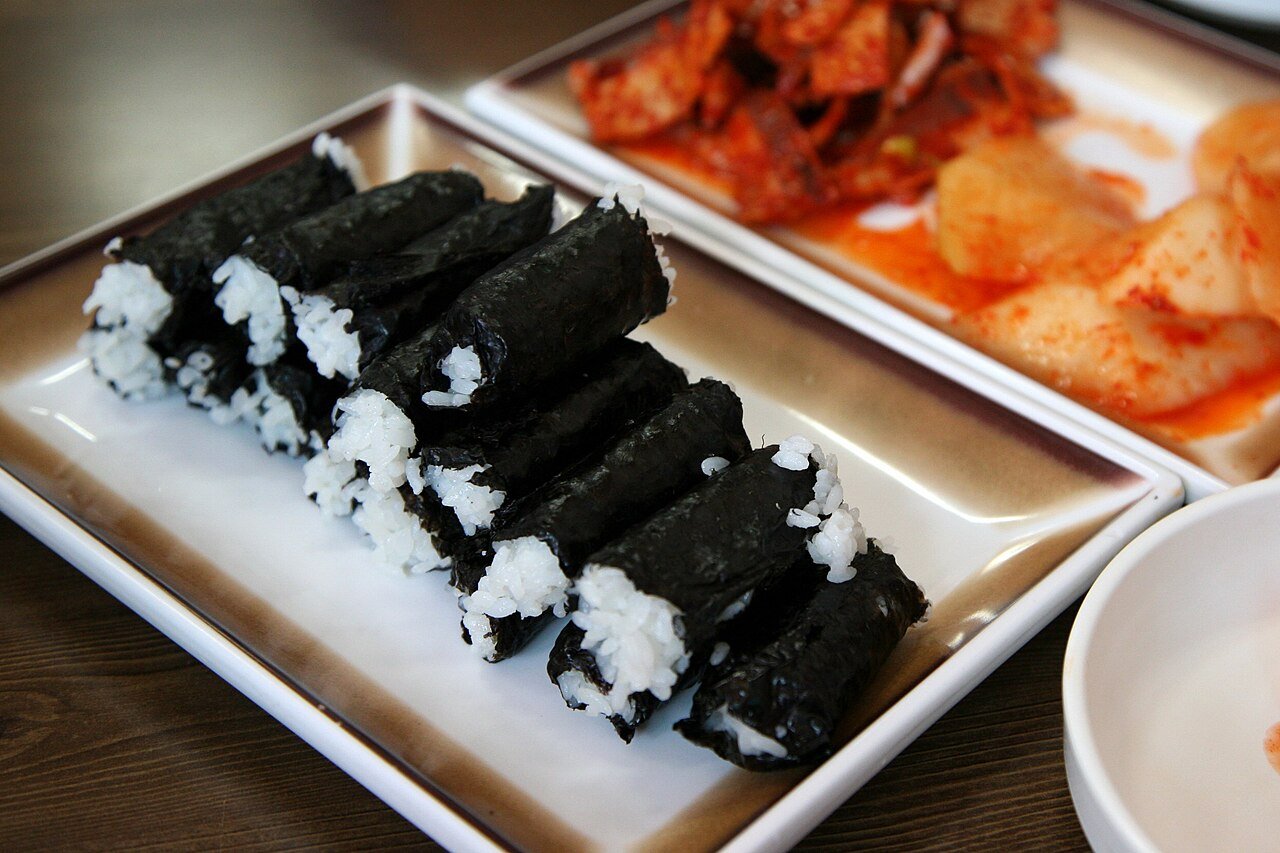
Before it was a snack you could order in Seoul, chungmu gimbap was ferry food. In the harbor at Chungmu — the old name for the port town now called Tongyeong, on Korea’s southern coast — women used to sell rice rolls to passengers boarding boats for the outer islands, and the trip could run long in summer heat. A normal filled roll goes off within a few hours. So they stripped the filling out entirely, sold plain rice-and-seaweed cylinders that could survive a hot afternoon, and served the perishable, flavorful part — spicy stir-fried squid and cubed radish kimchi — in a separate dish on the side. That split is still the whole identity of the dish, and it’s the first thing to understand if you’ve only ever had regular kimbap.
Quick Facts
| Time | 35 min prep, 20 min cook (plus 30 min radish resting) |
| Makes | 16 thin rolls, 4 servings |
| Difficulty | Easy — fewer components than regular kimbap |
| Spice level | 3 / 5, mostly from the squid |
| Vegan? | Not easily — the squid is the point, but eomuk works if you want a milder version |
Not a Variation of Kimbap. A Different Dish With the Same Name
It’s tempting to think of chungmu gimbap as kimbap with the fillings swapped out, but that gets the relationship backward. Regular kimbap is built around a full cross-section — egg, pickled radish, carrot, spinach, all visible when you cut it. Chungmu gimbap has nothing inside but rice, rolled thin, and the flavor comes entirely from what sits next to it on the plate rather than what’s rolled into it.
That makes it a genuinely different eating experience, not a stripped-down one. You pick up a bare roll, you pick up a piece of spicy squid or a cube of radish, and you eat them together in one bite, mixing the flavors in your mouth rather than in the roll. It’s closer to how you’d eat rice and banchan at a regular meal than it is to eating a sandwich.
Ingredients, and What to Use Instead
For 16 rolls and both side dishes.
| Ingredient | Where to get it, or what to use instead |
|---|---|
| 4 sheets gim (seaweed), unseasoned | Same as sushi nori. No need for the roasted, salted snack kind here. |
| 600 g / 3 cups cooked short-grain rice | Calrose or sushi rice. Long-grain rice won’t cling in a roll this thin, and thin is the whole point. |
| 300 g / 10 oz squid, cleaned and sliced | Fresh or thawed frozen squid, widely sold at any grocery with a seafood counter. If squid isn’t for you, sliced eomuk (Korean fish cake) or imitation crab takes the same sauce well — much milder, no chew at all, but genuinely common even in Korea now. |
| 200 g / 7 oz daikon radish, cubed | The same radish used for kkakdugi. If you can find jarred kkakdugi already made, skip the pickling step entirely and use that. |
| 2 tbsp gochugaru | Korean chili flakes. Sub 1 tbsp sweet paprika plus 1 tsp cayenne — sharper heat, none of the fruity note. |
| 1 tbsp gochujang | If you don’t have it, 1 tsp white miso plus extra gochugaru gets you close enough for this small a quantity. |
| Soy sauce, rice vinegar, sugar, garlic, ginger, scallion | All standard pantry items. |
Chungmu Gimbap
Ingredients
Method
- Toss the radish cubes with 1 tbsp rice vinegar, half the sugar, a pinch of salt and half the ginger. Let it sit at room temperature at least 30 minutes, stirring once, while you do everything else.
- Cook the rice with 10% less water than usual, then fold in the sesame oil and salt while it’s still warm.
- Score the squid rings lightly and pat them dry — dry squid sears instead of steaming.
- Heat the neutral oil in a pan over high heat and sear the squid for 90 seconds, until just opaque, then remove it from the pan.
- In the same pan, combine the gochugaru, gochujang, soy sauce, remaining sugar, garlic and 2 tbsp water and simmer 1 minute until it thickens slightly.
- Return the squid to the pan, toss to coat for 30 seconds, then stir in the scallions and take it off the heat immediately — overcooked squid turns rubbery fast.
- Cut each seaweed sheet into quarters lengthwise so you end up with 16 narrow strips.
- Lay a strip rough side up, spread a thin line of rice along the near edge only, about a third of the width of the strip, and roll it into a tight, thin cylinder with no filling inside.
- Repeat with the remaining strips, sealing each with a few grains of rice, then rest the rolls seam-side down for a minute.
- Brush the rolls with sesame oil, scatter sesame seeds, and cut into short 2 to 3 cm pieces if you like, or leave them whole to eat by hand.
- Serve the rolls with the spicy squid and the radish alongside, not inside — the two are meant to be eaten in the same bite, not rolled together.
Two Small Side Dishes, Not One Big Roll
The radish is the easier of the two and it needs the most lead time. Toss cubed daikon with rice vinegar, a little sugar, salt and grated ginger, and let it sit at room temperature for at least half an hour. It won’t be a fully fermented kkakdugi in that time — more of a quick pickle — but it does the same job on the plate: something cold, sharp and crunchy to cut against the rice and the chili.
The squid wants high heat and very little time in the pan. Pat it dry first; wet squid steams instead of searing and turns tough. Ninety seconds over high heat is enough to cook it through, then it comes out of the pan while you build the sauce, and it goes back in only long enough to get coated — another thirty seconds, no more. Squid keeps getting more rubbery the longer it sits over heat, which is the one thing to watch closely here.

Rolling Thin, Which Is Its Own Small Skill
Cut each sheet of gim into quarters lengthwise, so you’re working with narrow strips instead of a full sheet. Spread a thin line of rice along the near third of the strip only — there’s no filling to hold the shape here, so a rice line that’s too thick just makes a fat, floppy roll instead of a tight one.
Roll it into a cylinder the way you would a normal kimbap roll, but expect it to feel looser in your hands, because you don’t have a bundle of fillings acting as a core to compress around. Seal the far end with a few grains of rice as glue, and let the rolls rest seam-side down for a minute before you handle them again. If a few come out uneven at first, that’s normal — this is a different motion than rolling a full sheet, and it takes a couple of tries to get a feel for how much pressure a bare rice roll can take before it splits.
Serving It the Traditional Way
Put the rolls, the squid and the radish on the same plate but keep them physically separate. Eat by picking up a roll in one hand and a piece of squid or radish in the other, taking a bite of each together rather than dipping or stacking. If you’d rather cut the rolls into rounds like regular kimbap, that’s a fine modern shortcut and plenty of restaurants in Seoul do it now — just know that eating them whole, by hand, is closer to how this actually started on a boat dock.
Storage
The rice rolls, plain as they are, keep at room temperature for a few hours the same way any kimbap does, but they dry out faster than a filled roll because there’s less moisture inside to begin with — wrap them tightly if you’re not eating within an hour or two. The squid keeps two days refrigerated and reheats fine in a hot pan for thirty seconds; any longer in the pan and it goes tough again. The quick-pickled radish actually improves after a day in the fridge, once it’s had more time to take on the vinegar and ginger.
Common Questions
Is chungmu gimbap the same as regular kimbap with less filling?
Not really — it’s built around a different idea. Regular kimbap puts the whole meal inside one roll; chungmu gimbap separates the rice from the flavor entirely and serves them side by side. It’s a different way of eating, not a smaller version of the same dish.
Can I make chungmu gimbap without squid?
Yes. Sliced eomuk fish cake or imitation crab takes the same spicy sauce well and is far easier to find outside Korea. You’ll lose the specific chew that squid brings, but the dish still works, since the sauce and the radish are doing most of the flavor work either way.
Why did my rolls come out loose instead of tight?
Almost always too much rice or not enough pressure while rolling. Without a filling bundle to compress around, a chungmu roll needs a genuinely thin line of rice and firm, even pressure the whole way through the roll. If they’re coming out loose, use less rice next time rather than pressing harder on a thick line — thick rice with no filling core just won’t hold a tight cylinder.
Related
If you want the opposite approach — one roll that carries the entire meal inside it — regular kimbap is the place to start. And if what you actually want is something small enough to eat one-handed from a convenience store rather than a plate you sit down to, samgak kimbap is the modern, grab-and-go cousin of this same rice-and-seaweed idea. If you’re still filling out your pantry, the Korean pantry starter kit covers which gochugaru is worth buying for dishes exactly like this squid.