The first time I tried to cook gamjatang outside Korea, I called four different butchers before one of them understood what I was asking for. Two just heard “pork bones” and offered me ribs. One offered dog food bones, which is not a joke I’m proud of laughing at. The fourth, a small family shop, said “oh, neck bones, give me a day” and that was the entire fix. Gamjatang is not a hard soup to cook. It’s a hard cut of meat to source, and once you get past that one obstacle, the rest of the recipe is just patience with a pot.
Quick facts
- Total time: about 2 hours, most of it unattended simmering
- Serves: 4, with rice and side dishes
- Difficulty: medium
- Spice level: 3 out of 5
- Vegan-friendly: no — this is a bone broth dish by definition
What is gamjatang?
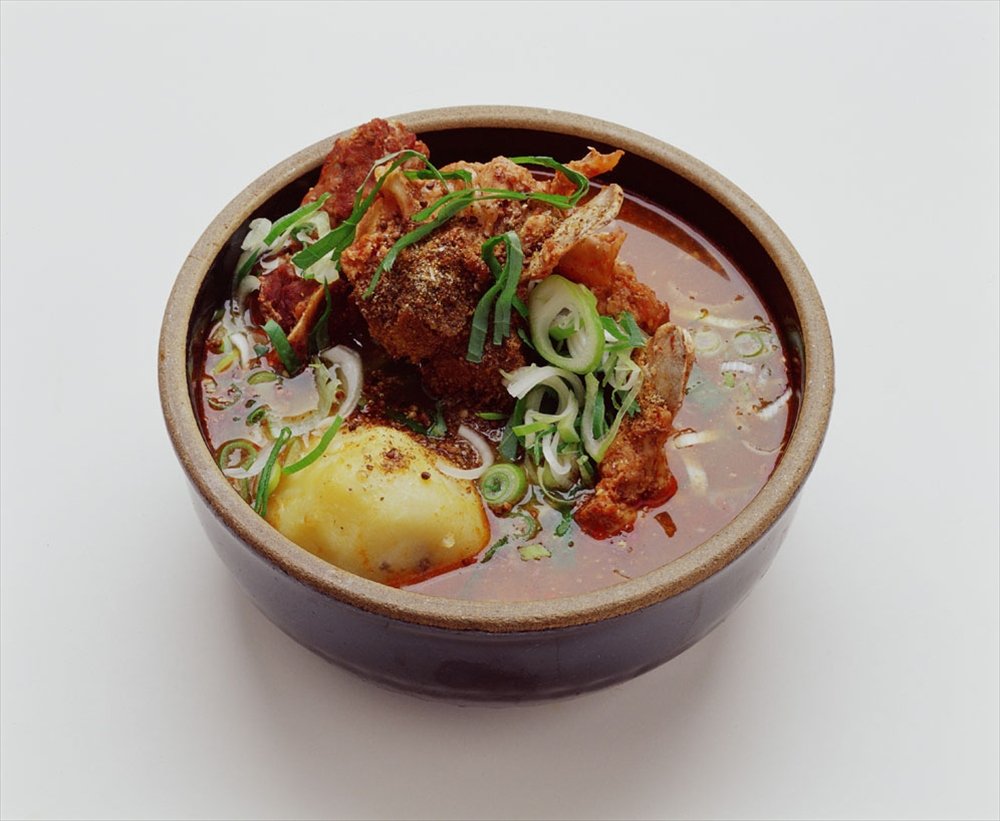
Gamjatang (감자탕, roughly gam-ja-tang) is a red, chili-spiced stew built on slow-simmered pork spine or neck bones, with potatoes, napa cabbage, and perilla leaves added toward the end. The name is a small trap for English speakers: gamja means potato, so the dish sounds like it should be a potato soup with pork on the side. It’s really the other way around. The bones are the point. The potatoes are there to soak up the broth and to give you something to eat once you’ve worked through the meat still clinging to the spine.
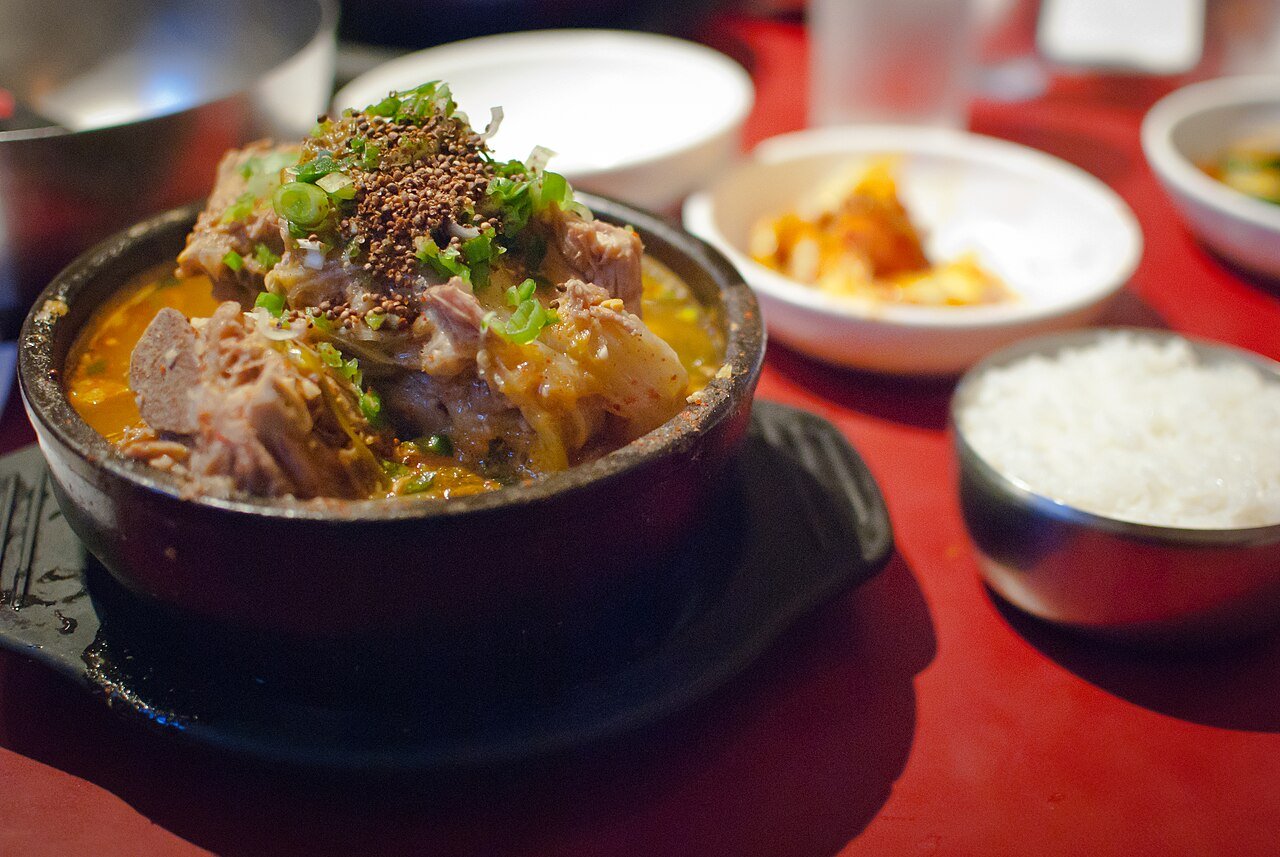
It’s a communal dish, served in a big pot in the middle of the table, and it’s the kind of place you eat with your hands a little — picking meat off the bone, wiping your fingers, going back for more. Restaurants that specialize in it often stay open past midnight, which tells you something about who eats it and when.
The bone problem, and how to actually solve it
Korean gamjatang uses deung-ppyeo (등뼈), pork spine cut into thick sections, sold specifically for this soup at Korean grocers and butchers. Outside Korea, this cut mostly doesn’t exist on a normal supermarket shelf, and that’s the entire reason home cooks give up on this dish before they’ve started.
Here’s the script that works. Call a butcher — not a supermarket meat counter, an actual butcher shop — and ask for “meaty pork neck bones or spine, cut into 5 cm sections, for soup.” Say “for soup” specifically; it tells them you want bone with some meat left on, not clean-picked bones for stock. Most butchers who break down whole pigs have this cut even if it isn’t displayed, because it’s a byproduct of cutting loins and shoulders. If you strike out, a Korean or Chinese grocer’s frozen section often carries a bag labeled specifically for gamjatang — look for “pork bone” or “감자탕거리” on the packaging.
If neither is available, meaty country-style pork ribs are the honest substitute. You lose some of the collagen that makes real gamjatang broth faintly sticky on the lips, and the meat yield is a little less generous per bone, but the soup is genuinely good and nobody at your table will complain. Don’t use clean, meatless soup bones — you’ll get a thin broth with nothing to eat.
Ingredients, and what to use instead
| Ingredient (for 4) | Where to get it, or what to use instead |
|---|---|
| Pork spine or neck bones, 1.2 kg / 2.5 lb | Butcher order (see above), or a Korean grocer’s frozen soup-bone section. Substitute: meaty country-style ribs — thinner broth, still good |
| Doenjang, 2 tbsp | Korean grocer. Substitute: red miso, 1:1 — smoother, less funky |
| Gochugaru, 2 tbsp | Korean grocer or online. Substitute: sweet paprika plus cayenne |
| Anchovy-kelp broth, 1.5 liters / 6 cups | A dashi-pack shortcut covers most of the depth a long bone simmer would otherwise need. We cover exactly how to make or buy it in our Korean pantry starter kit |
| Perilla seed powder, 2 tbsp | Korean grocer, sold dried and ground. Substitute: ground toasted sesame seeds — loses the nutty thickness, keeps the nuttiness |
| Perilla leaves, 6–8 | Korean or Southeast Asian grocer. Substitute: basil plus mint — a different plant, but closer in effect than leaving the gap empty |
| Potatoes, napa cabbage, garlic, ginger, scallions | Any supermarket |
Gamjatang Recipe
Ingredients
Method
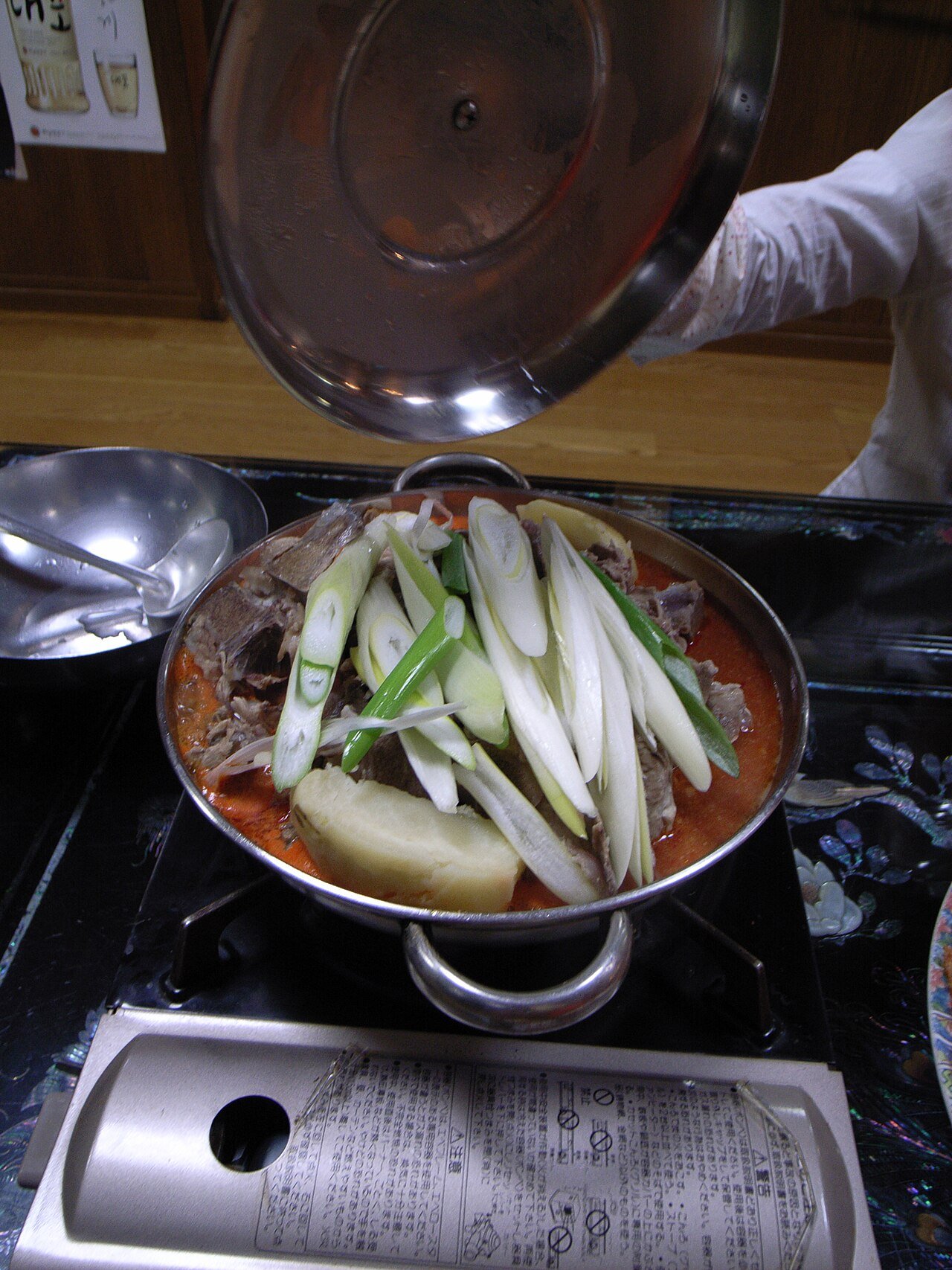
- Put the pork bones in a large pot, cover with cold water, and bring to a hard boil for 5 minutes. Drain and rinse the bones and the pot under running water, scrubbing off any grey scum stuck to the bone. Skip this and the broth turns cloudy and smells distinctly of pig.
- Return the rinsed bones to the pot with 1.5 liters / 6 cups fresh water. Bring to a boil, then simmer, partly covered, for 60 minutes, skimming any foam that rises in the first 15 minutes.
- Stir in the gochugaru, gochujang, doenjang, garlic, and ginger. Simmer 10 more minutes so the paste dissolves into the broth instead of sitting on top.
- Add the anchovy-kelp broth and the potatoes. Simmer 15 minutes, until a knife slides into the potato with only slight resistance.
- Add the napa cabbage leaves and perilla seed powder. Simmer 8 minutes, until the cabbage has gone fully soft.
- Stir in the perilla leaves and scallions, season with salt to taste, and simmer 2 more minutes.
- Serve directly from the pot. If anyone wants ramyeon noodles added to the leftover broth once the meat is gone, drop them in at a rolling boil for 3 minutes.
How to make it
- Boil the bones hard for 5 minutes in fresh water, then drain and scrub off the grey scum under running water. This step alone is the difference between a clean broth and one that smells like a butcher’s back room.
- Simmer the rinsed bones in 1.5 liters of fresh water for a full hour, skimming foam early on.
- Stir in the gochugaru, gochujang, doenjang, garlic, and ginger and simmer 10 minutes so the pastes actually dissolve rather than float on top.
- Add the anchovy-kelp broth and potatoes, and simmer 15 minutes until a knife meets slight resistance in the potato.
- Add the napa cabbage and perilla powder, and give it 8 more minutes.
- Finish with perilla leaves and scallions, salt to taste, and 2 minutes more.
- Bring the whole pot to the table. Save the ramyeon-noodle move for the very end, once most of the meat is gone — it’s a real, common way to close out the pot rather than a gimmick.
Tips and storage
The biggest time-saver, honestly, is a pressure cooker. Thirty-five minutes at high pressure replaces the hour-long simmer in step 2, and the broth comes out just as rich. If your only pot is a regular stockpot, don’t rush it — a thin, watery-tasting gamjatang is almost always a broth that didn’t get its full hour.
Leftovers keep 3 days refrigerated, and the flavor deepens overnight. Reheat gently on the stove with a splash of water; the broth thickens as it sits. This is also one of the few stews that freezes well, bones and all, for up to 2 months — just leave the perilla leaves out of what you freeze and add them fresh when you reheat.
Frequently asked questions
Can I make gamjatang without pork spine bones?
Yes, with meaty country-style ribs as the substitute described above. You’ll get less collagen richness and slightly less meat per bone, but the seasoning and vegetables carry most of the character of the dish anyway.
What does perilla seed powder actually do here?
It thickens the broth slightly and adds a nutty, faintly sesame-like undertone that’s distinct from actual sesame. If you can’t find it, ground toasted sesame seeds are the closest stand-in, though the broth stays thinner without the real thing.
Is gamjatang the same as haejangguk?
Not exactly, but the two overlap. Gamjatang is often eaten as a late-night or hangover-friendly meal because it’s hearty and hot, but it’s a distinct dish with its own name and its own restaurants. Our haejangguk recipe is the more direct “morning after” soup, built differently around a lighter broth.
What to cook and eat next
If sourcing the pork bones took some doing, put them to full use — the leftover broth is exactly what our ramyeon upgrades guide is built around, and gamjatang restaurants do this on purpose. For a different kind of long-simmered pork and vegetable stew, doenjang jjigae uses the same fermented soybean paste in a lighter, faster format.
Gamjatang restaurants in Korea tend to cluster in older, working-class neighborhoods, open late and unfussy about decor. If you’re planning a trip, k-trips has a guide to where locals actually eat around Jongno, one of the neighborhoods where this kind of place has stuck around.