You’ve picked up a bag of malted barley powder on a Korean grocery run, maybe on a whim, maybe because a recipe card next to the register mentioned sikhye, and now it’s sitting in your cupboard while you try to figure out what to actually do with it. Most sikhye instructions assume you either own a yogurt maker or are willing to babysit an oven set to its lowest temperature for six hours, checking a thermometer every twenty minutes. If neither of those describes your kitchen, there’s a much simpler tool already on your counter: the rice cooker you use three times a week without thinking about it.
Sikhye (식혜) is a sweet Korean rice punch made by letting malted barley enzymes slowly break rice starch down into sugar, a process called saccharification, which needs a narrow warm temperature window held steady for hours. A rice cooker’s keep-warm setting sits right in that window by default — it’s built to hold cooked rice at a food-safe, gently warm temperature for exactly this kind of long, low, hands-off hold. No thermometer required. You’re just borrowing a function the appliance already has.
Quick facts
- Total time: about 30 minutes active work, plus 4 to 6 hours mostly unattended in the rice cooker
- Serves: 6
- Difficulty: medium, though almost none of that is hands-on labor
- Vegan: yes
- Traditionally served: chilled, often at the end of a big meal or during Korean holidays
Why the rice cooker works for this
Saccharification, the process that turns bland rice water into something sweet, happens because the malted barley contains active amylase enzymes that break long starch chains into shorter sugars. Those enzymes work best in a specific range, roughly 55 to 65°C (130 to 150°F) — too cool and the process crawls, too hot and the enzymes denature and stop working entirely, the same way an egg white goes from clear to white once it passes a certain temperature.
A rice cooker’s keep-warm setting is engineered to sit inside food-safe warming territory, which happens to land close enough to that enzyme sweet spot to get the job done reliably, especially with the lid propped slightly open to let a little heat escape rather than sealing it in at the higher end of the range. It’s not a precision tool built for this specific purpose, but it holds a steadier temperature for longer than most people can manage by hovering over a stove, and it does it without anyone standing there.
Ingredients, and what to use instead
| Ingredient | Where to get it, or what to use instead |
|---|---|
| Malted barley powder (yeotgireum), 1/2 cup | Korean grocers, in-store or online. There’s no real substitute — this is the ingredient that makes the whole process work |
| Cooked short-grain rice, 2 cups | Leftover rice a day old works better than fresh, since it’s slightly firmer and holds together better through the long warm soak |
| Sugar, 3/4 cup | Adjust after straining and tasting — the malt water itself is already somewhat sweet |
| Fresh ginger, pine nuts, dried jujube | Any supermarket for ginger; Korean grocer for the garnishes, both entirely optional |
Sikhye Recipe
Ingredients
Method
- Whisk the malted barley powder into the warm water. Let it sit 20 minutes, stirring once or twice, so the starch-digesting enzymes release into the water.
- Strain the mixture through a fine sieve lined with cheesecloth, or an ordinary clean dish towel, squeezing firmly to push out as much cloudy liquid as possible. Discard the coarse bran left behind. This liquid is your malt water.
- Pour the malt water into the rice cooker insert along with the cooked rice.
- Set the rice cooker to its keep-warm function, not the cook setting, and leave the lid propped very slightly open with a chopstick. Let it sit 4 to 6 hours.
- Check it after 4 hours: the liquid should taste distinctly, unmistakably sweet, and a few grains of rice should be floating on the surface rather than sitting on the bottom. If it still tastes mostly like water, give it another hour.
- Scoop out about 1/2 cup of the floating rice grains and set them aside in a bowl of cold water. Pour the rest of the liquid into a saucepan, leaving the remaining softened rice behind or straining it out.
- Add the sugar and sliced ginger to the saucepan. Bring to a boil, skimming off any foam, then simmer 5 minutes.
- Cool the liquid completely, then refrigerate until cold. Serve in cups or bowls with a few of the reserved floating rice grains and pine nuts on top.
How to make it
- Whisk the malt powder into warm water and let the enzymes release for 20 minutes.
- Strain it firmly through cloth, keeping the liquid and discarding the bran.
- Combine the malt water and rice in the rice cooker.
- Set it to keep-warm with the lid slightly propped open, and leave it 4 to 6 hours.
- Check for sweetness and floating rice grains before moving on.
- Reserve a few floating grains, then boil the rest of the liquid with sugar and ginger for 5 minutes.
- Cool, chill, and serve with the reserved rice grains floating on top.
Where this goes wrong
Sealing the rice cooker lid completely shut is the most common issue. A fully sealed keep-warm environment traps too much heat and pushes the mixture toward the top of or past the enzyme’s working range, which can stall the sweetening process rather than speed it up. Propping the lid open with a chopstick or a folded towel lets enough heat escape to stay in the useful zone.
Not tasting along the way is the second mistake. The timing given here is a starting point, not a guarantee — rice cooker models vary in exactly how warm “keep warm” runs. Taste at the four-hour mark and every hour after until it’s clearly, obviously sweet, not just faintly less bland than water.
Serving and storage
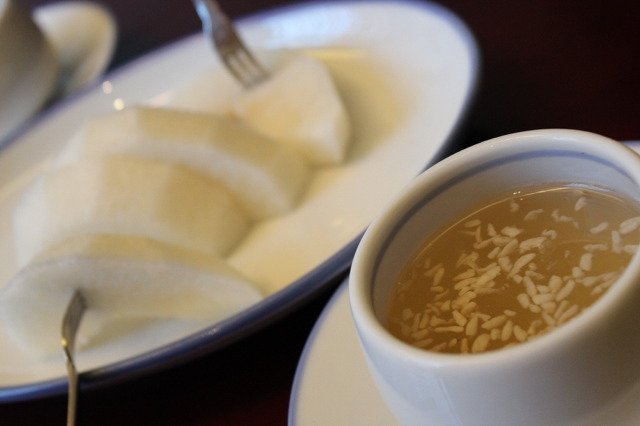
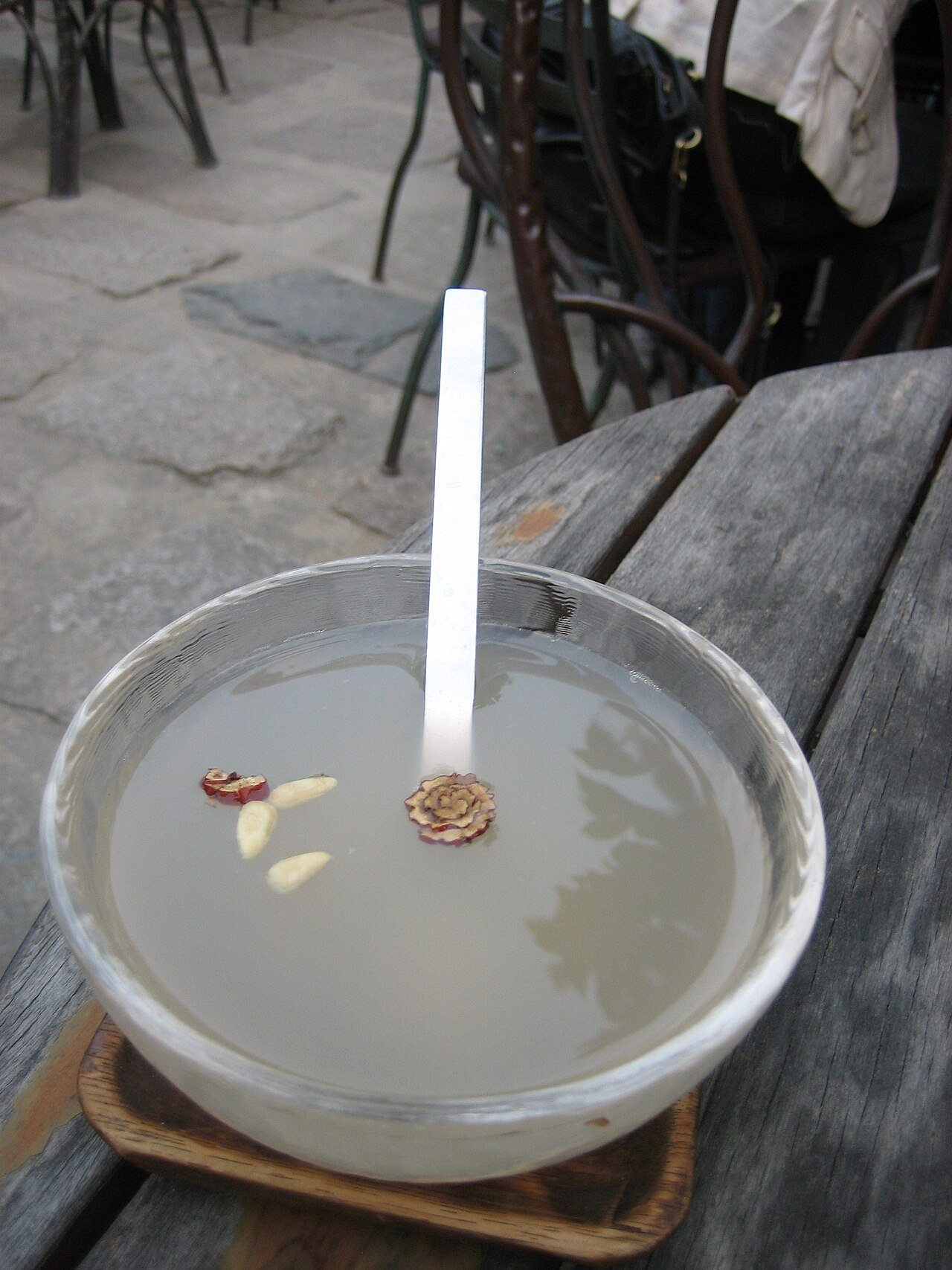
Sikhye is meant to be served cold, traditionally in a wide bowl with a spoon, the floating rice grains as much a visual signature as a textural one. It keeps in the fridge for about a week in a sealed container, and the flavor mellows slightly as it sits. It’s a common way to close out a big traditional meal or a holiday table, valued as something light and sweet after heavier, richer dishes, rather than as an everyday drink.
A regional variation worth knowing about
Most sikhye is pale and mild, but the version from Andong, in the southeast, looks and tastes entirely different — deep red from gochugaru stirred into the mix, with a spicy, gingery kick instead of the plain sweetness described here. It’s still built on the same malted barley process underneath, just seasoned in a completely different direction once the saccharification stage is done. If the version in this recipe interests you enough to make a second batch, the Andong style is worth trying specifically because it shows how much range a single base technique can cover.
Frequently asked questions
Can I make sikhye without a rice cooker?
Yes — a very low oven, around 60°C (140°F), with the door propped slightly open, or a yogurt maker set to its lowest setting, both work on the same principle. The rice cooker method is simply the version that needs no extra equipment beyond something most kitchens already own.
What exactly is malted barley powder, and can I substitute anything for it?
It’s barley that’s been sprouted and dried, which activates the amylase enzymes that break down starch into sugar. There isn’t a workable substitute — it’s the one ingredient actually doing the chemistry here, not just adding flavor.
Why didn’t my rice grains float to the top?
This usually means the mixture didn’t sit warm long enough, or the rice cooker’s keep-warm setting runs cooler than average. Give it another hour or two, tasting as you go — the floating grains are a sign that saccharification has properly finished, not just a garnish.
Where to go from here
Sikhye shares its core idea — patient, low-temperature fermentation doing work that heat alone can’t — with the kimchi recipes on this site, just applied to grain instead of vegetables; if that interests you, baechu kimchi walks through the same kind of slow transformation from the vegetable side. For serving it the traditional way, sikhye is a common finish after a substantial meal like samgyetang, Korea’s ginseng chicken soup. And if you’re building a full cold-dessert table for a hot day, patbingsu, Korean shaved ice, is the other classic on the same table.