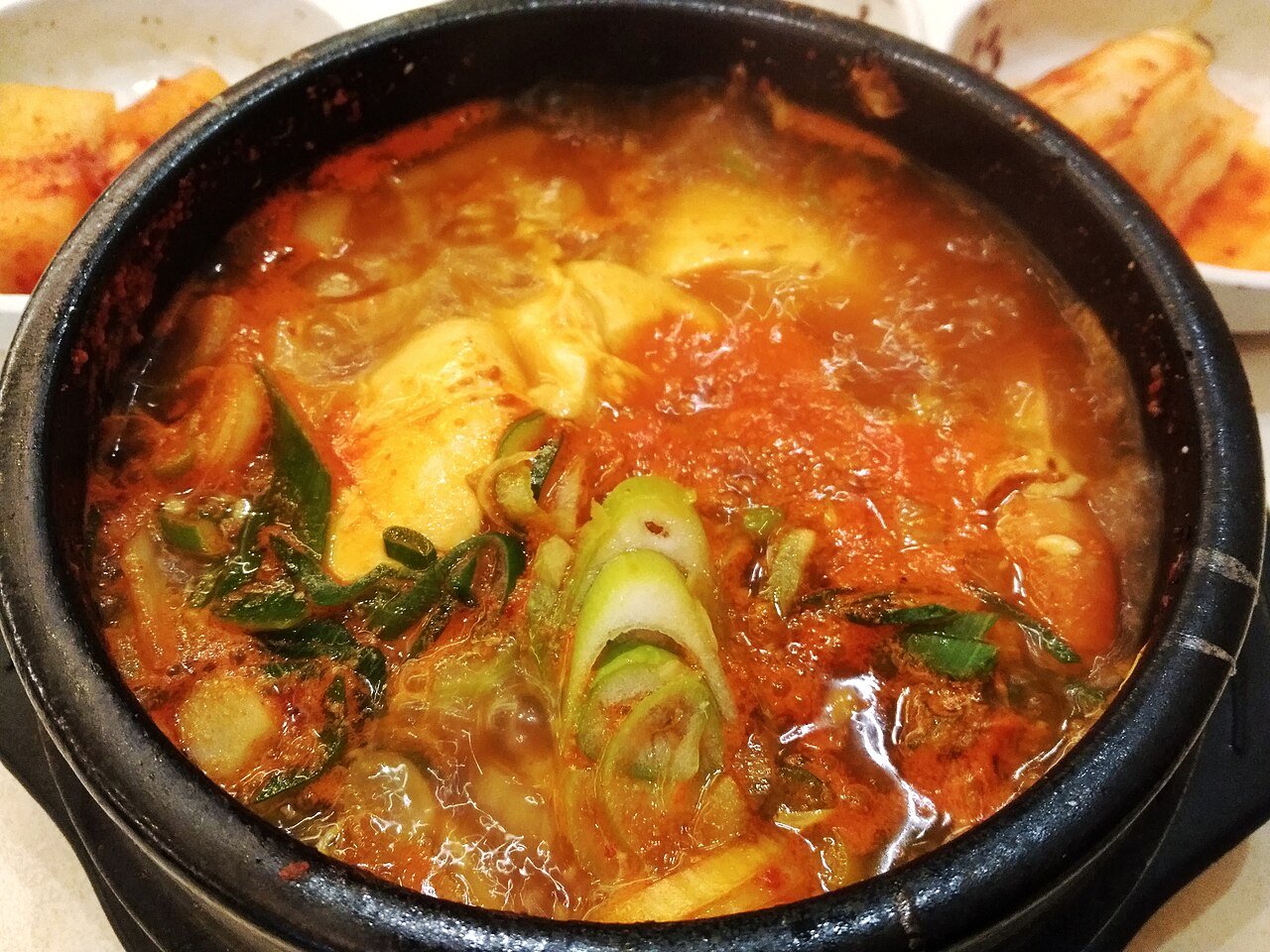
A black clay pot lands on the table at a full boil, red oil shivering across the surface, with a raw egg waiting beside it. Within a minute the tofu has begun to slump into the broth, and nobody waits for it to cool. That is sundubu jjigae at an ordinary Korean lunch counter, served with rice and a few side dishes. The notes below explain why the stew behaves the way it does, then follow the pot from the first slice of pork to the last spoonful.


Soft curds that were never pressed
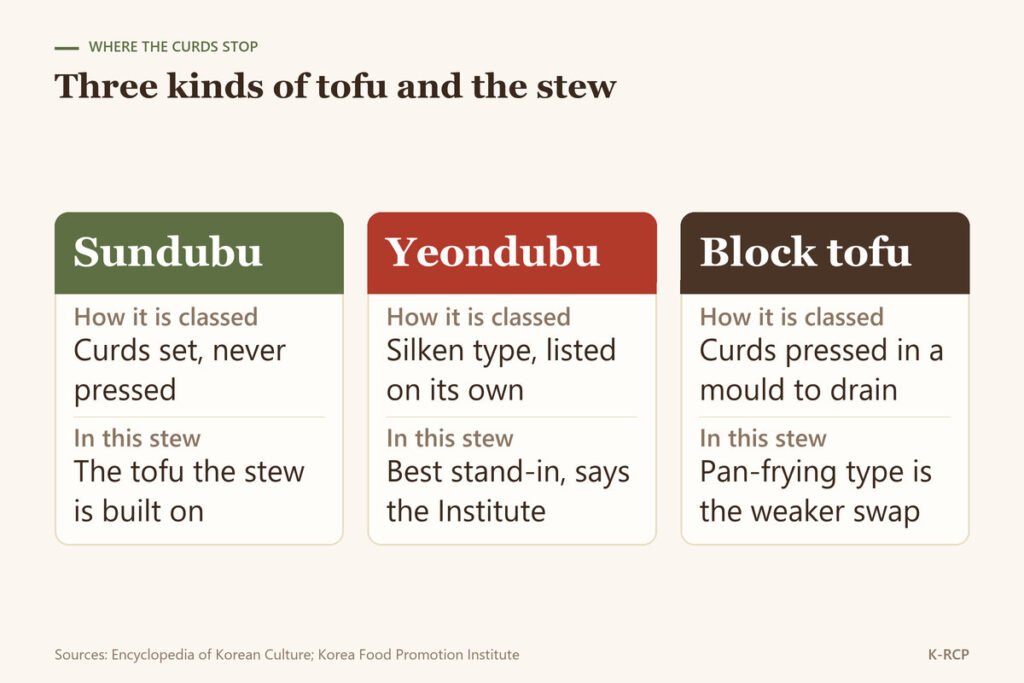
Sundubu (순두부, roughly soon-doo-boo) is tofu that stops before the pressing stage. The Standard Korean Language Dictionary defines it in exactly those terms, as tofu that has not been pressed firm. The steps behind it, as the Encyclopedia of Korean Culture lays them out, are to grind well-soaked white soybeans, boil the paste, strain off the soy milk, and stir in bittern so that curds form and clear whey separates. Press those curds in a mould and you get the familiar block of tofu. Leave them alone and you get sundubu, a mass of loose, wet curds that eats closer to a custard.
Nobody can date the first pot of sundubu. The encyclopedia’s reasoning is indirect: a poem collection by the Goryeo scholar Yi Saek mentions a soup with tofu in it, and the eighteenth-century Seongho saseol praises a savoury soup made from the leftover dregs of tofu-making, so the unpressed stage was probably eaten the same way. It says outright that no concrete record exists. That caution is worth remembering whenever a menu or a caption announces a precise origin for the stew.
The encyclopedia’s separate entry on tofu adds one practical fact about why the whole family of dishes endures. Soybeans digest at only 50 to 70 percent even when cooked, while tofu made from them reaches about 95 percent. The same entry sorts tofu by how it is processed, into plain, unpressed (sundubu), dried, bagged, silken (yeondubu), frozen, fried and pressed types, which is the sorting the diagram below borrows.
A jjigae is a stew, thicker and saltier than a soup, built to be eaten with rice. The encyclopedia describes the classic version as sundubu set in an earthenware pot (ttukbaegi) over the fire, brought to a boil, and finished with seasoned clams and shredded spring onion. It also records two seasoning rules that are easy to miss. Soy sauce used alone gives the tofu a poor colour, so soy sauce and salt are mixed. Salted shrimp does something stranger: it makes the tofu firmer. The recipe card below seasons with soy sauce and fish sauce at the very end, which keeps the curds pale and soft.
The Korea Food Promotion Institute cooks its version in an ordinary pot, ladles it into single-serving pots, and cracks one egg into each so that only the white sets. In the Institute’s sundubu jjigae recipe the curds simmer for about 10 minutes over low heat.
A pot with a plot: the stew in Itaewon Class
Itaewon Class is the JTBC drama, adapted from a webcomic by the same name, that aired its first episode in January 2020 (Korea Herald). In it the stew carries the plot. Tatler Asia’s roundup of K-drama food describes sundubu jjigae in the series as a recipe handed down from the hero’s late father, which the hero, played by Park Seo-joon, reworks in the kitchen of his young bar, DanBam. Treat that as the show’s use of the dish and not as a statement about how Koreans cook it. The drama gives the pot a story, while the sources above give it a method.
The order of work for the red-oil version
Shopping is short. You need one tube of sundubu, 350 to 400 g for two people, 100 g of pork belly or shoulder, 2 tablespoons of gochugaru, and some properly sour kimchi. If the pantry staples are new to you, a starter list of Korean pantry staples covers the chili flakes, fish sauce and dried kelp in one pass. The sour kimchi is the same backbone that carries the sour-kimchi stew, and it is hard to fake. Buy a jar that smells sharply sour, since fresh, mild kimchi leaves the broth tasting of chili and little else.
Sundubu Jjigae Recipe (Korean Soft Tofu Stew)
Ingredients
Method
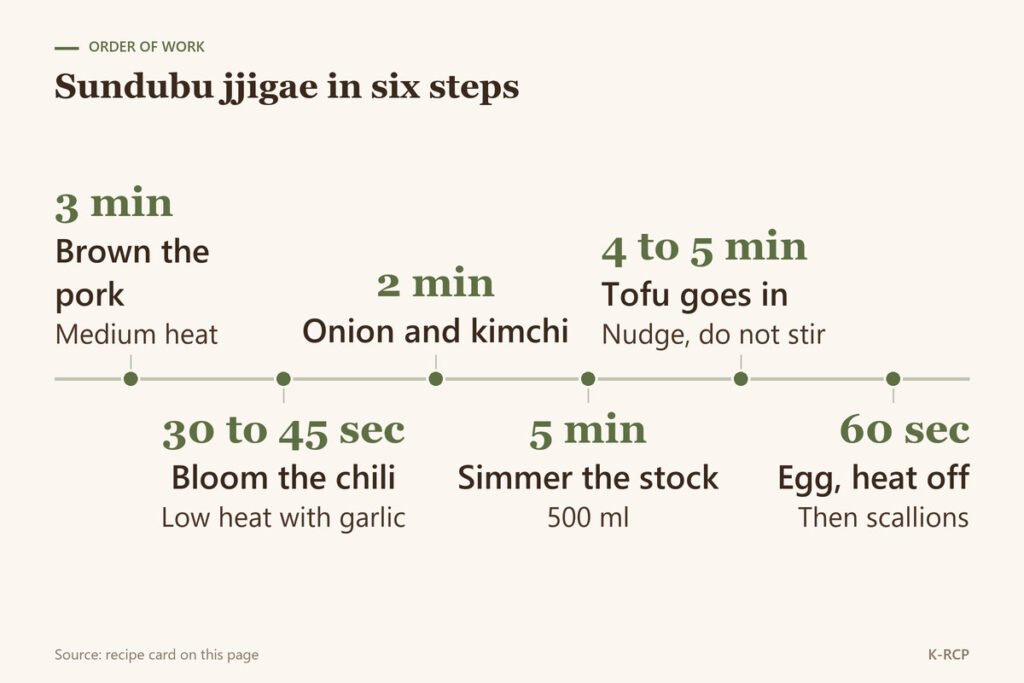
- Heat 1 tbsp neutral oil in a small heavy pot over medium heat and cook the sliced pork until the edges brown, about 3 minutes.
- Turn the heat to low, add the gochugaru and minced garlic, and stir constantly for 30 to 45 seconds until the oil turns deep red and smells toasty. Do not let it darken past that or it will taste burnt.
- Add the onion and chopped kimchi and cook 2 minutes, until the onion softens.
- Pour in 500 ml / 2 cups stock, raise the heat, and bring to a boil. Simmer 5 minutes.
- Open the tube of sundubu and squeeze it into the pot in large pieces. Do not stir hard — nudge the curds apart with a spoon so they stay in soft clouds.
- Simmer 4 to 5 minutes, until the tofu is heated through and the broth is bubbling at the edges.
- Season with 1 tbsp soy sauce and 1 tsp fish sauce. Taste and adjust with salt.
- Crack the egg into the center, kill the heat, and let it sit 60 seconds so the white just sets. Scatter scallions and finish with 1 tsp toasted sesame oil. Serve straight from the pot with hot rice.
Recipe card photo: Haemul-sundubu-jjigae.jpg by Ajumeoni, CC0, via Wikimedia Commons.

The sequence matters more than the ingredient list. Pork browns first for about three minutes, because its rendered fat carries the chili flavour. The heat then drops to low before the gochugaru and garlic go in, and they get only 30 to 45 seconds, just until the oil turns deep red and smells toasted. Chili that scorches turns bitter and nothing repairs it later, so a bitter pot usually traces back to this step. Onion and kimchi follow for two minutes, then 500 ml of stock simmers for five minutes before the tofu goes in, where the curds simmer 4 to 5 minutes more.
The Institute’s route is quieter. It fries minced pork with a paste of gochugaru, sesame oil, spring onion, garlic and soup soy sauce, adds 3½ cups of water, and drops in the drained, roughly broken sundubu with oyster mushrooms. There is no kimchi and no separate chili-oil stage, and salt does the final seasoning. Both routes end the same way, with soft curds in a boiling red broth.
The portions differ more than the methods do. The Institute’s 500 g of sundubu is for four servings, about 125 g each, alongside 100 g of pork and 100 g of mushrooms. The card here uses 350 to 400 g for two, closer to 175 to 200 g a person. Choose by temperament: with more tofu per bowl the stew eats like a pot of curds in broth, and with the Institute’s ratio it reads as a broth with curds floating in it.
For the card version, cut the corner off the tube, squeeze the curds into the pot, and nudge them into four or five rough chunks. Stirring hard turns soft clouds into sludge. Season at the very end, because the kimchi and the stock already bring salt and the broth reduces as the tofu heats.
Why the egg waits until the heat is off
The Institute’s single-serving pots cook the egg in the boil until the white sets. The card on this page takes the gentler road: crack the egg into the middle, switch the burner off, and give it 60 seconds. A hard boil scrambles an egg into threads, while a minute of residual heat sets the white and leaves the yolk loose. If you are serving from one big pot, the second method is the safer one.

Two questions before the shopping trip
Can boxed silken tofu replace the tube? Yes. The Institute’s note says that when sundubu is unavailable, silken tofu (yeondubu) is the better substitute and the firmer tofu sold for pan-frying is the poorer one. Boxed silken tofu is slightly firmer than the tube, so break it into rough chunks and handle it as gently. Tip the packet liquid away first, because extra water thins the broth and washes out the red oil.
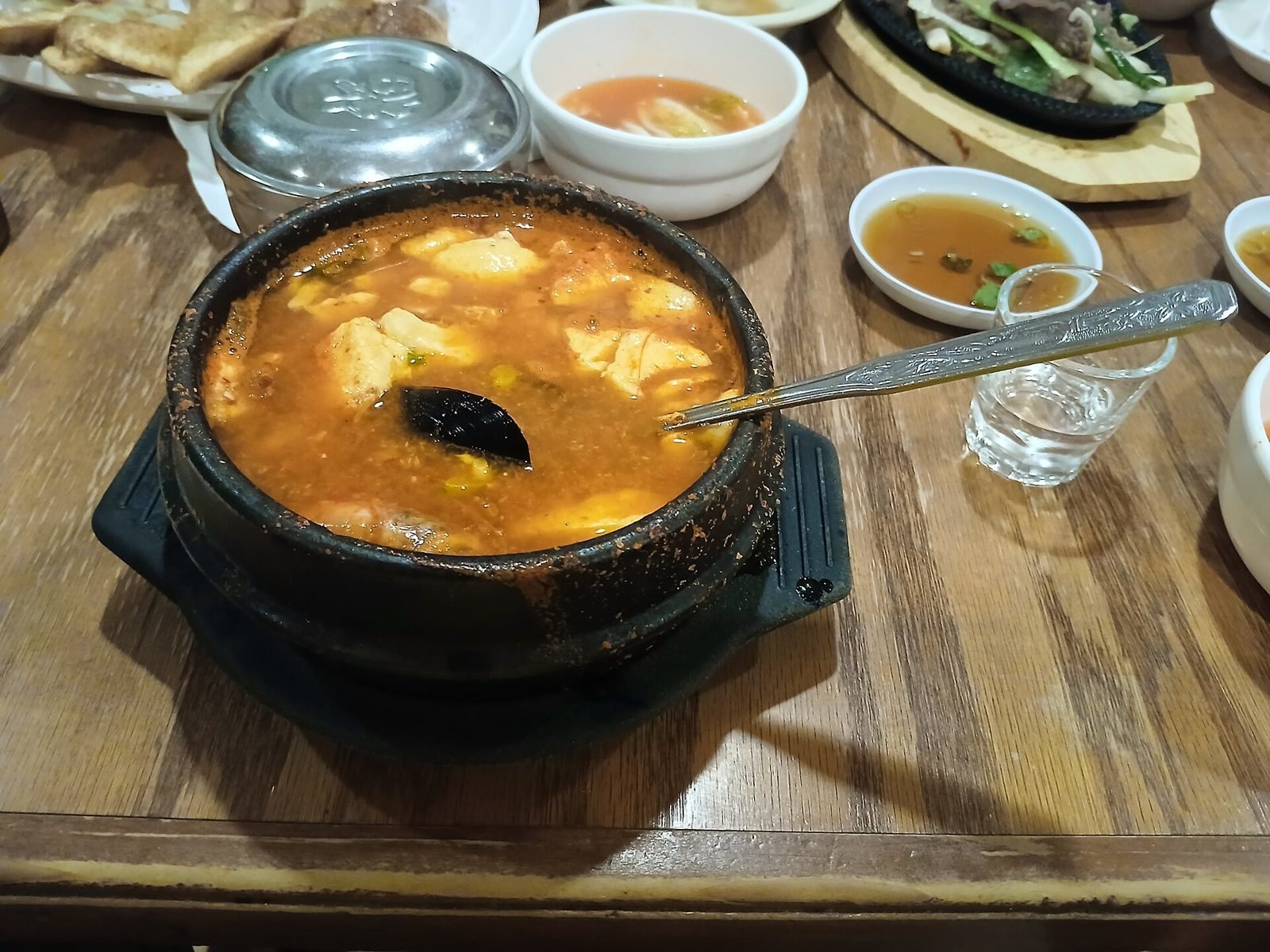
Do I need a clay pot? No. A small heavy saucepan or a cast-iron pot cooks the stew perfectly well, and the Institute itself makes the stew in an ordinary pot before dividing it. What a ttukbaegi adds is heat that lingers at the table, so a saucepan version should go straight from stove to bowl. For a bigger, meatier pot in the same one-pot-with-rice tradition, the pork-bone stew gamjatang is the next step up.
Swaps that keep the stew recognisable
Sundubu jjigae survives more substitutions than most stews, provided you know what each one costs in flavour.
| Hard to find | Stand-in | What changes |
|---|---|---|
| Sundubu in a tube | Boxed silken tofu | A touch firmer and keeps its edges, but eats almost the same |
| Gochugaru, 2 tbsp | 1 tbsp sweet paprika plus 1 tsp cayenne | Colour and heat arrive, the sun-dried fruitiness does not |
| Anchovy-kelp stock | Water plus 1 tsp instant dashi, or kelp simmered 10 minutes with 1 tsp soy sauce | The kelp version is cleaner and less oceanic; plain water leaves the stew flat |
| Fish sauce, 1 tsp | 1/2 tsp anchovy paste, or soy sauce with a pinch of salt for a vegan pot | Slightly less savoury depth, though the soy version balances well |
| Pork belly or shoulder | 150 g mixed seafood, thin-sliced beef, or 100 g shiitake | Seafood brightens the broth; mushrooms add savour but no fat, so add a teaspoon of oil |
| Well-fermented kimchi | 1 tsp rice vinegar plus 1 extra tsp gochugaru | You get the acidity but not the fermented depth |