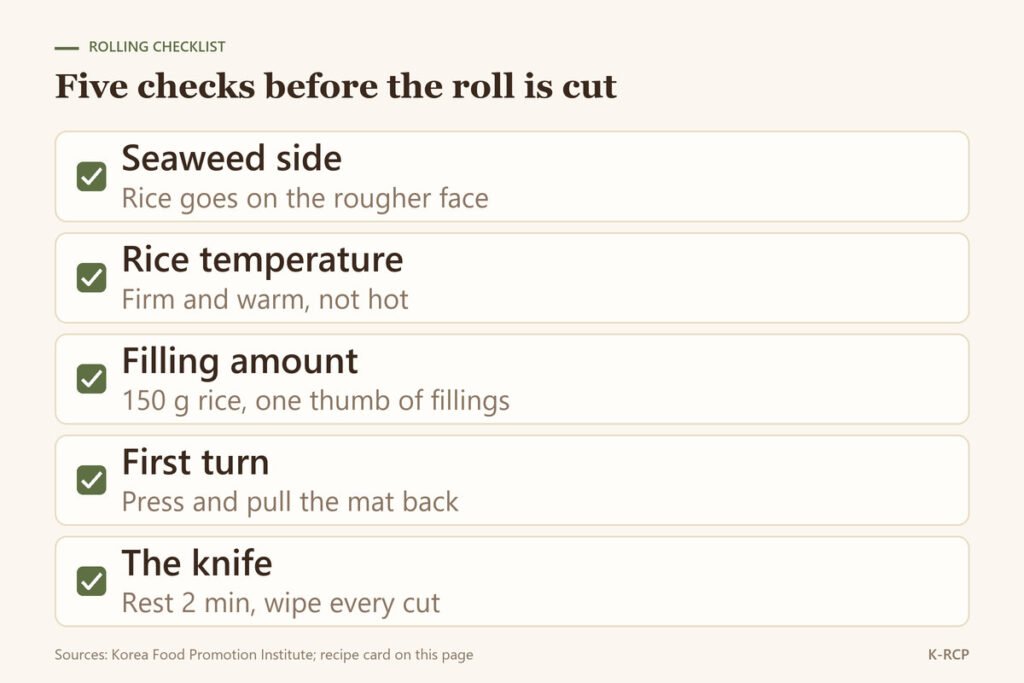
Pickled yellow radish and ham feel as if they have always lived inside kimbap, yet the Encyclopedia of Korean Culture traces the first newspaper mention of each to 1958. Before that the roll was plainer, and it has only grown more crowded since. When a first roll tears or slides apart, though, the fillings are rarely to blame. It comes down to five places: the side of the seaweed, the warmth of the rice, the amount of filling, the pressure on the first turn, and the knife.
Laver, rice and the roll’s Japanese ancestry
Kimbap (김밥, gim-bap) is two words joined: gim, roasted dried laver, and bap, cooked rice. Rice and cooked fillings are rolled in laver and sliced into rounds. It resembles sushi and still differs from it in the details that matter. The Korea Food Promotion Institute seasons the rice with salt and sesame oil, and while it mentions that some cooks use a sweet vinegar mix for a sushi-style rice, the plain seasoning is the base. Nothing inside needs to be raw.
Where the roll came from is spelled out in the encyclopedia’s kimbap entry. Its account is that today’s kimbap is the Japanese gim-chobap (norimaki) that arrived in the colonial period and was gradually naturalised. It cites a 1925 Chosun Ilbo shopping column that tells readers which rice to buy for making gimbap and recommends packing it for outings. A 1930 Dong-A Ilbo recipe insisted on thick Japanese laver because Korean laver was too thin to roll. By 1939 the cookbook author Hong Seon-pyo was recommending Korean laver filled with rice, braised beef and kimchi for a lunch box, and a 1946 home-cooking book wrote out a rolled rice with no mirin, explaining that the Japanese seasoning was neither possible nor necessary. Korea did have older ways of eating laver, which the entry also records: bokssam, rice and other foods wrapped in laver or vegetable leaves and eaten on the first full moon for luck. Those are wraps, not the rolled form, and the entry does not present them as the roll’s origin. This post follows the encyclopedia: the rolled form was imported, and the Korean version was built afterward.
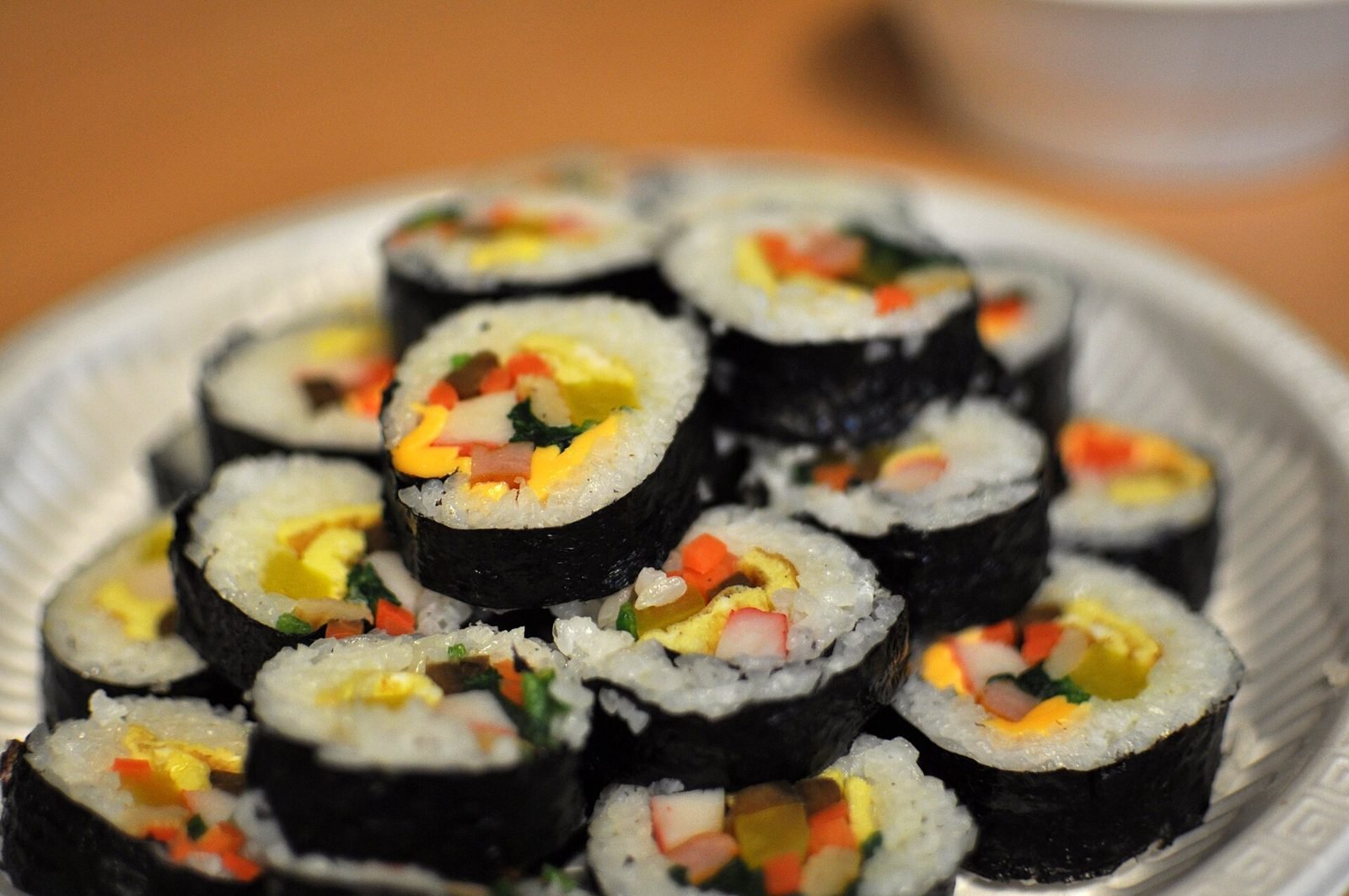

A roll made to be read in cross-section
Kimbap has a famous screen moment in Extraordinary Attorney Woo. A Korea Times report summarising a Washington Post essay says the show’s heroine, played by Park Eun-bin, spends her first lines of the series making the case for the roll: “Kimbap is reliable. I can see all the ingredients, so I will not be alarmed by unexpected texture or flavor.” The same report notes that the series, which reached Netflix in July 2022, held first place among non-English shows for seven weeks, that Trader Joe’s launched a frozen vegetable gimbap in August 2023 which sold out within weeks, and that kimbap restaurants have opened in Germany, Australia and South Africa.
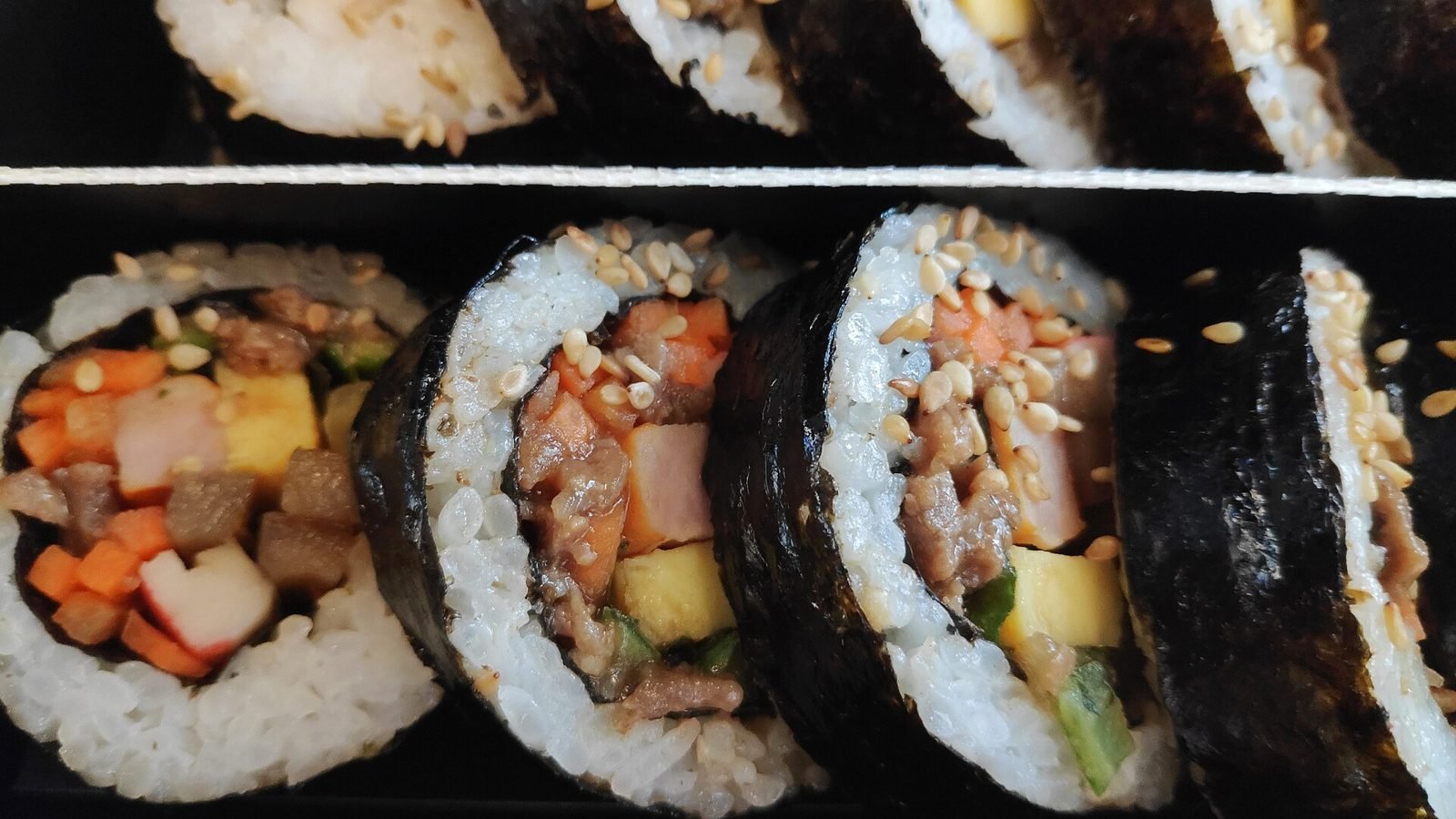
The heroine’s logic doubles as a quality test. A well-made roll shows clean, distinct stripes of yellow, orange, green and white when it is cut. A smeared, blurry cross-section means the rice layer was too thick or the pressure uneven, which is the diagnosis the next sections work through.
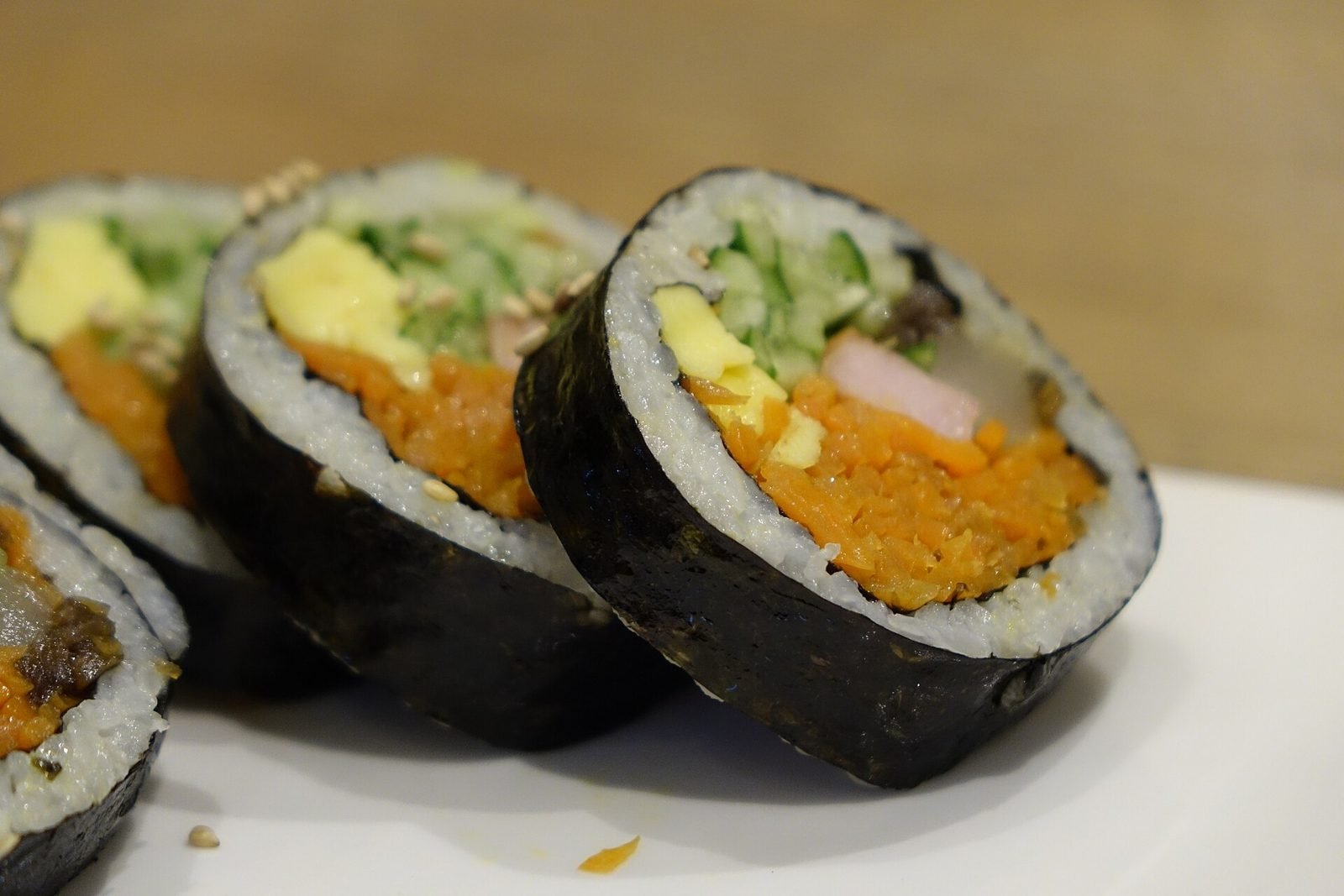

Rice, laver and six fillings, with stand-ins
Start with four full sheets of laver, sold as sushi nori in any supermarket. The small salted snack sheets are pre-oiled and too thin, and they tear on the first turn. About 600 g of cooked short-grain rice makes four rolls, and Japanese sushi rice or Calrose both work. Basmati and jasmine do not, since the grains will not cling. The Institute’s kimbap recipe uses 920 g of rice for four servings and gives each roll one cup of seasoned rice, while the card here spreads 150 g per roll. Both are thin layers by design.
The fillings on the card are a carrot, 150 g of spinach, three eggs made into a thin omelet, imitation crab, strips of yellow pickled radish (danmuji) and optional seasoned burdock (ueong). The Institute’s list is beef, danmuji, cucumber soaked in sweet vinegar for 30 minutes, carrot and egg, all cut to the width of a pencil. The encyclopedia gives the history of these choices: ham entered rolls around 1958, a dedicated kimbap ham reached shelves in 1996, and burdock took the place of braised dried gourd strips. A dill pickle spear patted very dry stands in for danmuji and is sourer. Salted cucumber batons are fresher and milder, pressed tofu fried in soy sauce replaces egg for a vegan roll, and drained canned tuna can replace crab, though it must be squeezed out or the roll goes soggy. Those swaps are suggestions; none of them comes from the Institute’s recipe.
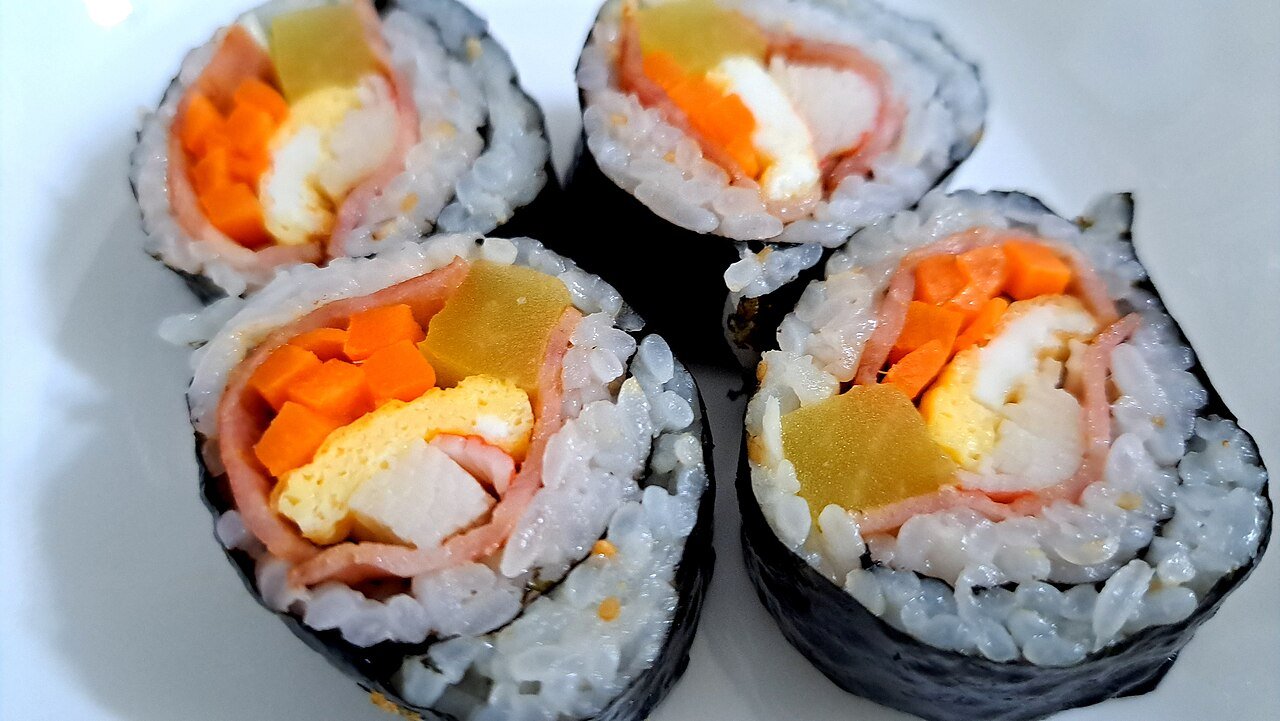
Kimbap Recipe: Why Your Rolls Fall Apart, and the Fix
Ingredients
Method
- Cook the rice with 10% less water than usual, spread it on a wide tray, fold in the sesame oil and salt, and fan it until it is warm rather than hot.
- Blanch the spinach 30 seconds, cool it under running water, then squeeze it in your fist until it stops dripping. Season with salt, sesame oil and grated garlic.
- Stir-fry the julienned carrot with a pinch of salt over medium-high heat for 2 minutes, until flexible but still snapping.
- Beat the eggs with a pinch of salt and cook undisturbed in an oiled nonstick pan over low heat for 3 minutes, until just set. Cool, then cut into 1 cm strips.
- Cut every filling to the same length as the width of the seaweed sheet.
- Lay a sheet of gim on a bamboo mat, rough side up, long edge running left to right.
- Spread 150 g of rice in a thin, even layer, leaving the far 3 cm of the sheet completely bare.
- Lay the fillings in one tight bundle a third of the way up from the near edge.
- Lift the near edge of the mat over the fillings, then pull the mat back toward you while pressing down to compress the core.
- Roll forward in two or three short pushes, squeezing with the whole hand across the full length each time.
- Seal on the bare strip, rest the roll seam-side down for 2 minutes.
- Brush with sesame oil, scatter sesame seeds, and cut into 1.5–2 cm rounds, wiping the blade with a damp cloth between every cut.
Recipe card photo: Gimbap_Kimbap_Korean_food_02.jpg by 한국의 멋, CC0, via Wikimedia Commons.

Four places a roll fails before the knife
The four faults below look unrelated, but they share a root: a roll holds together when the rice is cohesive, the laver is intact and the core is under steady tension. Steam, excess filling, a loose fold or a wet filling each break one of those three conditions, which tells you where to look first. A roll that tears has usually been fed hot rice or too much filling, while a roll that slides apart after cutting has usually been rolled loosely or packed with wet spinach.
The seaweed has a right side
Every sheet has a glossy face and a matte one. The Institute places the smooth face against the bamboo mat, which puts the rice on the rougher side where it grips, and the card says the same thing as “rough side up”. Spread the rice and stop short of the far edge: the Institute leaves the top quarter of the sheet bare, the card leaves 3 cm, and either strip is the seal that holds the roll shut.
Rice at body temperature
Hot rice traps steam against the laver, which goes limp and tears under pressure. Cold rice has set, and the starch will not bind. Both recipes cook the rice firm, with less water than usual (the card says 10 percent less), because the fillings bring their own moisture. Season it with sesame oil and salt while it is warm, spread it on a wide tray, and fan it for two or three minutes until it is pleasantly warm.
Less filling than feels right
The Institute warns against laying the rice too thick, and its fillings are as thin as a pencil. A full sheet carries about 150 g of rice and one tight bundle of fillings no thicker than a thumb. Past that, the laver runs out of circumference before the seam meets the rice. Squeeze blanched spinach until it stops dripping, because wet spinach is a common cause of a sliding roll, and cut every filling as long as the sheet is wide so the stripes run the full length.
The first turn
Lay the fillings in a tight bundle about a third of the way up from the near edge. Lift the edge of the mat over them, then pull the mat back toward you while pressing down. That backward pull compacts the core and squeezes out air, and a fold without it leaves a loose centre that pulls apart on the board. Finish with two or three short pushes, squeezing along the whole length with the whole hand.
The knife and the resting minutes
Set the sealed roll seam-side down for two minutes before cutting, since it is still settling into shape. The sources give three ways to keep the blade from dragging. The Institute rubs sesame oil on the knife and cuts rounds about 1 cm thick. The encyclopedia quotes a 1976 cookbook that wet the knife with vinegar. The card wipes the blade with a damp cloth before every cut and slices 1.5 to 2 cm, which is sturdier for a first roll. Starch builds up on steel within a single slice, so whichever method you pick, repeat it every time. Draw the knife toward you in one long stroke instead of pressing straight down.
Chungmu rolls, triangles and the plain roll
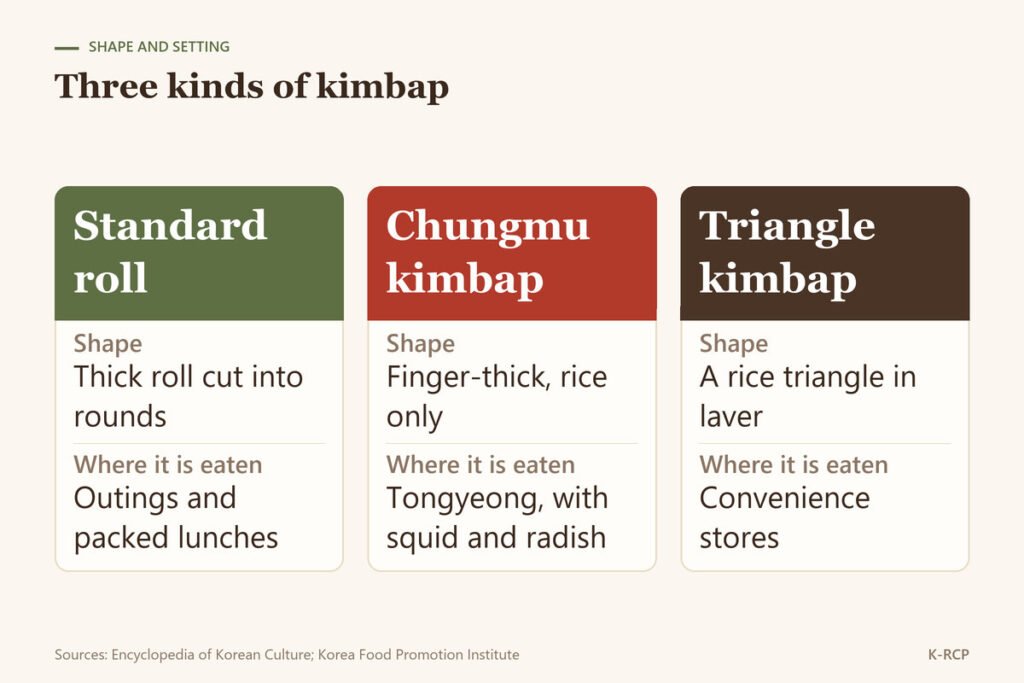
Not every kimbap is rolled the same way. Chungmu kimbap, from Tongyeong, is a finger-thick roll of rice alone, served with seasoned squid and a radish kimchi, and it is easy to practise on because there is nothing inside to fight you. The encyclopedia records two oral origin stories, both aimed at keeping food from spoiling. In one, fishermen wrapped only rice so it would last through summer and carried the side dishes separately. In the other, the roll was sold to passengers at the ferry terminal. The entry treats the dish as a creation of the years after liberation in 1945 and says it became a national name after it was shown at the 1981 Gukpung festival.
The triangle rolls and long rolls of convenience stores are a different engineering problem, and the encyclopedia calls both reliable sales leaders there. For the rest of that refrigerated case, see what fills a Korean convenience-store fridge. Kimbap also sits on the menus of Korean snack shops, which sell many kinds of crisp street fritters alongside it. And the spinach in this recipe is the same seasoned side dish that works on its own as sigeumchi namul, so a double batch serves both.
Safe hours for a packed roll
Kimbap is built to travel, and a Korea Times health report from August 2026 explains why that is also its risk. The roll is handled by hand, usually eaten without reheating, and often holds egg, ham, fish cake or imitation crab, all of which spoil quickly in heat. The list below starts with the resting minutes and then follows that guidance.

- Minutes 0 to 2: the roll rests seam-side down. Do not cut yet.
- Up to 2 hours: Korea’s Ministry of Food and Drug Safety and its disease control agency advise that cooked food stay at room temperature for no more than two hours where possible.
- Any longer trip: keep it at 5 degrees C or below, in an insulated bag with ice packs. Above 35 degrees C, bacteria such as Staphylococcus aureus and Bacillus cereus multiply much faster, and even two hours becomes risky.
- Never: leave it in a parked car or in direct sun.
- Sat warm, then chilled: the report says returning it to the refrigerator does not make it safe again, and that discarding it is the surest course when in doubt.