A housekeeper takes a phone call and learns that two packets of instant noodles are about to become a steak dinner. In the film’s Oscar-season coverage, a Maeil Shinmun report from February 2020 names the caller as Yeon-kyo, the lady of the house, and the topping as hanwoo chaekkeut, a loin cut from Korean beef.
The English subtitle calls the dish “ram-don,” a word coined for the film, while Koreans had been eating it as jjapaguri for years, and each of the two packets has a history of its own.


What the phone call actually orders
The dish is jjapaguri, the name Koreans use for Chapagetti and Neoguri cooked together. The same Maeil report says Nongshim, which makes both products, was the biggest beneficiary of the film’s four Oscars, a haul that included Best Picture. It also says the company planned to sell a ready-made jjapaguri cup noodle in the United States from that March, because requests for the dish had been arriving from overseas buyers before and after the ceremony.
The order itself is on record: two named products, one named cut of beef, and a housekeeper expected to turn them into a meal. Pairing instant noodles with a costly cut is why the recipe card sears real steak instead of leaving the beef out.
A word made up for the subtitles
Viewers who read English never saw the word jjapaguri. The subtitle says “ramdon,” and the translator, Darcy Paquet, has said in an interview in the Korean Cultural Center New York webzine that he made the word up. The word is first used in a phone conversation. Later, as a character prepares the food, the packages appear on screen and Paquet wrote “ramyeon” and “udon” over them so the viewer could see how the compound formed.
The reasoning is spelled out in a Korea Times report on his Busan honorary citizenship: jjapaguri combines Chapagetti, instant black bean noodles, with Neoguri, spicy udon-like noodles, and because non-Koreans do not know those brands, Paquet joined two more familiar words. The subtitle itself spells it “ramdon”; below, the film’s version is written ram-don to keep it apart from the everyday jjapaguri.
The 2013 boom, in sales figures
The mixture was not invented by the film. A Kyunghyang Shinmun report dated 24 April 2013 credits a jjapaguri craze with record monthly sales for both products: 14 billion won for Chapagetti and 11.5 billion won for Neoguri in March. In the two months that followed the MBC show Dad! Where Are We Going?, from 18 February to 18 April, hypermarket sales rose 58 percent for Chapagetti and 20 percent for Neoguri.
The same report places the two products second and third in Korea’s instant noodle market behind Shin Ramyun that month, and says Nongshim’s March market share reached 69.9 percent. It also notes that Chapagetti Big Bowl and Szechuan Chapagetti newly entered the top 20 that month, so the craze lifted other black bean noodles too, not only the two packets in the recipe.
The Maeil report gives a different starting point, saying a netizen’s recipe made jjapaguri known around 2009. The two accounts fit together if the recipe circulated online first and the television show turned it into a supermarket habit. Neither report says who first combined the packets.
What each packet brings to the pot
Each packet has its own history, and knowing it explains why the pair works.
Chapagetti, the black bean half
Nongshim launched Chapagetti in March 1984, according to a Newsis feature on long-lived brands. The same article says the company developed an instant jajang noodle as early as 1970, and that for Chapagetti the researchers recreated the flavor of restaurant-fried ganjjajang by frying chunjang and onion into the seasoning. They also asked for a soup powder that mixed evenly into the noodles, which is why the sauce comes as fine granules.
The sauce it echoes is the restaurant one. The Folk Museum’s definition of jjajangmyeon describes chunjang mixed with water and starch, stir-fried with meat and vegetables, and spooned over noodles, which is the Korean-Chinese dish Chapagetti was built to recall. That explains the packet’s role in the bowl: it is the savory, sweet part, built to coat noodles rather than to make soup.


Neoguri, the udon-like half
The Korea Times report describes Neoguri as spicy udon-like noodles. In jjapaguri that means chew, which holds up under the black bean sauce, and heat from the red soup powder.


How much beef, and which cut
The recipe card uses 150 g (5 oz) of sirloin or ribeye cut into 2 cm cubes for two bowls. The film’s cut is hanwoo, a premium Korean beef, and hanwoo is the right choice if it is on the counter, but any steak that sears quickly gives the same effect. Skirt steak and flat iron are cheaper and take the same 60 to 90 seconds in a hot pan.
Pat the cubes dry and season them with salt and pepper while the water heats. Dry meat at room temperature browns instead of steaming, and the brown crust is the point: the topping should taste of seared beef, not of boiled meat. Minced beef browned hard in a dry pan is a workable budget swap, though it gives richness without the bite of a cube.
Cooking both packs in one pot
The card boils both blocks in 600 ml (2 1/2 cups) of water in a wide pot. That is a small amount of water on purpose: whatever you do not pour off becomes the base of the sauce, so a deep pot with a liter of water would leave you reducing the liquid for minutes while the noodles overcook. The reserved 150 ml is the only water the sauce gets.
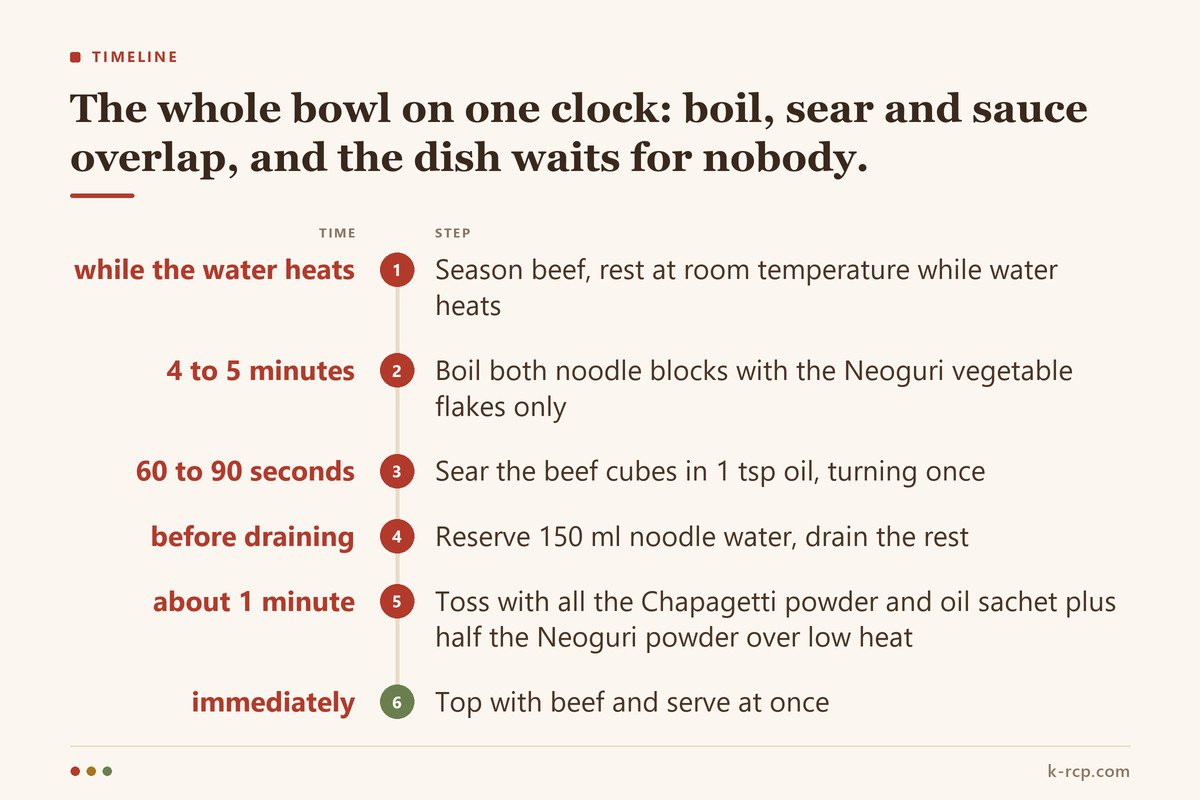
The card lists eight steps, and the order matters because the noodles, the beef and the sauce all finish within a couple of minutes of each other. Read the steps once before you start, and have the tongs, the mug for noodle water and the bowls ready.
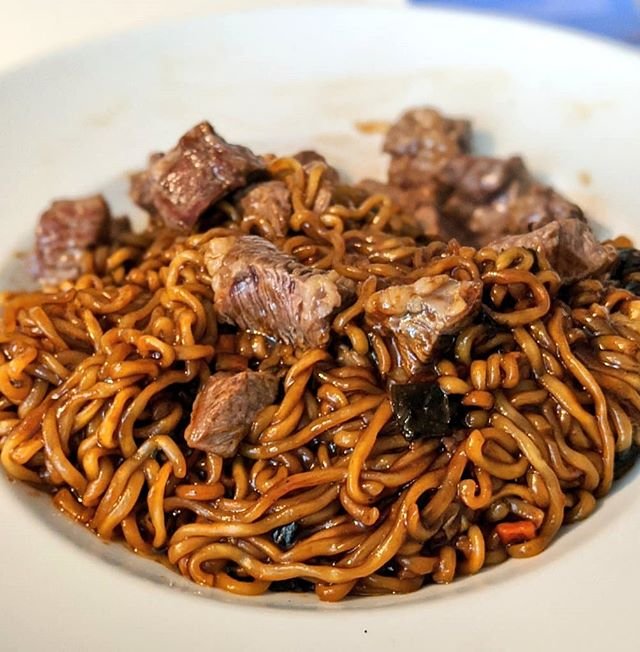
Ram-Don Recipe (Jjapaguri): The Noodles from Parasite
Ingredients
Method
- Pat the beef dry, season with salt and pepper, and let it sit at room temperature while the water heats.
- Bring 600 ml / 2 1/2 cups water to a rolling boil in a wide pot.
- Add both noodle blocks and only the dried vegetable flakes from the Neoguri packet. Boil 4 to 5 minutes, separating the blocks with chopsticks as they soften.
- Meanwhile, heat 1 tsp oil in a skillet over high heat and sear the beef cubes 60 to 90 seconds total, turning once. Pull them off while the centers are still pink and set aside.
- Reserve 150 ml / 2/3 cup of the noodle water in a mug, then drain the rest.
- Return the noodles and reserved water to the pot over low heat. Add the Chapagetti black bean powder, the Chapagetti oil sachet, and half the Neoguri red soup powder.
- Toss with tongs for about 1 minute, until the sauce turns glossy and coats every strand with almost no liquid pooling at the bottom.
- Taste and add more Neoguri powder a pinch at a time if you want it hotter. Divide between two bowls and pile the seared beef on top.
Recipe card photo: File:Ram-don.jpg by Jens Ohlig, CC BY 2.0, via Wikimedia Commons.

Boil and sear in parallel
Use a wide pot so the two noodle blocks lie flat, and add only the dried vegetable flakes from the Neoguri packet to the boiling water. The card gives both blocks 4 to 5 minutes; loosen them with chopsticks as they soften, and take the full five if you like soft noodles. While they boil, heat the skillet until it is very hot and sear the beef for 60 to 90 seconds, turning once. Take the cubes off while the centers are still pink; they keep cooking on the plate.
The reserved water and the powders
Before draining, scoop out 150 ml (2/3 cup) of the noodle water. Return the noodles and that water to the pot over low heat, add all of the Chapagetti powder and its oil sachet, and add half of the Neoguri red powder. Toss with tongs for about a minute until the sauce turns glossy and almost nothing pools at the bottom. The starch in the water is what lets the black bean powder dissolve into a sauce instead of sitting on the noodles as grit. Taste, and add more red powder only by the pinch, since you cannot take salt back out. Divide the noodles between two bowls and pile the beef on top, as the card does.
Stand-ins for the two packets
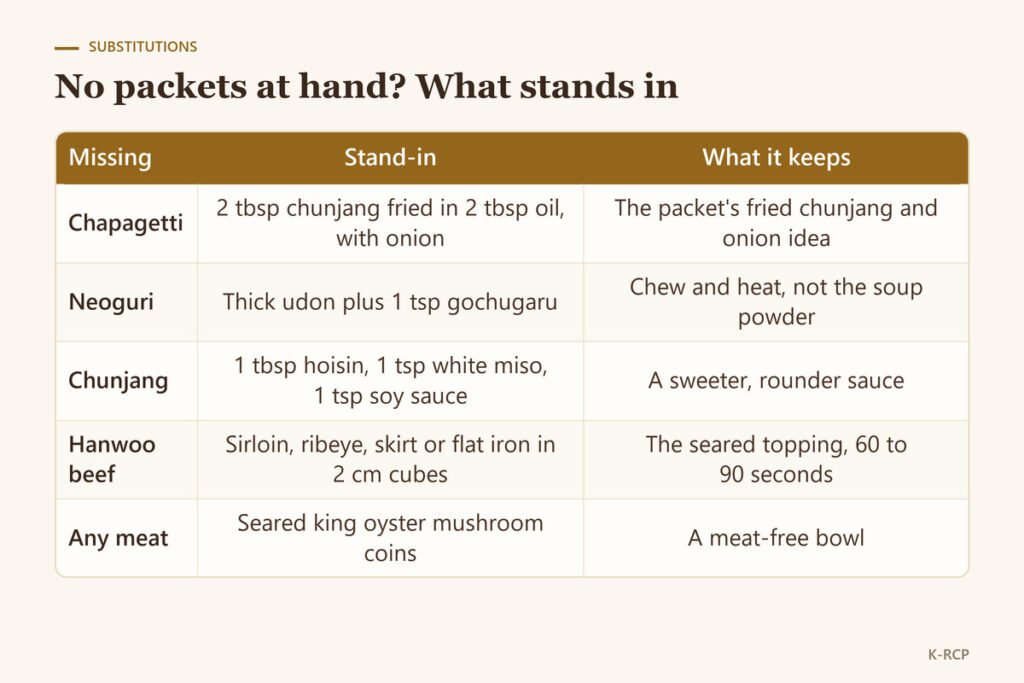
Outside Korea the two packets are the usual obstacle, and the substitutions below follow what the sources say each one contributes: Chapagetti is a fried chunjang and onion sauce, and Neoguri is spicy, thick and udon-like.
A quick black bean sauce
For two servings, fry 2 tbsp of chunjang in 2 tbsp of neutral oil over medium-low heat for about 2 minutes, then add half a small onion, finely diced, and cook until translucent. Stir in 1 tsp of sugar, 1 tsp of gochugaru, 1 tsp of soy sauce and 120 ml of noodle water and simmer. Thicken with 1 tsp of cornstarch mixed into 1 tbsp of cold water, and finish with 1/2 tsp of toasted sesame oil off the heat. Toss it with 200 g of boiled udon or two plain instant noodle blocks, and top with the beef. This is a stand-in built on the same idea as Chapagetti’s seasoning, not a copy of the packet.
When the red packet is the missing one
Thick udon noodles with a teaspoon of gochugaru keep the chew and the heat, though not the soup powder’s flavor. If chunjang is also out of reach, a tablespoon of hoisin with a teaspoon each of white miso and soy sauce is a sweeter, rounder substitute. The pantry notes in the Korean pantry starter list cover which bottles and pastes to buy first, and jjajangmyeon, the restaurant original, is the dish that Chapagetti set out to imitate.
Leftovers and a meat-free bowl
Jjapaguri does not keep well, because the noodles keep absorbing sauce and set into a block. If you must keep some, seal it airtight and refrigerate it, then loosen it in a pan with two tablespoons of water over medium heat rather than in a microwave. For a version without beef, use the quick sauce above, replace any fish-based seasoning with a little soy sauce, and top the noodles with king oyster mushrooms cut into thick coins and seared in the same hot pan. For other add-ins, see the ramen hacks Koreans actually use.
How much of each powder goes in?
The card answers with one rule: all of the Chapagetti powder and its oil sachet, but only half of the Neoguri powder, with more added a pinch at a time. The reasoning here is the author’s, not the card’s: the black bean powder already carries plenty of salt, so a full red packet on top makes the bowl both very salty and very hot, and salt cannot be taken back out.
For a milder bowl, use a quarter of the red powder, and for a hotter one add it in pinches until you reach your limit. Serve the noodles immediately, because jjapaguri stiffens as it cools.