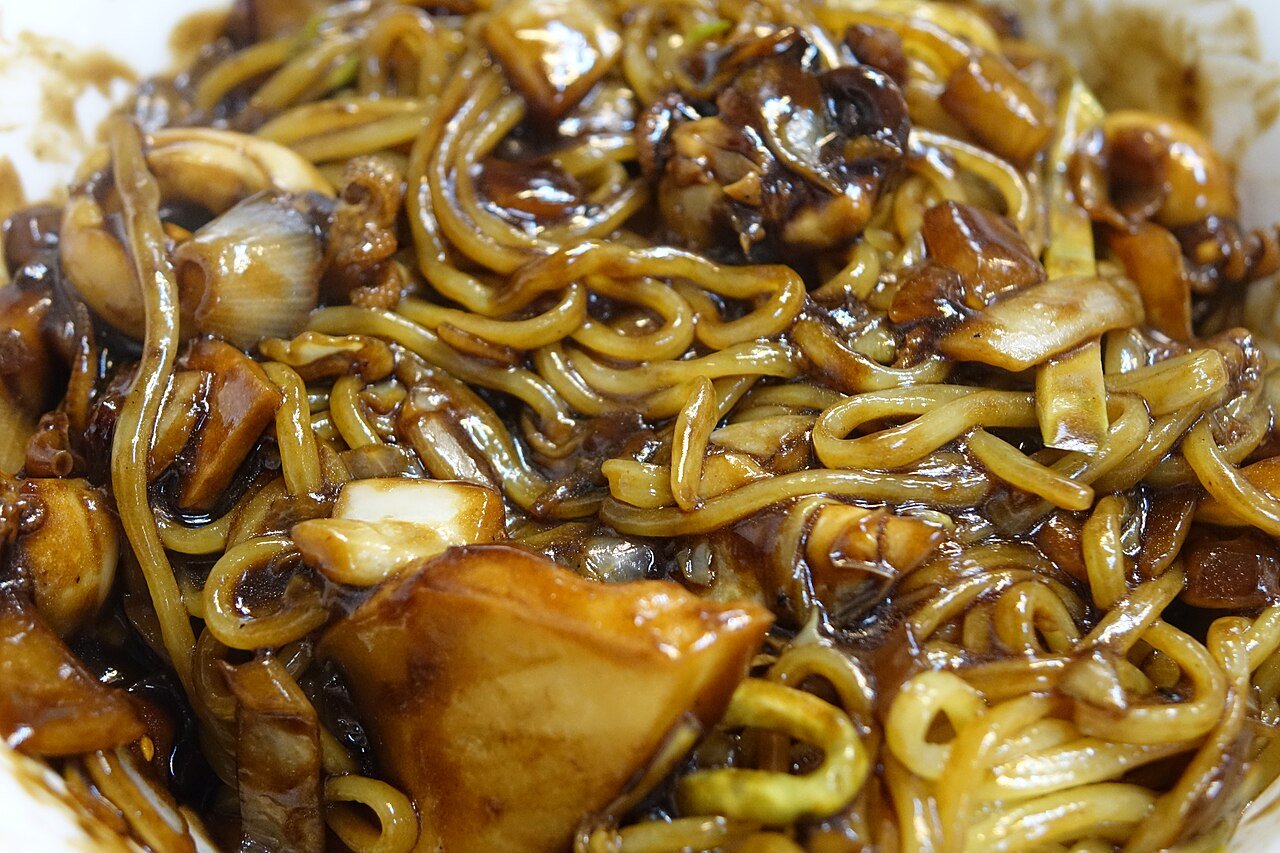
The first thing to understand about any jjajangmyeon recipe is that you are not cooking Chinese food, and you are not cooking Korean food either. You’re cooking a third thing — the food that Chinese immigrants built in Korea, for Koreans, out of what they had. Koreans have a name for that whole category: jung-hwa yori (중화요리). It has its own restaurants, its own delivery culture, its own menu that barely overlaps with what you’d order in Beijing. Jjajangmyeon sits at the center of it.
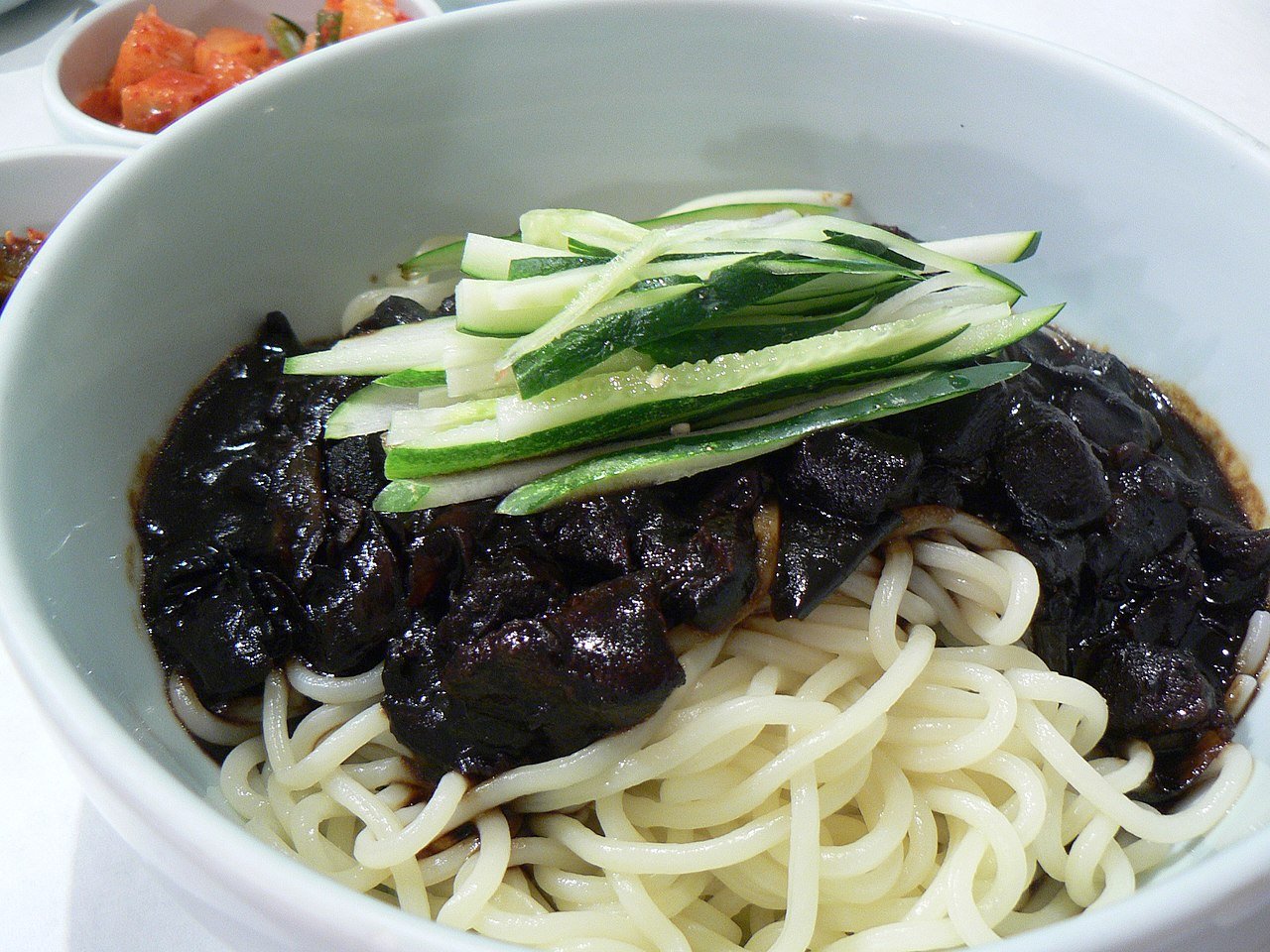
I’ve eaten this dish maybe four hundred times in my life and cooked it a few dozen. The version below is the plain, classic, not-spicy one — glossy black sauce, sweet onion, soft potato, a fistful of raw cucumber on top for contrast. It takes about 45 minutes and one non-negotiable technique that most home recipes gloss over.
Quick Facts
| Total time | 45 minutes (20 prep, 25 cook) |
| Servings | 2 generous bowls |
| Difficulty | Easy, with one technique step that matters |
| Spice level | 1 / 5 — not spicy at all, sweet-savory |
| Meat-free? | Yes — swap pork for firm tofu and mushrooms |
| Hardest ingredient | Chunjang (춘장), the roasted black bean paste |
What Is Jjajangmyeon?
Say it jja-jang-myeon — three even beats. The opening jj is a tense Korean consonant, roughly the “j” in jar said with your jaw clenched. “Myeon” rhymes closer to yun than yawn, and just means noodles.
Strip it down and it’s wheat noodles under a thick black sauce made from chunjang, diced pork, and a pile of onion cooked until it’s given up all its sugar. The sauce isn’t spicy and isn’t really salty in the way you’d expect from something that dark. It’s sweet first, savory second, with a low roasted bitterness underneath that keeps the whole bowl from tasting like candy.
There’s a small orthography story here that Koreans find funny. For decades the officially correct spelling was 자장면 (jajangmyeon), even though essentially nobody said it that way. Everyone said 짜장면. On 31 August 2011 the National Language Deliberation Council gave in and accepted 짜장면 as a standard spelling too. You’ll still see both romanizations floating around online, and they’re the same dish.
Why a Jjajangmyeon Recipe Is Not a Zhajiangmian Recipe
This is the part I care most about, so bear with me.
The dish arrived with migrant workers from Shandong province in the late 19th century, landing in the port of Incheon. Gonghwachun, a Chinese restaurant in Incheon Chinatown founded in 1905 and run by a Shandong immigrant, is the name that comes up in every account of the dish’s early years. Incheon still has a jjajangmyeon museum, which tells you something about how seriously the city takes its claim.
But the thing that got served in Incheon drifted, fast, away from its parent. The original Chinese sauce was saltier, richer, a deep brown rather than black. Korean cooks pushed it somewhere else: caramel went in to sweeten it, grains went in and darkened the color. What came out the other end is chunjang, and chunjang is the whole reason these are two different dishes rather than one dish with an accent.
Practically, here’s what that means at the stove. Chinese zhajiangmian is typically built on a sweet wheat-flour bean paste, served with the sauce sitting distinct on top and a heap of raw vegetable batons alongside — you eat it dry-ish, the sauce salty and concentrated. Korean jjajangmyeon is built on chunjang, gets thickened with a starch slurry into something closer to a gravy, and is meant to be stirred until every noodle is uniformly black. The vegetables are diced into the sauce, not piled next to it. Sweetness leads. Texture is the giveaway: if your sauce isn’t glossy enough to coat a spoon, you’ve made something else.
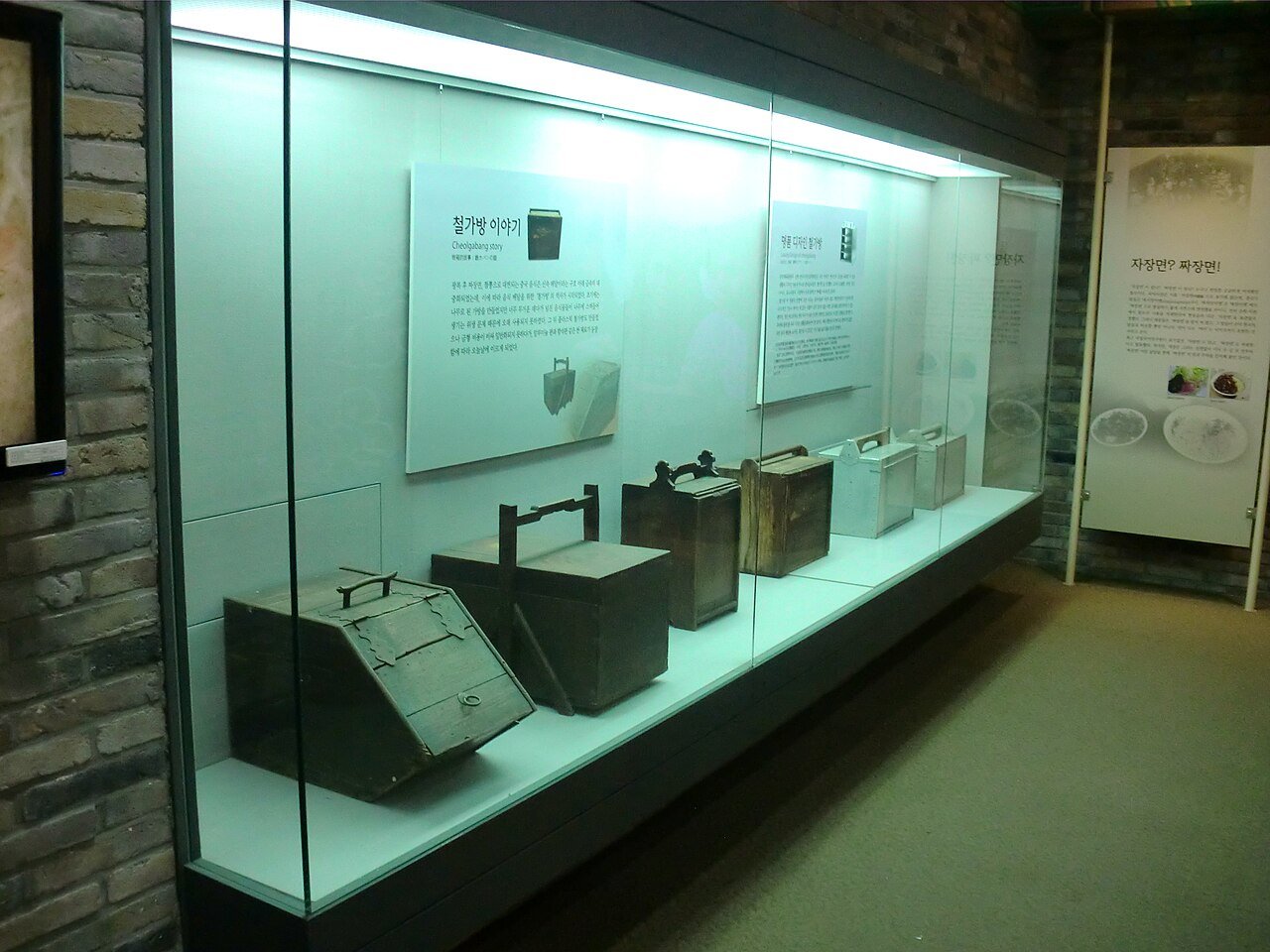
Then there’s the cultural role, which has no equivalent anywhere else. Jjajangmyeon is Korea’s default delivery food. It’s what you order on moving day, sitting on the floor of an empty apartment because the table hasn’t arrived yet. It’s what a lot of families eat after a kid’s graduation ceremony. Those metal delivery boxes in the photo above are their own piece of design history — riders balanced stacks of them on one shoulder through Seoul traffic for decades. If you want to know how ordering actually works on the ground in Korea, k-trips has a walkthrough on how to order food in Korea.
Jjajangmyeon Recipe
Ingredients
Method
- Bring a large pot of unsalted water to a boil for the noodles and leave it at a low simmer while you make the sauce.
- Cut the pork, onion, cabbage, potato and zucchini into even 1 cm / ½ inch dice, keeping them in separate piles.
- Heat the 3 tbsp oil in a wok or wide skillet over medium-low heat, add the chunjang and 1 tsp of the sugar, and fry for 2 to 3 minutes, stirring constantly.
- Watch for the paste to loosen, darken slightly and smell toasted and nutty rather than sharp and raw, then scrape it into a small bowl and set aside.
- Return the pan to medium-high heat and cook the diced pork for 4 to 5 minutes until the edges are browned and fat has rendered out.
- Add the grated ginger and cook for 30 seconds until fragrant.
- Add the onion and the remaining 2 tsp sugar, and cook for 3 minutes until the onion turns translucent and starts to look glossy at the edges.
- Add the potato, cabbage and zucchini and cook for 4 to 5 minutes, stirring, until the potato edges are just starting to soften.
- Stir the reserved fried chunjang back into the pan and toss for 1 minute so every piece of vegetable is coated black.
- Pour in the stock or water and the soy sauce, bring to a simmer, then cook uncovered for 6 to 8 minutes until the potato is tender to a fork.
- Bring the noodle water back to a rolling boil and cook the noodles according to the package, usually 3 to 5 minutes for fresh.
- Stir the cornstarch slurry to loosen it, then pour it into the simmering sauce in a thin stream while stirring.
- Cook for 1 minute more until the sauce turns glossy and thickly coats the back of a spoon, then stir in the sesame oil and turn off the heat.
- Drain the noodles well and divide between two deep bowls.
- Ladle the sauce over the noodles, top with cucumber matchsticks, and mix everything together at the table before eating.
The One Step Nobody Should Skip: Frying the Chunjang
Straight out of the tub, chunjang tastes harsh. Sharp, a bit bitter, slightly metallic. If you stir it raw into your pan, that flavor does not go away — it just spreads.
So you fry it first. Three tablespoons of oil, medium-low heat, the chunjang and a teaspoon of sugar, stirring for two to three minutes. Three things tell you it’s done: the paste loosens and goes fluid, the color deepens by a shade or two, and the smell flips from sharp to toasted and nutty. That last one is the real signal. Trust your nose over the clock.
Keep the heat down. Chunjang is a paste with sugars in it and it will scorch, which gives you a genuinely bitter sauce you can’t rescue. If it starts smelling acrid instead of nutty, pull the pan off the heat immediately.
Some cooks fry it in a corner of the same pan as the meat. I prefer frying it separately and scraping it into a bowl — you get a clean look at the color change, and there’s nothing else in the pan competing for your attention.
If you’ve already made my ram-don (jjapaguri) from scratch, this will feel familiar. That post’s homemade sauce runs on the same skeleton — chunjang fried in oil with onion and sugar, built out with stock and finished with a cornstarch slurry — but with gochugaru and gochujang stirred in for heat, because ram-don wants that edge. Think of them as siblings. Go there for the spicy one. Stay here for the original.
Notes on the Ingredients
Chunjang comes in a black plastic tub, usually 300 g, at any Korean grocery and most Asian supermarkets. It keeps in the fridge for months. Look for 춘장 on the label. One tub makes this recipe five or six times over, which is the main argument for buying it rather than substituting. If it’s genuinely unavailable, Chinese tianmianjiang gets you a browner, saltier, more straightforwardly sweet sauce — recognizable but not the same. Skip hoisin unless you’re desperate; the five-spice notes read as wrong here. A few more Korean pantry basics worth stocking are in the Korean pantry starter kit.
The onion is not a background ingredient. A quarter of the bowl’s flavor comes from it. Use a big one, dice it the same size as everything else, and give it the full three minutes.
Potato is optional but I’d keep it. It softens into the sauce and gives it body. Restaurant versions vary on this and people have opinions.
Noodles. Fresh jjajangmyeon noodles are thick, chewy and alkaline. Thick udon is the easiest substitute and honestly quite good, just softer. The spaghetti-with-baking-soda trick works better than it has any right to — half a teaspoon in the boiling water, and the chew moves noticeably toward the real thing.
Tips, Storage and What to Serve With It
Make the sauce ahead. It’s better on day two, and it keeps in the fridge for four days in a sealed container. It thickens as it cools, so loosen it with a splash of water when reheating over low heat. It freezes well for a month — freeze the sauce only, never cooked noodles, which turn to mush.
Cook noodles to order, always. Jjajangmyeon waits for nobody; five minutes in the bowl and they start absorbing sauce and going soft.
Yellow pickled radish (danmuji) and raw white onion with a dish of chunjang for dipping are the standard sides at any Korean-Chinese place, and they’re both there for the same reason: sharpness against a heavy sauce.
And the classic order, the one every Korean family has placed a hundred times, is jjajangmyeon plus tangsuyuk — sweet and sour fried pork — for the table to share. One person gets noodles, everyone shares the pork. If you’re cooking for more than two, that’s the move.
For a lighter noodle night instead, the ramyeon upgrades post covers the instant-noodle end of the spectrum.
The Drama Connection
If you want a show that lives inside a Korean-Chinese restaurant kitchen, Wok of Love is the one. It aired on SBS in 2018, ran 38 episodes, and is set at a struggling little Chinese restaurant called Hungry Wok sitting in the shadow of a luxury hotel — a former top chef, a bankrupt heiress, and an owner with a criminal past all end up tangled together in it. It’s worth watching for the kitchen scenes alone if you’ve just spent an evening frying chunjang. More food-drama locations are collected in the K-drama food filming locations in Seoul guide, and k-trips maps out K-drama filming locations in Seoul if you’re planning an actual trip.
FAQ
Is jjajangmyeon spicy?
No. Plain jjajangmyeon is one of the mildest dishes in the Korean repertoire — sweet and savory, no chili at all, which is why it’s what Korean parents order for small children. If you want heat, either add a spoonful of gochujang and a teaspoon of gochugaru when you fry the chunjang, or order jjamppong instead, the fiery seafood noodle soup that shares every Korean-Chinese menu with it.
Can I make jjajangmyeon vegetarian or vegan?
Yes, and it works well. Replace the pork with 200 g of firm tofu pressed and cut into cubes, plus about 100 g of diced king oyster or shiitake mushrooms. Brown the tofu hard before anything else goes in the pan so it holds its shape. Use water or a mushroom stock, add an extra teaspoon of soy sauce to make up for the lost depth, and check your chunjang label — most brands are plant-based, but not all.
Why is my jjajangmyeon sauce bitter?
Almost always the chunjang. Either it went in raw, or it got fried too hot and scorched. Raw chunjang gives you a sharp, flat bitterness; burnt chunjang gives you an acrid one. Medium-low heat, constant stirring, two to three minutes, and pull it the moment it smells nutty. The other, rarer culprit is an old tub of chunjang that’s been open in the fridge for a year — it does go stale.
Do I have to mix it before eating?
Yes, and mix it properly. Sauce sitting on top of noodles is how the Chinese version is served; Korean jjajangmyeon gets stirred until the noodles are uniformly black, right there in the bowl, before the first bite. Nobody will stop you, but you’ll be eating it wrong.
Related Recipes
- Ram-don (jjapaguri) — the spicy cousin of this sauce, plus the Parasite version
- Tangsuyuk — sweet and sour pork, the other half of the classic Korean-Chinese order
- Korean pantry starter kit — what to buy on your first Korean grocery run
- Ramyeon upgrades — instant noodles, treated seriously
- K-drama food filming locations in Seoul
Sources: Jajangmyeon (Wikipedia) · Wok of Love (Wikipedia)