Budae jjigae’s backstory is short and worth telling straight. After the Korean War, American military bases stationed nearby left surplus canned meat — Spam, sausages, sometimes hot dogs — moving into local markets around towns like Uijeongbu, close to one of the larger bases. Home cooks and street vendors folded that surplus meat into the kimchi and gochujang they already had on hand, and budae jjigae, literally “army base stew,” was the result. It’s a dish born out of scarcity that turned into something people now order on purpose, cheese and all.
These days nobody’s thinking about any of that at the table. Budae jjigae shows up at group dinners and late-night meals as one bubbling pot everyone shares, Spam and instant ramen noodles sitting next to kimchi in the same broth without anyone finding that strange. This budae jjigae recipe follows the version most home cooks and casual restaurants actually make.
Quick Facts
| Total time | 35 minutes |
| Serves | 4, shared from one pot |
| Difficulty | Easy |
| Spice level | 2 of 5 (easy to push higher with extra gochugaru) |
| Vegan? | No — this one is built entirely around the processed meats |
What Is Budae Jjigae?
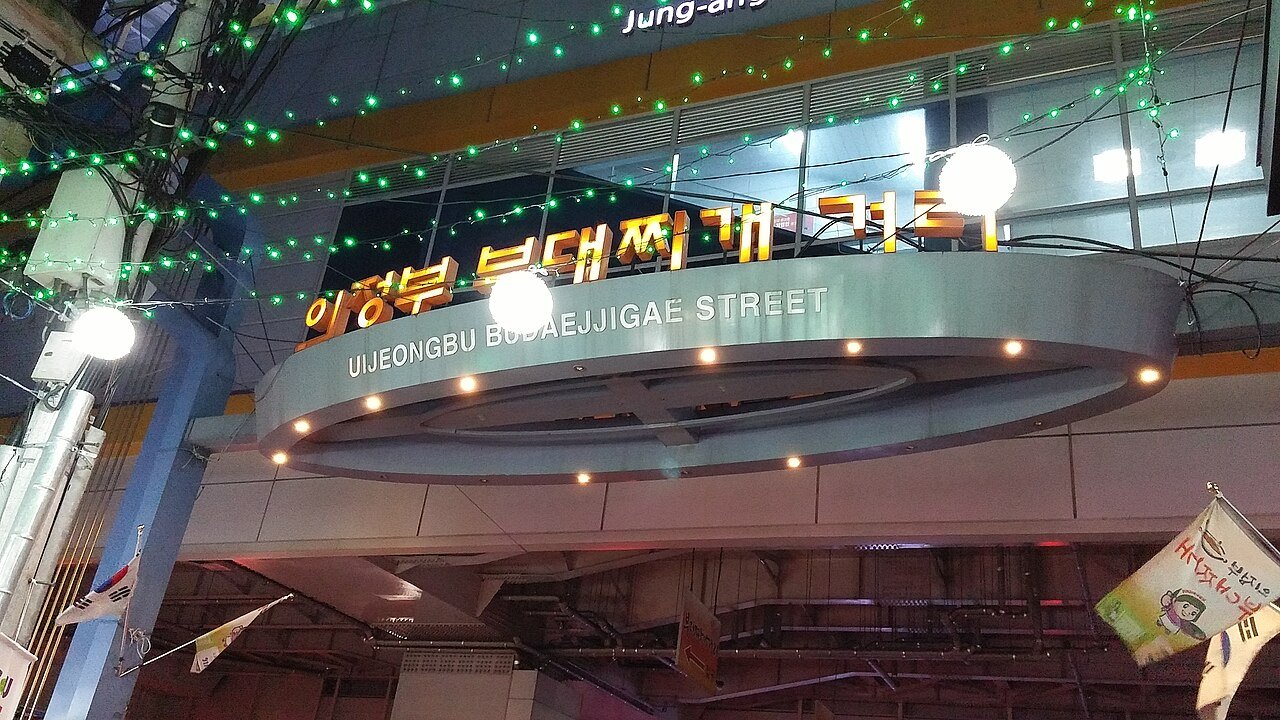
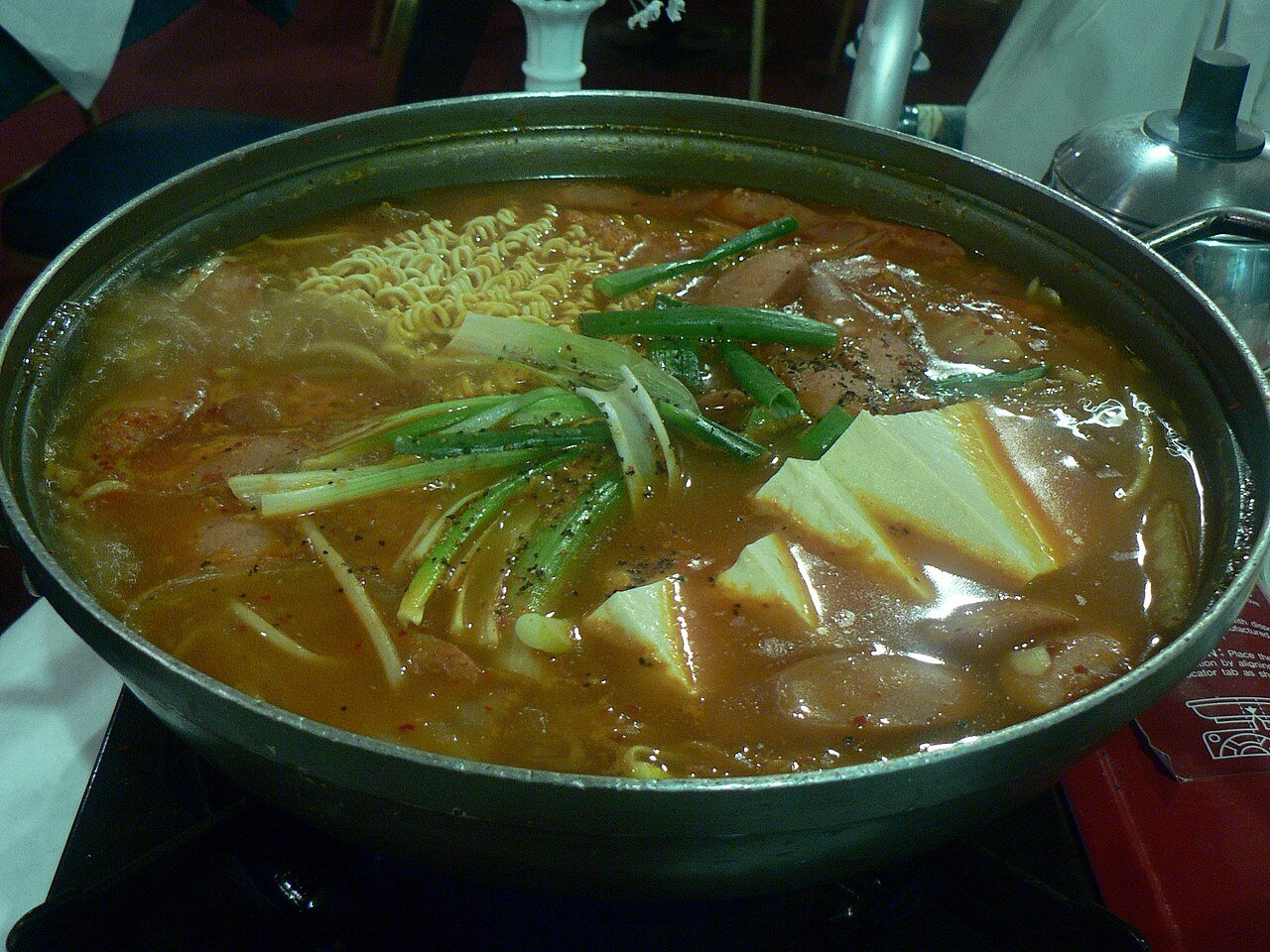
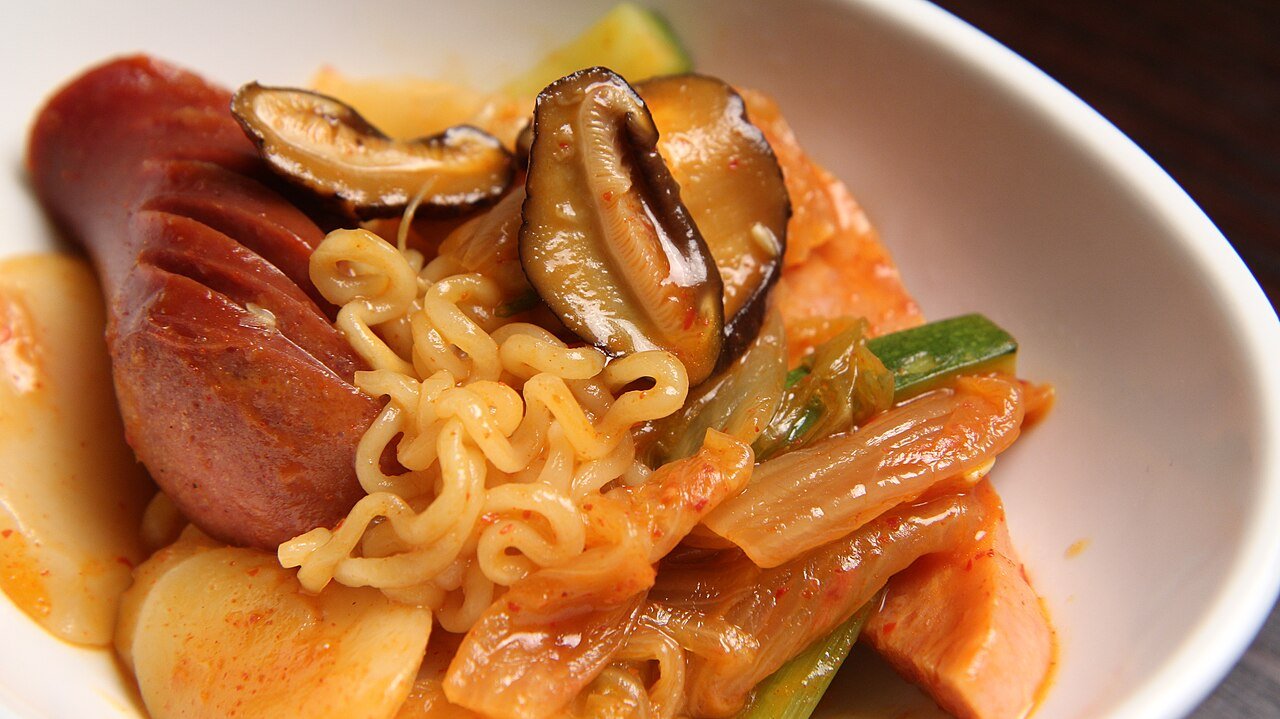
Budae jjigae (부대찌개, roughly boo-dae jji-gae) is a stew of Spam, sausage, kimchi, tofu, and instant ramen noodles simmered together in a gochugaru-and-gochujang broth. Budae means “army unit” or “army base,” a direct reference to where the canned meat originally came from. Uijeongbu, north of Seoul, still has a whole restaurant street built around the dish, and Pyeongtaek — home to a large U.S. base — has its own version of the same reputation.
Fans of Korean television will recognize the dish from Let’s Eat (식샤를 합시다), the 2013 tvN series built entirely around characters bonding over food, where a shared bowl of budae jjigae is the meal that pulls two of the main characters together over lunch. It’s a small, ordinary scene — no drama around the food itself, just two people deciding to eat it together.
Ingredients
| Ingredient (for 4) | Where to get it, or what to use instead |
|---|---|
| Spam, 200 g / 7 oz | Sold everywhere, including most non-Asian supermarkets. Any canned pork luncheon meat works the same way. |
| Hot dogs or sausages, 4 | Standard grocery item. Any smoked sausage, sliced into rounds, is a fine stand-in. |
| Kimchi, 200 g / 1 1/3 cups | Use kimchi that’s had time to sour — older, more fermented kimchi gives the broth more depth than fresh kimchi does. |
| Instant ramyeon noodles, 1 packet | Any brand works; discard the seasoning packet since the broth is already seasoned. Udon noodles are a chewier substitute if instant noodles aren’t available. |
| Gochugaru, gochujang, garlic, soy sauce | Standard Korean pantry staples. |
| American cheese (optional) | Any processed cheese slice. This addition is a modern, somewhat contested one — plenty of purists leave it out, and the stew is complete without it. |
Budae Jjigae Recipe
Ingredients
Method
- In the pot you’ll cook and serve from, whisk the gochugaru, gochujang, garlic, soy sauce, and kimchi brine into a rough paste at the bottom.
- Arrange the Spam, sausage, tofu, onion, and chopped kimchi around the pot in sections rather than stirring them together — this is the traditional presentation and it also makes portioning easier once everyone’s eating from the same pot.
- Pour the stock in gently around the edges, trying not to disturb the arrangement too much.
- Bring to a boil over medium-high heat, then lower to a steady simmer for 8 to 10 minutes, until the kimchi has softened and the broth has taken on color from the gochugaru and gochujang.
- Taste the broth and adjust — saltiness varies a lot depending on your kimchi and stock, so add a little more gochujang or soy sauce rather than trusting the measurements exactly.
- Nestle the instant noodle block into the broth and simmer 3 to 4 minutes, just until the noodles loosen and turn tender. Don’t walk away here — instant noodles overcook fast and turn mushy within another minute or two.
- Lay the cheese slice over the top in the last 30 seconds if using, letting the residual heat melt it into the broth.
- Scatter the scallion over the top and serve straight from the pot, ideally still at a gentle simmer, with rice on the side.
How to Make It
- Build the paste first, in the serving pot. Gochugaru, gochujang, garlic, soy sauce, and a splash of kimchi brine, mixed at the bottom before anything else goes in.
- Arrange, don’t toss. Spam, sausage, tofu, onion, and kimchi laid out in sections around the pot rather than stirred together. This is how it’s traditionally presented, and it also makes it easier to fish out what you want as the pot simmers at the table.
- Add the stock carefully around the edges so the arrangement holds.
- Bring to a boil, then simmer 8 to 10 minutes, until the kimchi has softened and the broth has taken on a deep red-orange color.
- Taste before adding the noodles. Kimchi and stock both vary in salt level, so adjust the seasoning now rather than after the noodles are already in.
- Add the noodle block and watch it closely. Three to 4 minutes is usually enough. Instant noodles go from perfect to mushy fast, so don’t step away from the pot at this stage.
- Cheese on top in the final 30 seconds, if using, letting it melt into the broth from residual heat rather than direct boiling.
- Serve immediately, straight from the pot, with rice alongside.
The Cheese Question
Sliced processed cheese on top of budae jjigae is genuinely divisive, and it’s worth knowing that going in. It isn’t part of the original dish — it shows up later, likely as restaurants leaned into the idea that this stew is already a mashup of odd influences, so why not one more. Some cooks consider it essential now; older recipes and more traditional restaurants skip it entirely.
If you do add it, timing matters more than people expect. Drop it in too early and it breaks apart into greasy strings instead of melting into a layer on top. Add it in the final 30 seconds, off any hard boil, and it holds together as a thin, glossy sheet that diners can stir in themselves at the table.
This is also very much a group pot rather than a single-serving stew. It’s built to sit in the middle of a table on a portable burner, simmering slowly while people eat straight from it with their own spoons, refilling with more stock as the level drops and the noodles soak it up. That format is a large part of why it’s become party food — it keeps a table occupied and fed for an hour rather than being finished in ten minutes.
Tips and Storage
Don’t add the noodles too early. This is the single most common mistake — instant noodles keep absorbing broth and turn to mush if they sit in a simmering pot for more than a few minutes.
Older kimchi is better here than fresh. The sourness balances the richness of the processed meats. If your kimchi is very fresh and mild, add a small splash of rice vinegar to compensate.
This stew doesn’t store well once the noodles are in. If you’re making a big batch, cook the meat-and-broth base ahead of time, refrigerate for up to 3 days, and add fresh noodles only when reheating to serve.
FAQ
Is budae jjigae really named after army bases?
Yes. Budae is the Korean word for a military unit or base, a direct reference to the surplus canned meat that originally came from nearby U.S. army bases after the Korean War.
Can I make budae jjigae without Spam?
You can substitute any canned luncheon meat, or lean more heavily on sausage and ham. The dish’s identity is really about the combination of processed meats with kimchi and gochujang, not Spam specifically.
Why do people add instant ramen noodles to a stew?
It’s a later addition to the dish, not part of the original postwar version, but it’s now close to universal — the noodles soak up the spicy broth and turn the stew into more of a full meal. Leaving them out and serving with rice instead is also completely normal.
Is budae jjigae very spicy?
It sits around a 2 out of 5 as written here, closer to warmly savory than sharply hot. The sweetness of the Spam and sausage and the mildness of American cheese, if you use it, both work against the chili, so it reads milder than a stew with the same amount of gochugaru in a plainer broth.
Related Recipes
Budae jjigae shares its fermented-kimchi backbone with kimchi jjigae, a simpler stew built on the same souring logic without the processed meats. If you like the doenjang-based stews in this same category, doenjang jjigae is the quieter, everyday version of a Korean home stew. And since instant noodles are doing real work in this pot, our guide to upgrading a packet of ramyeon has more ideas for what else those noodles can carry.