Hotteok and bungeoppang are sold from the same street carts, and they are built on opposite ideas. Bungeoppang pours a thin wheat batter into a fish-shaped metal mould around a spoonful of red bean paste, as the Folk Encyclopedia’s entry on bungeoppang describes it. Hotteok starts as a yeast dough, folds a loose brown-sugar filling inside, and is pressed flat on an oiled griddle until the sugar runs. One is baked in a mould and the other flattened by hand, and that difference explains most of what follows: how the dough is built, where the filling can escape, and why the first bite needs a pause.
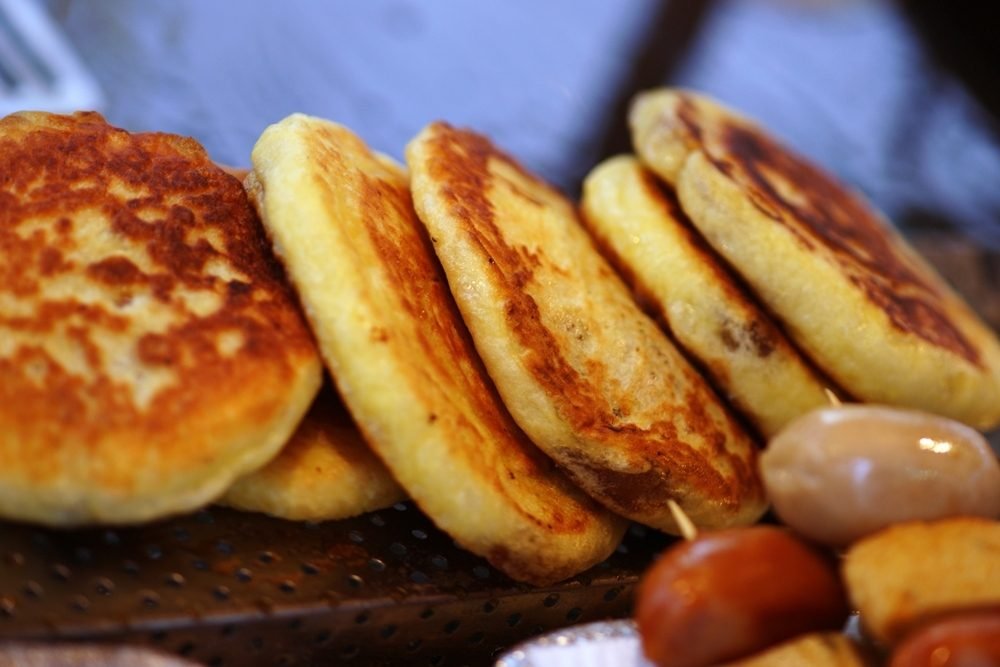

A pancake that the dictionary files under rice cakes
The Standard Korean Language Dictionary defines hotteok (호떡, also spelled hoddeok) as a round, flat tteok: a dough of wheat flour or glutinous rice flour, a sugar filling, and a pan greased with oil to fry it in. The entry adds that the food came from China and gives the old word gobyeong as a synonym (dictionary entry).
The Folk Encyclopedia describes the snack the way most people meet it: eaten mostly in winter, a sugar-filled dough pressed flat with a presser (nureugae) and fried (Folk Encyclopedia).
Merchants after 1882, and the shop count that followed
The Encyclopedia of Korean Culture dates hotteok’s arrival to the 1880s, carried by Chinese merchants who came after the 1882 trade treaty. The Folk Encyclopedia ties the same year to the Imo Mutiny: Qing troops arrived with merchants behind them, and those who stayed split into two groups. People with capital opened Chinese restaurants, and people without it opened hotteok shops.
The counts in the first source show how quickly the shops spread. A hotteok shop run by a Chinese immigrant from Guangdong was already open in Seoul in 1889. There were 17 hotteok shops in 1906, 203 in 1923, and 1,139 across the country in October 1930. About 500 were still trading in large cities in 1963. Then the snack lost ground: steamed filled buns (hoppang) took over in the 1970s, and tighter environmental rules made the wood-fired ovens hard to keep running. Only a few shops, such as Bokraechun in Incheon’s Chinatown and Yungtaehaeng in Seoul’s Bukchang-dong, carry on the old trade.
What the ho in the name points to
Sources disagree here. The common story says the first syllable means Qing people, who sold the cakes. The Folk Encyclopedia calls that a folk etymology and says the character 胡 points to Central Asia and the Arab world, with hotteok arriving in China along the Silk Road. The Encyclopedia of Korean Culture likewise traces the food back through Persia and Han-dynasty China. This post follows the Folk Encyclopedia on the name and the Encyclopedia of Korean Culture on the date of arrival in Korea.
How the pan changed the pancake
In the 1920s, hotteok was baked in an oven, not fried, according to the Folk Encyclopedia, which links the switch to pan-frying with the arrival of cooking oil in the 1970s. The Encyclopedia of Korean Culture calls today’s street hotteok a Korean reworking of the Chinese original, and says Chinese-speaking markets label it black-sugar cake. The usual filling is brown sugar with a cinnamon note, though vegetables, peanuts and other nuts appear too. Regional versions add glass noodles or seeds, and doughs may use glutinous rice, rice flour or green tea powder.
Why the dough borrows some glutinous rice flour
The card combines 250 g of all-purpose flour with 50 g of glutinous rice flour (chapssal-garu), so roughly one part in six of the flour is glutinous rice. The dictionary definition above allows either flour, and the blend adds chew.
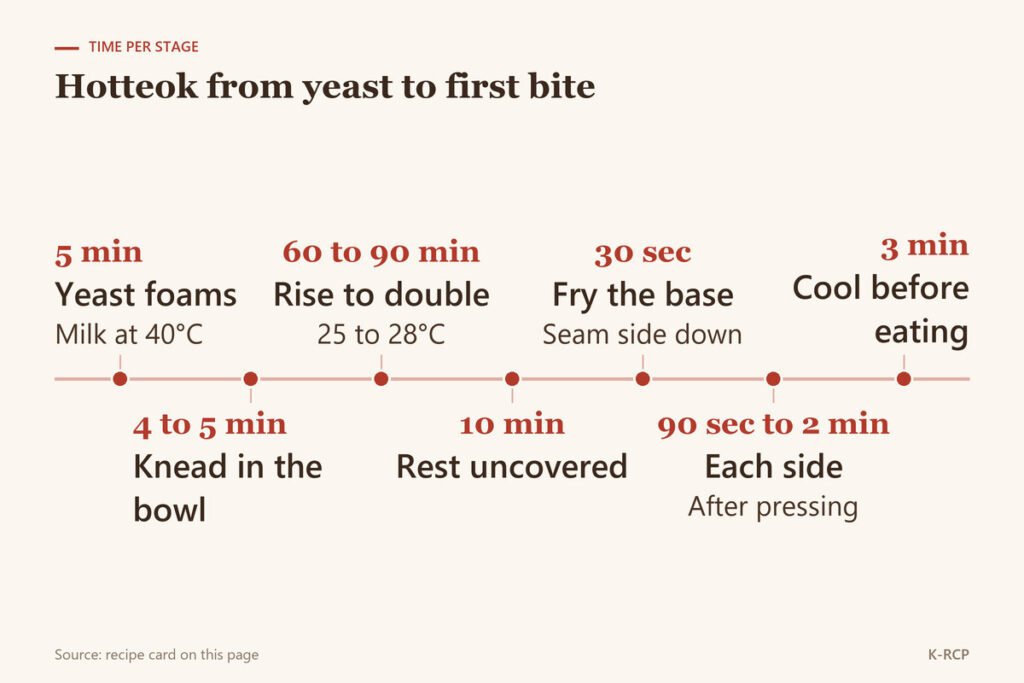
The rest of the dough is 5 g of instant yeast, 25 g of sugar, 4 g of salt and about 200 ml of lukewarm milk at 40°C (105°F), which should feel barely warm on the wrist. The yeast and sugar sit in the milk for five minutes until foamy, and the dough is kneaded right in the bowl for four to five minutes. It is meant to stay soft and slightly tacky, so the card tells you to oil your hand instead of adding flour. A rise of 60 to 90 minutes at 25 to 28°C should roughly double it, and after a gentle punch-down it rests uncovered for ten minutes before being divided into eight pieces of about 60 g.
A filling thick enough to stay put
The filling is 100 g of packed dark brown sugar, 1½ teaspoons of cinnamon and 40 g of chopped roasted peanuts, plus one tablespoon of plain flour stirred in. That last spoonful looks like an afterthought but carries the idea behind the whole snack. Melted sugar is runny, and a loose filling finds every weak point in the seam. The flour gives the syrup something to cling to.
Busan’s vendors reach the same result another way. The Encyclopedia of Korean Culture says they crush their seeds and nuts finely so the melted sugar does not leak (seed hotteok entry). If the sugar-meets-heat chemistry interests you, the sugar-and-baking-soda dalgona method shows what the same ingredient does on its own over a flame.
Hotteok Recipe
Ingredients
Method
- Warm the milk to about 40°C / 105°F — it should feel barely warm on your wrist, never hot.
- Whisk the yeast and the 25 g sugar into the warm milk and leave it 5 minutes until the surface looks foamy.
- Combine the all-purpose flour, glutinous rice flour and salt in a large bowl.
- Pour in the yeast milk and the 1 tbsp oil, then stir with a spatula until no dry flour remains.
- Knead in the bowl for 4 to 5 minutes — the dough stays soft and slightly tacky, so oil your hand rather than adding flour.
- Cover the bowl and let it rise at 25 to 28°C / 77 to 82°F for 60 to 90 minutes, until roughly doubled.
- Mix the brown sugar, cinnamon, chopped peanuts and 1 tbsp flour in a small bowl and set it beside the stove.
- Punch the risen dough down gently, then let it rest uncovered for 10 minutes.
- Oil your hands and divide the dough into 8 equal pieces, about 60 g each.
- Flatten one piece into a disc in your palm, spoon in 1 heaping tablespoon of filling, and pinch the edges shut into a sealed ball.
- Heat 2 tbsp oil in a heavy skillet over medium heat until a scrap of dough sizzles on contact.
- Place two balls seam-side down and fry undisturbed for about 30 seconds so the base sets.
- Flip them, then press each one slowly with an oiled flat press or the back of an oiled spatula to a disc about 10 cm / 4 inches wide and 1 cm / 3/8 inch thick.
- Fry 90 seconds to 2 minutes per side, until the edges turn deep golden and the surface blisters.
- Lift onto a rack or paper towel and let them sit at least 3 minutes before eating — the filling inside is far hotter than the dough.
- Wipe the pan, add fresh oil, and repeat with the remaining dough.
Recipe card photo: Hotteok Korean Food.jpg by Audreybertwin, CC BY-SA 4.0, via Wikimedia Commons.

Pressing without splitting the seam
Everything before this step is preparation, and this is where a hotteok succeeds or splits. The card gives it three small rules.
Fry the base first
Heat 2 tablespoons of oil in a heavy skillet over medium heat until a scrap of dough sizzles on contact. Set two sealed balls in seam-side down and leave them alone for about 30 seconds so the base sets.
Flatten to 10 cm across and 1 cm thick
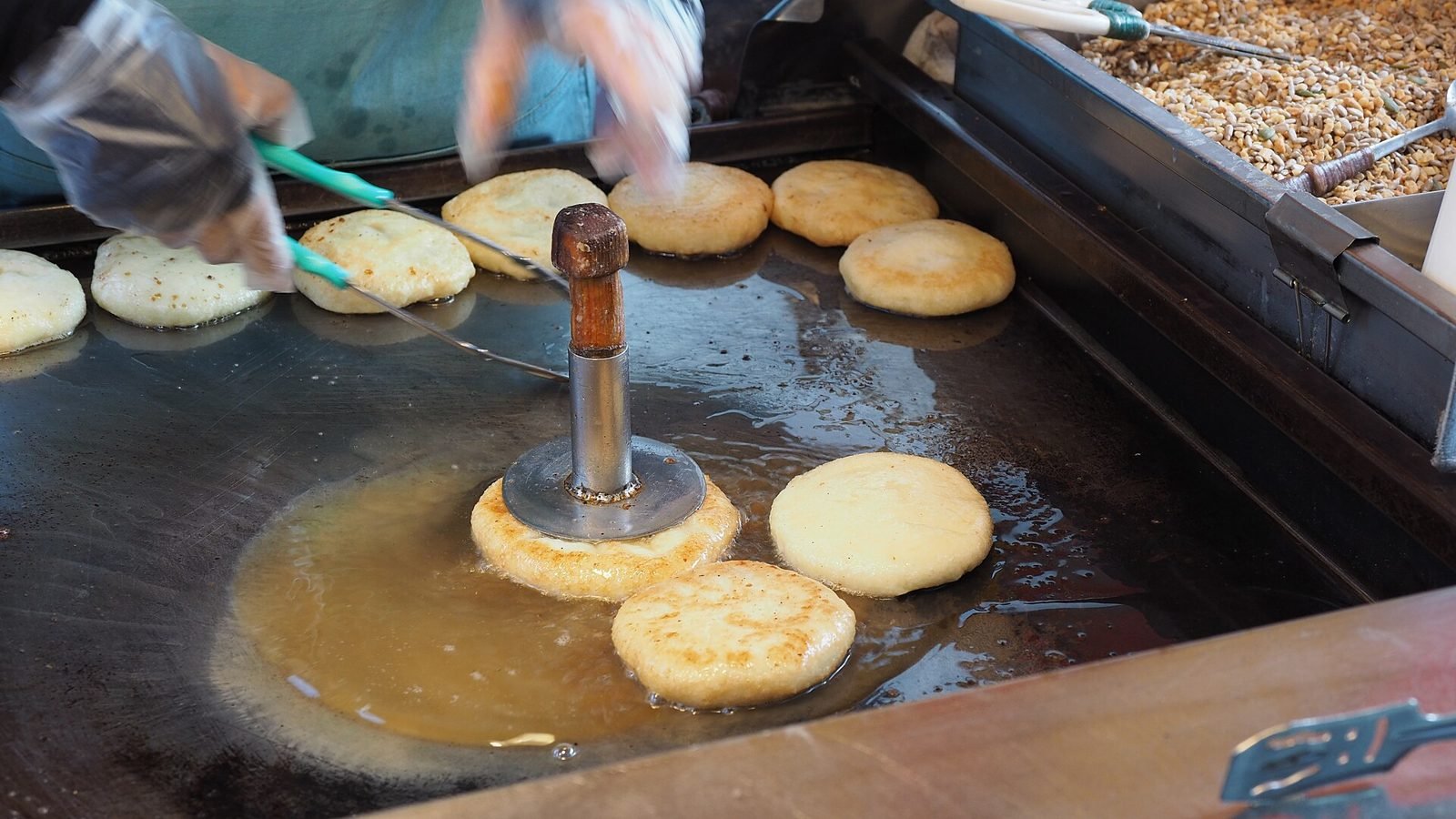
Flip the balls, then press each one slowly with an oiled flat press or the back of an oiled spatula. The target is a disc about 10 cm wide and 1 cm thick. Fry 90 seconds to two minutes per side, until the edges turn deep golden and the surface blisters. Street vendors keep an oiled metal disc on a wooden handle for this, and a spatula does the job on a home stove.

When the sugar escapes
A split seam lets syrup run into the oil, where it scorches fast. The card’s final instruction, to wipe the pan and add fresh oil before each new pair, keeps burnt sugar from flavouring every hotteok that follows. Lift out any that burst, clean the pan, and carry on.
Ssiat hotteok, the Nampo-dong version
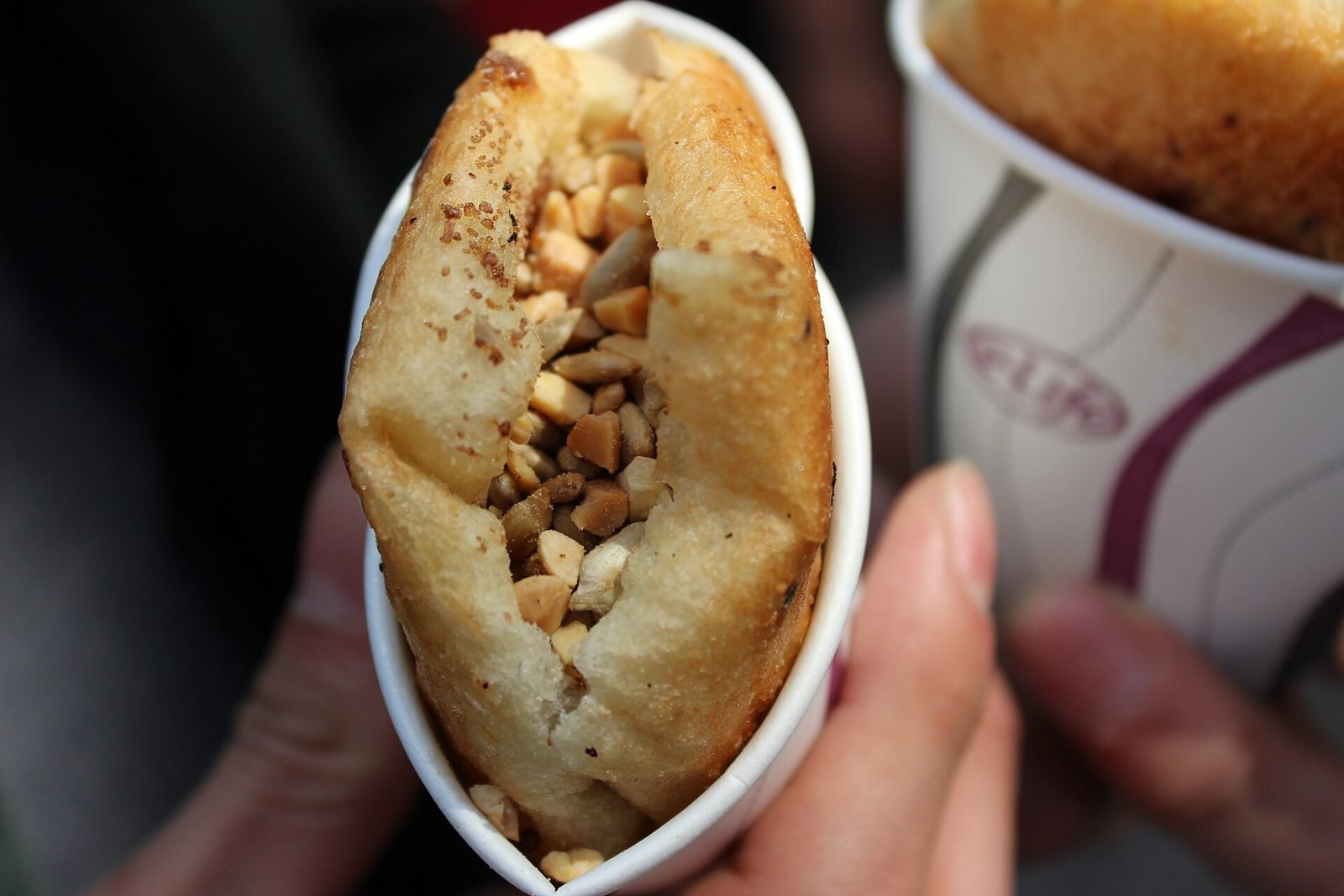

Busan’s seed hotteok (ssiat hotteok) is a regional variant with an encyclopedia entry of its own. The Encyclopedia of Korean Culture says it began in the 1980s on the streets of Nampo-dong. The dough is fried in generous oil, cut open in the middle and packed with peanuts, sunflower seeds, pumpkin seeds and other nuts. It is handed over in a paper cup. The older method used a thin layer of oil and pressing, and the newer one fries the dough, which is the main structural difference from the card’s method.
The same entry places the roots in the Korean War, when refugees in Busan made hotteok with all sorts of grain seeds, and in the American flour aid that made wheat dough cheap. Large food brands now sell hotteok mixes that include a presser, so the street snack also comes as a kit.
A home version is an adaptation. Make the card’s dough, fry the balls without much pressing, cut a slit in the edge and spoon in crushed toasted seeds while the hotteok is still hot. The seeds soak into the syrup, which is the logic of the Nampo-dong original.
Where bungeoppang and hotteok part ways
Bungeoppang, by the Folk Encyclopedia’s account, began in the 1930s when Japan’s fish-shaped taiyaki reached Korea. After the Korean War, American wheat aid made batter-cake stalls possible without much capital. The snack disappeared from city streets before the 1988 Seoul Olympics on the grounds that the stalls spoiled the look of the city, and it returned in 1997 when job losses in the financial crisis pushed people back into street selling.
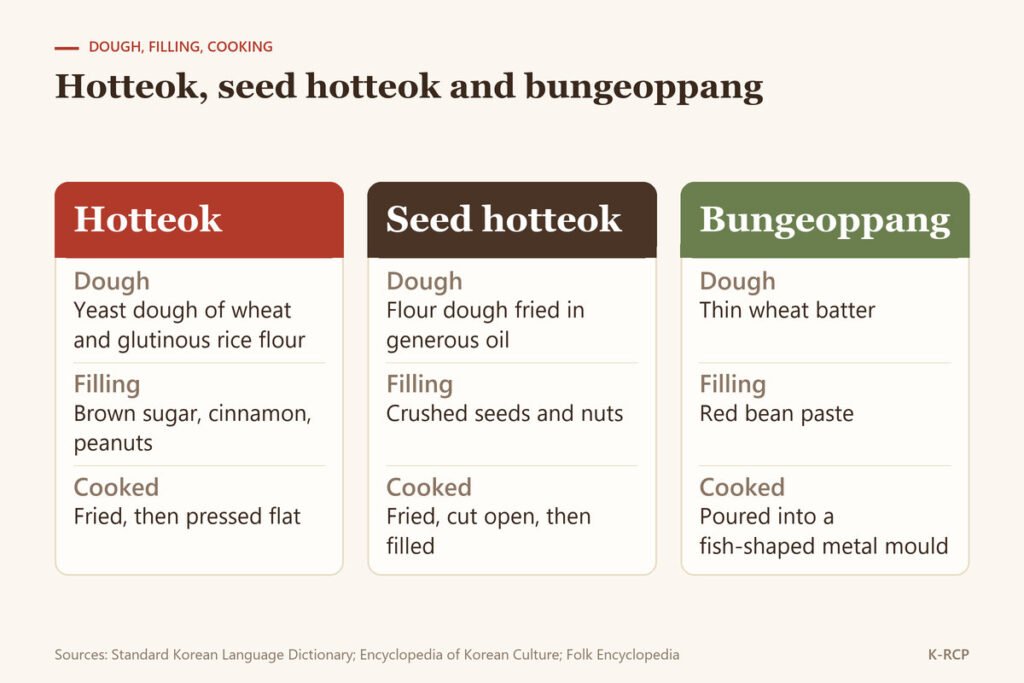
Hotteok took a different road, from Chinese merchants in the 1880s, to more than a thousand shops nationwide by 1930, and then to a street-cart snack. Both are wheat-flour snacks spread by the same post-war supply of flour, which is the thread between them. They differ in what they ask of the cook: bungeoppang needs a mould, and hotteok needs only a pan, a spatula and patience. The diagram compares them with the Busan version. For another cart snack built on oil and flour, there are batter-and-oil street snacks, and for a dessert from the other end of the temperature scale there is the chilled chestnut tiramisu.
Three minutes before the first bite
The card ends with an instruction worth obeying: let each hotteok sit for at least three minutes, because the filling inside is far hotter than the dough around it.