It’s 11:40 on a Tuesday, your friends have gone home, and the only thing still lit on the block is a rectangle of white light with a sliding door. Go in. In Korea a convenience store isn’t a sad backup plan — it’s a real dinner option, and locals treat it as one. Here’s what to reach for.
What you’re walking into
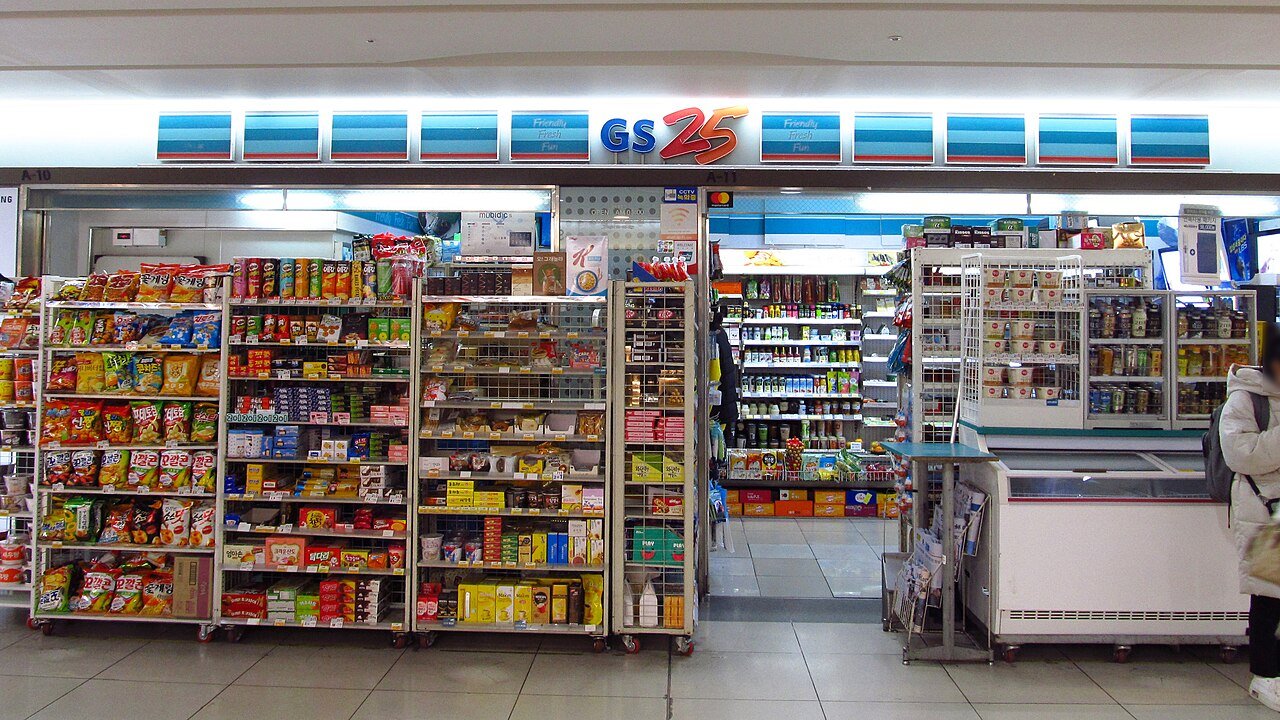
Four chains cover most of the country: CU, GS25, 7-Eleven, and emart24. In central Seoul you’ll often see two within sight of each other. Stock overlaps heavily, so don’t agonize over which sign to walk under.
The layout is almost always the same. Drinks fill the back wall in glass-doored coolers. The chilled shelf near the entrance holds the fresh stuff — rice triangles, sandwiches, lunch boxes — restocked on a delivery schedule, so late at night it’s picked over. Dry aisles hold instant noodles and snacks. And somewhere along a wall there’s a counter with a hot water dispenser, a microwave, and a bin of chopsticks. That counter is the whole reason this works as a meal.
Samgak gimbap, and how to unwrap it
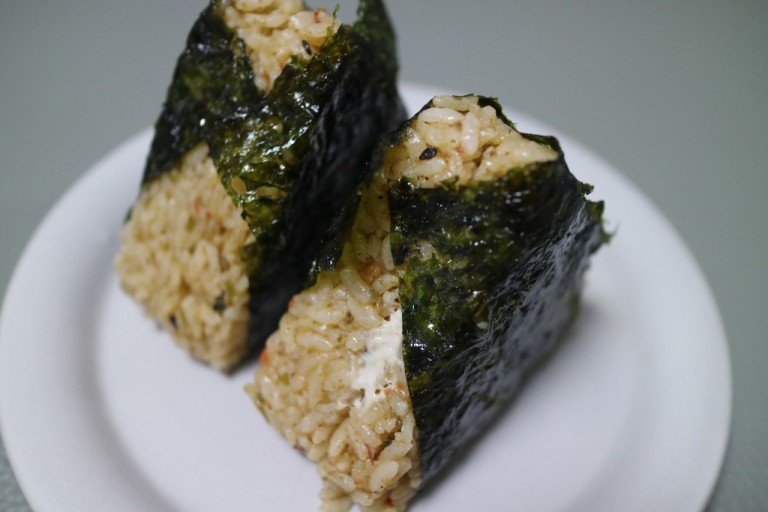
The signature item is samgak gimbap (삼각김밥) — a triangle of seasoned rice with a filling in the middle, wrapped so the sheet of dried seaweed stays separated from the rice until you open it. That’s the whole design goal. Crisp seaweed, not soggy seaweed.
There are numbers printed on the wrapper: 1, 2, 3. Pull the tab at 1 down the spine, then pull the flaps at 2 and 3 outward, and the film slides off while the seaweed wraps itself around the rice. Do it wrong and you get rice on your shoes. Everyone does it wrong once.
Common fillings, roughly in order of how often you’ll see them:
- Tuna mayo (참치마요) — the default, and the safest first try
- Spicy stir-fried pork (제육)
- Bulgogi, sweet and soy-based
- Kimchi fried rice, where the rice itself is seasoned rather than the center
- Spicy chicken, usually marked with a chili graphic
Expect roughly ₩1,200–1,900 each. Two plus a drink is a normal lunch for a lot of people here. It’s the same principle as full-size gimbap rolls, just built for one hand.
Cup ramyeon and the hot water station
Nearly every store has a hot water dispenser, and it’s free. Buy the cup, peel the lid back to the arrow, tip in the sachets, fill to the printed line, close the lid, wait three minutes. Chopsticks and forks sit in a box on the same counter.
Sizes matter more than brands. Small cups are a snack, the big bowl-shaped ones are a meal. If you like heat, the packaging signals it with a chili icon or a red flame — Korean “spicy” on a cup ramyeon label is not decorative.
If you’ve watched Hospital Playlist (슬기로운 의사생활), you’ve seen this exact scene more times than you probably registered: a doctor tearing open a triangle kimbap in a stairwell, a cup of noodles steaming on a desk during an on-call night. That’s not writers’-room shorthand for “busy.” It’s just accurate. Hospitals, editing suites, construction site offices, exam-prep libraries — any Korean workplace where people are regularly stuck past dinner runs partly on the convenience store downstairs, eaten fast and standing up while somebody keeps talking. If you want the version of that cup worth making on purpose, we cover the full upgrade in our Hospital Playlist–themed ramyeon guide.
The microwave, and the lunch box that goes in it
Next to the water dispenser is a microwave, free to use in essentially every store I’ve been in. Older shops occasionally still have a coin slot; the amount is trivial, and staff will often just heat the thing for you instead.
What goes in it is the dosirak (도시락) — the convenience store lunch box. A compartmented tray with rice on one side and some mix of fried pork cutlet, sausage, braised meat, egg and two or three seasoned sides on the other. About ₩4,000–7,000. Peel the film back partway, ninety seconds to two minutes, done.
Chains compete hard on these and regularly launch boxes co-branded with a TV chef or a variety show, celebrity’s face on the sleeve, limited run. Those sell out by evening. If the shelf is bare at 8pm, that’s why.
Banana milk, and the ice cup trick
The drink to try is Binggrae banana flavored milk, sold in a squat, round-bellied plastic bottle that’s been essentially unchanged since the 1970s. Sweet, and everywhere — saunas, trains, 7am on the way to work.
The other thing worth knowing is the coffee system. In the freezer near the register there’s a plastic cup of ice sold on its own for about ₩1,000. Buy that, buy a pouch of liquid coffee from the cooler, pour it over, and you’ve made an iced americano for a third of cafe prices. That’s what the ice cups are for.

What “1+1” and “2+1” mean
You’ll see these stickers on shelf edges constantly. 1+1 means buy one, get a second free. 2+1 means buy two, get a third free. The catch: you have to physically carry the extra item to the register. It isn’t applied automatically, and nobody will chase you down to say you’re leaving one behind.
The free item usually has to be the identical product, though some promotions let you mix within a group listed on the tag. Deals rotate monthly and differ by chain.
Paying, and the stools by the window
Cards work everywhere, contactless included, and a foreign card will usually go through fine. Self-checkout kiosks are increasingly common and have an English toggle. Bags cost a small amount and you have to ask. There is no tipping.
Seating is the part visitors underuse. Plenty of stores have a narrow counter along the window with stools, a few tables inside, or plastic chairs on the sidewalk out front. Eating there is completely normal and nobody is timing you. Two etiquette notes: separate your trash into the labeled bins by the door, and wipe the table.
Make it at home
Most of this doesn’t translate to a home kitchen, and that’s the point of a convenience store. Two things do. The rice triangle is a single-serving version of gimbap, and once you can roll one you can build any filling you like. And the cup of noodles becomes a genuinely good bowl with the additions in our ramyeon upgrade guide. Stocking a kitchen from scratch? Our Korean pantry starter kit lists what to buy first.
Questions people actually ask
What should I buy at a Korean convenience store?
For a first visit: one tuna mayo samgak gimbap, one cup ramyeon, and a banana milk. That covers the three formats — cold, hot, drink — for well under ₩8,000. If you’re hungrier, swap the rice triangle for a dosirak and microwave it.
Do Korean convenience stores have seating?
Many do. Look for a window counter with stools, a table inside near the hot water dispenser, or plastic chairs on the sidewalk. Tiny station kiosks usually don’t, but eating on the spot is completely normal where seating exists.
Is convenience store food good in Korea, or just cheap?
Both. It’s cheap, and it’s better than the category is in most countries, because the chains compete hard on their fresh lines and turn products over constantly. A ₩5,500 lunch box won’t beat a proper restaurant meal. It will comfortably beat what you were expecting.
Related on k-trips.blog
If ordering is the part making you nervous, our sister site’s guide to how to order food in Korea covers the phrases and payment norms that apply once you leave the convenience store for a restaurant.
For the opposite end of the spectrum — same country, none of the packaging — our Gwangjang Market food guide walks the stalls where everything is cooked in front of you. General visitor info is on the Korea Tourism Organization site, and Binggrae has made that banana milk since 1974.