You’ve got a bag of soybean sprouts going soft in the crisper drawer, twenty minutes before dinner, and no real plan for them. This is the dish they’re for. Kongnamul muchim (콩나물무침) is seasoned soybean sprouts — boiled, drained, dressed with garlic and sesame oil — and it’s one of the fastest, cheapest banchan on a Korean table. It’s also the one where a single kitchen rule, the kind that sounds like superstition until you understand what it’s actually doing, decides whether it turns out right.
This is the second piece in a short series on namul, the family of seasoned vegetable side dishes that includes the sigeumchi namul (spinach) we covered first and the oi muchim (cucumber) coming after. All three share the same seasoning logic — sesame oil, garlic, a little salt — but each teaches a different lesson about water and timing. Spinach is about squeezing. This one is about the lid.
Quick facts
| Time | 10 min prep, 8 min cook |
| Makes | 4 small side-dish portions |
| Difficulty | Easy |
| Spice level | 0 / 5 (1 / 5 with the optional gochugaru) |
| Vegan? | Yes |
What kongnamul muchim actually is
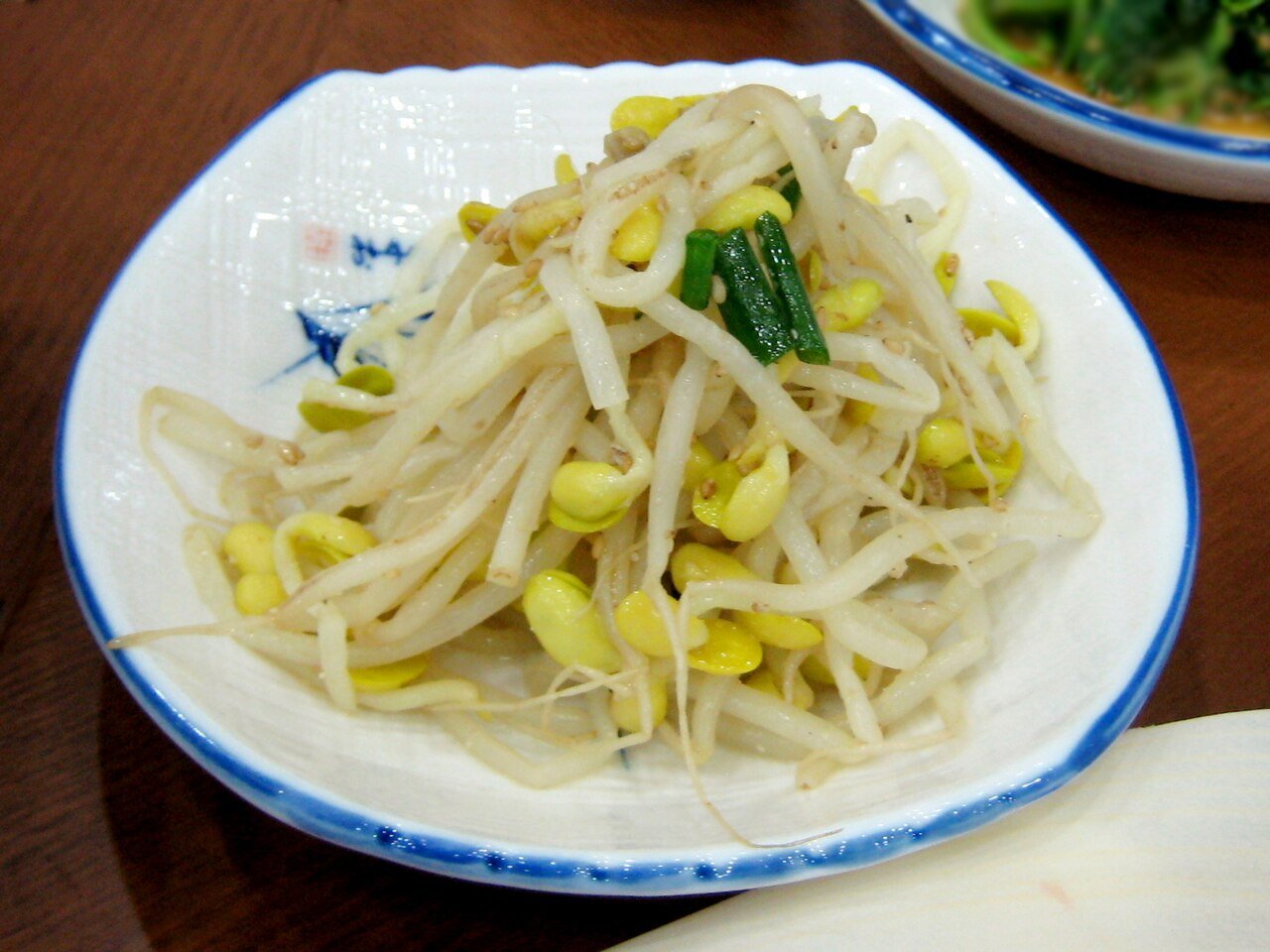
Kongnamul (콩나물) is soybean sprouts — thicker, crunchier, and nuttier than the mung bean sprouts more familiar outside Korea. Muchim (무침) just means “seasoned and tossed,” the same word that shows up in oi muchim. Boil the sprouts, drain them, toss them with garlic, sesame oil, and salt while they’re still warm, and you have a banchan that keeps for days and shows up on nearly every Korean table in one form or another — including cold, dressed with a little gochugaru and vinegar as a spicier variant, or simmered into kongnamul-guk, a clear soup built from the same sprout.
The rule that decides the dish: keep the lid on
Here’s the instruction every Korean home cook grows up hearing: once the pot is covered and boiling, do not lift the lid until the timer goes off. Not to check, not to stir, not to peek at how they’re doing. The accepted explanation, passed down more as kitchen law than chemistry lecture, is that soybean sprouts release a faintly sulfurous, beany smell as they cook, and that smell needs to stay trapped and cook off inside a sealed pot rather than escaping into the air only to settle back onto the sprouts once the steam that carried it away condenses again on a lifted lid. Whatever the precise mechanism, the practical result is consistent and easy to test for yourself: sprouts cooked with the lid lifted partway through taste faintly raw and grassy in a way that fully covered sprouts don’t, even at the exact same total cooking time.
There’s a second, more straightforward reason the rule works: lifting the lid drops the pot’s internal temperature immediately, and soybean sprouts are unusually sensitive to that kind of interruption. A sprout that’s cooked at a slightly uneven simmer, rather than a hard, sustained boil, ends up with a texture that’s soft in some places and still crunchy-raw in others. Keep the lid shut, keep the heat high and constant, and the whole batch cooks through evenly in the five minutes it actually needs.
Why five minutes, and why it matters more than it sounds like it should
Five minutes covered is the number that gets soybean sprouts past raw without pushing them into mushy. Undercooked kongnamul tastes exactly like the raw bean it is — grassy, faintly bitter, unpleasantly crunchy in the wrong way. Overcooked kongnamul loses the snap that’s the entire reason to choose soybean sprouts over the softer, quicker-cooking mung bean sprout in the first place. Mung bean sprouts, if you’re substituting them, need roughly two to three minutes less; they’re thinner and cook through faster, and pushing them to a full five minutes turns them limp.
Timing matters more here than with most vegetables because there’s no visual cue to rely on the way there is with spinach going from bright to dark green. A sprout that looks done at three minutes might still taste raw in the center. Set a timer. Don’t eyeball it.
Ingredients and substitutes
| Ingredient | Where to get it, or what to use instead |
|---|---|
| 300 g / 10 oz soybean sprouts (kongnamul) | Mung bean sprouts are the easiest swap — crunchier, milder, and done about 2-3 minutes sooner. Thin-sliced celery is a distant stand-in that at least keeps the crunch, as noted in our bibimbap recipe. |
| 1 clove garlic | Foundational to the seasoning; there isn’t a real substitute worth using. |
| Toasted sesame oil | The dark, toasted bottle only — pale sesame oil carries almost no aroma. Covered in more detail in the Korean pantry starter kit. |
| 1 scallion | Chives work, finely chopped onion in a pinch, though onion adds a sharper raw bite that scallion doesn’t. |
| Toasted sesame seeds | Buy pre-toasted or toast raw seeds 2-3 minutes in a dry pan until they hop, then crush lightly as you scatter them. |
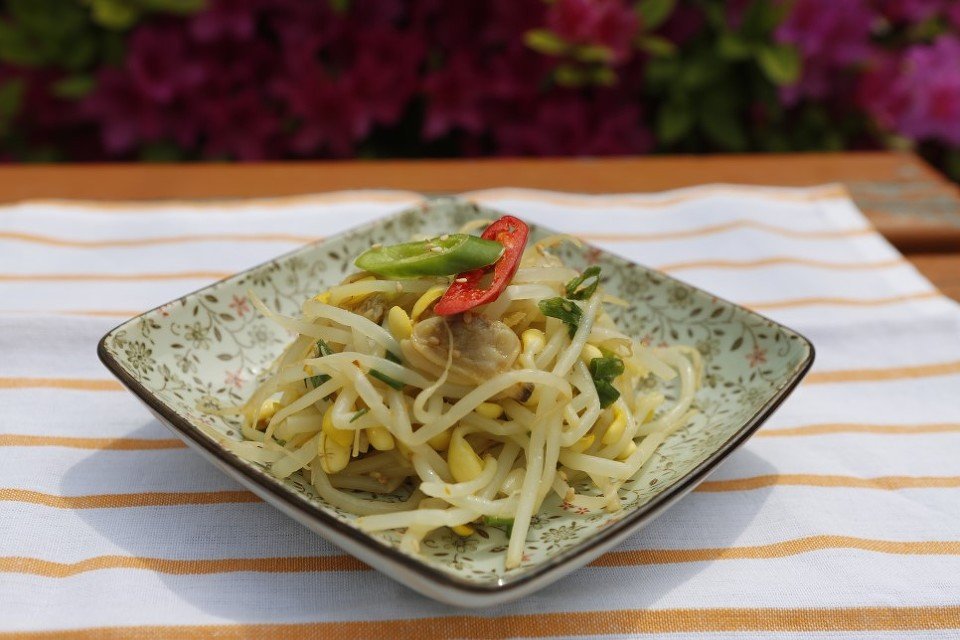
Kongnamul Muchim Recipe
Ingredients
Method
- Rinse the sprouts and pull off any loose brown husks floating on the surface — they turn bitter when cooked.
- Put the sprouts, water, and 1/2 tsp salt in a pot and cover with a tight-fitting lid.
- Bring to a boil over high heat and cook covered for exactly 5 minutes without lifting the lid.
- Turn off the heat and let the pot sit covered for 1 more minute before you open it.
- Drain in a colander, saving the cooking liquid for soup stock if you’d like, and spread the sprouts out to cool slightly.
- While the sprouts are still faintly warm, add garlic, sesame oil, scallion, sesame seeds, and salt to taste.
- Toss gently with your hands or two spoons until evenly coated, without crushing the sprouts.
Why the seasoning goes on warm, not cold
Adding garlic and salt while the sprouts are still faintly warm, rather than after they’ve cooled fully, isn’t just a matter of convenience. Warm sprouts have slightly open, softened cell surfaces that take on seasoning more readily than cold ones; salt dissolves and spreads through the batch instead of sitting on the outside of individual sprouts as undissolved grains. It’s the same underlying idea as seasoning sigeumchi namul while it’s still slightly warm from blanching — warmth is doing quiet, useful work in both dishes, and skipping it in favor of a fully cold vegetable leaves the seasoning sitting on the surface rather than actually in the dish.
Toss gently. Soybean sprouts are more brittle than they look once cooked, and an aggressive stir with a spoon snaps them into shorter, less appealing pieces. Two spoons, lifting and folding rather than stirring, keeps them whole.
Tips and storage
The two failure points worth watching for: lifting the lid mid-boil, covered above, and over-draining the sprouts to the point they’re bone dry before seasoning, which leaves the sesame oil with nothing to cling to and the dish tasting one-dimensional. A little residual moisture from draining is fine; you’re not aiming for the same aggressive squeeze that spinach namul needs.
Kongnamul muchim keeps 3 to 4 days refrigerated in a sealed container — slightly longer than the more delicate sigeumchi namul, since the sprouts hold their texture better over time. Serve cold or at room temperature. Reheating turns them soft and releases more of their water, undoing the texture the covered-pot method was built to protect.
Frequently asked questions
Why do you cover the pot when cooking bean sprouts?
To keep whatever compound gives soybean sprouts their beany smell from escaping and settling back onto them, and to keep the cooking temperature high and even so the whole batch finishes at the same texture. Lifting the lid, even briefly, is the single most common reason home cooks end up with sprouts that taste faintly raw despite a full five minutes on the stove.
Can I make kongnamul muchim with mung bean sprouts instead?
Yes — it’s a common and easy substitution. Cut the covered cooking time to about 2 to 3 minutes rather than 5, since mung bean sprouts are thinner and cook through faster. The flavor will be milder and less nutty, and the texture noticeably less crunchy, but the seasoning and method stay identical.
How long does kongnamul muchim keep in the fridge?
Three to four days in a sealed container, and it holds up well as a make-ahead side dish for the week. Keep it cold and serve it straight from the fridge or brought briefly to room temperature; it isn’t meant to be reheated.
Related
Kongnamul muchim sits comfortably alongside just about anything on a Korean table, but especially a bowl of kimchi jjigae, where its cool crunch offsets the heat of the stew. If you’re building a full bibimbap bowl, this is one of the standard namul that goes into the ring around the rice. And for the rest of this short namul series, sigeumchi namul covers the squeezing rule that governs blanched greens, while oi muchim skips cooking altogether in favor of salting. If gochugaru and sesame oil aren’t already on your shelf, the Korean pantry starter kit is the place to start.