Gochujang is Korea’s fermented red chili paste — a thick, sticky, deep-red condiment made from chili powder, glutinous rice, fermented soybean, and salt, aged for months until it tastes sweet, salty, savory, and spicy all at once. It comes in a plastic tub or a squeeze tube, it lives in the refrigerator once it’s open, and if you own exactly one Korean ingredient, this is almost certainly the one.
That’s the definition. What the definition doesn’t tell you is how much heat you’re actually signing up for, how little of it most recipes want, how to pick a tub you won’t regret, and what to do when your local supermarket doesn’t stock it. That’s the rest of this page.
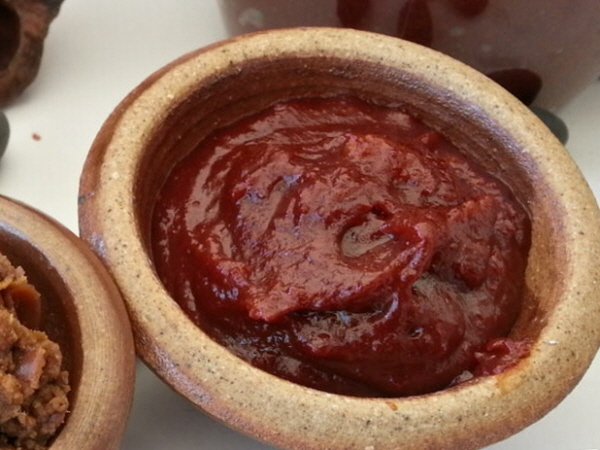
What’s actually in the tub
Four things carry the whole thing: gochugaru (Korean sun-dried chili powder), a cooked starch — usually glutinous rice, sometimes barley or wheat — meju powder made from fermented soybeans, and salt. Most versions also include malt, and the malt is the part people miss.
Malt enzymes break the cooked rice starch down into sugar over weeks. That’s where gochujang’s sweetness comes from. It isn’t a spoonful of sugar stirred into hot sauce; it’s the rice turning into sugar slowly, in the jar, while the soybean and chili ferment around it. Commercial tubs do usually add sweeteners on top of that, but the underlying process is the same one Korean households have used for centuries.
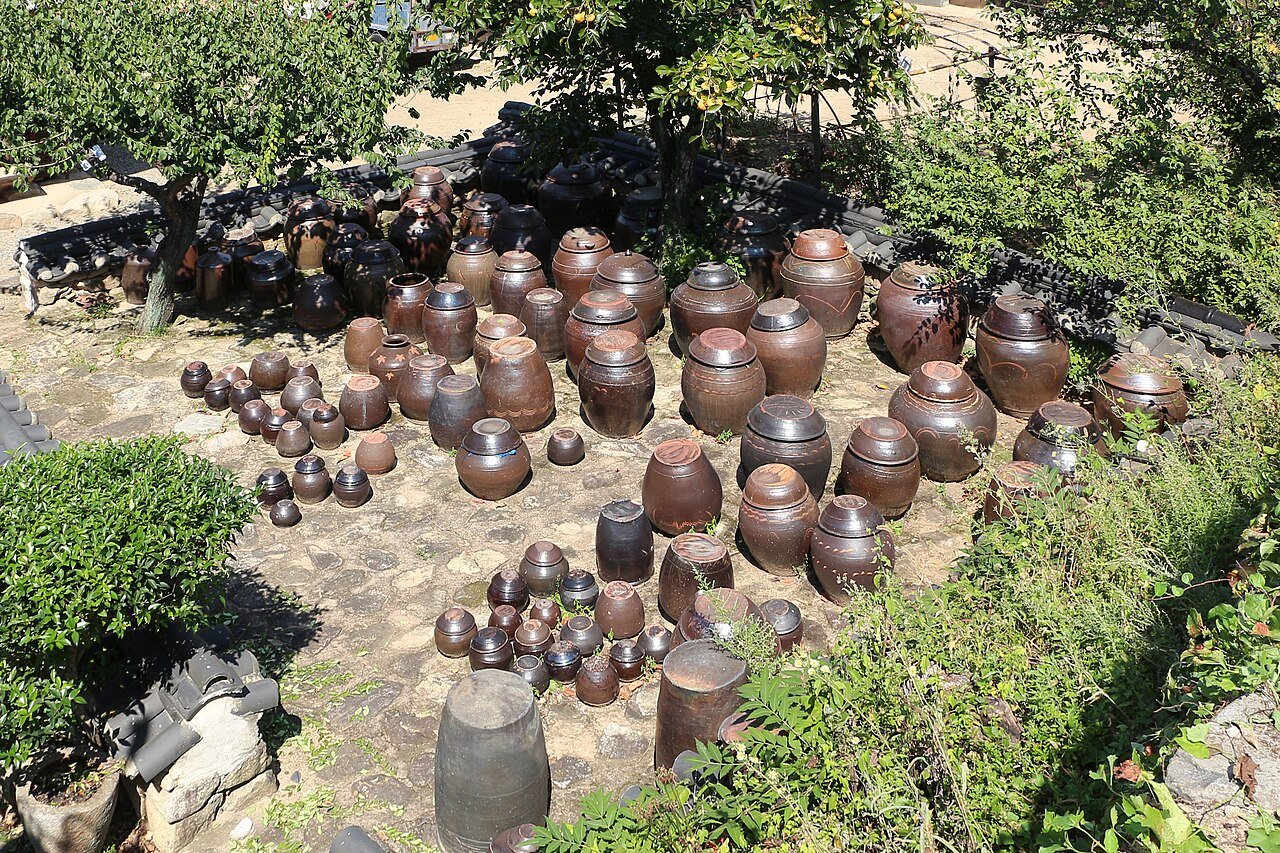
Traditionally the paste is packed into onggi — unglazed, breathable earthenware jars — and left outdoors on a raised stone platform called a jangdokdae, where it ferments and ages through at least one full season and often more than a year. You still see these jar platforms on the roofs of apartment buildings in Seoul. In 2024 UNESCO added Korean jang making, the whole family of fermented soybean and chili pastes, to its intangible cultural heritage list.
One thing to be clear about up front: this is not a make-your-own-gochujang guide, and I’d gently steer you away from treating it as a weekend project. Real gochujang is a multi-week to multi-month fermentation with meju powder you’d have to source anyway, and the failure modes take months to show up. It’s genuinely out of scope here. Buy a tub.
What it tastes like
Sweet arrives first. Then salt, then a heavy, rounded savoriness from the fermented soybean, and the heat comes in last and slowly, more like warmth spreading than a sharp hit. Compare it to sriracha or a Tabasco-style sauce, which announce themselves immediately and are gone almost as fast. Gochujang builds. Taste a dab off a spoon and the heat you register at three seconds is not the heat you’ll register at fifteen.
Texture matters as much as flavor here, and this is the part most substitute discussions ignore. Gochujang is thick and genuinely sticky — closer to tomato paste than to any sauce, but tackier. It doesn’t pour. It clings to a spoon and has to be scraped off. That stickiness is doing structural work in Korean cooking: it’s why a fried chicken glaze coats the crust instead of running off it, and why a stew gains body rather than just color.
How Koreans actually cook with it
Four jobs, mostly.
In stews, in small amounts. This surprises people. A two-person pot of kimchi jjigae takes about 1 teaspoon (5 ml) of gochujang against 500 ml / 2 cups of broth — the chili flakes do the heat and color, and the gochujang adds a background sweetness and body. Dump in a whole tablespoon and the stew turns muddy, cloyingly sweet, and slightly gluey. Restraint is the entire skill.
In marinades. Mixed with soy sauce, garlic, sugar, and sesame oil, it becomes the coating for spicy pork stir-fry and the spicy end of the Korean barbecue spectrum. Roughly 2 tablespoons (30 ml) per 500 g / 1 lb of meat is a normal starting point.
In dipping and mixing sauces. Thinned with vinegar and sugar it becomes chogochujang, the tangy red sauce for raw fish and cold noodle dishes. Mixed with doenjang, garlic, and sesame oil it becomes ssamjang, the paste that goes into every lettuce wrap at a Korean pork belly grill.
As a glaze. Sweet, sticky, and stable under heat, which is exactly what Korean fried chicken sauce needs.
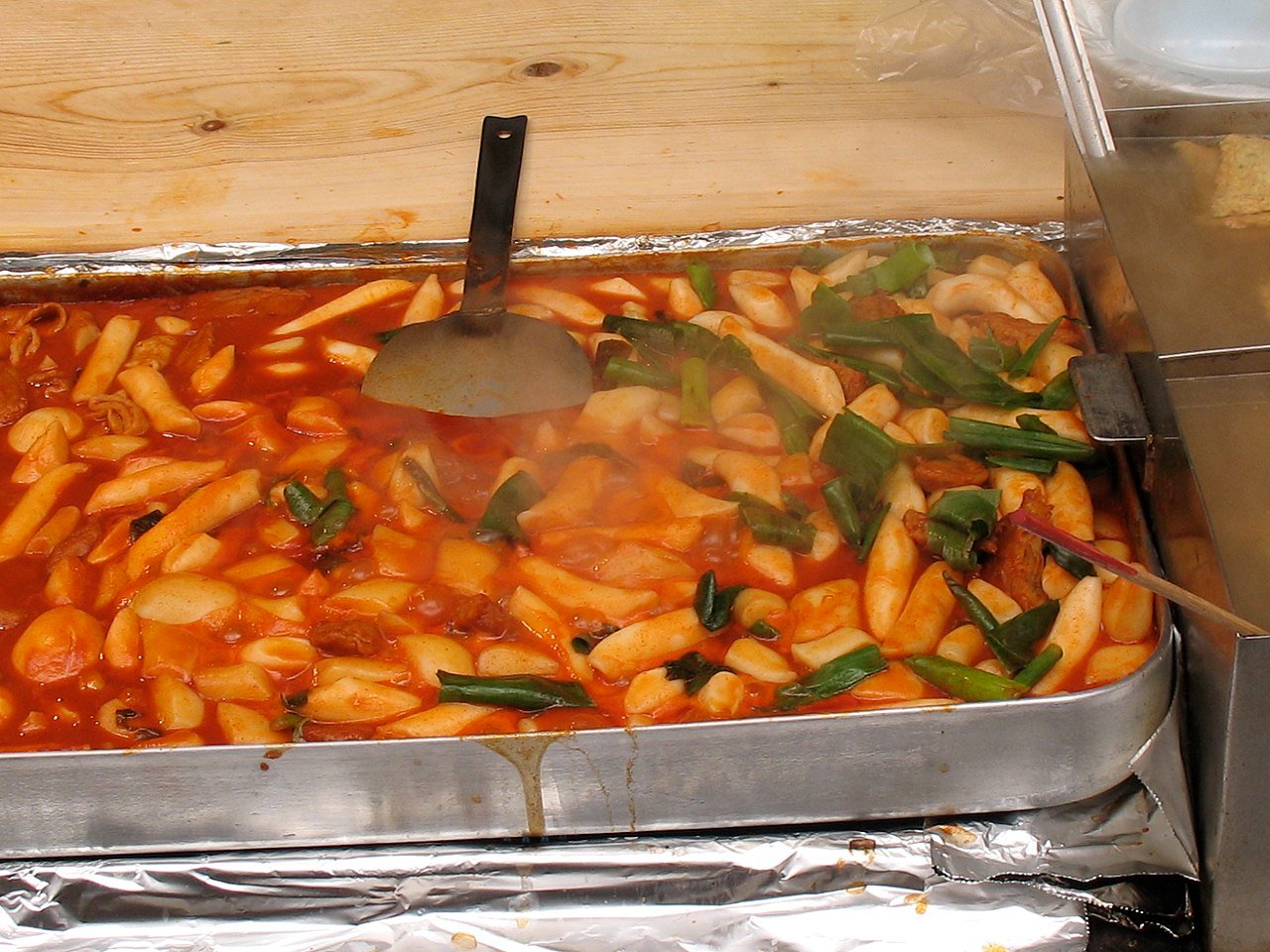
And then there are the two dishes where gochujang isn’t an ingredient so much as the point. Bibimbap is really a delivery system for a spoonful of it stirred through rice and vegetables. Tteokbokki is chewy rice cakes suspended in a sauce that is mostly gochujang, sugar, and stock reduced until it clings.
How spicy is it, really?
Milder than the color suggests. The standard supermarket tub — the one you’ll find in a Western international aisle — sits somewhere in mild-to-medium territory. Someone who eats chili regularly will find a plain spoonful of it warm rather than hot. Someone who doesn’t will find it noticeably spicy, mostly because the heat keeps building after they’ve swallowed.
Hotter versions absolutely exist, and Korean manufacturers label them. Most tubs carry a heat rating printed as a small five-step scale on the front, running from 순한맛 (mild) through 덜매운맛, 보통매운맛, 매운맛, up to 아주매운맛 (very spicy). If you can’t read the words, look for a row of small chili icons or a colored band, and count how many are filled in. Most exported tubs land in the middle two steps. Check the label rather than assuming — the difference between step one and step five is large enough to ruin a dish you’ve scaled by volume.
The sweetness also masks heat while you’re cooking. Taste sauces after they’ve reduced, not before.
Buying it and keeping it
Tub or squeeze tube, both are fine and both contain the same product. The tube is more convenient if you cook Korean food occasionally; the tub is cheaper per gram and worth it if you’re cooking weekly.
If you can’t read the Korean label, three things are worth checking. First, the ingredient list order: chili powder and rice (or rice syrup) should be near the top. Cheaper tubs lead with wheat flour and corn syrup, and they taste correspondingly thin and candy-sweet. Second, the heat scale described above. Third, the size — a 500 g / 1 lb tub is a lot of gochujang for someone cooking two Korean meals a month, and a smaller tube will be fresher when you finish it.
Storage is easy. Refrigerate after opening; it keeps roughly a year and stays good far longer than that in practice, because the salt and sugar concentration is high. It’ll darken from bright red toward brick brown over the months, and a little liquid may separate on the surface. Both are normal. Stir it back in, always use a clean dry spoon, and press a piece of plastic wrap flat against the surface if you’re going to leave it untouched for a while. An unopened tub is happy in the cupboard.
Gochujang vs. gochugaru — not the same thing
These two words look nearly identical in English and get confused constantly. Gochugaru (고춧가루) is dried Korean chili ground into flakes: a dry spice, nothing else in it. Gochujang (고추장) is a wet fermented paste that contains gochugaru along with rice, soybean, and salt.
They are not interchangeable, in either direction. Swap a tablespoon of paste in where a recipe wants a tablespoon of flakes and you get a sweet, thick, muddy dish with almost no heat. Swap flakes in for paste and you get heat and color but no sweetness, no body, and nothing to make a sauce cling. If chili flakes are the thing you’re actually missing, our guide to gochugaru substitutes covers that problem separately, because the answers are completely different.
What to use instead of gochujang
Substitutes are the reason this site exists, so here’s the honest version, worst-case tradeoffs included.
White miso + cayenne + sugar, 4:1:1 by volume. This is the best general-purpose stand-in and the ratio used throughout this site. For 1 tablespoon (15 ml) of gochujang: 1 tablespoon (15 ml) white miso, 3/4 teaspoon cayenne, 3/4 teaspoon sugar. Scaled down, 1 teaspoon of gochujang becomes 1 teaspoon miso plus 1/4 teaspoon cayenne plus 1/4 teaspoon sugar.
The tradeoff: it lands savory rather than sweet, and the umami is thinner and more soybean-forward — miso’s fermentation is clean where gochujang’s is deep and slightly musty. You also lose the fermented-chili character entirely, since the cayenne is just raw heat. White (shiro) miso is the closest match because it’s mild and already faintly sweet. Red miso works too but is saltier and more assertive, so cut back on the soy sauce or salt elsewhere in the dish. Texture-wise it’s close enough that glazes and marinades still behave properly, which is why this one beats everything else.
Doubanjiang (Chinese fermented chili bean paste). A real alternative when you want fermented depth rather than plain heat, and plenty of kitchens already have a jar. It’s genuinely fermented, genuinely chili, and it brings umami that miso-plus-cayenne can’t.
The tradeoff is a clear flavor shift: doubanjiang is broad-bean based, so it’s more fermented-bean-forward and funkier, and it’s usually much saltier and barely sweet at all. Use about two-thirds the amount and add 1/2 teaspoon of sugar per tablespoon (15 ml) to close the gap, then taste before adding any other salt. It works reasonably in stews and stir-fries, where the direction of the dish shifts Sichuan-ward but stays coherent. It works badly anywhere gochujang’s sweetness is the whole point — tteokbokki and fried chicken glaze both come out harsh.
Sriracha — no. This is the substitute people reach for first and it’s the one that fails hardest. Sriracha is a water-and-vinegar-based sauce of chili, garlic, and sugar; it has no fermented soybean in it, no meaningful depth, and nothing structural going on. Two separate failures follow. Flavor first: you get sharp acid where gochujang gives slow sweetness, and a garlic note that reads Thai rather than Korean. Texture second, and this is the one that actually ruins dishes: sriracha is pourable, so it thins whatever you stir it into instead of thickening it. A tteokbokki sauce made with sriracha tastes like hot ketchup and slides off the rice cakes; a chicken glaze made with it runs straight to the bottom of the bowl. Keep sriracha as a table condiment and build the sauce around something else.
If you happen to have gochugaru and miso. Warm 2 tablespoons (30 ml) gochugaru, 1 tablespoon (15 ml) miso, 1 tablespoon (15 ml) rice syrup or honey, and a splash of water in a small pan until it thickens. It isn’t fermented chili paste and it never will be, but it’s the closest single-bowl approximation, and the chili flakes give you the fruity note that cayenne can’t.
Two sauces that put a tub to work
Once there’s gochujang in your fridge, the fastest way to use it is a sauce you can keep on hand. Our all-purpose gochujang sauce is the sweet-spicy one that goes on grilled meat, roasted vegetables, and rice bowls. Yangnyeomjang is the thinner soy-and-chili seasoning sauce that Korean households keep in a jar and spoon over tofu, eggs, and noodles. Between the two, a tub gets finished rather than forgotten.
Frequently asked questions
Is gochujang the same as gochugaru?
No. Gochugaru is dried Korean chili ground into flakes — a dry spice with one ingredient. Gochujang is a fermented paste made from gochugaru plus rice, soybean, and salt, aged for months. They aren’t interchangeable 1:1 in either direction: paste in place of flakes makes a dish sweet and muddy with little heat, and flakes in place of paste give you heat with no body or sweetness.
Is gochujang very spicy?
Usually not very, no. The common supermarket tub is mild to medium — clearly spicy if you don’t eat chili often, mild if you do. Hotter grades exist and Korean labels rate heat on a five-step scale printed on the front, so check the tub rather than assuming. Because gochujang is sweet, the heat also builds slowly, which makes it easy to underestimate while you’re cooking and easy to overdo in the bowl.
Can I make my own gochujang at home?
Technically yes, and Korean households have done it for generations. Realistically, no — not as a normal cooking project. Real gochujang needs meju powder (fermented soybean) and malt, then weeks to many months of controlled fermentation and aging, ideally in breathable clay. It’s a different category of undertaking from the twenty-minute sauces elsewhere on this site, and the results only tell you whether it worked after several months have passed. A good commercial tub costs a few dollars and is genuinely excellent. Buy one, and if you want the homemade feeling, make the sauces instead.
Where to start
If gochujang is the first Korean ingredient you’ve bought, cook tteokbokki with it — it’s the dish where you can taste exactly what the paste is contributing, because there’s almost nothing else in the sauce to hide behind. Then bibimbap, which teaches you how little of it a dish actually needs. If you’re assembling a Korean shelf from nothing, our Korean pantry starter kit ranks gochujang against the other eleven things worth buying and explains what to get first.
And if you’re going to Korea, buy your jang at a market rather than an airport shop. The dried goods and paste stalls at Gwangjang Market sell gochujang and doenjang by weight from open tubs, at prices no export label matches — k-trips has a walk-through of Gwangjang Market that covers the food alleys and the grocery side both.